


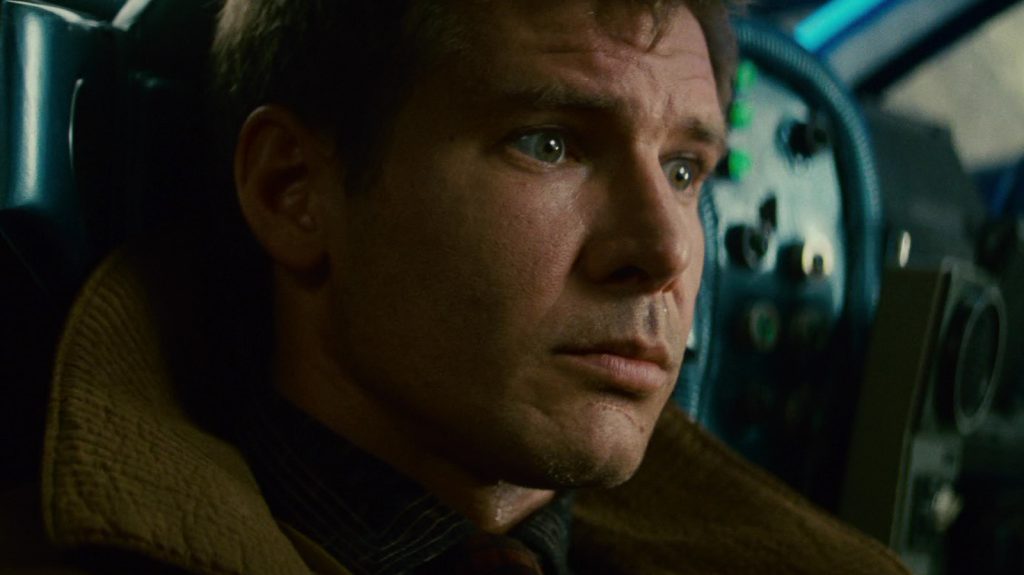

In the American theatrical version of Ridley Scott’s 1982 sci-fi film “Blade Runner,” the film had a happy ending for Rick and Rachael.
This was an alteration made to “Blade Runner” after Scott’s original cut was not well-received by test audiences. Scott’s intended ending involved a weirdly symbolic image of a character examining a piece of origami folded into a unicorn, and Rick Deckard (Harrison Ford) walking into an elevator with the replicant Rachael (Sean Young). The ending was ambiguous and downbeat, in the spirit of film noir.
Scott recalled the experience in a 2015 interview with The Hollywood Reporter, saying that an unnamed investor wanted him to tack on a happy ending where Rick and Rachel drive off into the woods together. In the happy ending, Rick talks in voiceover about how Rachel is a special kind of replicant who can live indefinitely. Harrison Ford is on record about how much he hates that voiceover.
There have been many cuts of “Blade Runner” over the years, and Scott has been very frank about how much he dislikes the “happy ending” that was mandated to him.
Despite the frustration, though, Scott followed orders from his investors. To make that happy ending, Scott consulted with fellow director Stanley Kubrick and managed to get some of Kubrick’s footage that was shot for the opening credits of his 1980 horror film “The Shining.” The “happy ending” of “Blade Runner” featured a high shot of a lovely wilderness as Rick and Rachael drive off into the woods together. That was actually reused “Shining” footage, granted to Scott with Kubrick’s blessing.
Blade Runner used footage from The Shining
Stanley Kubrick had previously cold-called Ridley Scott after Kubrick watched “Alien” for the first time, wondering how the heck Scott had pulled off one of that film’s most memorable moments. That call began their relationship as colleagues.
Scott remembered the whole experience borrowing “The Shining” footage, explaining:
“I had finished Blade Runner, and it was a disaster. My investors were giving me a really hard time, saying ‘You can’t end the film with picking up a piece of origami, looking at the girl, walk in the elevator, nod, and bingo that’s it.’ I said, ‘It’s called a film noir.’ And they said, ‘What’s a film noir?’ That was a big problem. And he said, ‘We have to test this with an uplifting ending, where they will go off into the wilderness together.’ I said, ‘Well if they go off into a beautiful wilderness, why do they live in this dystopian environment?'”
Scott then said he asked Stanley Kubrick for a little of that lovely woodsy footage he shot for “The Shining” and inserted it into “Blade Runner.” He continued:
“By then I had talked to Stanley a few times. I said, ‘I know you shot the hell out of ‘The Shining,’ can I have some of the stuff?’ So at the end of the film in ‘Blade Runner,’ that’s Stanley Kubrick’s footage.”
Stanley Kubrick gifted Ridley Scott 17 hours of Shining footage
Of course, the cut of “Blade Runner” that used footage from “The Shining” was eventually abandoned in favor of the more popular Director’s Cut. To orient you on all the jiggery-pokery that went down with “Blade Runner,” /Film has assembled a guide to the film’s multiple endings. It’s … a lot.
And then, after all that, Kubrick was said to have hated “Blade Runner” regardless.
Sarah Maitland, who spent a spell collaborating with Kubrick on his never-completed version of “A.I. Artificial Intelligence,” spoke with Far Out Magazine in 2025, and recalled a time when Kubrick talked about “Blade Runner,” and how the movie was kind of pointless. Half the movie, Kubrick said, was devoted to solving whether or not Rachael was a replicant, and Kubrick felt that if no one could tell the difference, then why bother with anything? “(I)f they can’t tell,” Maitland recalled Kubrick saying, “why do they think it matters? There is nothing in that film that suggests for one second why it should matter.”
Kubrick was a pal for lending Scott that “Shining” footage, but nothing he did made “Blade Runner” a better movie.