


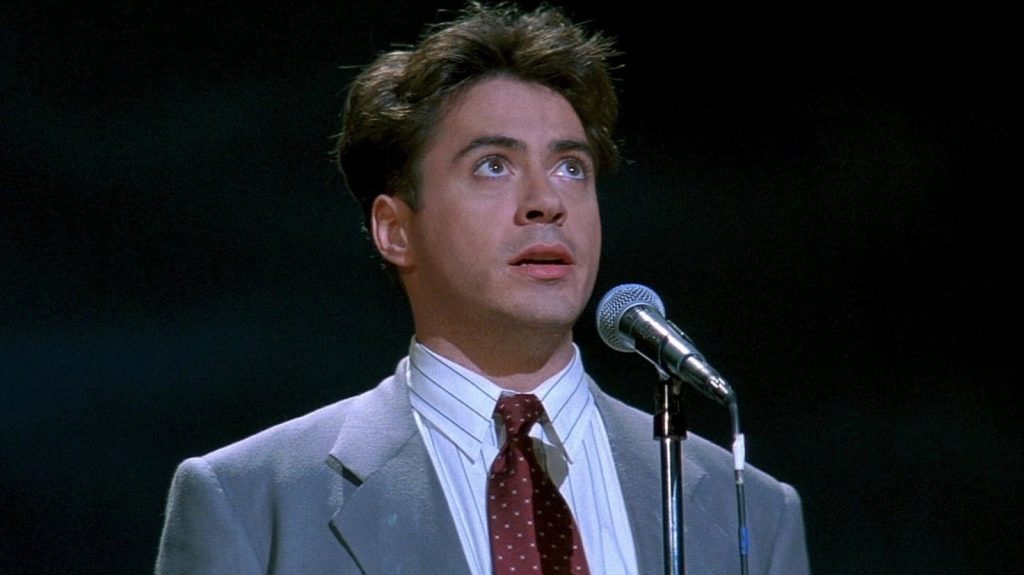

It’s no exaggeration to say that Ron Underwood’s 1993 fantasy comedy film “Heart and Souls” boasts one of Robert Downey Jr.’s best performances. He wasn’t nominated for an Oscar (although he surely deserved to be), but at least he won a Saturn Award for Best Actor for his work on it. Yet, because it flopped at the box office, it’s rarely ranked among Downey’s best movies of all time.
Downey stars in “Heart and Souls” as Thomas Reilly, an arrogant yuppie who is possessed by a pack of friendly ghosts that have been following him since birth. Thus, over the course of the movie, Downey takes on the speech patterns and affectations of his ghostly co-stars (Kyra Sedgwick, Tom Sizemore, Alfre Woodard, and Charles Grodin), and he does so with utter aplomb. The result is a film that’s funny, profound, and sentimental in equal measure. It has the mood and structure of a high-concept Hollywood comedy, but with a toe rooted in the warmth of something like “It’s a Wonderful Life.” Plus, its view of the afterlife is pretty light and fun and makes sense in a secular way.
The world of ghosts plays by its own rules in “Heart and Souls,” but it’s not oblique or difficult. Here, the living and the dead are cosmically bound, like sometimes-invisible family members contracted to make wrongs right and assuage regrets. It’s a positive and touching movie with its messages tucked in between hilarious bouts of Downey zaniness. Ultimately, Thomas learns to be less selfish and far more understanding to his girlfriend, Anne, played by Elisabeth Shue. See what I mean about the amazing cast?
Heart and Souls has a novel plot
“Heart and Souls” opens in 1959 and introduces us to our ghost characters while they’re still alive, each of them boarding the same ill-fated bus. Julia (Kyra Sedgwick) is hoping to find her boyfriend, whose marriage proposal she regrets rejecting. Penny (Alfre Woodard) has to work a late shift away from her sons. Milo (Tom Sizemore) is a small-time crook who conned some valuable stamps from a local kid and regrets it. And Harrison (Charles Grodin) is a singer who just fled an audition due to overwhelming stage fright.
Sadly, their bus driver, Hal (David Paymer), gets distracted and crashes the vehicle, killing everyone on board in front of a car carrying a woman in labor. The four passengers, now ghosts, then witness a young Thomas being born. Over time, the ghosts realize they’re physically bound to Thomas (meaning, they get dragged along if he walks away) and grow up with him. However, because they’re invisible to everyone but him, Thomas’ parents assume he’s mentally unwell. So, the ghosts eventually decide to become invisible to Thomas to protect his mental health.
Fast-forward to the present, and the ghosts are unexpectedly visited by the now-deceased Hal. He tells them that Thomas is their “earthly vessel” and they should’ve been spending their time using him to right the wrongs in their lives so they can finally enter the afterlife. Now, they have to solve their biggest regrets in the next few days or risk oblivion.
Thomas, meanwhile, has become a heartless foreclosure banker who believes he had schizophrenia as a child, causing him to see his childhood “friends.” But after the ghosts reappear to him, he eventually accepts that, yes, they are real, and he agrees to help them solve their earthly problems and ascend.
What did critics think of Heart and Souls?
I maintain that “Heart and Souls” is one of the best films of its year. And, to reiterate, Robert Downey Jr. gives an Oscar-worthy performance in it. However, he wouldn’t win his Oscar until “Oppenheimer” decades later, having only just been nominated for an Academy Award for the first time right before “Heart and Souls” came out for his turn as Charlie Chaplin in Richard Attenborough’s biopic “Chaplin.”
Overall, critics were mixed on “Heart and Souls.” Most reviews tended to praise the performances from the movie’s gaggle of stars, as seen in Michael Wilmington’s review for the Los Angeles Times. He noted that “Heart and Souls” was about the spiritual crisis of modern humanity, “buried under several tons of Hollywood slick.” But, he added, you should trust the film’s actors. To quote him directly:
“There’s one great opportunity for virtuoso fun here: the chance handed Downey to impersonate the mannerisms of his co-stars whenever one takes over his body. With (…) delicate, precise mimicry (…) he slips delightfully into (Alfre) Woodard’s feline assurance, (Tom) Sizemore’s swagger, (Kyra) Sedgwick’s sexiness or (Charles) Grodin’s repressions. The character he’s playing — the same kind of languid, self-obsessed, inwardly anxious hedonist he played throughout the ’80s — isn’t deep, but Downey digs something comic out of his superficiality.”
If that sounds fun or intriguing, it can serve as your “in” to “Heart and Souls.” You may discover a new gem.