
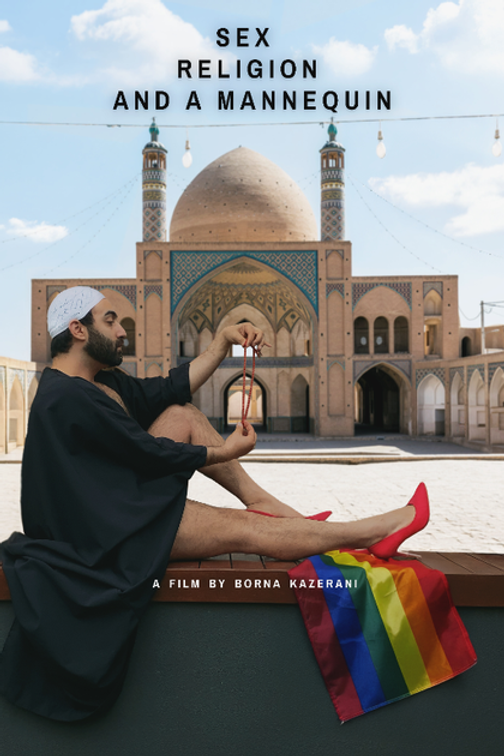
A gay Iranian cleric in exile confronts the self his country demanded he bury
After escaping Iran — where homosexuality carries the death penalty — a former Muslim cleric rebuilds his life in Australia, isolated and emotionally fractured. He forms an unsettling bond with a mannequin that becomes the physical manifestation of everything he was taught to deny about himself. As memories of torture, doctrine, and shame resurface, the line between reality and projection begins to blur.
Why It Is Trending: A Filmmaker Who Lived the Story He Is Telling
Borna Kazerani is a gay Iranian-Australian filmmaker, language interpreter, and court interpreter who fled Iran and rebuilt his life in Australia — the same biographical arc as the film’s protagonist. His real life includes a documented 2024 homophobic assault in Sydney, which he described publicly, and years of work within Australian LGBTQ+ communities. The film’s A$300,000 budget and self-production credit — Borna Kazerani as sole production company — signal the deepest possible level of personal investment and autobiographical authority. France theatrical release May 13, 2026 positions the film in the European arthouse market most receptive to this kind of formally intimate, politically urgent diaspora cinema. The title alone — blunt, three-part, unafraid — announces a film that refuses euphemism.
Elements Driving the Trend: The mannequin conceit is the film’s most formally precise decision — a physical object that functions simultaneously as therapeutic projection, erotic substitute, and psychological double for a self that was systematically denied existence. The 127-minute runtime and the psychological journey structure signal a film built for sustained immersion rather than genre efficiency. Kazerani plays Borna opposite Tania Eslam and Nastaran Paryap — a small, intimate ensemble whose casting within an autobiographical framework gives the film the texture of confession. Ken Welsh rounds out the cast as Ken, the film’s only non-Iranian character, whose presence anchors the Australian context.
Virality: The title generates immediate cultural conversation — three words that individually signal major social fault lines and together describe a film that is genuinely hard to categorise. The autobiographical basis — a filmmaker playing a version of himself — gives the film a documentary authenticity that scripted fiction cannot replicate.
Critics Reception: No reviews at time of writing — France theatrical premiere May 13, 2026. Pre-release only. The film’s subject matter and autobiographical authenticity position it for the kind of reception that LGBTQ+ cinema with lived-experience authority consistently generates at international film festivals.
Awards and Recognitions: No awards confirmed. France theatrical release May 13, 2026. Australian production, English language.
Sex, Religion & a Mannequin arrives as one of the most formally and politically radical Australian independent films of 2026 — a work that derives its power from the filmmaker’s refusal to aestheticise or distance himself from the experience he is documenting. The film’s existence is itself an act of survival and testimony. It will find its audience through the LGBTQ+ cinema community, the Iranian diaspora, and the arthouse circuit that programmes autobiographical cinema of genuine moral urgency.
It is the kind of film that gets made once — because it can only be made by the person who lived it.
What Movie Trend Is Followed: The Autobiographical Diaspora Film as Psychological Survival Document
Sex, Religion & a Mannequin belongs to a growing tradition of diaspora cinema in which filmmakers from countries with death penalties for homosexuality use the film medium to process, document, and reclaim experiences that their countries of origin erased. It is related to — but more intimate than — films like Circumstance (Iran), A Sinner in Mecca, and the broader tradition of exile queer cinema. What distinguishes it is the mannequin — a formal conceit that transforms the film from a straightforward asylum narrative into a psychological portrait of dissociation, desire, and the specific damage that religious persecution inflicts on a person’s relationship with their own body. The self-casting adds a layer of documentary authority that pure fiction cannot achieve.
Trend Drivers: A Film Built From One Person’s Entire Experience Kazerani writes, directs, produces, and stars — a concentration of creative control that is only possible and only meaningful when the material is autobiographical. The mannequin as the film’s central relationship object is the kind of formally adventurous conceit that only emerges from a deep engagement with the subject’s psychological reality rather than a scripted imagination of it. The Iranian cleric background gives the film an institutional dimension that individual persecution narratives often lack — the protagonist is not simply a gay man who fled, but a man who was a religious authority who fled, carrying the contradiction of having represented the very institution that persecuted him.
The film’s refusal to separate the political from the psychological — the mannequin is simultaneously a mental health narrative and a political statement — is its most formally coherent quality.
What Is Influencing Trend: The global LGBTQ+ cinema movement has produced an increasingly sophisticated audience for films that address state persecution of queer people through intimate, psychologically specific narratives rather than political documentary. Australian independent cinema — funded at modest scale, formally adventurous, and increasingly reaching international arthouse audiences — has produced some of the most important LGBTQ+ cinema of the past decade. The Iranian diaspora’s creative output — in cinema, literature, and visual art — is one of the most culturally vital and underrepresented bodies of work in contemporary international culture.
The autobiographical film in which the filmmaker plays themselves remains one of cinema’s most ethically powerful formats — and for subjects involving persecution and survival, it carries an authority that representation alone cannot provide.
Macro Trends Influencing: The global LGBTQ+ persecution crisis — in Iran, Uganda, Russia, and beyond — has created an urgent demand for first-person cinema that gives survivors the authority to narrate their own experience rather than having it narrated by outsiders. The French arthouse theatrical market remains one of the most receptive platforms for politically urgent independent cinema from former colonies and diaspora communities. The psychological film — using formal conceits like the mannequin to externalise internal states — is experiencing a significant revival in international arthouse cinema.
The conversation about queer Muslim experience specifically — at the intersection of faith, sexuality, and exile — remains one of the most culturally necessary and least cinematically represented subjects in contemporary global cinema.
Consumer Trends Influencing: The Iranian diaspora globally — particularly in Australia, France, Germany, and the UK — represents a significant audience for cinema that addresses their specific experience with documentary authority. The LGBTQ+ film festival circuit — including Frameline, MIX, and Queer Screen in Australia — provides the ideal distribution pathway for a film of this scale and subject matter. The autobiographical film’s performance at festivals consistently generates the kind of critical word-of-mouth that sustains long-term discovery on streaming platforms.
The intersection of Iranian diaspora cinema and queer cinema creates a specific and loyal audience segment that is actively seeking exactly the kind of film Sex, Religion & a Mannequin represents.
Audience Analysis: Iranian Diaspora, LGBTQ+ Cinema Communities, and Arthouse Audiences for Autobiographical Film The core audience is 25–55 — LGBTQ+ film festival audiences globally, Iranian diaspora communities in Australia and Europe, arthouse audiences receptive to formally adventurous psychological cinema, and the broader community of viewers seeking cinema that addresses persecution and survival with first-person authority. The film’s A$300,000 budget signals it was made for love and necessity rather than commercial return — a signal that arthouse audiences read as authenticity. The mannequin conceit gives the film discovery appeal beyond its specific subject matter — it is formally strange enough to generate curiosity independent of the political context.
The film’s audience will find it through LGBTQ+ film festivals, Iranian diaspora cultural networks, and the arthouse distribution pipeline that reaches French and European cinema communities in particular.
Final Verdict: Sex, Religion & a Mannequin Is the Most Formally Radical and Most Personally Urgent Australian Film of 2026 — Made by the Only Person Who Could Have Made It
Borna Kazerani delivers a film that derives its authority entirely from the fact that he lived what he is depicting — and that authority is the film’s most important quality. The mannequin conceit transforms what could have been a straightforward persecution narrative into a genuinely strange and formally inventive psychological portrait. The self-casting, the 127-minute sustained intimacy, and the refusal to separate political from psychological give the film a moral and formal seriousness that its modest budget cannot diminish. This is a film that exists because it had to.
Audience Relevance: For Viewers Who Understand That the Most Important Films Are Sometimes Made With Everything the Filmmaker Has The A$300,000 budget, the self-production credit, the autobiographical casting — these are not limitations but statements. They tell the audience that the film was made from necessity and conviction rather than commercial calculation, which is the only basis on which a film about this subject could carry the authority it requires. Every formal choice points toward the same truth: this is the only filmmaker who could make this film.
What Is the Message: The Self You Were Denied Does Not Disappear — It Waits, and Eventually It Demands to Be Met The mannequin is the most precise image available for the specific experience of a queer person who spent decades performing a self constructed by religious doctrine — a figure that holds the shape of the body without the interiority. Kazerani’s relationship with the mannequin is the film’s central argument: that the repressed self does not disappear under persecution but takes form elsewhere, waiting for the exile that will finally allow it to surface. That is not metaphor. That is testimony.
Relevance to Audience: A Film That Gives Language to an Experience That Has No Mainstream Representation The gay Iranian cleric is not a figure that cinema has previously found a way to address directly — the intersection of religious authority, homosexuality, persecution, and exile is too specific, too contradictory, and too morally complex for mainstream narrative. Kazerani’s film gives this experience its first genuinely intimate cinematic form. For Iranian diaspora LGBTQ+ viewers, the film may be the first time they have seen their specific experience addressed with this level of authority and specificity.
Social Relevance: Iran’s Death Penalty for Homosexuality, Made Visible Through One Man’s Survival The film’s political context — Iran’s death penalty for homosexuality, the specific institutional violence of clerical authority turned against a gay man it had trained and deployed — is never abstract. It surfaces through memories of torture, doctrine, and shame that the mannequin relationship keeps pulling back to the surface. The film is the record of what Iran’s theocracy does to a person — and what survival requires when that person reaches a country where they can finally speak.
Performance: Kazerani Performs Himself — Which Is the Most Demanding Role Possible Playing a version of yourself — carrying the actual memory of what the character has survived — is an act of artistic and personal courage that lies outside conventional performance assessment. Tania Eslam and Nastaran Paryap give the film’s female relationships their emotional texture. Ken Welsh grounds the Australian context with veteran authority. The ensemble is small enough that every performance carries the weight of the film’s entire emotional architecture.
Legacy: A Film That Will Be Discovered Slowly and Remembered Permanently Sex, Religion & a Mannequin will be remembered as the film that gave the gay Iranian diaspora experience its most intimate and formally adventurous cinematic form — and as a debut of moral authority from a filmmaker whose biography is also a political document. Its audience will be smaller than its importance. That is consistently the fate of films that matter most.
Success: French Theatrical Release, Autobiographical Authority, A$300,000 Budget No awards confirmed. France theatrical release May 13, 2026. A$300,000 estimated budget. Self-produced by Borna Kazerani. Australian production, English language.
The film’s success will be measured not in box office but in the conversations it generates, the festivals that programme it, and the viewers for whom it is the first time their experience has been named on screen. Those measures are not lesser than commercial metrics. They are more durable.
Sex, Religion & a Mannequin is the film Borna Kazerani had to make — and the fact that he made it is itself a form of survival the Iranian theocracy tried to prevent. Cinema, in this instance, is testimony. And testimony is everything.
Insights Industry Insights: Self-produced autobiographical cinema at A$300,000 — made by a filmmaker whose biographical authority is the film’s entire justification — represents a model of independent filmmaking that no development process can replicate. The French arthouse theatrical market and LGBTQ+ film festival circuit are the ideal distribution channels for a film of this scale and moral urgency. Audience Insights: The gay Iranian diaspora audience is underserved by cinema to a degree that makes a film like this genuinely unprecedented — and the LGBTQ+ cinema community’s appetite for first-person survival narratives with documentary authority gives Sex, Religion & a Mannequin a global audience well beyond its national production context. Social Insights: A film that makes visible the specific psychological damage inflicted on a gay man by Islamic theocratic persecution — told from the inside, by the person who survived it — is one of cinema’s most important political functions, and one of the few things cinema can do that journalism and human rights documentation cannot. Cultural Insights: The mannequin conceit transforms what could have been a documentary into something more formally ambitious and more emotionally precise — a psychological portrait of the self that persecution creates, the self it denies, and the exile that finally allows both to exist in the same body at the same time.
Sex, Religion & a Mannequin is the kind of film that cinema exists to make possible — a work that could only be made by this filmmaker, about this experience, with this level of personal conviction. It will find the audience that needs it. That is enough.
Summary: One Man, One Mannequin, and the Identity That Iran Tried to Erase
-
Movie themes: Religious persecution of LGBTQ+ people, the psychological cost of identity suppression, exile and self-reconstruction, the Iranian theocracy’s violence against queer people, and the specific experience of a gay man who once represented the institution that persecuted him.
-
Movie director: Borna Kazerani — Iranian-Australian filmmaker, court interpreter, gay man who fled Iran — writes, directs, produces, and stars. The biographical authority is the film’s foundation and its most important quality.
-
Top casting: Kazerani as Borna — performing a version of himself with the weight of actual survival behind it. Tania Eslam and Nastaran Paryap give the film its female emotional texture. Ken Welsh anchors the Australian context.
-
Awards and recognition: No awards confirmed. France theatrical release May 13, 2026. Australian production, English language. A$300,000 estimated budget.
-
Why to watch: The only film that gives the gay Iranian cleric exile experience its genuinely intimate, psychologically precise cinematic form — built from autobiographical authority, a formally adventurous mannequin conceit, and the conviction of a filmmaker who made this film because he had to.
-
Key success factors: Kazerani’s biographical authority plus the formally radical mannequin conceit plus the French arthouse theatrical positioning plus the LGBTQ+ film festival circuit — a combination that gives a self-produced film the cultural standing its subject matter demands.
-
Where to watch: French theatrical release May 13, 2026. International LGBTQ+ film festival circuit.







Leave a Reply