


The race is on in the NBA.
Not for the Larry O’Brien Trophy or even a spot in the playoffs, but the first overall pick in the 2026 draft — and currently, around one-third of the league is actively engaging in that race to the bottom.
Watch NBA with ESPN on Kayo Sports | Stream an average 9 LIVE Regular Season games per week plus the best of the NBA Playoffs.| New to Kayo? Join now and get your first month for just $1.


One team is making most of the headlines, with the Utah Jazz’s particularly blatant form of tanking drawing the ire of former front office executive and ESPN analyst Bobby Marks.
He accused the Jazz is “messing around with the integrity of the NBA”, and the league was swift to act, with the NBA fining both Utah and the Indiana Pacers late last week.
Tanking is far from a new issue in the NBA though. In fact, the NBA only fined the Jazz $100,000 for violating the league’s player participation policy last year.
Two years prior, they whacked the Mavericks with a $750,000 fine for sitting all of their key players in their penultimate game of the season in a blatant attempt to miss the play-in tournament and protect their first-round draft pick, which would have otherwise conveyed to the Knicks.
That came after NBA commissioner Adam Silver said he was putting “teams on notice” and that the league would be “paying particular attention” to the issue of tanking as hype continued to grow for French phenom Victor Wembanyama, who was later taken first by the San Antonio Spurs in the 2023 draft.
Yet, all these years later, tanking remains rampant in the NBA. In fact, Zach Lowe said on his podcast that the tanking “crisis is here like it’s never been before”.
So, how did we get to this latest flashpoint in the tanking debate, and is there any way the league can fix the problem once and for all?
Brawl erupts between Hornets and Pistons | 02:19
MOMENT ‘ALL-TIME’ TANK RACE EXPLODED… AND ‘ELEPHANT IN THE ROOM’
Starting with how we got here, it is important to recognise this is a draft class like few others.
Unlike the 2023 or 2025 drafts, for example, where Wembanyama and Cooper Flagg were the clear-cut first overall picks and considered generational prospects, there are three top-tier players in this year’s class.
While The Athletic’s draft expert Sam Vecenie didn’t give any of them a higher grade than he gave to Flagg last year, he wrote that “in the decade-plus that I’ve been scouting the NBA Draft, I’ve never had three players as Tier One prospects in a single class”.
To put that in context, Vecenie gives prospects a ‘Tier One’ grade if he believes they have a “significant chance at All-NBA upside”.
That is what NBA teams will be getting in BYU wing AJ Dybantsa, Kansas guard Darryn Peterson and Duke forward Cameron Boozer, all of which are locked in as top-three picks in the upcoming draft class.
To further underline why the tanking could be particularly aggressive this year, Vecenie also noted that the two draft classes after this one are, at this stage, not expected to have any truly elite talents.
“We’re about to see one of the all-time races to the bottom,” he predicted.
That prediction has already come true with the blatant tanking starting far earlier than expected.
While big names began popping up on injury reports around March last year, we aren’t even midway through February and already the spotlight is on the race to the bottom.
Specifically, fair or unfair, all eyes have been on Utah.
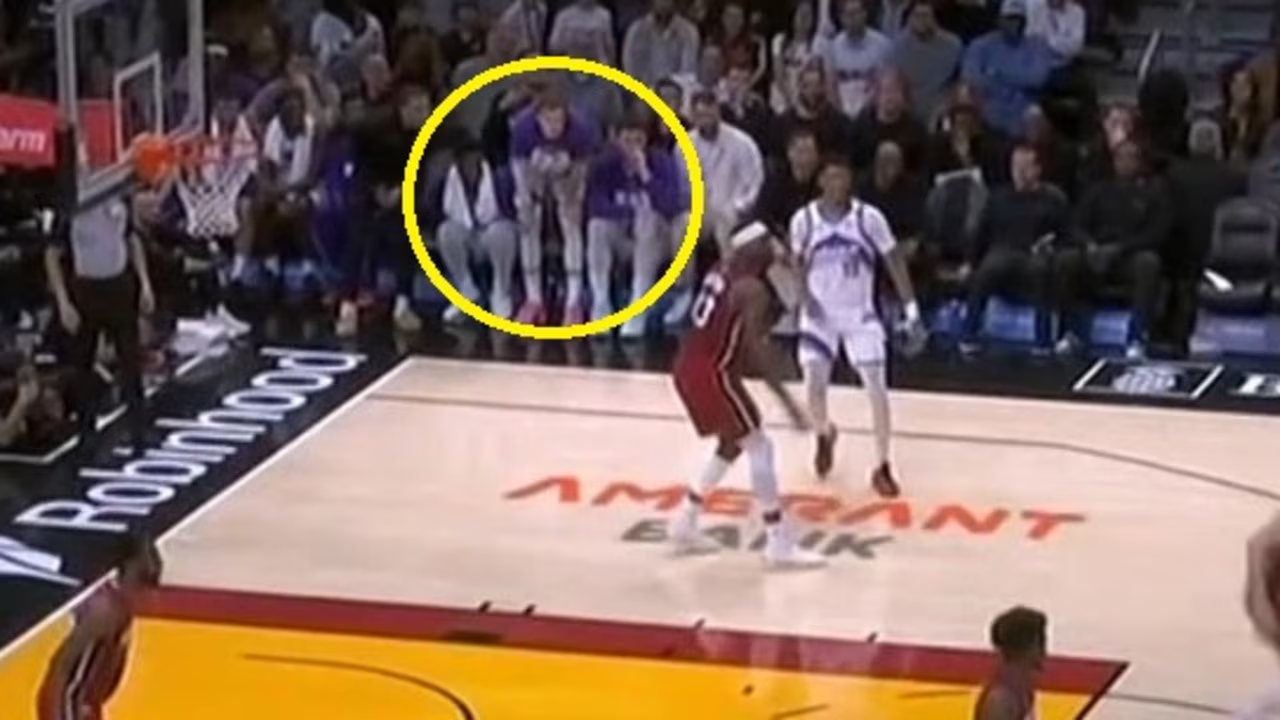
That is because earlier this month during a game against the Orlando Magic, the Jazz benched Lauri Markkanen, trade deadline acquisition Jaren Jackson Jr. and fellow starter Jusuf Nurkić for the entire fourth quarter.
What was particularly unsettling about that whole situation was the fact the Jazz were ahead 94-87 entering the fourth quarter, and Markkanen had combined with Jackson Jr. for 49 points.
With both off the court along with Nurkic for the entire final quarter, the Jazz’s young roster eventually fell away as the Magic finished on top 120-117.
Two nights later, they did it again. But this time, it didn’t work. The Jazz had a 85-82 lead at the end of the third quarter and by the final buzzer they were still ahead, beating the Miami Heat 115-111.
Now, the Jazz are far from the only team tanking. After all, the Pacers were also fined after Pascal Siakam, Andrew Nembhard and Aaron Nesmith were held out of a 131-122 loss to the Jazz on the second night of a back-to-back.
An NBA investigation of the Pacers, including a review by an independent physician, found that Siakam, who is deemed a ‘star player’ under the league’s player participation policy, and two Indiana starters who also didn’t play could have played under the medical standard as outlined in the policy.
“Alternatively, the team could have held the players out of other games in a way that would have better promoted compliance with the Policy,” the league added in its news release.
Then there are the Wizards, who have reportedly shut down Anthony Davis for the season — and have not exactly dismissed the possibility of him missing the rest of the year when quizzed on the reports, while Trae Young has also been a non-participant since being traded to Washington.
There is always going to be a certain grey area when it comes to tanking and what is deemed acceptable.
Given Davis’ injury history, why wouldn’t the Wizards — in a lost season — hold him out for the rest of the season? And if the Jazz were singled out for benching their biggest stars for the entire fourth quarter, what is to stop teams from being more creative in how they stagger minutes, especially if they hide behind the guise of player development?
The Jazz may be the team making all the headlines, but realistically there are up to 10 teams in the NBA right now who have every reason to lose games right now in order to win in the future.
The Kings are anchored to the bottom of the Western Conference and having failed to get rid of their aging assets at the trade deadline, would be incentivised to position themselves for the opportunity to draft a potential franchise cornerstone.
The same goes for the Nets, who have a lot of cap space and draft capital to take a major swing in the summer but could also do with an injection of elite, young talent to build around.
The Mavericks, meanwhile, don’t have access to their own draft picks from 2027 to 2030, so they may as well get the most out of their 2026 pick and they know all too well how beneficial the lottery can be.
Fans OUTRAGED by dunk contest fail | 00:37
Then there are the Bucks, who can’t completely bottom out to get the first overall pick, but will get the least favourable of either their or New Orleans’ pick, and so they too are incentivised to acquire a high draft pick they can either build around if Giannis Antetokounmpo leaves or use in a trade to add a win-now piece around him.
The Grizzlies and Bulls also made major moves before the deadline which clearly signalled they are entering rebuilds. That brings us to nine teams and while the Pelicans don’t own their 2026 pick and hence don’t have a reason to tank, they do have a reason to give their young players as many minutes as possible and may struggle to win games as a result.
“It’s seemingly as rampant as it’s ever been at this juncture of the season and it might be the foremost stain on the sport right now … or at worst as worrisome as the mounting concern over the ever-increasing presence of gambling as an accessory to the game,” NBA insider Marc Stein wrote on his Substack.
That is an important point Stein makes because while tanking is not a new issue for the NBA, there is a “big elephant in the room” that the league can’t ignore as Yahoo Sports’ Tom Haberstroh pointed out.
“From the NBA’s perspective there is one big elephant in the room that happened in October that would potentially change their position on this,” he said on ‘The Big Number’.
“There was a gambling scandal. The FBI was involved and a lot of the details in those indictments allege that inside information stemming from tanking games where guys were being held out of games before the public knew about it or guys were leaving early in games before the public knew about it.
“These are not things that the NBA wants to perpetually happen every day, especially not in February. The earlier that this happens, the more problematic it is because there’s just so many games that they have to monitor.”
So, how can the NBA fix it?
NBA Wrap: LeBron notches triple-double | 03:22
POTENTIAL SOLUTIONS… INCLUDING ONE RADICAL MOVE
Well, NBA commissioner Adam Silver was quizzed on the league’s tanking crisis at his annual All-Star weekend press conference, where he admitted the behaviour this year is “worse than we’ve seen in recent memory”.
Silver said the league office is spending “a lot of time” communicating with teams on injury reports and coaches’ decisions and when asked whether there was any talk of draft picks being taken away instead of fining teams, he left the door open to any and every punishment.
“There is talk about every possible remedy now to stop this behaviour,” Silver added.
But as he later went to point on, this is going to be far from a straight-forward fix.
“Teams are in a difficult place,” he said.
“Many of you in this room have written understandably about our teams that the worst place to be, for example, is to be a middle-of-the-road team. Either be great or be bad, because then that will help you with the draft.
“In many cases, you have fans of those teams — remember, it’s not what they want to pay for to see poor performance on the floor, but they’re actually rooting for their teams in some cases to be bad to improve their draft chances.
“I think we’re coming at it in two ways. One is, again, focusing on the here and now, the behaviour we’re seeing from our teams and doing whatever we can to remind them of what their obligation is to the fans and to their partner teams.
“But number two, as I also said in that statement, the Competition Committee started earlier this year reexamining the whole approach to how the draft lottery works.”
After all, you could make a compelling argument that the draft lottery, which was changed to flatten the odds in 2019 to prevent teams tanking for the bottom spot, has only made the problem worse.
Previously, the odds for the three worst teams to win the lottery were 25 per cent, 19.9 per cent, and 15.6 per cent, respectively.
Since 2019, the worst team only has had a 14 per cent chance at the top pick. The result has been chaos.
You only have to look at Dallas lucking into Cooper Flagg last season or, conversely, Washington’s lottery misfortune after years of bottoming out as proof that just getting into the lottery in itself can dramatically change a team’s trajectory.
That means more teams making moves at the deadline when it’s clear they can’t compete for the championship, with the hope of dropping down the standards and later having the lottery gods smile down on them.
So, what are a few of the solutions that have been raised?
Abolish the draft
This is the least likely solution of them all, at least for now, because the draft is such a big television product and driver of content that the NBA and its broadcast partners would need another event to fill its place.
Haberstroh floated the idea of a rookie signing day as a television program, which could work but again wouldn’t have the same intrigue as the draft.
Andscape’s David Dennis Jr. argued in a recent column that there is no solution to tanking outside of abolishing the draft itself, writing that the NBA doesn’t have a tanking problem.
“The league has an ownership and power problem,” he instead argued.
“… As long as there is a draft or any way that adds randomness and lottery odds to secure a once-in-a-generation player or players, teams are going to tank.
“The only solution to tanking is abolishing the draft itself. If players are allowed to simply go to whatever team they want, then it puts the onus on organisations to make their teams desirable destinations for incoming rookies.”
As he went on to point out, the typical counter-argument to this solution is that young players would all go to the same markets, but it isn’t that straight-forward.
Are those rookies going to see the kind of minutes they want playing for the Lakers or Knicks, and what sort of chemistry will they develop with already established superstars in the league who are prioritising winning a championship?
It is not like teams can load up on young draft talent either. That isn’t guaranteed to be a long-term solution in the modern NBA with the new CBA, and will all these top rookies want to be on the same team sharing minutes and, eventually, money?
Dennis Jr. went on to write that when he brings up the idea of abolishing the draft, the “biggest pushback” is that owners won’t be on board.
Limit pick protections
This seems the most likely option, at least as a short-term fix. It won’t solve the NBA’s tanking issue, but it’ll at least show the league is doing something to address it.
It is particularly relevant this year given Utah’s pick goes to Oklahoma City if it falls outside of the top eight, while Washington also owes its draft pick to the Knicks if it drops out of the top eight.
Indiana’s situation is especially interesting given the Pacers found such a creative way to protect their pick in the Ivica Zubac deal. In case you missed it, the Pacers will keep their first-round pick if it lands in the top four or outside of the top 10. If it is inside the No.5 to No.9 range, it goes to Los Angeles.
ESPN insider Shams Charania reported last year that the NBA had already started to gather input from owners and general managers on ways to combat tanking, with one idea including limiting pick protections to either top-four or 14 and higher.
Have a cut-off date
This one is also gaining steam.
The idea is pretty simple. Lottery positions would be locked after March 1, and there could be an extra wrinkle added in where teams receive more credits for winning games after that date too.
But the argument against it is just as simple. It would just lead to teams tanking sooner.
The wheel
This idea, first coined by Celtics general manager Mike Zarren, would see teams rotate through each draft slot over a 30-year period.
“The idea of the wheel was every team over 30 years cycles through all 30 draft slots in a not random order but in an order that is meant to imitate randomness… every team would be guaranteed a top-five pick every five seasons and at least one top-12 pick every four years,” NBA insider Zach Lowe said on his podcast.
“So, you would know 29 years in advance where you are picking… the idea was we are going to completely sever the connection between your place in the standings and where you draft. That is the only way to eliminate tanking, everything else is a band-aid.”
There were, of course, some issues raised with that initial proposal.
For example, the NBA is a business and one of the biggest drawcards, even for fans of the most miserable teams in the league, is hope. The hope of getting the first overall pick and dramatically changing the trajectory of the franchise overnight.
Under the proposed wheel, that may no longer be there for teams who are already struggling and won’t be picking near the top of the draft for numerous years.
Furthermore, given there are obviously some bigger markets that are more desirable than others, could elite draft prospects time their entry into the draft for when those teams, like the Lakers and Knicks, would have the top pick?
Obviously there would be a risk in potentially stunting or complicating your development just to join a specific team, but it is another factor worth weighing up.
Zarren later proposed a revised version which involved teams rotating through six-pick groups over five years, and another which saw teams rotate through three-pick groups over 10 years.
Those would, to varying degrees, add more randomness to the process but would still be a major change, as Lowe said, in completely severing draft picks from records.
Kevin O’Connor also proposed his version of the ‘wheel’ in an article for Yahoo Sports.
Some other ideas
Chicago Bulls beat writer Will Gottlieb had an interesting suggestion of using three-year records to determine lottery odds instead of one.
“Would be way harder to manipulate the standings late season and actually help the teams the draft is designed to help,” he wrote.
The Athletic’s Sam Vecenie, meanwhile, had a left-field idea to incentivise both players and owners to win as many games as possible, although as he conceded it is unlikely to get support from the players in particular.