


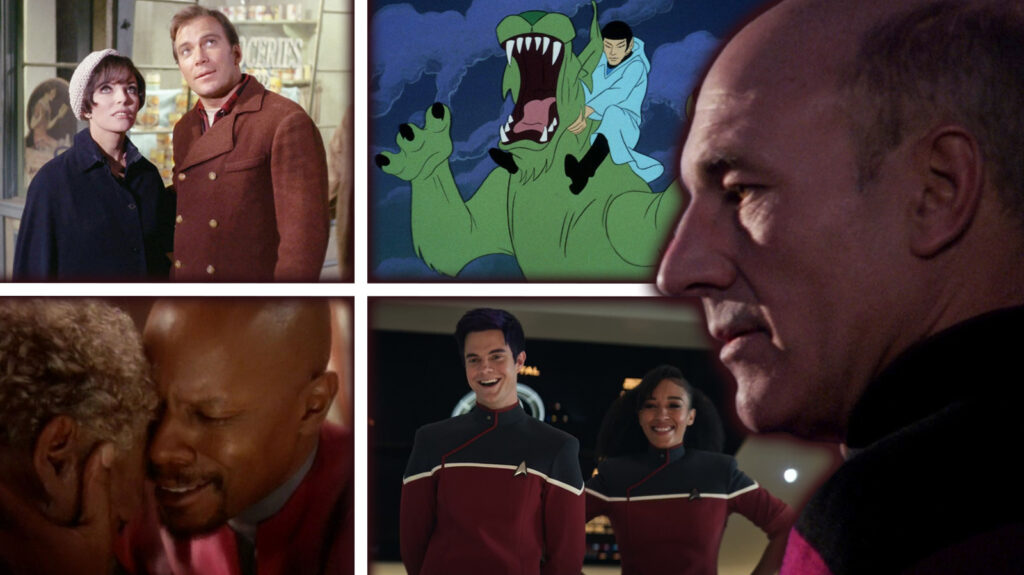

One of the biggest recurring tropes in “Star Trek” is the use of time travel, something that’s existed since the earliest days of the franchise. Through the technological advancements available in the future, the main characters have traveled into the past, future, and alternate realities and timelines in varying capacities. The franchise has inventively used this narrative mechanic over the years, creating some of the biggest plot twists that we never saw coming. In many cases some of the best “Star Trek” stories of all time heavily involve the use of time travel.
Simply put, we love it when “Star Trek” bends the rules of space-time, with its fan-favorite characters traveling through the timestream. This can involve more conventional time travel or the characters being caught in temporal loops and anomalies as they explore the cosmos. While we certainly love “Star Trek IV: The Voyage Home” and “Star Trek: First Contact,” we’re sticking with the franchise’s time travel stories on television.
With that in mind, here are “Star Trek’s” 15 best time travel episodes, ranked and ready for fans to check out.
15. Twilight (Enterprise)
The best “Star Trek: Enterprise” episode ever is the third season installment “Twilight,” set at the height of the Xindi War. While rescuing T’Pol (Jolene Blalock) from a spatial anomaly, Captain Jonathan Archer (Scott Bakula) endures a grievous injury and is infected by mysterious parasites. These parasites severely inhibit Archer’s long-term memories, forcing him to be relieved from his command, paving the way for the Xindi to triumph over humanity. But 12 years later, Doctor Phlox (John Billingsley) discovers a cure for Archer’s condition, which will retroactively correct the timeline and prevent Earth’s defeat from taking place.
“Twilight” captures the danger and darkness that “Enterprise” became known for in its later seasons, delving into humanity’s precarious early interactions with new worlds and new civilizations. The episode not only highlights how important Archer’s health is to the integrity of the timeline, but offers an inventive way to avert history from being irrevocably altered. A time-bending tale of how the devotion that Archer inspires from his crew saves the day, “Twilight” is “Enterprise” at its best.
14. Endgame (Voyager)
The series finale for “Star Trek: Voyager,” the two-parter “Endgame,” revolves entirely around the use of time travel. The episode opens with the surviving members of the USS Voyager celebrating their return to Earth 10 years prior, despite suffering grave personal losses and a 23-year trek. Determined to change the fate of her crew, an older Kathryn Janeway (Kate Mulgrew) travels back in time with advanced technology to help her younger self lead Voyager home sooner. This involves the Voyager traveling through a region dominated by the Borg Collective, culminating in the time-traveling Janeway confronting the Borg Queen (Alice Krige).
“Endgame” provides a thrilling, cinematic ending for “Star Trek: Voyager” and a happy ending from the jaws of certain tragedy. The Borg had already established themselves as a major presence in “Voyager” and were also no strangers to time travel stories. This all coalesces into an epic finale, with Admiral Janeway inspired by her old crew on one last adventure. A fitting finale for “Voyager” and its arduous journey, “Endgame” offers a satisfying tale facilitated by a time-traveling Janeway.
13. Timescape (The Next Generation)
“Star Trek: The Next Generation” featured plenty of memorable episodes dealing with temporal shenanigans across its seven-season run, including the sixth season installment “Timescape.” While returning to the Enterprise in a runabout, Captain Jean-Luc Picard (Patrick Stewart) and a small landing party find the starship and a Romulan warbird frozen in time. Developing makeshift devices to prevent themselves from being affected by the temporal disruptions, the team investigates what’s going happening to the two vessels. More than just a potential danger to both ships and their respective crews, Picard and his unaffected associates realize there is something more sinister at work.
With its frozen in time visuals and the story’s overarching sense of mystery, “Timescape” is an effective, problem-solving oriented story. In terms of time travel mechanics, the timestream around the Enterprise isn’t just frozen but advances and resets at various points of the story. This creates some surprises as the tale unfolds while playing with the visual effects that help the episode stand out. An essential “Next Generation” episode that everyone should watch, “Timespace” blends sci-fi spectacle with a captivating mystery of the unknown.
12. Relativity (Voyager)
The “Voyager” episode that is the most time-travel intensive, in terms of temporal mechanics, is the fifth season installment “Relativity.” Seven of Nine (Jeri Ryan) is plucked from the timestream by a 29th century Starfleet vessel moments before Voyager is destroyed by a bomb, causing a time paradox. Seven is sent to different points of Voyager’s existence, including before it was lost in the Delta Quadrant as part of her investigation. Teaming up with Janeway during her visits, Seven identifies the culprit and stops the ship’s destruction to rectify the timeline.
With a particularly pronounced time-bending premise, “Relativity” is an episode that asks its viewers’ full attention to follow along. Jeri Ryan and Kate Mulgrew do a great job of playing different versions of their characters at different points in the timeline, highlighting their rapport. The episode itself plays out like a cosmic murder mystery, with a surprising culprit in its final twist. A solid time travel story that makes great use of Ryan’s Seven, “Relativity” has fun with its premise, even if its wider implications don’t make that much sense.
11. Visionary (Deep Space Nine)
Of the entire “Deep Space Nine” main cast, Miles O’Brien (Colm Meaney) stood as the crew’s unassuming everyman. The third season episode “Visionary” thrust O’Brien in the middle of a time travel adventure involving his own possible death. Suffering from radiation exposure, O’Brien temporarily gains the ability to glimpse five hours into the future at a time. When it becomes clear that the entire space station is in danger, the O’Brien of one timeline sacrifices himself to warn his future self about what’s coming.
With steadily mounting stakes across each subsequent look into the future, “Visionary” offers a great showcase for Meaney. O’Brien was always something of an unsung hero for the series, at least until “Lower Decks” made him the most important man in “Star Trek” history. “Visionary” is prime evidence about why that distinction is well-earned, albeit in a more understated way than most explosive “DS9” episodes. A great character-centric story for Miles O’Brien, “Visionary” is a largely underrated episode in the series.
10. Cause and Effect (The Next Generation)
Though perhaps better known for Kelsey Grammer’s “Star Trek” cameo, the “Next Generation” episode “Cause and Effect” is one of the series’ best. The Enterprise is caught in a temporal loop with the USS Bozeman, a Starfleet vessel missing for over 90 years, resulting in both ships’ destruction. With time resetting after every destruction, the crew begins to develop a heightened sense of déjà vu while Beverly Crusher (Gates McFadden) detects audio signals from past loops. Using his unique positronic brain, Data (Brent Spiner) programs a clue into himself in a future loop for how to avert the ships from repeating their collision.
With its temporal loop mechanics more effectively staged than realized, “Cause and Effect” had TV stations flooded with confused calls from viewers. Kicking off things with an explosion, the episode certainly captures the audience’s attention from jump before gradually building out its mystery. That sense of repetition that the crew begins to steadily experience spreads to the viewers, fueling a general unease before a solution is discovered. A solidly crafted looping narrative, “Cause and Effect” showcases “TNG” firing on all cylinders.
9. Year of Hell (Voyager)
One of the most memorable stories in “Voyager” was the fourth season two-parter “Year of Hell.” After taking a shortcut through hostile territory, Voyager is severely damaged by a temporal disruption, making them targets of enemies in the region. The episode chronicles the starship continuing their journey for the following year, suffering further damages and heavy casualties along the way. During this grueling trek, the ship encounters a mysterious time-traveling vessel linked to the temporal disruptions.
Early on, “Year of Hell” was considered to last for an entire season of “Star Trek: Voyager” before it was condensed into two episodes. The decision to streamline the story works for the best, providing just enough time for the Voyager to endure its disastrous detour before revealing its time-traveling stakes. This also helps the conclusion of the story have a strong payoff, with its happy ending a relief given the harrowing road to reach that point. Easily one of the greatest “Voyager” episodes, “Year of Hell” encapsulates the desperate tone when the show was at its best.
8. Yesteryear (The Animated Series)
“Star Trek: The Animated Series” is one of the most underrated shows in the franchise or, at the very least, is a forgotten spin-off worth revisiting. Among the highlights from the two-season series is the episode “Yesteryear,” placing Spock (Leonard Nimoy) on an adventure into his own history. While undergoing temporal research through the Guardian of Forever, Spock’s place in the timeline is inadvertently threatened. This forces Spock to return to Vulcan during his own childhood to ensure that his destiny will be restored and preserved.
“Yesteryear” is one of the best “Star Trek” Spock episodes regardless of series or era for the franchise. The story provides invaluable insight on Spock’s background, including the unhappier elements of his upbringing on Vulcan. The episode also exemplifies what “TAS” was all about, using the possibilities of animation to deliver thought-provoking tales on par with “The Original Series.” If there’s any single episode of “Star Trek: The Animated Series” to watch, “Yesteryear” stands out as the strongest contender.
7. Blink of an Eye (Voyager)
The “Voyager” episode “Blink of an Eye” doesn’t deal with conventional time travel so much as revolve its entire story around time dilation. The Voyager becomes trapped in the magnetic field of a planet enveloped in a tachyon field that affects how time passes on its surface. While the crew develops a way to continue their journey, time on the planet passes 58 days for every minute on the ship. With the ship visible from the planet’s surface, the indigenous population tries to contact or destroy the ship to stop its harmful effects to their environment.
“Blink of an Eye” offers a unique take on “Star Trek” characters inadvertently contaminating local cultures with their presence. The time dilation mechanics provide an intriguing directions for the story, especially once the Voyager crew realizes the implications of their impact on the planet. The episode also contains a memorable guest-starring appearance from Daniel Dae Kim as an astronaut from the planet who endures a visit to the Voyager, unpacking the story’s consequences. A solid sci-fi story with an interesting concept at its core, “Blink of an Eye” weaves a time-bending tale as only “Star Trek” can.
6. Trials and Tribble-ations (Deep Space Nine)
Not all of “Deep Space Nine” is doom and gloom resulting from the tense Dominion War storyline dominating its later seasons. One of the best “Deep Space Nine” episodes veers heavily into time-traveling comedy, with the fifth season’s “Trials and Tribble-ations.” A celebration of the franchise’s 30th anniversary, the episode has the DS9 crew travel back in time to the events of the “TOS” story “The Trouble with Tribbles.” Sisko and his crew prevent a time-traveling Arne Darvin (Charlie Brill) from assassinating Captain Kirk and changing history.
“Trials and Tribble-ations” lets the “DS9” cast showcase their comedic chops and they do not disappoint in that regard. The crossover retains all the comical appeal of its “TOS” source material while adding a fresh time travel twist to the story. Seeing the characters try to fit into this classic era never outstays its welcome right down to its closing scene. “Trials and Tribble-ations” is a strong reminder that not every time travel story, or “DS9” episode, has to be so self-serious all the time.
5. Those Old Scientists (Strange New Worlds)
Another effective intra-franchise crossover is “Those Old Scientists,” bringing together “Star Trek: Strange New Worlds” and “Star Trek: Lower Decks.” While investigating an ancient portal, Brad Boimler (Jack Quaid) and Beckett Mariner (Tawny Newsome) are accidentally transported back to the 23rd century. Picked up by the Enterprise while it’s captained by Christopher Pike (Anson Mount), Boimler and Mariner are surprised by how the crew appears compared to history. The two characters search for a way to return to their own time while trying not to contaminate the timeline and contend with a hostile Orion vessel.
“Those Old Scientists” is a beautiful and hilarious tribute to “Star Trek” fandom brought to life by two fan-favorite casts. Quaid and Newsome make the transition to live-action with their animated characters seamlessly, with “Lower Decks'” brand of humor fitting into “Strange New Worlds.” Moreover, the time travel story bringing both shows together feels organic to the wider “SNW” tale being told in its second season. A highlight in the “Star Trek” resurgence on Paramount+, “Those Old Scientists” celebrates the franchise as it charts a new future.
4. The Visitor (Deep Space Nine)
Arguably the most emotionally devastating episodes from “Deep Space Nine,” the fourth season episode “The Visitor” centers its focus on father and son. A subspace accident leaves Sisko drifting through time, periodically reuniting with his son Jake (Cirroc Lofton) for brief intervals. Jake becomes obsessed with finding a way to rescue his father from his ethereal fate, even at immense cost to his personal life. This culminates in a shocking sacrifice from an older Jake (Tony Todd) entirely fueled by his deep love for his father.
“The Visitor” is so powerful and has connected with fans on such a profound level that the “Deep Space Nine” episode changed Tony Todd’s life. After watching the episode, it’s easy to see why, with its time-bending twist leaving viewers as shattered as Sisko. The whole story only works if we believe the lengths Jake will go to save his father and both Lofton and Todd deliver that quality in full. An absolute heartbreaker with a unique time-travel hook, “The Visitor” stands as the saddest moment in the “Star Trek” franchise.
3. Yesterday’s Enterprise (The Next Generation)
One of the most enigmatic figures in “The Next Generation” is Guinan (Whoopi Goldberg), who gets a major role in the third season episode “Yesterday’s Enterprise.” The episode opens with the Enterprise-D, the series’ main starship, encountering the long-lost Enterprise-C in a mysterious time rift. This changes the timeline radically, with only Guinan aware that reality has been altered around her on the Enterprise-D. Working with the formerly deceased bridge officer Tasha Yar (Denise Crosby), Guinan must convince the Enterprise-C to return to its own time and restore history.
With rewrites to the script and a tight production schedule, “Yesterday’s Enterprise” was one of the series’ hardest episodes to produce. There is a lot that’s happening in this episode, from the reappearance of a lost starship to the sudden return of Tasha in a darker vision of the 24th century. But the episode balances all these plot lines and elements well, while presenting one of the best time travel stories in the franchise. A time travel episode with consequences resurfacing later in the series, “Yesterday’s Enterprise” demonstrates “The Next Generation” at its very best.
2. All Good Things… (The Next Generation)
Just as “The Next Generation” began with the omnipotent Q (John de Lancie) testing Picard to see whether humanity is worthy of existence, its finale continues this trial. In his latest challenge to Picard, Q whisks the starship captain to three different points in his life, including his first day on the Enterprise and his twilight years. Picard must solve the mystery tying all three temporal points together in an effort to impress Q. The future timeline involves Picard having to reunite with his old crew, even as they stand divided by circumstances since their time together on the Enterprise.
The best “Star Trek” series finale to date, “All Good Things…” celebrates the show’s history while peering into its possible future. The episode effectively recreates the aesthetics from the series premiere while offering interesting possible futures for its familiar characters. In having Q serve as the engine for the story, the finale offers a beautiful parallel to the show’s very first episode. A perfect bookend tying together Q’s best moments across the franchise, “All Good Things..” gives “The Next Generation” the sendoff it deserves.
1. The City on the Edge of Forever (The Original Series)
“Star Trek” fans probably guessed that “The City on the Edge of Forever” was going to top this list, and that’s for good reason. An episode that towers above the rest of “The Original Series,” the story clearly establishes the emotional and moral depths the franchise is capable of. The episode has a temporarily crazed Doctor McCoy (DeForest Kelley) travel back to America in the 1930s and accidentally change history. Kirk and Spock pursue their time-displaced friend, with Kirk falling in love with local social worker Edith Keeler (Joan Collins) only to realize the future rests in her grim fate.
Given its vaunted reputation, it should go without saying, but “The City on the Edge of Forever” is an essential “Original Series” episode everyone should watch at least once. Compared to the campier stories in the series, the episode delivers a grounded tale with genuine stakes and palpable emotional fallout. William Shatner was rarely in finer form with his performance as a morally conflicted Kirk here, evident right down to its somber ending scene. The tale about sacrifices needed for the greater good, especially with the space-time continuum at stake, “The City on the Edge of Forever” is “Star Trek” at its very best.