


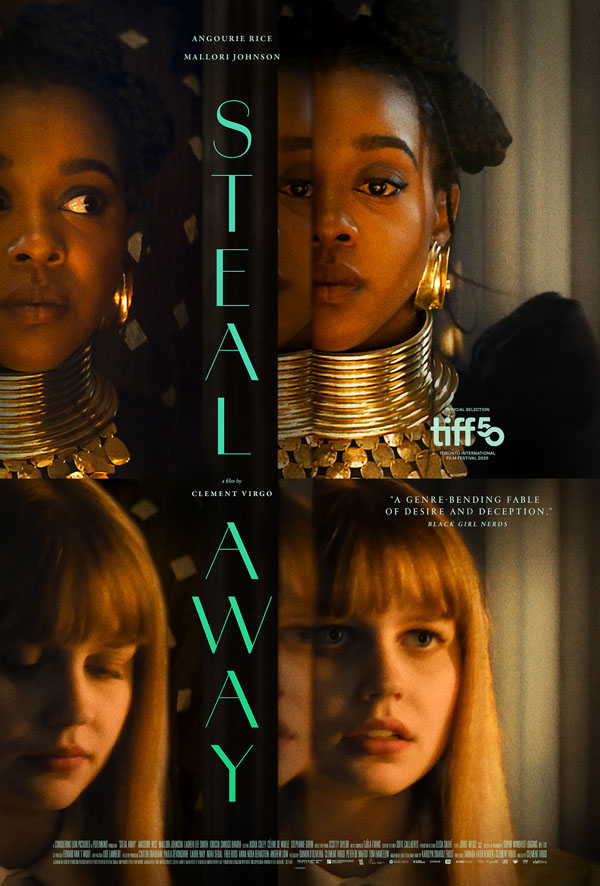
BE | CA | 2025 | 113 min | Thriller, Drama
➡️ Where to Watch: CA
When Friendship Becomes Fascination, Desire and Something More Dangerous
Fanny is a sheltered teenager living inside a protected world of wealth when Cécile, a mysterious young refugee from Congo, is taken in by her family. Cécile possesses the confidence, independence and experience that Fanny lacks, and their friendship quickly becomes more complicated as fascination develops into imitation, jealousy and desire.
Clement Virgo turns that relationship into the emotional centre of a psychological thriller that refuses to remain in one recognizable place or period. Its world evokes the American South, colonial history and contemporary Europe at once, allowing Fanny and Cécile’s increasingly obsessive connection to become part of a larger story about race, migration, privilege, freedom and who gets to control another person’s life.
➡️ Movie Insight: Steal Away makes friendship dangerous because Fanny wants more than Cécile’s companionship. She becomes fascinated by the freedom and identity Cécile appears to possess. The closer they become, the more friendship turns into a struggle over desire, jealousy and power.
Why This Movie Matters Right Now: Old Systems of Power Keep Reappearing in New Forms
Steal Away deliberately creates a world that feels historical and contemporary at the same time. Refugees are treated with suspicion, racial hierarchies shape everyday life and privileged institutions present themselves as benevolent while maintaining systems designed to control the people supposedly being protected.
That ambiguity gives the movie contemporary relevance without locking its ideas to one political moment. Virgo uses the echoes of slavery, colonialism and migration to ask whether societies truly leave oppressive structures behind or simply recreate them in forms that look more acceptable to a new generation.
➡️ Why It Matters: The movie connects historical inequality with contemporary fears around migration and belonging. Its fictional world suggests that progress can never simply be assumed. Freedom has to be recognized, protected and repeatedly fought for.
Should You Watch It?: Come for a Friendship That Keeps Becoming Stranger
Steal Away is best approached as a psychological puzzle rather than a conventional coming-of-age drama. Its attraction lies in watching the relationship between Fanny and Cécile continually change meaning as affection, curiosity, sexual awakening, resentment and power begin overlapping.
Angourie Rice and Mallori Johnson give the movie the relationship it needs at its centre. Their characters are simultaneously drawn toward and unsettled by each other, creating a friendship where it becomes increasingly difficult to separate genuine emotional connection from fascination and possession.
➡️ Viewing Recommendation: Watch it if you enjoy psychologically charged coming-of-age stories that leave room for interpretation. The movie combines teenage desire with social allegory and an intentionally unreal atmosphere. Its strongest appeal is the uncomfortable relationship developing between its two young women.
Why Everyone Is Talking About It?: Clement Virgo Turns History Into a Fever Dream
Steal Away arrived with a distinctive festival identity, premiering at the 2025 Toronto International Film Festival before continuing through international festival screenings. Instead of directly recreating the historical circumstances that inspired the story, Virgo and co-writer Tamara Faith Berger transform them into a stylized world of refugees, wealthy estates, racial hierarchy, sexuality and political menace.
The approach also marks a significant creative shift for Virgo after Brother. Rather than returning to naturalistic social drama, he moves toward psychological thriller, fairy tale, Afrofuturism and speculative world-building, using genre to make historical patterns feel disturbingly contemporary.
➡️ Viral Potential: Steal Away gives audiences a relationship they can debate as much as a world they can decode. Its mixture of desire, privilege, race and obsession creates multiple interpretations of what Fanny actually wants from Cécile. That ambiguity makes the film naturally suited to discussion after the credits.
Why Steal Away Stands Out: Its Friendship Is Never Emotionally Equal
Fanny and Cécile may be teenagers forming an intense bond, but they enter that friendship from radically different positions. Fanny is protected by wealth while Cécile enters her environment as a refugee, meaning intimacy develops inside a structure where one girl belongs to the household and the other depends upon it.
That imbalance makes Fanny’s fascination increasingly uncomfortable. She can admire Cécile’s confidence, imitate her appearance and desire her freedom, but she cannot simply borrow the experience that produced Cécile’s identity. Friendship therefore becomes a way for the film to expose the difference between wanting to understand someone and wanting to possess what makes them different.
➡️ Cinema Insight: Steal Away refuses to make friendship automatically innocent. Attraction can coexist with jealousy, privilege and control. That tension transforms a teenage bond into the movie’s most unsettling expression of power.
Movie Trend: Dangerous Friendship — When Fascination Turns Into Obsession
Cinema is increasingly interested in friendships that become emotionally consuming, particularly stories where admiration begins erasing the boundary between affection and possession. These relationships work because friendship can create an intimacy that is every bit as volatile as romance while carrying different expectations about loyalty, identity and competition.
Steal Away pushes that idea into coming-of-age territory. Fanny sees Cécile as friend, mystery, rival and doorway into a life she has never experienced, making her attraction less about one emotion than an escalating desire to become closer to everything Cécile represents.
➡️ Movie Trend: Dangerous friendship stories turn emotional closeness into suspense. The person a character admires most can also expose everything they feel they are missing. In Steal Away, fascination becomes dangerous because friendship starts changing how Fanny sees herself.
Viewer Profile: Audiences Drawn to Psychological Coming-of-Age Stories
Steal Away is positioned for viewers who enjoy character-driven films that combine intimate relationships with larger social ideas. Its mixture of teenage awakening, psychological tension and speculative world-building should particularly appeal to audiences comfortable with movies that do not immediately explain the rules of their worlds.
The film also reaches beyond conventional coming-of-age audiences through its engagement with migration, race, colonial history and female power. Viewers interested in festival cinema and visually constructed allegories are likely to find the film’s deliberate ambiguity central to its appeal.
|
Viewers of psychological thrillers, festival cinema and unconventional coming-of-age films |
|
|
Audiences interested in female friendship, migration, race, identity and historical allegory |
|
|
Broad audience with strong relevance to viewers interested in female-led psychological stories |
|
|
Broad middle-income, student, professional and culture-focused audience |
|
|
Film-festival audiences, arthouse viewers and culturally engaged consumers |
|
|
Psychological thrillers, coming-of-age films, speculative drama, historical allegory and international cinema |
➡️ Audience Insight: The ideal viewer wants more than a straightforward friendship drama. Steal Away rewards audiences willing to interpret symbols, shifting identities and deliberately unstable realities. Its strongest audience is likely to enjoy discussing what the movie means as much as following what happens.
What This Movie Means for the Industry: Historical Stories Can Escape Historical Realism
Steal Away is inspired by Karolyn Smardz Frost’s nonfiction book Steal Away Home, but Virgo and Berger do not treat adaptation as an obligation to reproduce history literally. They use the historical foundation as a launching point for an invented universe where slavery, contemporary migration, colonialism and speculative imagery can occupy the same cinematic space.
That demonstrates another route for filmmakers adapting difficult histories. Instead of reconstructing the past exactly, filmmakers can use genre and world-building to investigate how the structures created by that past continue to shape the present.
➡️ Industry Insight: Historical adaptation does not have to mean historical reconstruction. Genre can connect the past with contemporary anxieties while giving filmmakers greater visual and thematic freedom. Steal Away shows how nonfiction can become the foundation for radically imaginative cinema.
Creative Analysis: Two Girls Enter a World Where Friendship and Freedom Are Never Simple
Clement Virgo builds Steal Away around contrasts: Black and white, refugee and privileged citizen, freedom and confinement, attraction and jealousy, historical memory and speculative possibility. Those contrasts are concentrated inside Fanny and Cécile’s relationship until their friendship begins carrying much of the movie’s political meaning.
The result is deliberately unstable. The audience is encouraged to question where and when the story is happening, whether familiar images belong to history or the present, and whether the apparent safety surrounding Fanny’s family is actually another form of control.
Storytelling: History Becomes a Puzzle Instead of a Timeline
The screenplay takes inspiration from historical nonfiction but abandons conventional period-drama boundaries. Elements associated with slavery, contemporary migration and European history coexist, creating a story that feels simultaneously familiar and impossible to place.
That structure makes Fanny’s awakening both personal and political. Discovering Cécile means discovering desire, but it also means gradually recognizing the systems that have made Fanny’s own protected existence possible.
Direction: Clement Virgo Makes the World Feel Almost Familiar
Virgo deliberately avoids explaining every element of the movie’s universe. Instead, he treats the setting like a puzzle box in which architecture, costume, race and political authority provide clues without establishing one definitive historical period.
That uncertainty supports the movie’s central idea. Oppressive systems do not belong exclusively to the past, so the world cannot comfortably be dismissed as something that happened somewhere else.
Performances: Angourie Rice and Mallori Johnson Build the Movie Around Attraction and Unease
Angourie Rice plays Fanny as someone fascinated by experiences beyond the narrow environment in which she has been raised. Her growing fixation on Cécile combines curiosity with insecurity, making even moments of closeness potentially uncomfortable.
Mallori Johnson gives Cécile a contrasting confidence and presence. Their performances work because affection and tension remain visible at the same time, preventing the relationship from settling neatly into friendship, rivalry or desire.
Visual Style: Two Worlds Compete Inside the Same Movie
The visual construction distinguishes Fanny’s restrained European environment from the more vibrant influences associated with Cécile. Costume, production design and framing become part of the film’s argument about who defines beauty, sophistication and belonging.
The result gives Steal Away its fairy-tale quality. Its world is recognizable enough to evoke history but artificial enough to suggest that the audience is watching a symbolic version of multiple histories simultaneously.
Themes: Desire, Race, Migration and the Illusion of Benevolence
At the centre is the question of what happens when privilege mistakes fascination for understanding. Fanny can be attracted to Cécile’s confidence and difference while remaining protected by a social structure that gives the two girls fundamentally unequal positions.
The movie expands that contradiction into questions about migration and institutional kindness. Hospitality means little if the person receiving it is never given genuine freedom, turning the language of protection into another potential mechanism of control.
What Makes It Different: It Refuses to Choose Between Period Drama and Speculative Cinema
Steal Away could have approached its historical inspiration as a conventional period story. Instead, Virgo uses anachronism, fairy tale, psychological thriller and Afrofuturist influences to build an alternate reality.
That choice makes the film’s historical echoes harder to contain. Rather than reassuring audiences that oppression belongs to another century, Steal Away creates a world where past and present seem capable of occupying the same frame.
➡️ Creative Insight: The movie’s greatest creative decision is refusing to tell audiences exactly when its world exists. That uncertainty turns history into something still moving through the present. Fanny and Cécile’s relationship becomes the human battleground where those larger forces collide.
If You Liked Steal Away (2025): More Stories About Desire, Control and Young People Trapped Inside Dangerous Worlds
These three recent films similarly turn intimate relationships and coming-of-age experiences into confrontations with power. Each places its characters inside a world where attraction, belonging or social acceptance becomes increasingly complicated by control, identity and the pressure to become what somebody else expects.
100 Nights of Hero (2025) by Julia Jackman: Female Intimacy Becomes an Escape From Control
Inside a remote castle governed by a deeply patriarchal social order, Cherry is trapped inside a cruel wager involving her husband and a seductive visitor while her devoted maid Hero becomes her closest ally. Desire, storytelling and female intimacy gradually become ways of resisting a world determined to decide what women are allowed to want.
➡️ Why It Connects: Like Steal Away, 100 Nights of Hero places female relationships inside a deliberately heightened world shaped by unequal power. Attraction and intimacy cannot be separated from questions about freedom, possession and who controls another person’s future. Both films use an almost fairy-tale environment to make familiar systems of gender and social control feel strange again.
Companion (2025) by Drew Hancock: When Love Becomes Ownership
Iris believes she is spending a weekend away with her boyfriend Josh and their friends, but discovering the truth about her own identity completely changes the relationship. What appeared to be romantic companionship becomes a disturbing struggle over programming, autonomy and whether another person can ever claim ownership over who you are.
➡️ Why It Connects: Companion and Steal Away both examine relationships where intimacy hides a profound imbalance of power. Iris’s fight to define herself echoes Steal Away’s larger questions about identity, possession and the difference between loving someone and controlling them. Both turn the desire to possess another person into a threat to individual freedom.
Sound of Falling (2025) by Mascha Schilinski: Young Women Inherit the Lives That Came Before Them
Across four different eras, four girls and young women grow up on the same German farm, their experiences separated by decades but connected through place, memory, violence, desire and the expectations imposed upon female lives. The boundaries between generations gradually become less secure as the film reveals patterns repeating across history.
➡️ Why It Connects: Sound of Falling shares Steal Away’s refusal to treat history as something safely contained in the past. Both use young female perspectives to explore how identity is shaped by inherited systems of power, while their deliberately atmospheric storytelling allows different historical periods to echo one another. In both films, coming of age also means discovering that the world young women inherit was shaped long before they arrived.
➡️ If You Liked Insight: 100 Nights of Hero turns female intimacy into resistance, Companion transforms possession into a fight for autonomy and Sound of Falling connects young women’s lives across generations. Each uses a distinctive cinematic world to examine who gets to control identity, desire and freedom. Together with Steal Away, they show how contemporary cinema is using young women and intimate relationships to expose much larger systems of power.
Final Verdict: Friendship Becomes Most Dangerous When You Want Someone Else’s Freedom
Steal Away is an ambitious psychological coming-of-age film that uses the relationship between Fanny and Cécile to explore far more than teenage attraction. Desire becomes connected to race, privilege, migration and the uncomfortable possibility that admiring another person’s identity can become another way of trying to possess it.
Clement Virgo’s refusal to place the story comfortably in one historical period is central to its identity. The result is less interested in recreating history than showing how its patterns can survive, mutate and unexpectedly return.
➡️ Final Verdict: Steal Away turns teenage fascination into a disturbing examination of privilege and power. Its most compelling relationship is simultaneously affectionate, jealous and unequal. The film leaves behind the unsettling idea that getting close to another person does not automatically mean understanding them.
Quick Facts: Steal Away at a Glance
|
Tamara Faith Berger, Clement Virgo |
|
|
Inspired by Steal Away Home by Karolyn Smardz Frost |
|
|
Angourie Rice as Fanny, Mallori Johnson as Cécile |
|
|
Lauren Lee Smith, Idrissa Sanogo, Matteo Simoni, Nola Elvis Kemper, Denise M’Baye, Arnold Pinnock |
|
|
Conquering Lion Pictures, 2CFilm, Potemkino |
|
|
Damon D’Oliveira, Clement Virgo, Peter De Maegd, Tom Hameeuw |
|
|
Toronto International Film Festival, Atlantic International Film Festival, Vancouver International Film Festival, Santa Barbara International Film Festival, Brussels International Fantastic Film Festival |
|
|
2025 Calgary International Film Festival nominee — Best International Feature, International Narrative Competition |
|
|
Dangerous Friendship — When Fascination Turns Into Obsession |
|
|
A sheltered teenager’s fascination with a refugee taken in by her family develops into an obsessive relationship shaped by desire, jealousy and unequal power |
|
|
A coming-of-age psychological thriller unfolding in an alternate world that blends historical, contemporary and speculative imagery |
|
|
Friendship, obsession, desire, jealousy, race, migration, privilege, colonialism, freedom, identity |
|
|
A visually distinctive female-led psychological thriller that transforms historical memory into an unsettling story about friendship and power |
Final Insights: Dangerous Friendship Is Becoming a Powerful Way to Explore Identity
Dangerous friendship stories work because intimacy gives filmmakers access to forms of power that are less obvious than conventional conflict. Admiration, imitation, jealousy and emotional dependence can gradually transform a relationship without either character recognizing exactly when closeness became possession.
Steal Away pushes that trend further by connecting obsessive friendship to social inequality. Fanny does not simply want to be close to Cécile; she is drawn toward the freedom, confidence and identity she believes Cécile represents, making their relationship a larger reflection of what happens when privilege desires something it cannot genuinely understand.
➡️ Final Insight: Dangerous friendship is becoming a space where cinema can explore identity through emotional obsession. The closer two characters become, the more clearly their differences in freedom and power can emerge. Steal Away shows that wanting someone’s world can be very different from understanding what it cost them to survive inside it.