



Back in 2017, IndieWire amassed a list of Stephen King’s favorite scary movies based on the titles he had either previously recommended on social media or written about in his 1981 non-fiction book “Danse Macabre.” Among the many, many films included were Ridley Scott’s “Alien,” Mario Bava’s “Black Sunday,” Brian De Palma’s “Carrie” (itself based on King’s own litany of feminine rage), and George A. Romero’s “Dawn of the Dead.”
Somewhat surprisingly, Alfred Hitchcock’s 1972 serial killer “Frenzy” made the cut as well. “Frenzy” was Hitchcock’s penultimate film and is famously the only one of Hitchcock’s movies to receive an R rating in the United States. Indeed, one might be startled to see actual on-screen nudity in a film from The Master of Suspense. The murders in “Frenzy” are notably brutal, too, and the movie, quite shockingly, contains scenes of sexual assault. This was clearly an attempt by Hitchcock to push the envelope, and one can only speculate if he was drawn to the film’s twisted serial killer mentality, the sweatiness of the overall picture, or its sheer amount of on-screen violence.
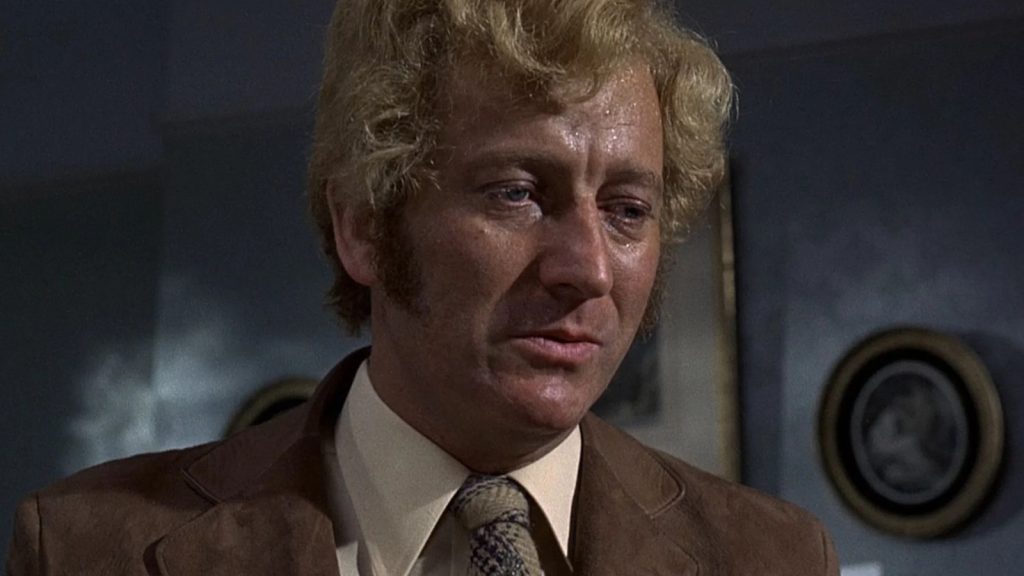
“Frenzy” tells the story of Richard Blaney (John Finch), a sad-sack and impoverished London-based former military man who is accused of sexually assaulting his ex-wife, Brenda (Barbara Leigh-Hunt), and using a necktie to strangle her to death. However, the necktie is connected to a string of other murders that have been committed all over the city, as the real killer is Richard’s creepy friend Bob Rusk (Barry Foster).
Frenzy brings other Alfred Hitchcock movies to mind while still feeling unique
As with so many other Alfred Hitchcock movies, the main character in “Frenzy” becomes a falsely accused man on the run (see also: “The Wrong Man,” “Stage Fright,” “The 39 Steps,” “Young and Innocent,” “North By Northwest,” “Saboteur,” “I Confess”), and he has to elude capture to clear his name. Along the way, Richard ends up finding an ally and lover in his former co-worker Babs (Anna Massey) … although, with Rusk still engaged in his murderous shenanigans, that doesn’t bode well for her.
Hitchcock films excel at making audiences unwittingly root for the bad guy (see “Dial M for Murder” and “Psycho” for two better-known examples), and “Frenzy” includes a sequence where Rusk has to retrieve a personal item of his from a victim whose body he has already disposed of. Because of this, viewers are forced to watch as he struggles with the tension of having to retrieve the incriminating evidence, and while we might not feel sympathy for Rusk, we do become involved in his plight. (It’s one of the most noteworthy scenes in Hitchcock’s filmography.) You can see, then, why Richard turns to Rusk for help at one point, not knowing that his friend is the murderer.
The final act of “Frenzy” gets a little involved and maybe spins a little too far off with its trials and prison sentences, but know that the ultimate conclusion is very satisfying. It’s a tonally unique movie as well, feeling very loose and 1970s-y. And where many of Hitchcock’s previous films felt mannered and polite despite involving murder and fetishes, “Frenzy” is comparatively casual, focusing more on Rusk’s overcooked murderous mindset and the sexual element of his killing spree.
Alfred Hitchcock’s Frenzy is genuinely disturbing
What many cineastes saw as the sexual subtext of Alfred Hitchcock’s previous movies becomes text in “Frenzy.” By the 1970s, the filmmaker could afford to be a little more frank. The murder scenes, more so than in any other Hitchcock movie, “Psycho” included, are brutal and unsettling. There’s even one particularly memorable shot in “Frenzy” of one of Rusk’s victims, freshly dead, with her eyes wide and her tongue lolling out, that will remain in your nightmares for quite some time. This is not the balletic, aesthetic, obfuscated violence of Hitchcock’s earlier movies. This is disturbing.
Many critics responded very positively to “Frenzy” at the time. Roger Ebert gave the film four stars (out of four), writing that it was both a departure for Hitchcock and a return to form. As he put it:
“This is the kind of thriller Hitchcock was making in the 1940s, filled with macabre details, incongruous humor, and the desperation of a man convicted of a crime he didn’t commit. The only 1970s details are the violence and the nudity (both approached with a certain grisly abandon that has us imagining ‘Psycho’ without the shower curtain). It’s almost as if Hitchcock, at seventy-three, was consciously attempting to do once again what he did better than anyone else.”
Ebert added that “Frenzy” possesses a nice macabre sense of humor, another feature Hitchcock’s fans appreciate from the Master. Vincent Canby, writing for the New York Times, listed “Frenzy” as one of the 10 best films of its year, and it was a hit at the box office to boot. (There’s a reason we here at /Film once listed it as one of Hitchcock’s 20 best movies.) Clearly, Hitchcock hadn’t lost his talent for snagging audiences.