


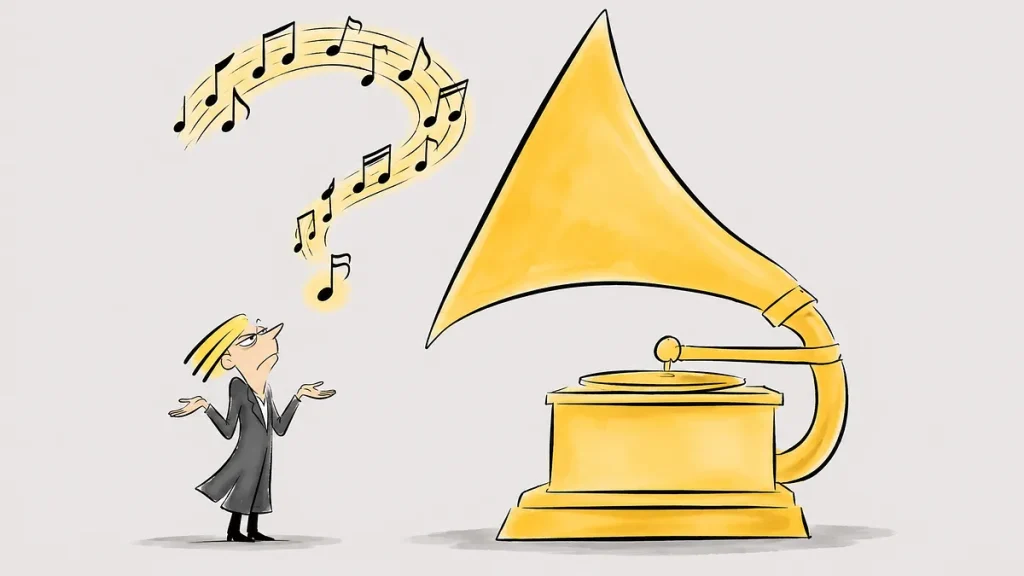

How we learned to buy attention, manufacture prestige, and call it musical excellence.
Yesterday, Monday, November 16, 2026, the nominations for the 69th Annual Grammy Awards were announced, and right on schedule, the music business lost its collective mind. Within minutes, social media was filled with breathless congratulations, elaborate promotional graphics, self-congratulatory announcements, and the annual arguments over who deserved a nomination and who had been tragically, unforgivably “snubbed.”
RAYE led the field with eleven nominations, followed by ROSALÍA with nine. Beyoncé reached an astonishing 100 career nominations. Across 100 categories, the Recording Academy selected hundreds of musicians, songwriters, producers, and engineers for recognition, setting off the familiar machinery of celebration, outrage, resentment, and expensive self-promotion.
Every year, the same arguments begin almost immediately. Who deserved it? Who was robbed? How could they possibly have overlooked this album or that artist? Music journalists publish their lists of the year’s biggest snubs, fans argue online, publicists congratulate their clients, and the industry spends several days treating an awards ballot as though it were an objective assessment of human achievement.
And every year, I find the entire spectacle a little more absurd. Perhaps because I’ve spent so much of my life making music, I’m increasingly fascinated by how much energy the industry devotes to talking about who gets recognized for making it.
Before anyone mistakes this for professional bitterness, let me make something perfectly clear: this is not sour grapes. I have never been nominated for a Grammy as an artist. Whatever. I’ve had a long and satisfying career making music, and I’m not particularly interested in measuring its significance by the approval of a voting committee. I know many wonderful musicians who have won Grammys, and I have enormous respect for their accomplishments. I have won Emmys and many other awards. This isn’t about the trophies.
But that doesn’t mean I accept the premise that the awards represent the best music being made, or that the increasingly elaborate business of pursuing them has much to do with artistic excellence.
This article is social archaeology in the present tense. I am interested in how an organization originally created to recognize musical achievement beyond commercial popularity became the centerpiece of an expensive industry devoted to manufacturing prestige. I am even more interested in why intelligent, talented, accomplished musicians continue to participate in a system that so frequently confuses visibility with value.
And now, with Disney taking over the Grammy broadcast beginning in February 2027, we are about to witness another fascinating chapter in this story. One of the world’s most sophisticated entertainment corporations is preparing to reinvent the presentation of an awards show whose cultural authority appears increasingly disconnected from the audience it hopes to attract.
The question isn’t simply whether Disney can make the Grammys more entertaining. It’s whether better entertainment can make an increasingly skeptical public believe that the awards themselves actually matter.
The Original Sin
The Grammy Awards began with an admirable idea. When the Recording Academy was established in 1957, part of its founding motivation was the realization that commercial record sales were an inadequate measure of musical achievement. Important musicians could have modest sales, while enormously popular recordings might contribute relatively little to the advancement of music as an art form.
The awards were supposed to recognize excellence beyond popularity. The first Grammys were presented in 1959, establishing an institution that would ostensibly celebrate craftsmanship, originality, performance, and creative accomplishment rather than simply rewarding the biggest commercial successes.
Nearly seventy years later, we’ve managed to construct a spectacular contradiction. An organization created partly because commercial popularity wasn’t a reliable measure of greatness now presides over an ecosystem in which commercial promotion plays an increasingly visible role in the pursuit of recognition.
It would be funny if it weren’t so expensive.
The problem isn’t necessarily that Grammy voters are dishonest, incompetent, or incapable of recognizing excellent music. Many are accomplished professionals who take the responsibility seriously. The problem is that the entire process exists inside an industry that has become exceptionally good at selling attention, and attention has a nasty habit of masquerading as merit.
For Your Consideration. Bring Your Checkbook.
Somewhere along the way, the pursuit of a Grammy became a business in its own right. There are consultants, publicists, strategists, advertising specialists, and promotional firms whose services revolve around helping musicians get nominated and, ideally, win.
The phrase For Your Consideration sounds dignified, almost scholarly. In practice, it can mean advertisements in trade magazines, billboards, targeted digital campaigns, email solicitations, social media promotions, private listening events, professional networking, and a relentless effort to get a recording noticed by a relatively small group of industry voters.
None of this is illegal, and the Recording Academy has rules prohibiting vote buying, improper gifts, and other forms of undue influence. But let’s not pretend that the ability to purchase attention has no bearing on the competition. If visibility were irrelevant, nobody would be spending money on it.
Think about how ridiculous this becomes for the independent musician. An artist spends months, perhaps years, creating an album. They pay musicians, engineers, studios, producers, mastering facilities, photographers, designers, and distributors. They invest not only money but an extraordinary amount of time and personal creative energy into making something they believe is worthwhile.
Then comes the possibility of another substantial expense: campaigning to convince a select group of people to listen to it.
Not necessarily to reach the public. Not necessarily to develop a long-term audience or introduce the work to people who might genuinely love it. The object is to get the attention of voters who are simultaneously being courted by thousands of other hopefuls, many of whom have considerably larger promotional budgets.
It’s an extraordinary arrangement. We’re asking artists to spend money making music, then spend more money persuading people that the music deserves recognition for its artistic merit. The more sophisticated the campaign becomes, the more difficult it is to distinguish an authentic judgment of excellence from the effects of repeated exposure.
This doesn’t mean an expensive campaign guarantees a nomination. It means the playing field is not remotely level, and the institution’s lofty rhetoric about pure artistic achievement exists in uncomfortable proximity to the reality of the marketing industry surrounding it.
The Grammys don’t need to sell votes to create an advantage for artists with money. They only need to exist in a business where attention can be purchased.
And perhaps the most depressing part is that everybody knows this. We simply dress it up in enough professional language to make the process seem respectable.
The Greatest Musicians Who Apparently Weren’t Good Enough
One of the most effective ways to evaluate the authority of an awards institution is to look at the people it failed to recognize.
Consider the following musicians, none of whom has ever won a competitive Grammy Award.
Keith Jarrett, Queen, Jimi Hendrix, Diana Ross, Bob Marley, The Beach Boys, ABBA, Nina Simone, Patti Smith, Björk, Snoop Dogg, Tupac, Joe Satriani, Nicki Minaj and Lana Del Rey. Amazing.
Several of these artists have received honorary awards or Lifetime Achievement recognition. Those distinctions are meaningful, but they aren’t the same as winning a competitive Grammy, which is the mechanism we’re supposedly using to recognize the best work in a particular year.
For me, Keith Jarrett is an especially revealing example.
Jarrett has received twelve Grammy nominations and has never won a competitive award. This is a musician whose recordings helped redefine the possibilities of improvisation, solo piano performance, and the relationship between composition and spontaneous musical invention.
His 1975 recording The Köln Concert is one of the most extraordinary achievements in recorded piano music. Created in the moment, under famously difficult performance circumstances, it became a landmark recording that continues to influence musicians more than half a century later.
Twelve nominations. No wins. What exactly are we supposed to conclude from that? That the music wasn’t sufficiently accomplished? That his performances lacked originality or technical sophistication? That he simply wasn’t the best choice in any of those twelve competitions?
Or perhaps that the act of selecting a single winner from a collection of radically different creative accomplishments is an inherently arbitrary exercise dressed up as professional judgment.
Consider Queen, a band whose music has reached generations of listeners and permanently altered the vocabulary of popular music. Four competitive nominations, zero wins. Jimi Hendrix transformed the electric guitar and received only one competitive nomination, without a win.
Diana Ross received thirteen competitive nominations and never won. Bob Marley never received a competitive nomination during his lifetime, despite becoming one of the most consequential figures in the international history of popular music.
At a certain point, the exceptions become so numerous that they begin to undermine the premise.
Nobody hears Bohemian Rhapsody and thinks Queen’s contribution to music is somehow incomplete. Nobody listens to Hendrix and wonders whether he was sufficiently validated by his professional peers. Nobody encounters the astonishing musical imagination of Keith Jarrett and concludes that twelve unsuccessful Grammy nominations constitute a meaningful assessment of his work.
The music doesn’t need defending. The awards system does.
The Annual Snub Industry
The most predictable part of Grammy season isn’t the nominations themselves. It’s the immediate creation of an entirely separate conversation about the people who didn’t receive them.
Within hours of yesterday’s announcement, the arguments were already underway. Harry Styles was among the conspicuous omissions, and debates about genre representation, commercial success, and institutional favoritism began circulating almost immediately.
The word “snubbed” has become particularly irritating because it implies that the absence of a nomination represents a deliberate insult. In reality, a musician can be overlooked for countless reasons: the competition within a category, the tastes of voters, inadequate exposure, eligibility rules, or simply the limitations of a process attempting to reduce an enormous amount of music to a handful of selections.
But “not nominated” doesn’t generate the same outrage as “snubbed.” Outrage attracts readers, produces engagement, and creates another opportunity to transform an ordinary awards announcement into a much larger media event.
This creates a peculiar secondary economy. First, artists and their representatives work to obtain nominations. Then journalists, commentators, and fans generate additional attention by debating which nominations should or shouldn’t have happened.
The entire process becomes self-perpetuating. The awards generate controversy, the controversy generates publicity, and the publicity reinforces the cultural importance of the awards. Even the people attacking the nominations are participating in the same attention economy that makes them valuable.
And what is almost completely absent from these arguments is any serious conversation about the music itself. We talk about nominations as though we were discussing the results of a sporting event, with winners, losers, favorites, upsets, and injustices. The actual recordings frequently become little more than supporting evidence in a larger argument about status.
It’s a remarkable trick. An institution announces its preferences, the public argues about those preferences, and the resulting controversy makes the institution appear more important than it was the day before.
The Public Is Losing Interest in the Verdict
There is evidence that the public is becoming increasingly skeptical about the Grammys’ authority, even if people still enjoy watching the spectacle.
A national survey conducted in January 2026 found that 72 percent of respondents were not particularly interested in the Grammy Awards, while 69 percent had no plans to watch the ceremony. More than half said the Grammys did not accurately represent the best music of the year, and only 14 percent believed the awards actually identified the year’s best music.
Perhaps the most revealing number was this: 78 percent said that an artist winning a Grammy would not change their likelihood of listening to that artist’s music.
Think about that for a moment. An institution spends enormous resources presenting itself as music’s highest professional honor, yet nearly eight out of ten people surveyed say that receiving that honor wouldn’t influence whether they listened to the winner.
That’s quite an achievement in public relations.
The Grammy telecast still attracts millions of viewers, of course. Approximately 14.4 million people watched the February 2026 ceremony, a significant audience by contemporary television standards. The event also generates enormous quantities of social media activity, video clips, online arguments, and celebrity coverage.
But television attention and cultural authority are not the same thing.
People watch for performances, clothes, speeches, controversies, and the possibility that something embarrassing or extraordinary might happen. They watch to participate in a shared entertainment event, not necessarily because they believe the winners represent an objective hierarchy of musical excellence.
The Grammys have become remarkably successful at producing a spectacle surrounding the idea of artistic achievement. Whether the audience actually believes in the underlying judgment seems increasingly beside the point.
Enter Disney: Can You Make People Care About Something They Don’t Care About?
This brings us to perhaps the most interesting development in the Grammy business in decades.
Beginning with the February 7, 2027 ceremony, Disney will take over the Grammy Awards’ broadcast and streaming rights from CBS, ending a relationship that lasted more than half a century. The new ten-year agreement extends through 2036 and puts the show on ABC, Hulu, and Disney+.
To be precise, Disney isn’t taking over the Recording Academy or choosing the winners. It is taking control of the awards’ principal television and streaming distribution, bringing the Grammy brand into one of the largest entertainment and advertising operations in the world.
The timing is fascinating.
Traditional awards shows have been struggling to maintain their place in popular culture, particularly among younger audiences. The Academy Awards, the Emmys, the Grammys, and other televised ceremonies belong to a media era when people regularly gathered around their televisions to watch the same programs at the same time.
That world is disappearing.
And now Disney, a company that has spent decades mastering the business of packaging entertainment for mass consumption, has acquired a ten-year opportunity to make the Grammys culturally relevant to an audience that increasingly doesn’t seem particularly interested in the awards themselves.
I find this almost irresistibly ironic.
The Grammys were created because music deserved to be judged on something other than commercial popularity. Now, almost seventy years later, one of the world’s most powerful media companies is preparing to use its considerable promotional resources to make the awards more commercially attractive.
Apparently, the problem with an institution that no longer commands universal attention is that it needs an even larger marketing operation.
To Disney’s credit, the company and the Recording Academy have acknowledged that the traditional awards-show model needs to evolve. Grammy leadership has discussed reconsidering the overall event strategy, expanding the use of the Grammy brand, developing documentaries and other music-related programming, and finding new ways to reach younger audiences through digital and social platforms.
The Academy has established Grammy Studios as a vehicle for creating additional content, including artist-focused storytelling, documentaries, and potentially scripted programming. The Disney agreement also includes additional Grammy-branded specials and programming intended to reach audiences beyond the annual ceremony.
One concrete change has already been announced. The Grammy Premiere Ceremony, where many of the awards are actually presented before the primetime telecast, will stream live exclusively on Disney+ in 2027. The principal ceremony will then air simultaneously on ABC, Hulu, and Disney+.
The same production company responsible for recent Grammy telecasts, Fulwell Entertainment, will produce both ceremonies. That suggests continuity as well as change, and although those responsible have spoken about evolving the presentation, a complete creative overhaul of the main telecast has not yet been publicly detailed.
The broad direction, however, is unmistakable: more platforms, more content, more artist stories, and more opportunities for viewers to encounter the Grammy brand outside the traditional television broadcast.
The Recording Academy understands that younger audiences spend enormous amounts of time on TikTok, Instagram Reels, YouTube, and other platforms built around short-form content. Its leadership has spoken about meeting those audiences where they already consume entertainment, rather than expecting them to return to an older model of appointment television.
This is sensible business strategy.
But it does raise a rather uncomfortable philosophical question.
Can you make an awards show more relevant by changing how people watch it, without changing what the awards themselves actually mean?
Disney can make the show faster, more visually spectacular, more emotionally engaging, and more widely available. It can hire extraordinary performers, create elaborate production numbers, develop compelling human-interest segments, and distribute short clips designed to dominate social media.
It can turn the Grammys into a year-round entertainment franchise rather than a single annual event.
But none of those changes addresses the basic question of whether the public regards the awards as a credible measurement of musical excellence.
You can redesign the packaging. You can change the network. You can offer more streaming options and surround the ceremony with documentaries, celebrity interviews, and promotional content.
You can even make the entire production considerably more entertaining.
But you cannot manufacture genuine cultural authority simply by increasing the number of platforms carrying your program.
And if younger listeners already distrust the notion that a small professional organization can tell them what constitutes the best music, why would an expensive television makeover change their minds?
The Disney Solution Is Also an Advertising Strategy
There is another dimension to the Disney arrangement that deserves attention.
Disney isn’t simply acquiring an awards show. It is acquiring a major live entertainment property that fits into a larger advertising and streaming strategy.
Consider the company’s extraordinary schedule for early 2027. Within a matter of weeks, Disney’s platforms will carry the College Football Playoff National Championship, the Grammy Awards, the Super Bowl, and the Academy Awards.
From an advertising perspective, this is a spectacular collection of live events. These programs attract large audiences, generate publicity, and give advertisers opportunities to build campaigns that extend across multiple platforms and weeks of programming.
Disney has been explicit about the commercial advantages of combining live events, streaming distribution, audience engagement, and advertising opportunities. The company can promote content before, during, and after an event, extending its value well beyond the original broadcast.
For the Grammys, this means the possibility of becoming part of a much larger Disney entertainment ecosystem.
The award itself becomes one element in an expanded commercial franchise.
There is something almost breathtaking about the logic. An awards organization dedicated to recognizing artistic excellence partners with a global entertainment company that can transform its ceremony into an even more valuable advertising and content property.
I don’t criticize Disney for doing this. Disney is a business, and creating valuable entertainment properties is what it does extraordinarily well.
I do find it amusing that the solution to declining public interest in an awards show apparently involves making that awards show a more sophisticated commercial product.
The irony becomes even sharper when we consider that the very audience Disney hopes to reach is increasingly uninterested in the traditional concept of being told what music deserves recognition.
Perhaps Disney will succeed brilliantly in attracting more viewers. Perhaps the 2027 ceremony will be a genuinely memorable entertainment event, with exceptional performances, imaginative production, and a renewed sense of excitement.
But if people are watching because they enjoy the entertainment rather than because they care who wins, what exactly has been saved?
The institution’s cultural authority?
Or merely the commercial value of its television franchise?
Those are not the same thing.
A Generation That Doesn’t Need a Gatekeeper
The decline of traditional awards-show authority is part of a larger cultural transformation.
For much of the twentieth century, a relatively small number of institutions helped determine what the public considered important. Record companies, radio programmers, television networks, music magazines, and awards organizations controlled much of the machinery of discovery and validation.
If these institutions recognized an artist, the public was encouraged to pay attention. If they ignored someone, that musician could remain invisible regardless of the quality of the work.
That world has largely disappeared, although the companies operating today’s digital platforms have developed their own forms of gatekeeping.
Younger music listeners don’t necessarily wait for an awards ceremony to discover something worth hearing. They find music through streaming platforms, social media, online communities, friends, and recommendation systems that can introduce them to recordings from any era or part of the world.
A teenager can discover an obscure jazz pianist, an independent electronic musician, or a singer from another continent without a record company, radio programmer, or awards committee granting permission.
This doesn’t mean young people are immune to manipulation. Algorithms are perfectly capable of manufacturing popularity, amplifying mediocrity, and turning temporary attention into the illusion of cultural significance.
But the old institutions no longer enjoy the same monopoly on telling people what matters.
Younger audiences may still like the Grammy telecast as entertainment. They may watch the performances, share the funniest moments, and participate enthusiastically in the online arguments. What they increasingly appear less inclined to do is accept an awards organization’s judgment as the final word on what constitutes great music.
In other words, the Grammys can remain famous while becoming less authoritative.
That may be the most revealing development of all. The public can continue consuming the ceremony while gradually withdrawing its belief in the ceremony’s underlying importance.
And now Disney is preparing to spend the next decade attempting to keep that audience engaged.
There is a delicious irony in watching an enormous corporation attempt to make an old cultural gatekeeper relevant to a generation that has increasingly learned to ignore gatekeepers.
The Artist as Professional Validation Seeker
I find the effect of this system on working musicians far more troubling than anything that happens on television.
Making music is difficult. Making excellent music is extraordinarily difficult. It requires years of practice, experimentation, failure, technical development, and the willingness to pursue ideas without knowing whether anyone else will find them interesting.
There are no guarantees of success, and the definition of success itself is often unclear. A musician can create something exceptional and receive almost no attention, while someone else can produce something perfectly ordinary and become enormously popular.
That uncertainty is part of the profession. It can also make artists particularly susceptible to outside validation.
Awards offer the comforting illusion of a measurable result. If you win, you’re excellent. If you’re nominated, you’re important. If neither happens, perhaps you simply haven’t reached the necessary level of achievement.
I think that’s a dangerous way to approach creative work.
The moment a musician begins asking whether a piece of music is likely to appeal to Grammy voters, something has shifted. The artistic problem is no longer simply how to create the strongest, most original, or most compelling work possible. It becomes a calculation about recognition.
Should the music fit more comfortably into a particular category? Would a well-known collaborator improve its prospects? Is the recording too experimental, too quiet, too unconventional, or too difficult for voters who have hundreds of other recordings competing for their attention?
These questions have very little to do with making music and quite a lot to do with navigating an institution.
I don’t doubt that some artists approach the process without compromising their creative decisions. I also know that many musicians genuinely value recognition from respected colleagues, and I can understand why a Grammy nomination might provide professional opportunities that would otherwise be difficult to obtain.
But the system creates an unmistakable temptation to confuse institutional success with artistic success.
And that temptation becomes especially corrosive when an artist begins spending more time pursuing recognition than pursuing the work itself.
At some point, the awards are no longer serving music. The music is serving the awards.
The Validation Economy
We live in a world obsessed with measuring approval.
Followers, views, streams, likes, rankings, playlists, engagement statistics, audience demographics, chart positions, and awards have become the vocabulary through which creative achievement is increasingly discussed.
An artist’s career can be reduced to a collection of numbers that seem objective but reveal remarkably little about the actual experience of listening to the music.
A recording can accumulate millions of streams and vanish from cultural memory within months. Another can sell modestly, reach a small audience, and become an essential part of people’s lives for decades.
Which artist was more successful? Which recording mattered more? Which one was better?
Those questions cannot be resolved by consulting a chart, reading a streaming report, or counting trophies.
The Grammy Awards provide an especially attractive kind of external validation because they appear to represent something more substantial than popularity. They carry the implication of professional judgment, historical importance, and peer recognition.
But the problem with artistic awards is that they borrow the language of objective competition for something that is fundamentally subjective.
Music is not a footrace. There is no stopwatch capable of identifying the best song, no measuring device that establishes the superiority of one interpretation over another, and no universally accepted formula for determining whether one recording is more meaningful than another.
We can assess musicianship, originality, craftsmanship, innovation, performance, and technical execution. These are useful and sometimes measurable considerations, but they do not add up to a definitive answer.
Even the most knowledgeable musicians disagree about what constitutes greatness.
Yet every year we announce winners as though a complex artistic question has been conclusively resolved.
The audience applauds, the winners thank their representatives, and the industry temporarily suspends its understanding that artistic judgment is subjective in order to celebrate the reassuring fiction of an objective result.
Then everybody goes back to arguing about the people who were snubbed.
Who Actually Benefits?
It would be naive to argue that Grammy recognition has no value.
A nomination can help an artist attract attention. A win can create opportunities, strengthen professional credibility, generate media coverage, and occasionally produce meaningful commercial benefits. For musicians working in specialized genres, even a nomination can carry professional weight.
But it’s worth asking who benefits most from the increasingly elaborate pursuit of those results.
Record labels can use nominations and victories as marketing tools. Publicists can turn them into promotional campaigns. Managers can use them to strengthen an artist’s perceived value. Advertising companies can sell access to the awards electorate, while broadcasters and media organizations generate revenue from the annual spectacle.
Disney has now added another enormous commercial platform to the equation. The Grammys will become part of a decade-long strategy involving television, streaming, additional programming, and advertising opportunities across one of the world’s most valuable entertainment ecosystems.
And the Recording Academy benefits from the continued prestige of an institution whose value depends on people believing that its recognition matters.
Meanwhile, the independent musician is left to calculate whether another five, ten, or twenty thousand dollars might improve their chances of getting noticed, or whether that money would be better spent creating something new.
That’s an awfully expensive way to ask a relatively small group of people to approve of your work.
I don’t think every artist who participates in this process is foolish, and I certainly don’t think the Recording Academy is without merit. Its charitable, educational, and advocacy activities provide genuine assistance to musicians, and those efforts deserve recognition.
But doing valuable work for the music community doesn’t automatically validate every aspect of the awards business.
We should be capable of respecting the organization while questioning the increasingly commercialized rituals through which it distributes prestige.
The institution began with the idea that musical excellence should be recognized independently of commercial success. Its contemporary awards culture has become entangled with the very promotional forces it was originally supposed to transcend.
That isn’t a small irony. It’s the central contradiction of the whole enterprise.
The Show Will Go On. Now on Disney+.
I have no doubt the Grammys will continue.
There is too much money involved, too much institutional history, too much professional ambition, and too much entertainment value for the entire operation simply to disappear.
The Disney agreement makes that even more apparent. The next decade will likely bring more programming, more sophisticated production, more streaming distribution, and an increasingly elaborate attempt to reach audiences who have largely abandoned the habits of traditional television viewing.
Perhaps the ceremony will become shorter, faster, louder, and more visually spectacular. Perhaps it will become an even greater collection of performances interrupted occasionally by the inconvenient business of presenting awards.
Perhaps the winners will become increasingly secondary to the entertainment surrounding them.
That would be an ironic but entirely plausible outcome for an event devoted to celebrating musical achievement.
Artists will continue campaigning. Publicists will continue selling their services. Journalists will continue announcing snubs. Fans will continue arguing about injustice, and television executives will continue looking for ways to turn the annual distribution of golden statues into something a distracted audience will watch.
Some extraordinary musicians will win, while other extraordinary musicians will be ignored. Some mediocre recordings will be celebrated, and some exceptional recordings will never receive serious consideration.
The machinery will continue operating because none of those contradictions threatens its underlying business model.
In fact, the controversies probably help sustain it.
The Grammys have become an industry event whose success depends as much on the argument surrounding the awards as on the awards themselves.
Maybe the public doesn’t have to believe that the winners are genuinely the best. Maybe it only has to care enough to argue about the outcome, watch a few performances, share a couple of video clips, and provide the audience engagement figures that make the entire enterprise commercially worthwhile.
That is a very different kind of cultural institution from the one imagined in 1957.
And it tells us something uncomfortable about the larger culture in which we now live: being recognized is increasingly treated as a substitute for having accomplished something worth recognizing.
We have become extraordinarily efficient at celebrating success and surprisingly incurious about what success actually means.
The Music Doesn’t Care
Yesterday, the nominations were announced, and hundreds of talented people were given a reason to celebrate. I’m happy for them, and I hope they enjoy every minute of the recognition.
But I also know that thousands of equally dedicated musicians weren’t nominated. Many never submitted their work, some couldn’t afford a meaningful campaign, and others probably never considered the possibility that their creative lives required the approval of an awards organization.
Some of those musicians are making extraordinary music that will never be heard by a Grammy voter.
Some are recording in small studios, composing at home, performing in clubs, teaching students, experimenting with sounds nobody knows how to categorize, and trying to create something that feels honest and original.
They are participating in the actual culture of music, not merely its annual publicity ritual.
And history suggests that some of them will leave behind work far more significant than whatever happens to win a trophy next February.
Keith Jarrett never won a competitive Grammy. Neither did Queen, Hendrix, or Bob Marley. Their accomplishments aren’t diminished by those omissions, and the passage of time has made the distinction between institutional recognition and artistic importance increasingly obvious.
The awards are a record of who won. They are not a comprehensive record of what mattered.
Perhaps that is the real lesson of this year’s nominations, and perhaps it is also the fundamental problem Disney will confront as it attempts to reinvent the Grammy broadcast.
The Grammys aren’t necessarily meaningless, but we’ve allowed them to become symbols of a significance they cannot possibly establish. They can celebrate achievement, create opportunities, and recognize talented people, but they cannot determine what music will endure or what it will mean to the people who encounter it.
That judgment belongs to time, history, and the listener.
And unlike the Grammy electorate, time doesn’t have a campaign season.
So congratulations to everyone who was nominated yesterday. I genuinely hope the recognition brings you satisfaction, new opportunities, and a reason to feel proud of the work you’ve done.
Just don’t confuse the recognition with the accomplishment.
As for everyone who was overlooked, ignored, or supposedly snubbed, I wouldn’t lose too much sleep over it. The history of music is filled with extraordinary artists who never received the industry’s highest honor, and their work seems to have survived the indignity perfectly well.
In a distracted world increasingly addicted to public validation, perhaps the most radical thing an artist can do is stop asking for permission to feel successful.
I have never been nominated for a Grammy as an artist, and at this point, I don’t particularly care whether that ever changes. I have spent my life doing something I love, and the work itself has given me more satisfaction than any award could reasonably promise.
The nominations were announced yesterday. The campaigns will continue, the arguments will intensify, and the industry will spend the next several months congratulating itself on its own importance.
Meanwhile, Disney will be preparing an expensive new television home for the entire spectacle, complete with streaming options, additional programming, and an ambitious strategy for making an increasingly indifferent audience pay attention.
Maybe it will work. Maybe millions of young people will tune in, share the highlights, and make the Grammys a massive entertainment success for another decade.
But there’s one thing no amount of Disney magic can change.
Making the Grammys more popular doesn’t make their judgments more meaningful. It just makes the popularity contest more popular.
And somewhere, long after the lights have gone down, the advertisements have been sold, and the winners have taken their trophies home, a musician will sit down alone at an instrument and create something extraordinary.
No campaign. No committee. No television audience. No consideration required.
Just music.
I have music to make…