


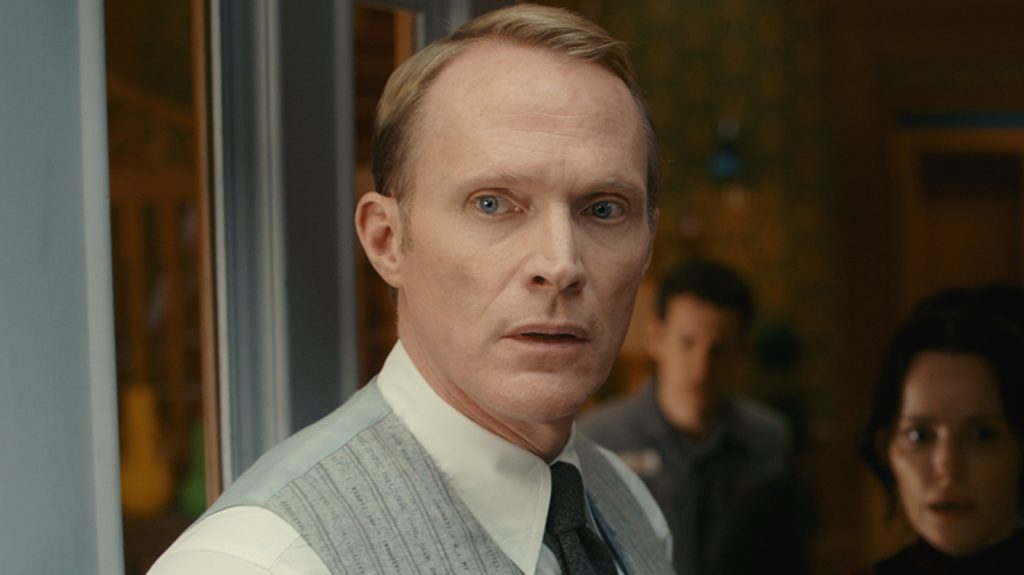

Spoilers ahead for “VisionQuest” Episode 8, “Forever.”
Ultron (James Spader) may have no strings on him anymore, but someone has been manipulating the events of “VisionQuest” like a puppetmaster. That someone is The Client, who hired the bounty hunter Paladin (Todd Stashwick) to capture Vision (Paul Bettany). We’ve gotten glimpses of The Client all season, but only as a digitally altered voice or a faceless avatar … until Episode 7, “Immolation.”
At the episode’s end, Vision and Ultron’s gynoid lover Jocasta (T’Nia Miller) are delivered to The Client’s doorstep. Out of said door walks … someone who looks just like Ultron’s human avatar. Huh?
“Forever” clarifies it. “The Client” is Virgil Horton, grandson of Phineas Horton (Bettany), the scientist who created the Synthetic Man/Human Torch (Bettany again) in the 1940s. As Virgil explains, the Synthetic Man’s uncontrolled fire powers mean that Dr. Horton was considered a failure. Years ago, Virgil joined with Dr. Josephine Carrington (Miller) to perfect AI in hopes of redeeming the Horton family legacy. They scanned their own brainwaves to create the genesis of what Tony Stark (Robert Downey Jr.) completed.
Horton and Carrington also fell in love. After Carrington’s death from a terminal illness, Horton revived her as Jocasta. As Virgil explains, he was one of the engineers hired by SWORD to rebuild Vision back in “WandaVision.” After that, he created a robotic body for Carrington’s mind-scanned AI. Jocasta being a recent creation helps explain why she looks like feminine Ultron, but why did Virgil then erase her memories of him and her creation?
Virgil believes the only worthy lover of a “goddess” like Jocasta is a god. So, he intends to delete Vision’s personality and then upload himself into Vision’s shell, so he and Jocasta can rule an Earth infected with Jocasta’s hive mind nanites.
Ultron’s human avatar comes from Virgil Horton
Virgil’s borderline-incestuous romance plan echoes the central influence of Ultron: “Frankenstein,” specifically when the Creature asks Doctor Frankenstein to make him a companion. Virgil’s plan is rather similar to Kenneth Branagh’s 1994 “Frankenstein” film adaptation, where Victor Frankenstein (Branagh) tries to resurrect his dead wife Elizabeth (Helena Bonham Carter) through the same process by which he made the Creature (Robert De Niro).
There’s an implication that Virgil scanning his brainwaves for his and Josephine’s AI embedded his personality into the AI code. That’s why Ultron basically has his same flamboyant personality, his voice, and why Ultron wears Virgil’s face as his human avatar. “VisionQuest” showrunner Terry Matalas has said giving Ultron a human form in “VisionQuest” was about getting the most out of Spader’s performance. Now, we know, it was also essential to the pay off of this twist about the Client’s identity. But “Forever” breaks out Ultron’s robotic form, too.
Virgil’s plan fails because Jocasta has fallen for Ultron and wants him to be her eternal partner. Using the nanites, Ultron recreates his physical form and crushes Horton to death with a hug. It’s a very Oedipal move: Ultron’s defining goal has always been killing his father, whether it be Hank Pym (in Marvel’s comics) or Tony Stark (in the Marvel Cinematic Universe). He comes close to that by killing the man of whom he’s an artificial echo.
Is Virgil Horton based on a Marvel Comics character?
Ultron being based on Virgil also explains why fell for Jocasta in the first place. This restores some of the mirroring of the creator and creation that’s present in comics Ultron. In the “Avengers” comics, Ultron created Jocasta from the brainwaves of Hank Pym’s wife: Janet van Dyne, the Wasp, and his spiritual mother. Since Ultron is based on Hank’s personality, he inherited his father’s affections for Janet though extremely twisted means. The same logic applies to Spader’s Ultron falling for this Jocasta.
Now, it’s worth noting that while Phineas Horton and his Human Torch originated in Marvel Comics, Virgil did not. Rather, he’s an original creation of this series, and “VisionQuest” seems to be using him as a proxy for the original Dr. Horton. Previously, Steve Englehart and George Tuska’s “Avengers” #135 tied Horton and the Ultron-Vision lineage together, with the issue revealing that Ultron had abducted Phineas Horton and forced him to rebuild the inert Human Torch into the Vision.
Keep in mind, Ultron and Vision debuted in 1968. At that time, it was plausible that a scientist active in World War II would be living in retirement. But not so much in 2026, where it makes much more sense to use a descendant of Horton in the present day. It’s the same time creep that led to Captain America originally missing only two decades of time while frozen to awakening almost a century later.
“VisionQuest” is streaming on Disney+.