


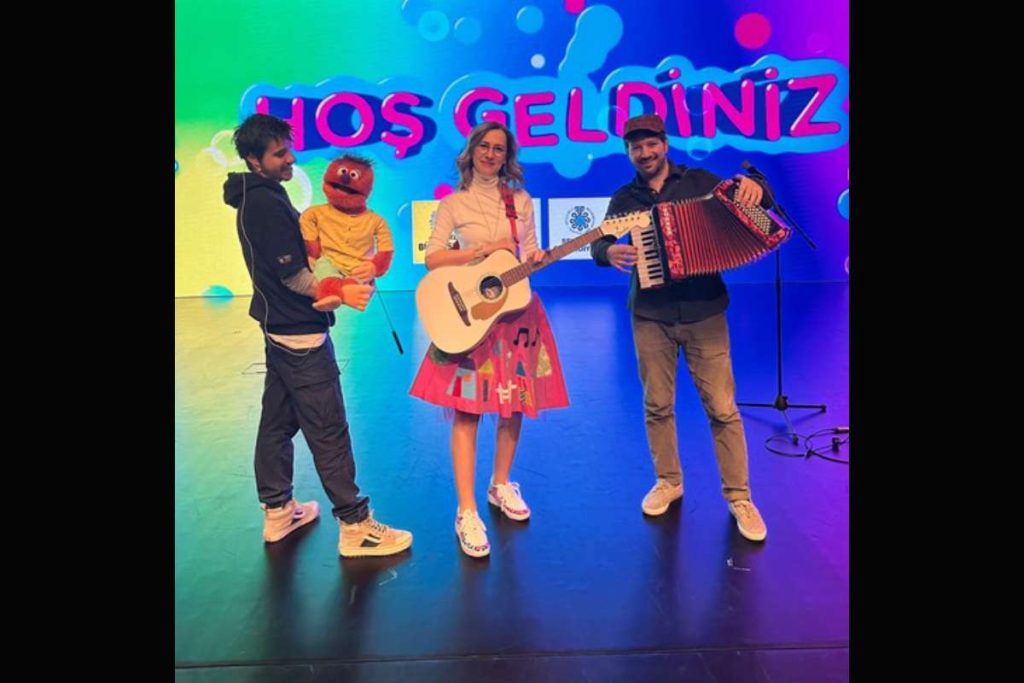

Photo Credit: Gönül Kazancı Yeprem
There is something quietly extraordinary about a children’s song that travels beyond the language in which it was written. A melody composed in Istanbul can find its way into a room of young listeners in London; a rhythm created in Türkiye can become the center of an afternoon’s musical play in Vienna. The words may not always be understood, but the feeling can be immediate. It is in this space between cultures, where music becomes a language of its own, that singer, songwriter, and composer Gönül Kazancı Yeprem is making an international impression.
Digital Music News is proud to partner with outside agencies to create opportunities for artists to be visible to the music industry.
An artist whose work is rooted in original composition and live performance, Gönül has spent years developing a musical world for babies and children. Her songs are not simply accompaniments to educational activities, nor are her performances conventional concerts scaled down for younger audiences.
They are carefully conceived musical experiences, built around melody, rhythm, movement and participation. At their center is the belief that children deserve original music with artistic substance, and that the earliest encounters with sound can become meaningful parts of a person’s relationship with music.
Born and raised in Sakarya, Türkiye, Gönül’s musical education began at Sakarya University State Conservatory, where she graduated first in her class.
Her thesis, The Role of Music in Preschool Education, reflected an interest that would remain important throughout her career, but her ambitions have extended well beyond the academic study of music and childhood. As a composer and performer, she has developed an original repertoire, released albums and brought her work to audiences through festivals, cultural programs and interactive concerts.
Her recordings include Cheerful Songs for Children (Çocuklar İçin Neşeli Şarkılar) and Hokkacık – Playful Songs for Babies (Bebekler İçin Oyunlu Şarkılar). The songs from these albums form an important part of her live repertoire, allowing Gönül to move between recorded compositions and performances that respond to the particular character of each audience. With 6.3 million combined Spotify streams for her ten most-streamed songs, alongside more than 1.3 million YouTube views and an Instagram following of over 57,000, Gönül’s listener base is well established. These figures suggest that her music has found an audience well beyond the rooms in which it was first performed.
In 2026, Gönül received the Children’s Artist of the Year award from Baby College, an independent organization providing activities for babies and young children. The recognition acknowledged her contributions to children’s music, including her original compositions, interactive concerts and musical experiences for young audiences. Her work has also taken her to cultural events across Türkiye, including the Türkiye Culture Route Festivals, municipality-organized festivals and community programs, where live performance has enabled her to introduce her repertoire to families in different cities and settings.
Yet it is through her recent international activity that another dimension of her artistic identity has begun to emerge.
In London, an ongoing collaboration with Yunus Emre Enstitüsü has brought her compositions into a multicultural environment where Turkish-speaking families share musical experiences with children from a range of backgrounds. The partnership began in October 2025 through the institute’s Yunus Kids’ Club, and has since developed into a series of concerts, workshops and creative programs.
The first event, Rhythmic Tales (Ritmik Masallar), took place on 11 October 2025, combining storytelling with songs, sounds and movement. Rather than asking children to remain passive listeners, Gönül invited them to become part of the stories through rhythm and musical response. In December that year, she presented Cheerful Notes (Neşeli Notalar), an interactive program built around songs and rhythm games, returning with the same program in March 2026. An original-music concert followed in April, before her latest appearance on 31 October 2026 with Songs for Children and Rhythmic Games (Çocuklara Şarkılar, Ritmik Oyunlar).
Audiences have included children from Turkish families, as well as those growing up in multicultural households with Turkish, British and other national backgrounds.
Gönül sees the opportunity to perform her own Turkish-language compositions in such an environment is central to a higher achievement. Cultural exchange, she believes, need not require an artist to abandon the identity of the work. Instead, it can create a shared space in which different backgrounds remain present and distinct.
“One of music’s greatest strengths is its ability to bring people from different cultures into a shared experience,” she explains. In London, she has seen children who speak little or no Turkish participate naturally in songs, rhythms and musical games. Some grow up speaking both Turkish and English at home; others encounter the language primarily through music. Their willingness to join in has reinforced her conviction that rhythm, melody and movement can offer common ground even when spoken language is limited.
This conviction was tested in a different way in Vienna.
Through BIANNA ART – Zentrum für Bildung und Kunst, an organization based in the Austrian capital, Gönül was invited to present her program Cheerful Notes in late July 2026. The connection began after the organization’s founder and director, Halil Bulut, encountered her work through a European Union project and a recommendation that led him to explore her musical activities online. Impressed by her interactive approach, he invited her to Vienna.
The performances brought Gönül into contact with Austrian children whose language she did not speak. German was unfamiliar to her, but the sessions did not depend on conversation alone. Through songs, rhythmic games, movement and musical stories, she was able to establish a connection with the young participants. The experience offered a practical demonstration of something that had already become a defining idea in her work: music can make participation possible before a common vocabulary exists.
Bulut’s professional feedback focused on the artistic and educational qualities of her approach, particularly the way she encourages children to become active participants rather than simply observers. He also highlighted the potential of these musical experiences to support communication and shared creativity among children from different cultural and linguistic backgrounds. The Vienna invitation and performances were not a formal award, but they represented a significant international collaboration and an opportunity to present her original program in a new cultural setting.
Gönül is careful not to describe herself as an official cultural ambassador. Her approach is more personal and, perhaps, more interesting: she wants to share music that grows from her own cultural experience while remaining open to what other places and audiences can teach her. “Cultural exchange does not mean that one culture must give up its identity to adapt to another,” she says. “It means creating a shared space in which different cultures retain their individuality.”
That outlook also shapes the way she performs. There is no rigid set list that dictates every moment of a concert. Although the opening and closing songs are predetermined, the material in between can change according to the ages, interests and energy of the children in the room. Gönül watches how they respond, adjusting the order of songs, transitions and activities as the performance unfolds. Repetition, movement and body language become part of the musical arrangement, allowing children with different levels of language ability to participate in their own ways.
The approach reflects her experience as an early childhood music specialist, but it is also a distinctive performance method. The audience is not simply receiving a finished work; its reactions help shape the event. A rhythm can become a game, a melody can prompt movement, and a musical story can develop through the sounds and gestures of the children taking part. Each concert becomes a particular encounter rather than a reproduction of the previous one.
Her recent London appearances have further extended this international work.
On October 31st, Gönül performed at Yunus Emre Enstitüsü London (10 Maple Street) with a program for children aged two to nine and their parents. This was followed with a performance on November, 1st when she appeared at Heatham House Youth Centre in Twickenham for a family concert marking the 103rd anniversary of the Republic of Türkiye. Organized in collaboration with Bind the Gap Foundation, Give From Heart, and Günebakanlar, this event connected her musical performance with a charitable initiative supporting children’s education.
Across these many concerts, the repertoire has drawn mainly from Gönül’s two published albums, alongside new compositions introduced to audiences for the first time.
The balance between familiar songs and emerging material is an important part of her artistic development. While her existing catalogue provides a foundation for international performances, the experience of working with audiences outside Türkiye has also encouraged her to think about new languages and new forms of expression.
While Turkish remains the principal language of Gönül’s London repertoire, reflecting the original compositions on which much of her work is built, she also performs songs in English and is increasingly interested in writing original material in that language. Her experience in Vienna, meanwhile, has reaffirmed that a performance can communicate without requiring the audience to understand every lyric. The challenge is to create an environment in which children of different ages and backgrounds feel included, while preserving the character of the music itself.
The next stage of recording work for Gönül will explore another side of her musical interests.
She is developing a new children’s album influenced by jazz and swing, styles whose rhythmic energy and melodic richness have long appealed to her. The project is planned for recording at the AKM Music Platform Recording Studio, within Istanbul’s Atatürk Cultural Centre. Rather than treating children’s music as a narrow category with fixed conventions, she wants to draw on a wider musical vocabulary and introduce young listeners to different textures, rhythms and melodic ideas.
This direction has emerged naturally from her own listening and creative process. Gönül notes that she has always been drawn to jazz and swing so it was natural when their movement gradually began to find its way into her compositions. The intention is not simply to make songs that are lively or easy to follow, but to create original musical experiences that invite children to encounter a broader range of sounds.
There is a long view behind that ambition. Gönül hopes to write songs that remain part of children’s lives long after the moment of their release, rather than compositions tied to passing trends.
She imagines a future in which listeners who grew up with her music introduce those same songs to their own children, allowing melodies to move between generations and acquire new memories along the way. Artistic value, in her view, should not be set aside simply because the intended audience is young.
Internationally, the possibilities are continuing to develop.
Gönül hopes to expand her activities in the United Kingdom through further concerts, bilingual family programs and collaborations with cultural and educational institutions. She is also interested in future artistic exchanges between London and Vienna, exploring the relationship between music, early childhood, and intercultural communication. These ambitions build on experiences already gained rather than on an abstract idea of international reach.
The discovery that her music was being streamed in countries around the world first prompted Gönül to consider the possibilities beyond Türkiye. The concerts in London and Vienna have since given that digital reach a human dimension: children in different places responding to the same musical ideas, sometimes without sharing a language. What began as an unexpected development has become a conscious part of her artistic direction.
There is no need to overstate the significance of a room full of children singing, moving and making rhythms together. Its value is immediate, and its effects may be difficult to measure.
But Gönül Kazancı Yeprem is doing more than presenting songs to a young audience, she is creating original music, testing its possibilities in live performance, and discovering how far a melody can travel while retaining the cultural identity from which it came. The hope is that these songs will continue to be sung years from now, carrying with them not only the memory of childhood, but the possibility of connection across generations and borders.