


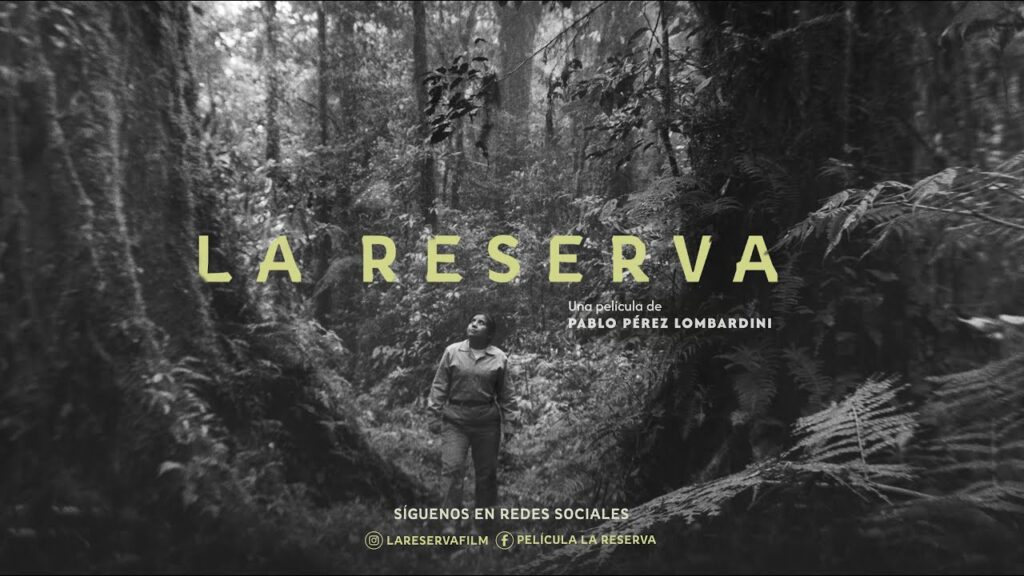
A park ranger alone against illegal loggers in Chiapas — when her community turns its back, she has nothing left but her dignity
The Black-and-White Mexican Debut That Swept Morelia With a Non-Actor Playing a Real Conservationist Fighting Organised Crime
The community won’t protect the forest. The criminal groups will. And the only person willing to stand alone is the one with nothing left to lose.: Julia patrols the Monte Virgen biosphere reserve in Chiapas as the community around her harvests coffee during a failing crop year. When illegal loggers arrive, she tries to rally her neighbours — and finds indifference, fear, and eventually worse. Shot in black and white in the actual El Triunfo Biosphere Reserve with non-professional actors drawn from the community, including Carolina Guzmán, a real-life conservationist who had never acted. Based on real testimonies from environmental defenders in a country where more environmental activists are killed each year than anywhere else on earth. Premiered Telluride 2025. Swept Morelia: Best Feature, Best Director, Best Actress.
Why It Is Trending: A Triple Morelia Sweep in Front of a Jury Led by Ava DuVernay — the Most Awarded Mexican Debut Thriller of 2025
The Morelia International Film Festival jury for the 2025 edition was led by Ava DuVernay alongside Pablo Berger, David Linde, and Andrea Pallaoro. They awarded La Reserva Best Feature Film, Best Director, and Best Actress — a complete sweep of the Feature Film Competition. Variety covered the wins immediately. The film previously won the Premio José María Riba at Morelia 2024 (in development) and the Latamcinema award at MAFIZ, screened at Ventana Sur’s Copia Final section, and premiered at Telluride 2025 before its national Mexican premiere at Morelia. Pérez Lombardini has confirmed he will tour nature reserves and rural communities with free screenings in 2026, returning the film to the communities whose story it tells.
Elements Driving the Trend: The black-and-white cinematography by Moritz Tessendorf — chosen by Pérez Lombardini to homogenise the locations without intervention, to emphasise the score, and to elevate the story toward the poetic rather than the naturalistic — is the film’s most immediately distinctive formal choice. IMCINE described Julia as one of the most powerful characters in recent Mexican cinema. The non-professional cast, drawn from the actual communities of Chiapas, gives the film a documentary authenticity that scripted drama cannot manufacture — their knowledge of the forest, the economics of coffee farming, and the specific texture of organised crime’s presence in rural Mexico is lived rather than researched. The film opens with camera trap footage of anteaters, leopards, and wildcats moving through the forest at night — establishing what is at stake before Julia enters the frame.
Virality: The Telluride premiere generated immediate English-language critical attention as a rare Mexican environmental thriller. LatinaMedia.co called it one of the most moving and memorable features at Telluride. The triple Morelia sweep in front of a DuVernay-led jury generated international distribution conversation. The film’s subject — Mexico as the world’s most dangerous country for environmental defenders, most of them women — gives it a political urgency that travels globally.
Critics Reception: LatinaMedia.co — beautifully haunting and terribly tragic, most quiet film that rings loudest, one of the most moving Telluride films; disappointed it hasn’t been selected for Cannes. IMCINE — begins in mystery, meanders through thriller and social denunciation, culminates in tragedy; Julia among the most powerful characters in recent Mexican cinema. La Estatuilla — tragedy resonating through its portrait of activist nobility against organised crime’s asphyxiating cruelty; Guzmán shines in resistance moments; forced displacement section has structural problems. Antfarm — unforgettable impression, rare mix of truth, sadness, and courage; makes your brain work and leaves you with empathy. IMDb 8.1 from 46 early viewers.
Awards and Recognitions: 3 wins. Morelia International Film Festival 2025: Best Feature Film, Best Director, Best Actress (Carolina Guzmán). Previous recognition: Premio José María Riba, Morelia 2024. Latamcinema award, MAFIZ. Ventana Sur 2024 Copia Final selection. Telluride Film Festival 2025 world premiere. Mexican theatrical release December 18, 2025.
La Reserva arrives as the most institutionally validated Mexican debut thriller of its cycle — a film that Mexico’s own most important film festival has crowned with all three top prizes, validated in front of one of international cinema’s most prominent jury presidents.
Why Is It Trending: The Mexican Environmental Thriller Finds Its Most Urgent and Most Formally Precise Expression
La Reserva belongs to the neorealist Mexican cinema tradition — Fernanda Valadez, Tatiana Huezo, Amat Escalante, Fernando Frías — that has established a specific international arthouse pathway for films about marginalised Mexican communities observed with documentary precision and formal restraint. What Pérez Lombardini adds is the environmental thriller dimension: a film that is simultaneously a social document and a genre film, moving from mystery through thriller to tragedy across its 93 minutes. The black-and-white aesthetic connects it to the documentary tradition while giving it a visual poetry that pure naturalism cannot achieve.
Trend Drivers: A Filmmaker Who Cast the Real Conservationist as the Fictional One Pérez Lombardini’s casting of Carolina Guzmán — a real-life conservationist from Montecristo de Guerrero who had never acted — is the film’s most significant creative decision. Her passion for the forest is visible in every scene involving the natural world; her acting in the film’s most critical confrontation scenes — facing an intolerant crowd, making a decisive choice — is where she shines most authentically. The result, as multiple critics noted, is a performance that crosses the boundary between documentary and fiction in exactly the way the film’s formal approach requires. The use of improvisation and scene prompts rather than scripted lines gives the community actors’ dialogue the specific texture of how people in rural Chiapas actually speak.
The black-and-white choice elevates the story’s timeless dimensions while visually homogenising spaces that a colour palette would have fragmented.
What Is Influencing Trend: The Morelia Film Festival has established itself as the most reliable Mexican platform for debut features of formal ambition and social urgency — and the 2025 jury’s triple award confirms that La Reserva represents exactly the kind of film Morelia was built to champion. Ventana Sur’s Copia Final section gave the film international buyer attention before its premiere. The environmental defender subject matter connects to a global audience concern that makes Mexican stories of this kind internationally legible without requiring cultural translation.
Mexico’s status as the world’s most dangerous country for environmental defenders — most of them women — gives the film a political urgency that no amount of marketing could manufacture.
Macro Trends Influencing: The documentary-fiction hybrid in Latin American cinema — non-professional actors, real locations, real communities — has built a sustained international arthouse audience for exactly this kind of film. The environmental thriller as genre is experiencing a global resurgence driven by the climate crisis’s cultural saturation. The Chiapas setting — one of Mexico’s most biodiverse regions and one of the most threatened by organised crime’s resource extraction — gives the film geographical and ecological specificity that distinguishes it from more generic environmental narratives.
Consumer Trends Influencing: The DuVernay-led jury’s award generates international discovery through the cultural reach of the jury president’s profile. Variety’s coverage of the triple win gives the film distribution visibility with international buyers. Pérez Lombardini’s planned 2026 free screenings tour builds a community audience that commercial distribution cannot replicate.
Audience Analysis: Mexican Arthouse Audiences, International Environmental Cinema Communities, and the Latin American New Wave Audience The core audience is 25–55 — Mexican arthouse cinema regulars who follow the Morelia pipeline, international festival audiences who respond to the Valadez/Huezo neorealist tradition, and the global environmental cinema community for whom the subject matter generates immediate relevance. The triple Morelia sweep gives the film domestic discovery beyond the festival circuit. Guzmán’s non-actress presence gives the film an authenticity signal that the arthouse community consistently rewards.
Final Verdict: La Reserva Is the Most Formally and Politically Accomplished Mexican Environmental Thriller in Years — A Debut of Genuine Moral Urgency That the Morelia Jury Has Already Validated Completely
Pérez Lombardini delivers a debut of extraordinary formal confidence — black-and-white cinematography that poetically elevates the neorealist material, non-professional actors whose community knowledge gives the film its documentary authority, and a central performance from Guzmán that achieves genuine emotional power in the film’s key confrontation scenes. The structural transition from thriller to tragedy has some unevenness — the forced displacement final section doesn’t fully sustain the first two-thirds’ momentum — but the core of the film is precise, urgent, and deeply moving. La Reserva is the film that Mexico’s most dangerous environmental reality deserves.
Audience Relevance: For Anyone Who Has Watched a Community Choose Indifference Over Survival The town meeting sequence — Julia trying to rally her neighbours, met with fear, indifference, and personal attacks — is the film’s most universally legible scene. Every viewer who has encountered collective inaction on environmental or social issues will recognise it. The fact that the characters performing that scene actually live in the community they are depicting gives the recognition its most uncomfortable charge.
What Is the Message: Dignity Is the Only Thing They Cannot Take From You — Even When They Take Everything Else Pérez Lombardini’s IMCINE quote — Julia can lose everything except her dignity — is the film’s complete moral architecture. She loses community support, family peace, and ultimately safety. She retains the thing that the illegal loggers, the organised criminals, and the fearful community cannot extract: her committed relationship to the forest and to what it represents. That is not consolation. It is the specific tragedy of the environmental activist who was right about everything and still lost.
Relevance to Audience: The Biosphere Reserve as the Only Living Character With No Voice The camera trap footage that opens the film is the most formally precise statement of the film’s argument: the animals in the forest will survive or die based on decisions made by humans who will never see them. Julia sees them. The community cannot be bothered. The loggers have decided they’re irrelevant. The film is structured as a defence of what cannot speak for itself.
Social Relevance: Mexico Kills More Environmental Defenders Than Any Other Country — Most of Them Women That statistic is not backdrop but premise. Pérez Lombardini read an article about it and decided the film had to be made. Every decision Julia makes in the film — continuing to resist when the community has abandoned her, facing down organised crime with no institutional support — is a fictional representation of what real women in real Mexican biosphere reserves do every day. The film exists to make that reality visible to audiences who would never otherwise encounter it.
Performance: Guzmán Carries the Film’s Moral Weight in the Scenes That Matter Most Guzmán’s acting is uneven in the film’s more conventional dramatic scenes — as multiple Spanish-language critics noted, her work doesn’t always feel natural in dialogue-heavy passages. But in the scenes that require her specific knowledge and conviction — the community meeting, the moments of decisive resistance — her genuine passion for the forest she actually protects in real life produces a performance no professional actress could replicate. The Morelia jury’s Best Actress award recognises that specific and irreplaceable quality.
Legacy: The Mexican Debut That Morelia’s Most Distinguished Jury Has Called the Best Film of the Year La Reserva will travel the international festival circuit carrying the weight of the DuVernay jury’s triple endorsement and the Telluride premiere’s critical attention. It will reach communities through Pérez Lombardini’s free screening tour. Its distribution trajectory — still in development at time of writing — will determine whether its international profile matches the critical validation it has already received domestically.
Success: Triple Morelia Sweep, Telluride Premiere, Ventana Sur 3 wins — Morelia FICM 2025: Best Feature Film, Best Director, Best Actress (Guzmán). Ventana Sur 2024 Copia Final. Telluride Film Festival 2025. Premio José María Riba, Morelia 2024. Mexican theatrical release December 18, 2025.
La Reserva gives Julia a black-and-white forest to protect and a colour world that doesn’t care enough to help her — and in that gap, Pérez Lombardini finds the most honest portrait of environmental activism that Mexican cinema has produced.
Industry Insights: Morelia’s 2025 jury — led by Ava DuVernay — awarding La Reserva all three top prizes confirms the festival’s position as the most important institutional validator of Mexican debut features with documentary-realist ambition, and positions Pérez Lombardini’s Pikila production company as one of Mexico’s emerging debut filmmaker infrastructure stories. Audience Insights: The non-professional cast strategy — real community members, real conservationists, real knowledge of the specific ecosystem — gives La Reserva an authenticity signal that the international arthouse festival audience consistently rewards above conventional production values, and the Telluride premiere converted that signal into English-language critical attention immediately. Social Insights: A film about Mexico as the world’s most dangerous country for environmental defenders — most of them women, none of them supported by institutional structures that function — is making the most urgent available argument about the specific cost of environmental activism in the Global South, and the Morelia jury’s triple award confirms that Mexican cinema’s own critical establishment understands its significance. Cultural Insights: La Reserva positions Pérez Lombardini in the Valadez/Huezo/Escalante neorealist Mexican tradition while adding the environmental thriller dimension that distinguishes his debut — and the black-and-white aesthetic connects the film to a documentary heritage that gives its political argument a formal authority that colour naturalism would have diluted.
La Reserva proves that the most powerful environmental films are not about the environment — they are about the people who love it enough to be destroyed by it.
Summary: One Ranger, One Reserve, One Community That Won’t Protect Either
-
Movie themes: Environmental activism as personal sacrifice, community indifference and collective inaction, organised crime’s encroachment on rural Mexican ecosystems, forced displacement, and the specific dignity of the person who continues to resist after everyone else has stopped.
-
Movie director: Pablo Pérez Lombardini — trained with Alonso Ruizpalacios, Rodrigo Plá, and Laura Santullo — makes a debut of extraordinary formal confidence: black-and-white cinematography, non-professional cast, real location, improvised dialogue, and a structural arc that moves from mystery through thriller to tragedy with genuine precision.
-
Top casting: Carolina Guzmán, a real-life conservationist from Montecristo de Guerrero who had never acted, carries the film’s moral weight with uneven acting in conventional scenes and genuine power in the film’s key confrontation moments. The Morelia Best Actress award recognises what no trained performance could replace.
-
Awards and recognition: 3 wins — Morelia FICM 2025: Best Feature Film, Best Director, Best Actress. Premio José María Riba, Morelia 2024. Ventana Sur 2024. Telluride Film Festival 2025. Mexican theatrical release December 18, 2025.
-
Why to watch: The most politically urgent Mexican debut thriller of 2025 — a black-and-white environmental thriller based on real testimonies from women who are killed for protecting forests, shot in the actual reserve with the actual communities, and validated by the most distinguished jury Morelia has assembled.
-
Key success factors: Guzmán’s irreplaceable authentic presence plus Tessendorf’s nominated-quality black-and-white cinematography plus the real community cast plus the Telluride-to-Morelia festival arc plus the DuVernay jury’s complete endorsement — a combination that gives a debut without stars its fullest possible institutional support.
-
Where to watch: Mexican theatrical release December 18, 2025. International distribution in development. Free screening tour of Mexican nature reserves and rural communities, 2026.