


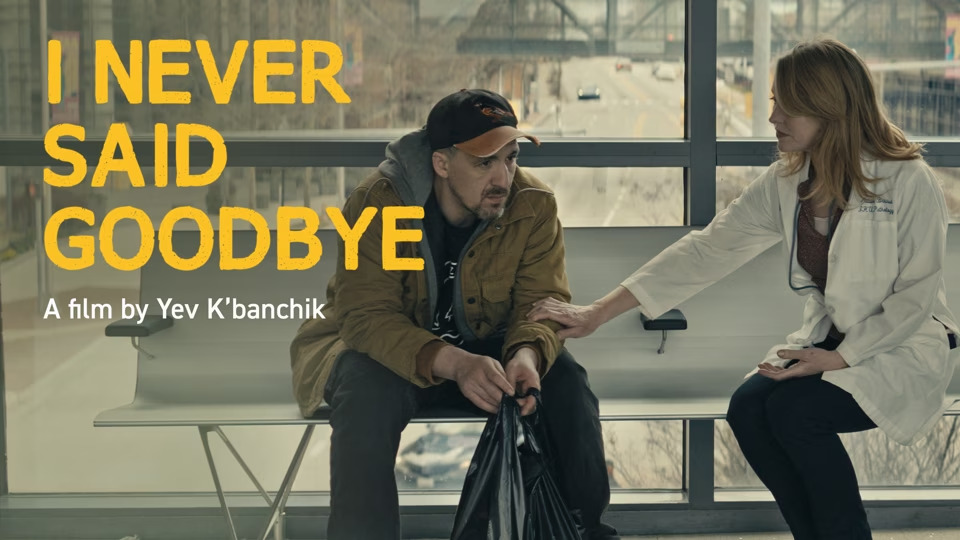
Summary of the Movie: A Transnational Requiem for a Lost Mother
The film is a haunting, experimental descent into the isolation of a Ukrainian immigrant in Baltimore, weaving a visceral tapestry of grief that bridges the gap between raw realism and supernatural folklore.
This 70-minute independent drama operates as a deeply personal “narrative-documentary hybrid,” reflecting the director’s own lived experience of loss and displacement. By stripping away traditional cinematic polish in favor of a minimalist, “hand-held” intimacy, the film captures the suffocating weight of being an only child navigating a foreign bureaucracy while mourning the woman who represented “home.”
-
Movie Plot: Following his mother’s death, Alex, a Ukrainian immigrant in Baltimore, struggles with a profound sense of “unbelonging” until he is guided toward healing by a compassionate Black funeral director and a yoga teacher who shares a similarly fractured past. The story follows his slow transition from the insular “immigrant bubble” to a shared, cross-cultural humanity, utilizing magical realism and real-time pauses to ground the viewer in his psychological stagnation.
-
Movie Trend: Adheres to the “Autobiographical Minimalism” movement, where filmmakers serve as their own editors and cinematographers to maintain an unfiltered, raw connection between the creator’s trauma and the audience’s experience.
-
Social Trend: Taps into the 2025-2026 global dialogue on “Displaced Grief,” specifically focusing on the intersectional struggles of Eastern European refugees and immigrants navigating racial and economic divides in American “checkerboard” cities.
-
Director’s Authorship: Yev K’banchik exercises total authorial control, blending documentary-style observation with elements of folklore to create a vision that is simultaneously grounded in the grit of Baltimore and the ethereal nature of the afterlife.
-
Top Casting: Artur Smolyaninov delivers a career-defining performance in his first English-language role, mirroring his real-life exile by portraying a man negotiating a new existence while stripped of his public identity.
-
Awards and Recognition:
-
Festival Presence: Made a significant impact at the 2025 Prague International Film Festival (PIFF), where its experimental sound design and narrative courage were highly commended.
-
Wins: Secured the Best Feature Film award at PIFF 2025, alongside a Best Actor win for Artur Smolyaninov for his nuanced portrayal of Alex.
-
Nominations: Received multiple nods across the independent circuit for Best Original Screenplay and Best Experimental Feature, particularly in festivals focusing on the immigrant experience.
-
Critical Infrastructure: Praised by “Indie-Sleaze” critics for its “anti-Hollywood” pacing and its ability to turn a $10,000 budget into a profound meditation on the human condition.
-
-
Release and Availability: Following its successful festival run in late 2025, the film is gaining traction on “Auteur-focused” streaming platforms and is scheduled for continued international festival screenings throughout 2026.
Insights: I Never Said Goodbye demonstrates that the most expansive stories are often told within the tightest budgets and the smallest physical spaces.
Industry Insight: The “Micro-Budget Feature” (under $15k) is seeing a prestige revival in 2026, as audiences reward “Extreme Authenticity” over the predictable rhythms of high-budget studio dramas. Consumer Insight: 2026 viewers are exhibiting “Empathy Fatigue” toward polished tragedy, instead gravitating toward “Experimental Realism” that allows for silent pauses and unscripted emotional moments. Brand Insight: Filmmakers who function as a “One-Person Studio” (Writer/Director/Editor/DP) are becoming the new symbols of “Pure Cinema,” appealing to a consumer base that values a single, uncompromised artistic voice.
The film’s success lies in its refusal to offer easy closure, choosing instead to sit with the protagonist in his silence. It proves that in the fragmented landscape of 2026, the most radical act a filmmaker can perform is to ask the audience to simply “see” the person standing right in front of them.
Why It Is Trending: The Cultural Resonance of “Hyper-Local Realism”
The film is gaining momentum in 2026 as a pivotal example of Hyper-Local Realism, capturing the digital zeitgeist’s shift toward stories that feel like discovered artifacts rather than manufactured entertainment. It has become a viral sensation within “Cine-Niche” circles on social media, where users are celebrating its “Zero-Budget Magic” as a revolutionary pushback against the AI-generated polish of the current blockbuster landscape.
-
Concept → Consequence: The film’s focus on “Bureaucratic Grief”—the literal paperwork of death—hits a raw nerve with a 2026 audience currently obsessed with the “De-influencing” of the immigrant experience.
-
Culture → Visibility: It has exploded on visual-first platforms where the “Baltimore-as-a-Character” aesthetic is being praised for its gritty, unwashed authenticity that contrasts with the usual “tourist” lens of American cinema.
-
Distribution → Discovery: Its success at the Prague International Film Festival has triggered a “Word-of-Mouth Engine,” leading to a surge in demand on niche streaming platforms like MUBI and Criterion Channel.
-
Timing → Perception: Releasing during a global peak in “Exile Narratives,” the film feels like a spiritual document for the millions navigating the 2026 reality of displacement and the longing for a home that no longer exists.
Insights: I Never Said Goodbye is trending because it treats the immigrant’s silence not as a void, but as a loud, heavy, and deeply cinematic presence.
Industry Insight: In 2026, the “Budget-Agnostic Winner” is a real category, where films produced for the cost of a used car are out-performing million-dollar features in cultural “share of voice.” Consumer Insight: There is a notable “Sincerity Surge” among Gen Z and Alpha cinephiles, who are abandoning irony in favor of “Raw-Vulnerability” content that feels genuinely personal and uncurated. Brand Insight: Production entities like Pinecone I are being identified as “Integrity Brands,” attracting a loyal following by prioritizing the lived experience of the filmmaker over commercial marketability.
The trending status of K’banchik’s work marks a shift toward “Documentary-Fiction Fluidity,” where the line between the actor’s reality and the character’s struggle is intentionally blurred. It proves that in the high-tech world of 2026, the most trending “effect” is a human face expressing a truth that cannot be scripted.
What Movie Trend Is Followed: The Era of “Radical Empathy Minimalists”
I Never Said Goodbye is a cornerstone of the Radical Empathy Minimalism trend, a 2025-2026 movement that strips away cinematic artifice to focus on the “micro-physics” of grief. This genre shift moves away from loud, performative drama toward Internalized Realism, where the narrative tension is found in the quiet, mundane struggles of navigating life after a monumental loss.
-
Format Lifecycle: The 70-minute runtime is a key part of the “Lean Narrative” trend, satisfying a 2026 audience that values concentrated, high-impact storytelling over the traditional “two-hour bloat.”
-
Aesthetic Logic: It follows the “Found-Footage Poetics” trend, utilizing natural lighting and handheld cameras to create a sense of “Witness Cinema” that feels like a private diary entry.
-
Psychological Effect: The film weaponizes “Shared Solitude,” tapping into the specific 2026 cultural desire for media that validates feelings of loneliness and the difficulty of forging new connections in a disconnected world.
-
Genre Inheritance: It acts as a spiritual successor to the “New Immigrant Cinema,” updating the trope by focusing on the “administrative burden” of death rather than just the struggle of relocation.
Insights: The trend in 2026 isn’t about the spectacle of tragedy, but about the quiet, exhausting labor of surviving it.
Industry Insight: Independent studios are pivoting toward “High-Resolution Intimacy,” investing in projects that offer deep emotional proximity to characters rather than wide-scale action. Consumer Insight: 2026 viewers are exhibiting “Authenticity Exhaustion,” rewarding films that present unvarnished, “ugly” emotions over curated, Hollywood-style vulnerability. Brand Insight: Production houses that champion “Lived-Experience Narratives” are becoming the new gatekeepers of emotional truth, as audiences seek out stories with a direct connection to the creator’s reality.
The film’s alignment with these trends highlights a broader cinematic shift toward “Micro-Drama”—where the act of filing a death certificate or attending a yoga class becomes a site of intense existential conflict. It proves that in the current landscape, the most effective stories are those that find the universal in the deeply personal.
Director’s Vision: K’banchik’s Architecture of the Unspoken
Yev K’banchik’s vision for I Never Said Goodbye is a masterclass in “Cinematic Stillness,” where the director treats the camera as a silent, breathing companion to Alex’s isolation. By eschewing the traditional “immigrant struggle” tropes in favor of a spiritual and psychological autopsy of grief, K’banchik creates a vision where the city of Baltimore becomes a purgatorial landscape that Alex must learn to re-inhabit.
-
Authorial Logic: K’banchik utilizes a “Real-Time Emotionality” structure, often holding shots for uncomfortable lengths to force the audience to experience the actual duration of a grieving person’s silence.
-
Cultural Synthesis: The director blends “Post-Soviet Stoicism” with the vibrant, spiritual warmth of Baltimore’s Black community, creating a visual dialogue between different forms of ancestral resilience.
-
Minimalist Precision: He maintains a strict “Anti-Gloss” aesthetic, stripping away artificial music and lighting to ensure that the sound of a closing door or a heavy breath carries the weight of a narrative climax.
-
Metaphysical Realism: K’banchik’s vision incorporates “Ghostly Presence” not through horror, but through the lingering framing of empty chairs and half-filled glasses, suggesting that the mother is a permanent, invisible character.
Insights: K’banchik proves that the most powerful way to direct a performance is to provide the actor with the space to simply “be” rather than “act.”
Industry Insight: In 2026, the “Auteur-as-Editor” model is being hailed as the ultimate way to maintain narrative purity, as directors take back control from studio-driven pacing. Consumer Insight: There is a growing “Patience Premium” among 2026 audiences, who are increasingly rewarding films that demand their total, undistracted presence. Brand Insight: Yev K’banchik is positioning himself as a “Documentarian of the Soul,” proving that a $10,000 budget can achieve “High-Art” status if the director’s vision is uncompromisingly honest.
The director’s vision turns the tragedy of “never saying goodbye” into a beautiful, lingering question about the nature of closure. He suggests that we don’t move on from our ghosts, but instead learn to carry them with us as we walk through new, unfamiliar streets.
Key Success Factors: The Power of “Micro-Budget Authenticity”
The success of I Never Said Goodbye rests on its “Emotional Efficiency,” proving that a $10,000 budget can generate more cultural capital than a multi-million dollar production when anchored by radical vulnerability. By bypassing traditional polish and leaning into the grit of its Baltimore setting, it achieved a “Raw Truth” status that resonates with the hyper-discerning audiences of 2026.
-
Niche Resonance: It successfully tapped into the “Global Exile” demographic, providing a mirror for millions of Eastern European immigrants who rarely see their specific brand of quiet grief reflected on screen.
-
Economic Discipline: The film utilized “Asset-Light Storytelling,” turning the limitations of its budget into a deliberate aesthetic choice that emphasizes the protagonist’s own stripped-back, survival-mode existence.
-
Cultural Cross-Pollination: The strategic pairing of the Ukrainian immigrant experience with Baltimore’s local communities created a “Universal Connection” that broadened its appeal beyond a single ethnic audience.
-
Performative Integrity: Casting Artur Smolyaninov, a real-life exiled actor, provided a layer of “Meta-Authenticity” that elevated the film from a fictional drama to a significant cultural document.
Insights: Consistency in emotional tone is the most valuable currency for independent filmmakers in the 2026 market.
Industry Insight: The “Micro-Prestige” model is thriving, as distributors realize that “Low-Risk, High-Impact” films are the most sustainable way to populate specialized streaming platforms. Consumer Insight: 2026 viewers are exhibiting “Marketing Skepticism,” gravitating toward films that feel like “accidental discoveries” rather than products of a massive promotional machine. Brand Insight: Building a brand on “Unfiltered Humanity” allows small production houses like Pinecone I to cultivate a community of viewers who value artistic bravery over technical perfection.
The film’s triumph is a testament to the fact that you don’t need a massive cast if your story is built on a foundation of universal pain. It proves that in the modern cinematic landscape, the smallest voice can often be the loudest if it speaks with total honesty.
Trends 2026: The Surge of “Bureaucratic Mourning” and Exile Cinema
In 2026, I Never Said Goodbye is at the forefront of the “Bureaucratic Mourning” trend, where storytelling focuses on the sterile, administrative hurdles that complicate the human process of grief. This reflects a society that is increasingly frustrated by the “algorithmization” of life and death, seeking out media that exposes the cold friction between personal loss and institutional requirements.
-
Cultural Shift: A massive pivot toward “The New Realism,” where the 2026 viewer prioritizes the “mundane struggle” over the “melodramatic outburst” as a more accurate representation of modern life.
-
Audience Psychology: The rise of “Intersectionality in Isolation,” as viewers seek stories that show how different marginalized groups (immigrants, local urban communities) find common ground through shared suffering.
-
Format Evolution: The surge of “Short-Form Features,” with the 70-minute runtime becoming the gold standard for directors who want to deliver a “pure, undiluted emotional hit.”
-
Meaning vs. Sensation: Moving away from the “tear-jerker” toward “The Heavy Silence,” where the goal is to make the audience feel the physical weight of loneliness rather than just the sadness of it.
-
Explicit Film Industry Implication: Increased funding for “Exile-Authored Content,” specifically projects that give a platform to filmmakers living in political or personal diaspora.
Insights: In 2026, the most compelling drama is found in the silence of a waiting room.
Industry Insight: Producers are pivoting to “Community-Integrated Production,” where filmmakers use real local businesses and non-actors to ground their stories in a specific, un-fakeable geography. Consumer Insight: The “Vibe-Check” for 2026 drama has moved into “Stark Vulnerability,” as fans reward films that refuse to “beautify” the immigrant experience or the mourning process. Brand Insight: Marketing strategies are shifting to “The Story Behind the Story,” engaging audiences by highlighting the director’s personal stakes and the film’s shoestring-budget origins.
The shift toward this “Stark Realism” shows a 2026 audience that is tired of metaphors. I Never Said Goodbye perfectly captures this zeitgeist, proving that the most effective special effect is the truth of a person’s face when they realize they are truly alone.
Social Trends 2026: The Era of “Found Families” and Grief Literacy
The social landscape of 2026 is moving toward “Grief Literacy,” as a global community traumatized by displacement seeks new ways to talk about loss. I Never Said Goodbye mirrors a society that is moving away from traditional support structures, instead finding solace in the “Unexpected Connection” of strangers who share a common emotional vocabulary.
-
Behavioral Shift: A rise in “Cross-Cultural Mentorship,” where individuals from different backgrounds use their shared experiences of trauma to help one another navigate “The System.”
-
Cultural Aesthetic: The popularity of “Intentional Minimalism,” a lifestyle trend that mirrors the film’s protagonist—focusing on essential possessions and “Quiet Spaces” to manage mental health and grief.
-
Institutional Breakdown: A surge in “Grassroots Healing,” with community-led yoga and meditation groups replacing formal therapy for those navigating the bureaucratic maze of immigration.
-
Emotional Coping: “Shared Humanity” is becoming a core social value, as people reject divisive political narratives in favor of the small, personal kindnesses that make survival possible in a foreign city.
Insights: In 2026, the most radical act is helping a stranger through a door you’ve already walked through.
Industry Insight: The wellness and funeral sectors are pivoting toward “Culturally-Specific Care,” recognizing that grief is handled differently across the various diasporas currently reshaping American cities. Consumer Insight: 2026 audiences are experiencing “Isolation Fatigue,” leading them to seek out stories that offer a blueprint for “reaching across the aisle” of personal pain. Brand Insight: Brands that emphasize “The Human Element”—prioritizing empathy and personal connection over efficiency—are winning over a consumer base that feels increasingly like a “number” in the system.
Final Social Insight: In 2026, the ultimate luxury is being seen in your most vulnerable moment by someone who has no reason to care, but does anyway. The film suggests that while the “goodbye” was never said, the “hello” to a new community is where the true healing begins.
Final Verdict: The Quiet Revolution of the Immigrant Soul
I Never Said Goodbye is a profound, stripped-back masterpiece of 2026 independent cinema that proves the “immigrant story” is most powerful when it is at its most personal. It leaves the viewer with a sense of “Aching Hope,” suggesting that while we may never get closure for our past, we can find a new beginning in the shared humanity of our neighbors.
-
Meaning: It deconstructs the “American Dream” into its most basic parts: the need for a home, the need for a mother, and the need to be heard.
-
Relevance: An essential text for the “Global Displacement” era, acting as a spiritual guide for anyone navigating the “purgatory” of a new life while grieving an old one.
-
Endurance: Destined to be a “Cult Essential” for film students and indie enthusiasts, frequently cited as the gold standard for what can be achieved with a $10,000 budget and a vision.
-
Legacy: It establishes Yev K’banchik as a “Filmmaker of the Invisible,” a creator who can turn the most mundane city street into a site of epic, spiritual importance.
Insights: The ultimate takeaway is that you don’t need a language to understand someone’s pain; you just need to be willing to sit in the room with it.
Industry Insight: 2026 has proven that “Hyper-Authentic Cinema” is the best defense against the homogenization of the global film market. Consumer Insight: Audiences are prioritizing “Emotional Honesty” over narrative complexity, rewarding films that allow them to feel “seen” in their own private struggles. Brand Insight: The success of this Baltimore-based production highlights the power of “Deep-Local Storytelling,” where the specificity of the setting makes the story feel more universal, not less.
The film is a quiet, steady heartbeat in a loud world. It is a chillingly beautiful reminder that in the age of borders and paperwork, the most important connection we have is the one we forge when we finally stop trying to do it all alone.
Trends Summary: The Architecture of Displaced Grief
The 2026 success of I Never Said Goodbye marks a definitive pivot toward “Emotional Austerity,” where the cinematic value is derived from the raw, unedited portrayal of survival in the face of institutional and personal loss.
-
Conceptual: “The Administrative Void”—focusing on the cold, sterile friction between deep human mourning and the bureaucratic systems of a foreign land.
-
Cultural: “The New Diaspora”—a shift in immigrant storytelling that prioritizes internal psychological healing over the traditional “assimilation” narrative.
-
Industry: “Micro-Budget Prestige”—leveraging extreme financial constraints to force a more intimate, “hand-held” connection with the audience.
-
Audience Behavior: “Active Empathy”—a 2026 trend where viewers seek out “uncomfortable” realism to bridge the gap between their own lives and the experiences of the displaced.
|
Bureaucratic Mourning. Life is reduced to paperwork during times of profound loss. |
Audiences find catharsis in seeing the “un-cinematic” parts of grief validated. |
|
|
Stark Humanism. Preference for unpolished, raw storytelling over high-budget artifice. |
Professional “polish” is increasingly viewed as a sign of emotional inauthenticity. |
|
|
Found Family Synergy. Seeking deep connection with strangers across cultural divides. |
Traditional support networks are being replaced by “empathy-first” local communities. |
|
|
Documentary-Fiction Hybrid. Blending real-life footage with scripted emotional beats. |
The line between “actor” and “subject” is permanently blurred for 2026 viewers. |
|
|
Existential Verification. Watching others struggle to confirm one’s own resilience. |
Film acts as a “stress test” for the viewer’s capacity for cross-cultural compassion. |
Insights: In 2026, the most compelling “special effect” is a single, unedited shot of a human face processing a truth they cannot speak.
Industry Insight: The “70-Minute Feature” is the new gold standard for indie ROI, proving that narrative density is more valuable than runtime.Consumer Insight: 2026 audiences are exhibiting “Sincerity Loyalty,” sticking with directors who maintain a “one-person studio” aesthetic.Brand Insight: Productions that highlight “Lived-Experience Credibility” (like using real local workers/mechanics) are gaining instant cultural authority.
Final Social Insight: In 2026, the ultimate luxury is being seen in your most vulnerable moment by someone who has no reason to care, but does anyway.
Why to Watch Movie: The Visceral Beauty of the Unspoken
I Never Said Goodbye is an essential experience for those who value “Cinema as a Witness,” offering a rare and unvarnished look at the intersection of grief and immigration. It is a film that demands your silence and rewards your attention, leaving you with a deeper understanding of the invisible people who make up the fabric of our cities.
-
Emotional Bravery: You watch it for the “Raw Vulnerability” of Artur Smolyaninov, whose performance captures the physical and mental exhaustion of grief with a haunting accuracy.
-
Atmospheric Grit: It offers the rare thrill of “Location-Authenticity,” turning the streets of Baltimore into a visceral, living character that reflects the protagonist’s own fractured internal world.
-
Minimalist Impact: The 70-minute runtime ensures a “High-Concentration Experience,” delivering a profound emotional journey without a single wasted frame or unnecessary subplot.
-
Spiritual Solidarity: It functions as a “Cine-Meditation,” utilizing the yoga and funeral home settings to explore the different ways we attempt to heal our “spirit-wounds” in a secular, bureaucratic world.
-
Indie Heroism: As a 2-time award winner produced on a shoestring budget, watching this film is a way to support the “Auteur Rebellion” that is currently saving the soul of modern cinema.
Insights: This film is for the viewer who believes that the smallest moments are often the ones that define a lifetime.
Industry Insight: In 2026, “Economic Narrative” is a trend; audiences are specifically looking for films that achieve “Massive Impact” through “Minimal Means.” Consumer Insight: There is a strong “Sincerity Seek” among 2026 viewers, who are gravitating toward stories that feel like a direct, unedited conversation between the filmmaker and the audience. Brand Insight: By positioning the film as a “Personal Requiem,” the production team successfully built a brand around the concept of “Cinema as Healing,” attracting a deeply loyal and engaged viewership.
The primary reason to watch is the film’s refusal to lie to you. It doesn’t promise that everything will be okay, but it does promise that you won’t be alone in the dark.