


RS / BG / SI / ME / HR / DE | 2026 | 91 min | Drama, Political Drama, Romance
➡️ Where to Watch: Currently on the festival/industry circuit — Festival Scope Pro.
When Falling in Love Means Crossing the Political Divide
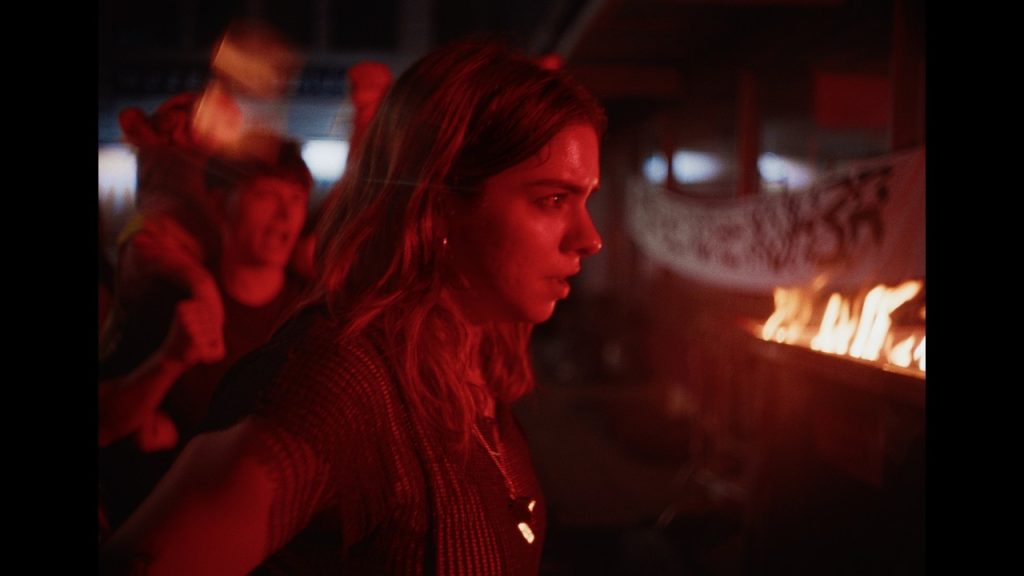
Belgrade is divided by protest. Lena is an anarchist student involved in the anti-government movement, while Stefan is a working-class young man who finds himself among pro-government loyalists. They appear to belong on opposite sides of a city increasingly defined by political confrontation, yet an unexpected connection begins to develop between them.
When violence erupts and Stefan fears he may have struck a police officer, the pair flee the city together. What begins as a political encounter becomes something more intimate: two young people discovering that the identities assigned to them by politics, friends and circumstances may not completely explain who they are.
➡️ Movie Insight: Until the Day Ends transforms political polarization into an intimate relationship between two young people expected to see each other as enemies. Their attraction forces ideology to collide with empathy. The political divide becomes most powerful when it enters their private lives.
Why This Movie Matters Right Now: Political Polarization Is Becoming Personal
Until the Day Ends arrives directly from a contemporary political reality. The film is rooted in Serbia’s student protest movement, which expanded following the November 2024 railway-station canopy collapse in Novi Sad that killed 16 people and developed into a wider challenge to government accountability.
Rather than constructing a conventional political drama around leaders or institutions, Jelena Maksimović follows young people living inside that polarization. Lena’s political commitment is clear, while Stefan is less ideologically fixed; their relationship makes the film less about proving which character is politically correct than about what happens when human attraction complicates political identity.
➡️ Why It Matters: Political division increasingly shapes friendships, relationships and personal identity, particularly among younger generations. Until the Day Ends turns that social tension into the emotional engine of a love story. Politics is not background decoration here; it determines who the characters are expected to love, trust and reject.
Should You Watch It?: Political Urgency Meets an Unconventional Young Romance
Until the Day Ends is best approached as an intimate European political drama rather than a conventional protest movie. Maksimović combines political unrest with romance, youth culture and an increasingly mobile story that moves from occupied spaces and crowded streets toward an escape from Belgrade. Venice describes the film as blending melodrama, comedy, crime and road-movie conventions within an elliptical coming-of-age portrait.
Critical reaction has not been uniformly enthusiastic. Screen Daily praised its urgency, intensity, stylistic energy and lead performance while finding aspects of the film frustrating, and other reviews have similarly debated whether its political ideas and characters are equally developed. Its combination of youthful energy, political immediacy and unconventional romance nevertheless gives it a distinctive identity.
➡️ Viewing Recommendation: Watch it for politically engaged European cinema that prioritizes atmosphere, youth and emotional contradiction over conventional plotting. Lena and Stefan’s unlikely connection provides an accessible human route into a much larger political conflict. Its strongest quality is the tension between the world telling them to separate and the attraction pulling them together.
Why Everyone Is Talking About It: Serbia’s Protest Generation Reaches Venice
Until the Day Ends premiered in the Orizzonti competition at the 83rd Venice International Film Festival, giving Maksimović’s fiction feature significant international visibility. The film was nominated for the Venice Horizons Award for Best Film.
Its timing strengthened that visibility. The film arrived while the Serbian student protests inspiring its setting remained a contemporary political issue, allowing a fictional relationship to connect directly with an unfolding European story. International sales are handled by Heretic, which acquired world rights ahead of the Venice premiere.
➡️ Viral Potential: The film has a clear conversation driver: two young people fall for each other while standing on opposite sides of a real political divide. Its Venice launch gives that premise international arthouse visibility beyond Serbia. The combination of contemporary protest culture, young romance and political polarization makes it especially relevant to festival and cinephile audiences.
Why Until the Day Ends Stands Out: Political Enemies Become Potential Lovers
Political dramas frequently place characters inside movements, institutions or struggles against authority. Until the Day Ends changes the mechanism by making political opposition the obstacle inside an emerging romantic relationship: Lena is aligned with the student protest movement, while Stefan ends up among government loyalists.
The difference is important. The film does not simply place a romance against a political backdrop; it asks whether personal empathy can survive when society increasingly organizes people into opposing camps. Stefan’s uncertain political identity makes the structure even less conventional, because the divide is partly ideological and partly produced by social belonging and circumstance.
➡️ Cinema Insight: Until the Day Ends turns political polarization into romantic tension rather than treating politics as external context. The central relationship makes ideological division emotional and physical. It reframes the familiar opposites-attract romance for an era in which political identity increasingly defines social belonging.
Movie Trend: Political Drama — When Two Young People on Opposite Sides of a Protest Fall in Love
divided city → youth protests → opposing political sides → anarchist student + pro-government youth → unexpected attraction → ideological differences become personal → protest violence → fear and uncertainty → escape together → love challenges political division
Until the Day Ends belongs to a growing strand of political cinema interested less in institutions themselves than in how political instability changes ordinary relationships. Politics enters friendships, attraction, identity and decisions about where someone belongs.
The film makes this particularly visible through young characters. Lena and Stefan inherit a polarized environment but do not fit perfectly into the roles that environment creates for them, turning their attraction into a small rebellion against the assumption that political opposition must automatically eliminate human connection.
➡️ Movie Trend: Contemporary political dramas are increasingly moving from institutions into intimate relationships. Protest, polarization and ideological identity become catalysts for romance, friendship and coming-of-age conflict. Until the Day Ends captures that shift by asking whether attraction can cross a political line society treats as absolute.
Viewer Profile: Rule Breakers – Young Arthouse Viewers Drawn to Rebellious European Cinema
The strongest audience is likely to be younger festival and arthouse viewers interested in contemporary European stories that connect social unrest with relationships and identity. The film’s political context gives it relevance, while its youthful protagonists, romance and visually assertive filmmaking make the material more experiential than a conventional issue drama.
|
Arthouse and international-film viewers |
|
|
Primarily young adult and adult audiences |
|
|
Culturally curious, socially aware, festival-oriented |
|
|
European drama, political cinema, unconventional romance, coming-of-age stories |
|
|
Discovers films through festivals, curated platforms, critics and international cinema communities |
|
|
Looks beyond mainstream releases for emerging directors and socially relevant stories |
➡️ Audience Insight: Rule Breakers are attracted to cinema that feels culturally immediate without following mainstream storytelling formulas. Political relevance may attract them, but character intimacy and filmmaking style keep them engaged. Until the Day Ends gives that audience both social urgency and an emotionally accessible relationship.
What This Movie Means for the Industry: Political Cinema Becomes More Personal
Until the Day Ends demonstrates how politically specific stories can travel internationally when they are built around recognizable human relationships. Serbia’s protests may provide the immediate context, but attraction across ideological boundaries, generational frustration and uncertainty about belonging are themes audiences can recognize well beyond Serbia.
Its multinational production structure reinforces that international potential: the film brings together partners from Serbia, Bulgaria, Slovenia, Montenegro, Croatia and Germany, with Heretic handling world sales. Its Venice Orizzonti selection gives a relatively small regional production a platform from which contemporary Serbian politics can enter the wider international film conversation.
➡️ Industry Insight: Political cinema does not need to explain an entire political system to travel internationally. A strong personal relationship can become the entry point into a highly specific national conflict. Festival platforms can then transform that local story into a broader conversation about polarization, youth and belonging.
Creative Analysis: Private Desire Collides With Public Unrest
Maksimović approaches political conflict through proximity rather than distance. Venice’s official description emphasizes a perspective kept close to Lena and Stefan, initially using obstruction and off-screen space to create entrapment before opening into more static compositions in nature.
That transition mirrors the characters’ journey: Belgrade represents the social identities surrounding them, while leaving the city temporarily creates room for another kind of relationship to emerge.
Storytelling: Political Conflict Becomes a Relationship Problem
The narrative starts with social division but gradually narrows its focus toward Lena and Stefan. A protest, a thrown stone and Stefan’s fear that he has injured a policeman push them out of the city, converting political confrontation into a more intimate journey.
Their relationship becomes the film’s method for exploring whether individuals can escape the political identities imposed on them.
Direction: Jelena Maksimović Brings Documentary Urgency Into Fiction
Maksimović previously worked across documentary and other audiovisual forms, and critics have identified a reportage-like immediacy in her fiction feature. Screen Daily specifically highlighted the film’s urgency, intensity and stylistic vigor.
The approach makes political unrest feel lived rather than merely explained, placing characters inside crowds, occupied spaces and unpredictable encounters.
Performances: Newcomers Make Political Opposition Feel Human
Lena Trifunović and Andrija Krivokapić carry the central relationship as Lena and Stefan. Their characters begin from very different positions, but the performances prevent the relationship from functioning only as a political metaphor.
International Cinephile Society particularly praised their chemistry, arguing that their emotional connection ultimately becomes as important as the film’s visual experimentation.
Visual Style: A Divided City Gives Way to Open Space
Cinematographer Paul Spengemann works with Maksimović on a visual structure that initially emphasizes confinement before moving toward more contemplative compositions outside the city. Venice explicitly describes this movement from obstruction and off-screen space toward static images in nature.
One particularly discussed device follows a cobblestone as it passes through multiple hands before connecting Lena and Stefan during the unrest, visually linking political violence and their emerging relationship.
Themes: Love, Political Identity and the Freedom to Choose a Side
The film explores political polarization, youth resistance, ideological identity, attraction and empathy. Lena believes political change is possible; Stefan is considerably less certain about where he belongs.
That imbalance allows the story to examine not only disagreement but also the pressure to adopt identities defined by surrounding groups. Their relationship asks whether emotional connection can create space outside those categories.
What Makes It Different: The Political Divide Creates the Romance
Until the Day Ends does not simply combine a political drama with a romantic subplot. The political divide itself creates the conditions that make the relationship unexpected and difficult.
Lena and Stefan are compelling precisely because they are not supposed to belong together. Their attraction therefore becomes the film’s most direct challenge to the social polarization surrounding them.
➡️ Creative Insight: Maksimović makes political division tangible by putting it between two people attracted to each other. The shift from crowded Belgrade streets toward greater physical openness gives their relationship room to challenge the identities surrounding them. Romance becomes a cinematic experiment in whether empathy can interrupt polarization.
If You Liked Until the Day Ends (2026): Political Upheaval Becomes Personal
These films similarly bring political instability into private lives, using individuals and relationships rather than institutions alone to make social conflict emotionally immediate.
The Seed of the Sacred Fig (2024) by Mohammad Rasoulof: Political Unrest Enters the Family
As political unrest intensifies in Tehran, an investigating judge’s paranoia spreads through his own household after his gun disappears. Like Until the Day Ends, the film collapses the distance between national politics and intimate relationships until public conflict becomes impossible to separate from private life.
➡️ Why It Connects: Both films turn political polarization into intimate conflict rather than distant political commentary. Young people confront identities and expectations created by the society surrounding them. Political instability ultimately changes whom characters believe they can trust.
I’m Still Here (2024) by Walter Salles: A Family Lives Through Political Repression
Walter Salles follows Eunice Paiva after her husband disappears under Brazil’s military dictatorship, transforming national repression into the story of a woman forced to rebuild her family and search for truth. Its historical scale differs from Until the Day Ends, but both films make politics meaningful through the people who must live with its consequences.
➡️ Why It Connects: Both films refuse to separate political history from personal relationships. State power changes the trajectories of ordinary people rather than remaining an abstract force. Emotional survival becomes another way of understanding political resistance.
The New Year That Never Came (2024) by Bogdan Mureșanu: Ordinary Lives Reach the Edge of Revolution
Set immediately before the Romanian Revolution of 1989, Bogdan Mureșanu’s ensemble drama follows six interconnected lives as personal problems collide with the approaching collapse of Nicolae Ceaușescu’s regime. Like Until the Day Ends, political upheaval is experienced through ordinary people before it becomes history.
➡️ Why It Connects: Both films treat political unrest as something lived in streets, homes and relationships. Individual decisions become inseparable from larger historical forces. Their protagonists reveal how quickly ordinary life can change when political tension reaches breaking point.
➡️ Where to Watch: FR
➡️ If You Liked Insight: These films belong to a contemporary wave of cinema bringing politics back to the level of everyday life. Protest, authoritarianism and revolution matter because they transform relationships, families and personal choices. Until the Day Ends distinguishes itself within that space by making unexpected attraction across the political divide its central emotional mechanism.
Final Verdict: Love Becomes an Escape From a Divided City
Until the Day Ends takes a recognizable political reality and refuses to reduce it to a conventional protest narrative. Instead, Jelena Maksimović focuses on two young people whose connection destabilizes the political identities surrounding them, allowing romance, coming-of-age uncertainty and political rebellion to occupy the same story.
Its Venice launch, contemporary Serbian context and distinctive visual approach make it an important festival discovery even if its unconventional structure may divide audiences. The film is most compelling when Lena and Stefan stop representing opposing political camps and simply become two uncertain young people trying to understand each other.
➡️ Final Verdict: Until the Day Ends turns political polarization into an intimate story about attraction across ideological boundaries. Its strongest idea is simple but timely: the person on the other side of a political divide may become impossible to reduce to an enemy. That tension gives this small European drama a much larger contemporary relevance.
Quick Facts: A Love Story Emerges From a City Divided by Protest
|
Jelena Maksimović, Ivan Salatić, Olga Dimitrijević |
|
|
Lena Trifunović, Andrija Krivokapić |
|
|
Irina Hotomski, Stefan Tarabić, Miodrag Miša Dragičević |
|
|
Serbia, Bulgaria, Slovenia, Montenegro, Croatia, Germany |
|
|
Drama / Political Drama / Romance |
|
|
Vladimir Živković, Ace Vaptsarov |
|
|
Taurunum Film with international co-production partners |
|
|
Venice International Film Festival 2026 — Orizzonti |
|
|
Venice Horizons Award — Best Film nominee |
|
|
Political Drama — When Two Young People on Opposite Sides of a Protest Fall in Love |
|
|
Attraction develops between two young people positioned on opposing sides of Belgrade’s protests |
|
|
Political polarization becomes the obstacle inside an emerging romance |
|
|
Political identity, protest, polarization, love, empathy, youth, belonging |
|
|
A contemporary European political drama that makes ideological division intensely personal |
Official Venice credits confirm the principal creative team, runtime, countries, cast and production information.
Final Insights: Political Cinema Is Moving From Institutions Into Relationships
Until the Day Ends reflects a broader direction in contemporary political filmmaking: major political conflicts are increasingly being explored through intimate relationships rather than through politicians, governments or institutions alone. The consequences of polarization become easier to understand when they determine friendships, families, attraction and the possibility of trusting another person.
That approach may become increasingly relevant as political identity occupies more space in everyday culture. Films can explore polarization not simply by recreating ideological debates but by asking what happens when people discover that the individuals they love, desire or understand do not fit comfortably inside their own political tribe.
➡️ Final Insight: The next generation of political cinema may be defined as much by relationships as by revolutions. Until the Day Ends shows how a national political divide can become emotionally legible through two young people who unexpectedly cross it. When politics divides society, cinema can examine what happens when human connection refuses to obey the same boundary.