
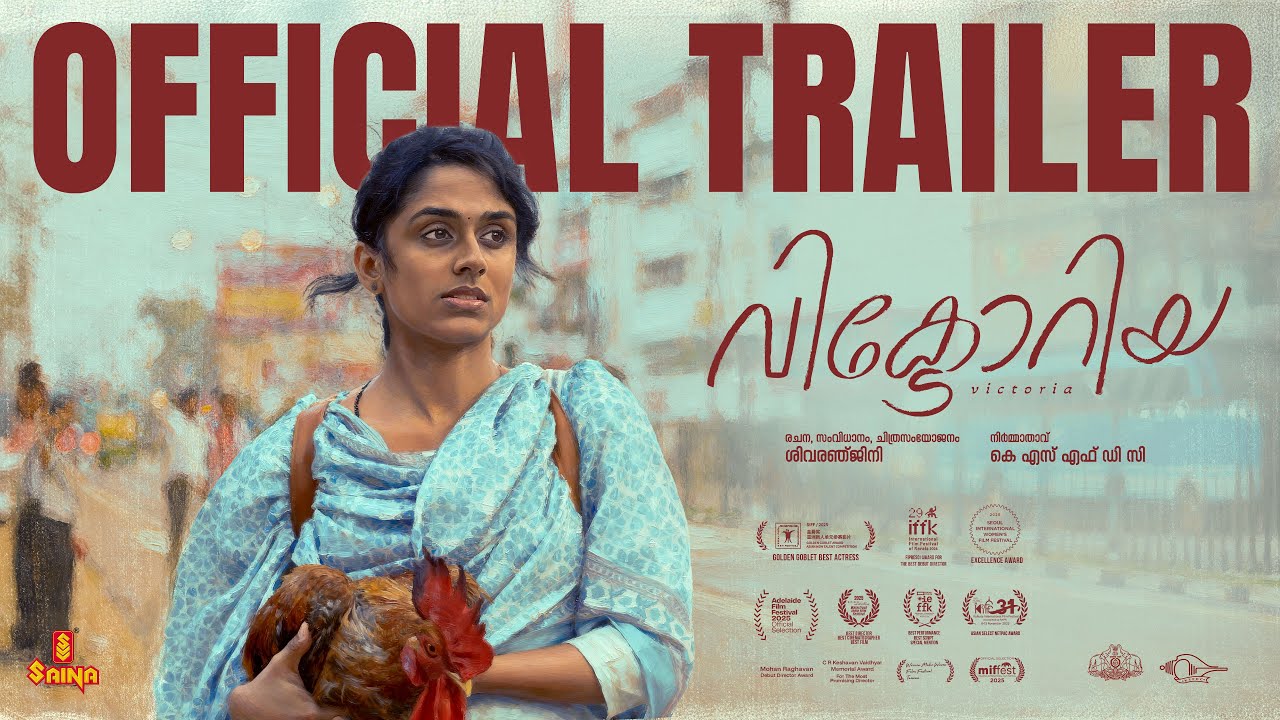
One day, one beauty parlour, one woman carrying everything the world refuses to see
Victoria is a beautician in a suburban Kerala parlour, keeping her plan to elope with her Hindu boyfriend from her conservative Catholic family — and keeping her bruises hidden from everyone else. A rooster, promised as a church offering and thrust into her care, becomes the day’s unexpected witness. As customers arrive and gossip and confide, Victoria works — hands always moving, face always composed, and everything real happening just out of sight.
Why It Is Trending: A KSFDC Women’s Grant Film Wins Shanghai — and Earns Its Way to International Screens
Victoria was made under the Kerala State Film Development Corporation’s grant programme specifically supporting women and Dalit filmmakers — a production born from institutional commitment to voices that commercial Malayalam cinema consistently marginalises. It won the FIPRESCI Award for Best Malayalam Debut at the 29th International Film Festival of Kerala in 2024 — an audience and jury known for discernment — and then won the Golden Goblet Award for Best Actress at the 2025 Shanghai International Film Festival for Meenakshi Jayan. The film also screened at the Seoul International Women’s Film Festival, Women Make Waves International Film Festival in Taiwan, and the Adelaide Film Festival — a remarkable international circuit for an 84-minute, ₹2 crore Malayalam debut. US release is set for April 2026. It is hard to believe that Sivaranjini J, the director of the film, is a debutante.
Elements Driving the Trend: Sivaranjini observed the women in the beauty parlour she used to visit like an ethnographer — and built a film from those observations that places the parlour as both principal location and arena of female desire, solidarity, and survival. The “No Entry For Men” sign on the parlour door is not just a detail but the film’s formal manifesto: the only male presence in the 84-minute film is a rooster, a phone call, and a shadow. Sivaranjini used a handheld camera to bring out Victoria’s anxiety — moving around the actors rather than forcing them to repeat actions, keeping them in character for longer and making the viewer feel physically present alongside Victoria. The beauty parlour as a setting is the film’s most culturally precise choice: there is a beauty parlour in almost every major corner of Kerala, small, familiar spaces where women from middle-class and lower middle-class backgrounds come not just for threading or a facial, but to breathe.
Virality: The IFFK premiere generated strong word-of-mouth among Kerala’s highly cine-literate festival audience. The Shanghai Best Actress win gave the film its most significant international signal, amplifying discovery across Indian film criticism communities and international women’s cinema circuits.
Critics Reception: The News Minute called it a calming watch and praised Sivaranjini’s formal control — you couldn’t ask for more from a debutante. Hollywood Reporter India called Jayan’s performance rock-solid and described feminism in the film as a caressing whisper rather than a loud wail. The Polisproject placed it alongside Feminichi Fathima as part of a new wave of Malayalam films wrestling with women’s labour and the politics of survival.
Awards and Recognitions: FIPRESCI Award for Best Malayalam Debut, IFFK 2024. Golden Goblet Award for Best Actress, Shanghai International Film Festival 2025. Screened at IFFK, Seoul International Women’s Film Festival, Women Make Waves Taiwan, Adelaide Film Festival. 1 win and 3 nominations total. US release April 2026.
Victoria arrives at a moment when Malayalam cinema’s new wave of women directors — funded partly through KSFDC’s women’s grant programme — is producing some of the most formally inventive and socially precise films in Indian cinema. For the industry, the film’s international festival circuit demonstrates that Malayalam women’s cinema can travel globally on the strength of craft and cultural specificity alone.
What Movie Trend Is Followed: Malayalam Women’s Cinema Finds Its Intimate Register
A new generation of Malayalam women filmmakers is building a body of work defined by constraint as method — small budgets, limited locations, single days, and the beauty parlour, the household, the tea shop as the whole world of the film. Victoria belongs to this tradition and extends it with particular formal confidence: the parlour as a chamber drama composed of a series of tasteful unbroken shots, the handheld camera tracking Victoria’s anxiety through cramped space and crowded mirrors, the male presence felt everywhere through phone calls and shadows and bruises without ever appearing on screen. Sivaranjini’s innovative use of small spaces, blocking, and mirrors allows her to focus on an increasingly crowded parlour — as customers arrive, the space fills with women’s stories, and Victoria’s personal crisis is held in relationship to a wider female community that does not know it is holding her.
Trend Drivers: KSFDC’s Women’s Grant as a Creative Infrastructure The film was produced through the KSFDC grant aimed at supporting female and Dalit filmmakers — a funding structure that is producing genuinely distinctive Malayalam cinema outside commercial production pressures. Sivaranjini applied after seeing a newspaper advertisement, went through a rigorous selection process as one of four grantees, and made a debut that has reached Shanghai and Seoul. That pipeline — institution to festival to international circuit — is replicable, and Victoria’s success will encourage more women filmmakers to pursue it.
What Is Influencing Trend: New Malayalam Women’s Cinema — alongside directors like Sharan Venugopal and Fasil Muhammed working in adjacent registers — is establishing a recognised aesthetic: socially specific, formally restrained, focused on women’s interior lives rather than their relationship to men. International women’s film festivals are increasingly programming Malayalam women’s cinema alongside Iranian, Korean, and Romanian social realist traditions. The IFFK platform remains the most reliable Malayalam launchpad for international discovery.
Macro Trends Influencing: The global expansion of regional Indian cinema beyond Hindi and Telugu — amplified by Malayalam cinema’s international profile through films like Jallikattu and Kumbalangi Nights — has created informed international audiences for Malayalam films of all scales. Women’s cinema funds and grants across India are producing a generation of debut films made outside the commercial production system that are finding international audiences the commercial system cannot reach. The beauty parlour as a feminist space has a growing presence in global cinema — a location that is simultaneously mundane and revelatory.
Consumer Trends Influencing: International women’s film festival audiences are among cinema’s most actively engaged and discovery-oriented demographics. The Shanghai Best Actress win gives the film discovery reach into Chinese-language media ecosystems that most Malayalam films never access. The US April 2026 release positions the film for Indian diaspora audiences who have driven Malayalam cinema’s international commercial expansion.
Audience Analysis: Malayalam Cinema Devotees, International Women’s Cinema Audiences, and the IFFK Circuit The core audience is 25–55 — women’s cinema enthusiasts globally, Malayalam cinema fans in the diaspora, and the IFFK-calibre audiences for whom formal sophistication and social honesty are the primary criteria. Victoria represents women in our society who carry the weight of oppression through invisible but real patriarchal structures — a description that translates across cultural contexts. The brevity of the film — 84 minutes, a single day — is not a limitation but a formal argument: one ordinary day is enough to contain everything the patriarchy does to one woman, if you know how to look.
Victoria works because it refuses sentimentality and spectacle equally. The waxing strip that sounds like a slap is the film’s most precise filmmaking moment — the body’s memory of violence surfacing through domestic labour, without a single frame of the violence itself. That restraint is the film’s greatest achievement.
Final Verdict: Victoria Is a Formally Precise, Emotionally Rich, and Quietly Radical Malayalam Debut That Announces a Director of Genuine Importance
Sivaranjini J delivers an 84-minute debut of extraordinary formal control — a film that uses the smallest possible canvas to say things about women’s lives that larger, better-funded productions rarely dare to articulate. The beauty parlour setting is chosen with ethnographic precision, the handheld camera is deployed with emotional intelligence, and Meenakshi Jayan’s performance is built from the kind of minute physical and facial detail that reveals a director and an actor in complete creative alignment. Feminism becomes a caressing whisper rather than a loud wail — and that whisper is harder to ignore than any shout.
Audience Relevance: For Anyone Who Has Ever Hidden Their Suffering Behind a Professional Smile Victoria’s most devastating quality is its observation that people can hide behind their work faces while they suffer within — and that it takes a close and caring eye to see through the professionalism to what is actually happening. The parlour’s sisterhood — the customers who arrive and talk and confide — is the community that gradually, quietly, holds Victoria even without knowing she needs holding.
That dynamic — the female solidarity that operates below the level of awareness — is the film’s most generous and most honest social observation.
What Is the Message: The Parlour Without Men Is Not an Escape — It Is the Only Space Where Truth Can Surface The “No Entry For Men” sign is not a solution but a condition of possibility — a temporary space where women’s unguarded selves emerge. Victoria cannot escape the patriarchal structures outside, but inside the parlour she can, for a moment, break down in a bathroom, be seen by a pregnant friend, and understand that the sisterhood around her is more sustaining than the romance she is risking everything for.
The rooster — the only male presence inside the parlour — is the film’s wittiest and most precise symbol: even within the female space, he belongs to the church, to sacrifice, to men’s religious economies.
Relevance to Audience: A Universal Female Experience in a Specifically Kerala Frame The beauty parlour of Angamaly is as precisely realised as any location in recent Malayalam cinema — the women who come through it, the gossip and grief they bring with them, and the specific texture of small-town Kerala Catholic social life are all observed with ethnographic exactness. Yet the experience it documents — women performing competence and calm while managing crises invisible to everyone around them — is entirely universal.
The film’s international festival success confirms that specificity and universality are not opposites but the same thing, properly achieved.
Social Relevance: Patriarchy Without a Villain — Just an Ordinary Day The film doesn’t give patriarchy a face. There are no abusive men on screen — only the bruises on Victoria’s face, the dismissiveness of the boyfriend on the phone, and the stories the customers bring through the parlour door. That formal choice is the film’s most radical social argument: patriarchy is not exceptional violence but the accumulated texture of an ordinary day.
The church feast, the elopement, the family pressure, the Hindu-Catholic relationship — all of it happening simultaneously in one woman’s body, on one ordinary workday, in a room where no men are allowed.
Performance: Meenakshi Jayan Delivers One of Indian Cinema’s Most Precise Recent Debuts Jayan’s Golden Goblet win at Shanghai is fully earned — she creates Victoria through a sustained physical and emotional performance where the emotions fall off her face, only to be replaced by the impassivity of a professional. The breakdown between her and the man on her phone, dimly lit and without drama, is the film’s emotional centre. The way she moves through the parlour — hands always busy, face always composed — is character-building as cinematography.
The ensemble of non-professional and first-time actors around her gives the parlour its lived-in authenticity — Sreeshama Chandran’s pregnant friend, who sees the bruises no one else notices, is the film’s most important supporting presence.
Legacy: A Kerala Women’s Grant Film That Will Be Studied Alongside the Best Malayalam Debuts of Its Era Victoria will be remembered as the debut that announced Sivaranjini J as one of Malayalam cinema’s most important emerging voices — made under institutional constraints that her formal intelligence transforms into artistic assets. The KSFDC women’s grant programme will point to this film as evidence of what it exists to produce. The international circuit — IFFK, Shanghai, Seoul, Adelaide, US — gives the film a legacy that transcends its modest commercial performance.
The film she makes next, with the confidence of this one behind her, will be anticipated across Malayalam cinema and well beyond it.
Success: FIPRESCI IFFK, Shanghai Golden Goblet Best Actress, International Women’s Festival Circuit FIPRESCI Award for Best Malayalam Debut, IFFK 2024. Golden Goblet Award for Best Actress, Shanghai International Film Festival 2025. 1 win and 3 nominations. Indian theatrical release November 28, 2025. US release April 2026. IMDb 7.2 from early viewers.
The commercial performance is modest — but the film was never built for commercial performance. It was built for exactly the circuit it has traversed, and it has done so with distinction.
Insights Victoria is proof that the smallest possible canvas — one day, one room, one woman — is more than sufficient for a filmmaker who knows precisely what she wants to say. Industry: The KSFDC women’s grant programme has produced a debut of genuine international significance — a demonstration that institutional support for women and Dalit filmmakers is not charity but investment in voices that commercial Malayalam cinema is too profit-focused to develop. The Shanghai Golden Goblet gives the programme’s mission its most prestigious validation to date. Audience: International women’s cinema audiences are among the most discovery-oriented and festival-engaged demographics in global cinema — and Victoria, with its IFFK premiere, Shanghai win, and Seoul selection, has traversed exactly the circuit that builds sustained discovery reach among exactly those viewers. Social: A film that makes patriarchy visible without showing a single act of overt male violence is doing something that most social dramas cannot — it makes the ordinary texture of oppression legible in a way that argument cannot, and solidarity in the way that sisterhood, rather than heroism, actually operates. Cultural: Victoria positions Sivaranjini J within a new generation of Malayalam women filmmakers who are building a recognisable aesthetic — restrained, spatially precise, socially grounded — that is establishing Malayalam women’s cinema as one of the most distinctive and internationally legible strands in contemporary Indian film.
Victoria is an 84-minute debut that contains an entire argument about women’s lives — made for ₹2 crore, set in a beauty parlour, and already showing in Shanghai and Seoul. That trajectory is itself a kind of manifesto.
Summary of Victoria: One Parlour, One Rooster, One Day That Contains a Woman’s Entire World
-
Movie themes: Female solidarity, invisible patriarchal violence, the beauty parlour as feminist space, interfaith love against family opposition, and the exhausting performance of composure that working women sustain through personal crisis.
-
Movie director: Formally confident and ethnographically precise debut. Sivaranjini J — National Institute of Design alum, IIT Bombay PhD candidate — brings academic rigour and genuine human warmth to a chamber drama that uses its constraints as creative fuel. Writes, directs, and edits.
-
Top casting: Meenakshi Jayan’s Golden Goblet-winning performance is the film’s anchor — physical, detailed, and entirely composed at the surface while every interior moment is visible. Sreeshama Chandran as the pregnant friend who sees the bruises no one else notices is the film’s most important supporting presence.
-
Awards and recognition: FIPRESCI Award for Best Malayalam Debut, IFFK 2024. Golden Goblet Award for Best Actress, Shanghai International Film Festival 2025. Seoul International Women’s Film Festival. Women Make Waves Taiwan. Adelaide Film Festival. US release April 2026.
-
Why to watch: An 84-minute Malayalam debut of extraordinary formal precision — a single-day chamber drama set entirely in a beauty parlour that says more about women’s lives under patriarchy than most films manage in two hours of dramatic incident.
-
Key success factors: KSFDC institutional support plus IFFK premiere plus Jayan’s performance plus the formal intelligence of the handheld, single-take approach — a combination that gave a ₹2 crore debut the international standing to reach Shanghai and Seoul.
-
Where to watch: Indian theatrical release November 28, 2025. US release April 2026. International festival availability continuing.






Leave a Reply