


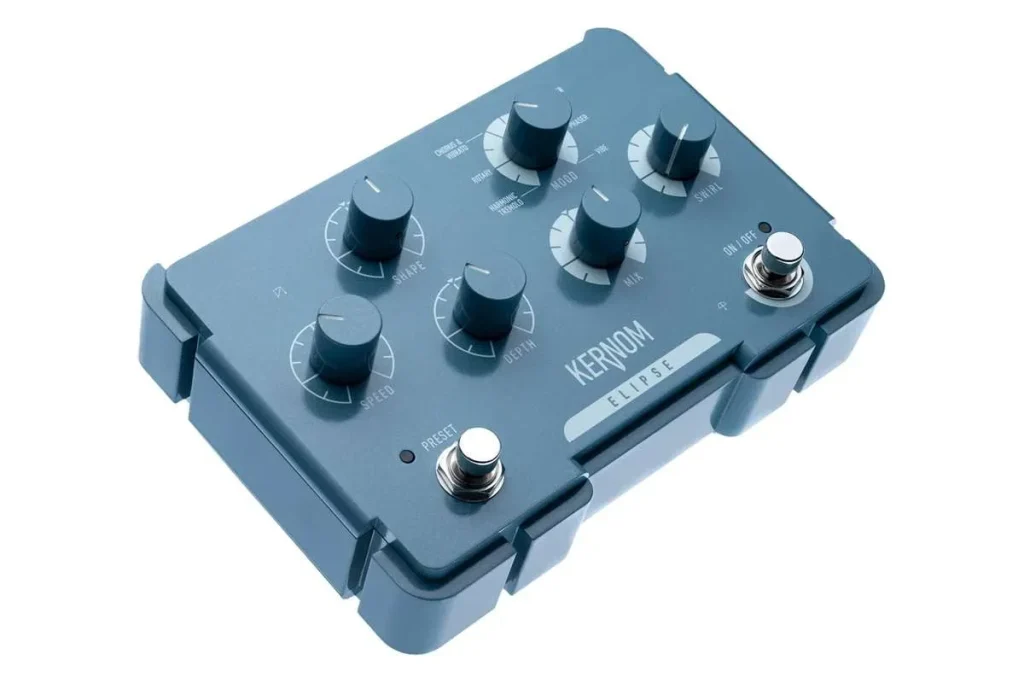

With an endless number of guitar effects on the market, it’s hard to know what’s worth trying. Guitar nerds might want to add the Kernom Elipse modulation pedal to the shortlist.
While attending the Mondo conference, I caught up with a friend who is working with Kernom, a boutique guitar pedal maker out of Paris. The company’s lineup includes the Elipse for modulation, the Moho for fuzz, and the Ridge for overdrive.
My friend was nice enough to give me a free Elipse so that I, as DMN’s resident guitar nerd, could check it out and let you know what I think.
I’ve now spent about four hours playing with it, and I’m really impressed by the sound and versatility. I could easily see this being a $450 to $550 pedal. It sells for $299.
Exploring the Elipse’s Modulation Effects
The Elipse’s mods include harmonic tremolo, rotary speaker, chorus/vibrato, flanger, phaser, and Vibe. Vibe is a Uni-Vibe-style phase effect, giving it a different character from the pitch modulation of vibrato.
Mood also lets you explore the sounds between the labeled positions. You can turn it gradually from one effect toward the next and stop wherever you like what you’re hearing.
The other controls are Speed, Shape, Depth, Mix, and Swirl. Speed and Depth adjust how fast and how intensely the effect moves, Shape changes the modulation waveform, and Mix controls the balance of your original and affected signals. Swirl adds a slow phaser through the first half of its range, then introduces drive as you turn it further.
A small adjustment makes a noticeable difference, and there are some pretty fun sounds to get out of this thing.
Something I appreciated was the expression input. I hooked up a cheap expression pedal I bought on Amazon years ago. It’s had mixed compatibility with other gear, but it worked right out of the box with the Elipse. I’ve wanted to find a phaser with expression capabilities for a while to try to emulate Jeff Lynne’s sound on songs like One Summer Dream and I kept finding options that were vintage and expensive. Finding a pedal that lets me control the sweep with my foot and modify a lot of other effects is very welcome.
Using it with the Vibe setting, I got a sound that reminded me of a delay, but with a thud that seemed less connected to the note I’d just played. I had a ton of fun with that, particularly because I could use my foot to dial it in or out while playing.
Saving a Sound and Coming Back to It
The Elipse has a dedicated Preset footswitch that lets you save a favorite sound. Dial in your settings, then hold the switch for more than two seconds until the LED flashes white. A short press then switches between that saved sound and the current knob settings.
That means you can save something you like and keep experimenting without losing it. You can also have two different sounds available underfoot, such as a chorus preset and a phaser set on the knobs.
The expression input works with that saved preset, too. In its standard operation, the expression pedal moves from the current knob settings at the heel position to the saved settings at the toe position. Several parameters can change together through that movement.
There’s one favorite preset accessible directly through the footswitch. For people with MIDI setups, the Elipse also has MIDI in and out, with 128 preset slots available through MIDI.
It requires an external 9V DC, center-negative power supply, sold separately. Kernom’s support page recommends a supply rated for at least 250mA. Plugging in is more convenient than dealing with batteries in my setup, so that’s fine with me.
Why the $299 Price Stands Out
For context, the Strymon Mobius is listed at $449 and the Walrus Audio M1 MKII at $399.99. Both have stereo capability, while the Elipse is mono, so those higher prices come with features that may matter to your setup.
Still, based on the sound and versatility I’ve experienced, I would have expected the Elipse to cost considerably more than $299.
Kernom has already attracted some recognizable names, with Mick Jagger among the musicians on its artist roster. My own experience with the brand is limited to these first four hours with the Elipse, but it’s made a very good impression and I’m excited to play on it more.
If you’re a pedal fan or looking for a good multi-modulation pedal, I’d suggest giving the Elipse a try.
Disclosure: I was given a free Elipse Pedal for review purposes, but I was not compensated for writing this by the company, or anyone else. I do not care if you buy one or not. No one from the brand was allowed to see this review or provide input on the content. If you would like your product reviewed, send an email to noah@digitalmusicnews.com. If it is something I find interesting, I might review it.