


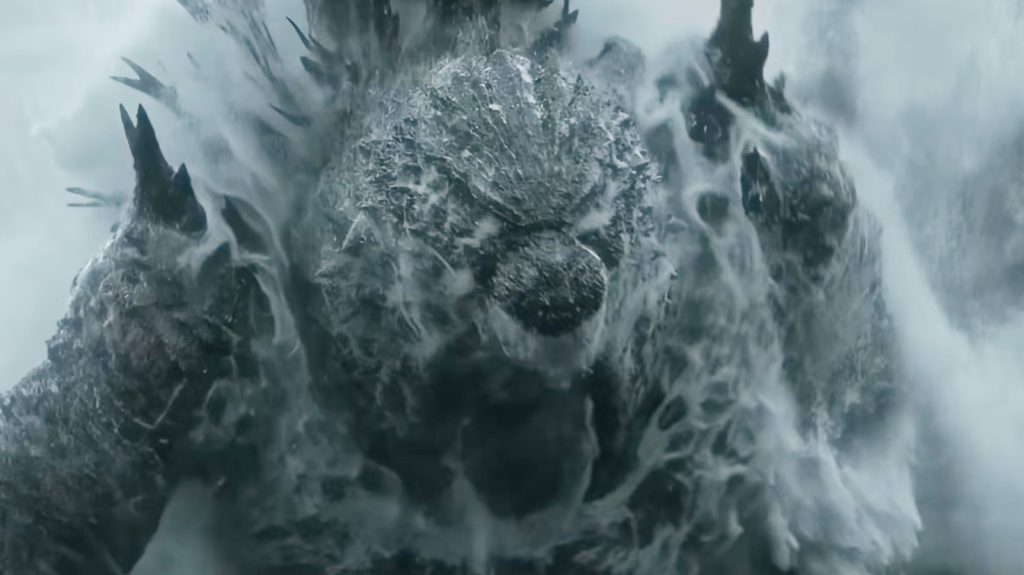

This article contains light spoilers for “Godzilla Minus Zero.”
For about as long as the Motion Picture Association (formerly “of America”) has existed, the conventional wisdom has been that blockbuster genre movies should receive the most inviting rating possible. This concept has existed at least since Steven Spielberg’s “Jaws” took the movie industry and pop culture by storm, as its PG rating allowed a wide audience to experience it. Certainly there have been exceptions, most famously at the hands of Spielberg himself, whose 1984 output revealed the necessity for a rating in between PG and R: the PG-13.
This middle ground rating then became the go-to standard for films that are edgy and adult without crossing a line into becoming too much for young teens. Its popularity has resulted in many filmmakers pushing its limits, especially as it came to be known as essentially the default movie rating. So far, every “Godzilla” film has received a rating of PG-13 or lower, as most of the movies involve giant monster-on-giant monster violence (thus meaning it’s impossible to emulate in real life, as per the MPA’s general view on violence).
However, that has now changed with the release of “Godzilla Minus Zero,” which has been given an R rating by the MPA. At first blush, it might seem that this is the “Godzilla” franchise’s move to appeal to an edgier audience, in the same way the Marvel Cinematic Universe was only too happy to make “Deadpool and Wolverine” a hard-R. Yet “Minus Zero” isn’t R-rated merely for surface-level indulgences like harsh language, extreme violence, or even sex. Instead, “Godzilla Minus Zero” earns the R for two very specific reasons, both of which make the higher rating more understandable.
Godzilla Minus Zero depicts real-world war violence
Ever since the very first “Godzilla” in 1954, the giant monster has been intentionally positioned as an allegory for the ravages of war — specifically, war with atomic weapons, whose devastation Japan had recently experienced. Though Ishirõ Honda’s film is a much more thoughtful and somber affair than modern audiences would expect, it’s still got enough B-movie flavor to explain why the franchise went on to become increasingly focused on spectacle and even more kid-friendly. While the darkness inherent in “Godzilla” has cropped up in several movies since, the allegorical nature of the character is usually kept to subtext.
Writer/director Takashi Yamazaki takes the franchise further in “Godzilla Minus Zero” by depicting real-life war violence: the immediate aftermath of the US bombing of Hiroshima. In the film, the fictional character Kanji Murakami (Min Tanaka) is one of the few survivors of the attack, and we’re shown a flashback in which he finds the charred remains of his family.
The upsetting reality of this moment not only fuels the themes of the film, but directly informs Murakami’s character, as we learn that his plan is to lure Godzilla to New York City and have the beast attack America. In this brief but powerful fantasy sequence, we see Godzilla shoot his heat rays at the city, causing people’s faces to melt off before they incinerate. It’s a sequence which does something rare, especially for blockbuster genre films: it depicts an intentional act of genocide on Americans. It’s a moment reminiscent of something like “Terminator 2” (which Yamazaki was inspired by), yet even more pointed given the emotion behind it. As such, it makes sense that the MPA would consider it rougher material than previous “Godzilla” movies.
The R rating for Godzilla Minus Zero is cumulative
As many have pointed out during the MPA’s 60-odd year existence, the organization’s rationale for a film’s rating is often frustratingly vague. Many filmmakers are annoyed by the process of submitting and resubmitting their movie to get their desired rating, with many decisions coming down to the tiniest omission of a handful of frames, as opposed to large swathes of material. While the MPA’s rulings are made on a literal case-by-case basis, the general idea seems to be that they’re usually judging a film by its overall tone and effect on an audience, rather than ticking checkboxes. While some elements like nudity and more than one F-bomb in the dialogue are near-guaranteed criteria for an R, some movies earn the rating through what the MPA likes to call “thematic elements.”
As such, the R rating for “Godzilla Minus Zero” is more of a cumulative one than anything else. Even if the Hiroshima flashback and NYC dream sequence were edited out, the film might edge close to an R solely for its grisly fight sequences between Godzilla and King Ghidorah. Both kaiju are particularly vicious in the way they take advantage of their respective regenerative powers, with the monsters ripping off each other’s heads and limbs, and we see sinewy tendons stretching before they snap. Although it’s still fantasy monster violence, when the film as a whole is taken into account, it does feel like giving it a PG-13 would be inappropriate, too. Ultimately, the rating is a reflection of how strong Takashi Yamazaki’s filmmaking is. It makes “Godzilla Minus Zero” the latest in a proud lineage of light R-rated films, meaning it’s likely to become a gateway genre movie for generations to come.
“Godzilla Minus Zero” is in theaters now.