


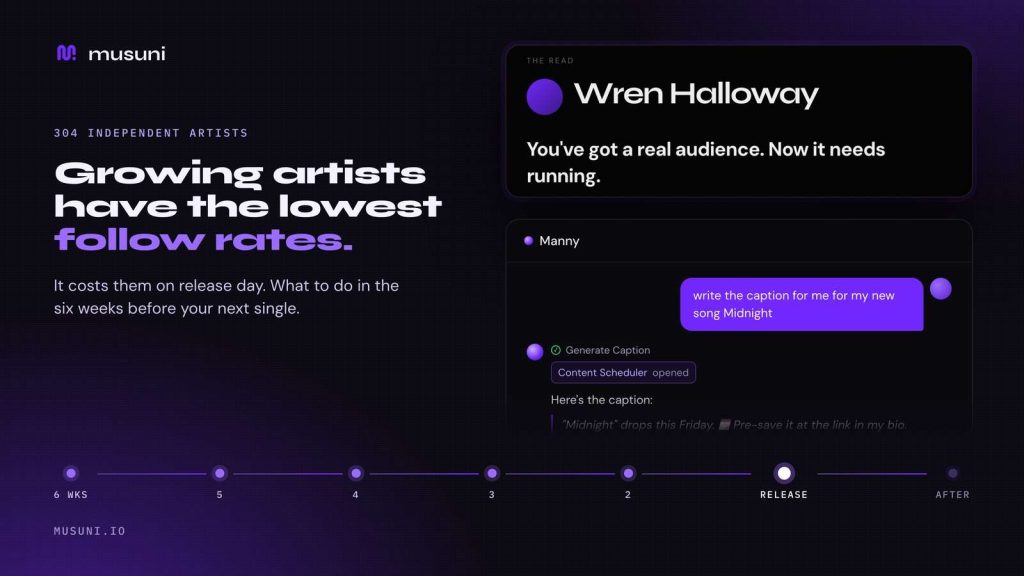

An analysis of 304 independent artists, and the six weeks that fix it.
The following comes from Musuni, a partner of DMN.
I’ve been putting out music on my own for nearly twenty years, and for most of them release day was where my work started. I’d finish the song, upload it, post “out Friday” and hope. A manager would have told me that by release day most of the result is already decided.
I didn’t have a manager. Most independent artists don’t.
This fall, while building Musuni, a manager app for independent artists, we looked at the streaming numbers of 304 of them, most with between a few thousand and 50,000 monthly listeners. One number stuck with me.
The artists whose listeners were growing had the lowest follow rates: about 25 followers for every 100 monthly listeners, against 45 for artists whose numbers were flat. Some of that is arithmetic, since a growing artist’s listener count rises faster than anyone could follow. It also means most of the people finding them were passing through.
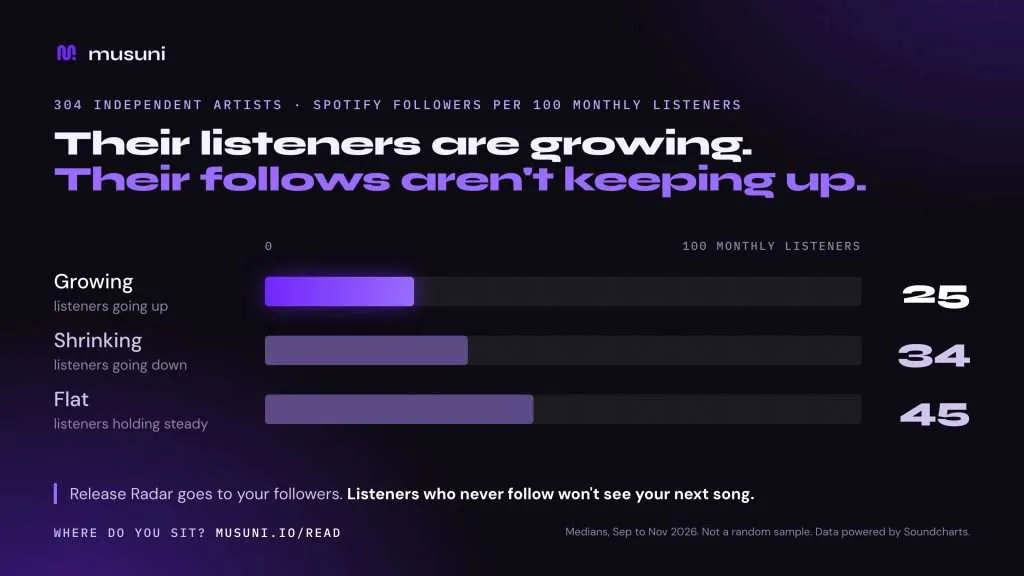
Artists whose listeners are growing turn the smallest share of them into followers. Among 304 independent artists, those whose audience was growing had 25 Spotify followers for every 100 monthly listeners. Artists holding steady had 45. Release Radar goes to your followers, so a listener who never follows won’t see your next song.
On release Friday, Spotify’s Release Radar goes to your followers. If new listeners don’t follow, most of them won’t see your next song.
You can check your own ratio in Spotify for Artists right now: divide your followers by your monthly listeners. The free Read at musuni.io/read runs that check and a few more from just your artist name, with no account and no email.
Below is how I’d use the six weeks before a single, and where Manny, the manager inside Musuni, helps. The artist is a composite. The screenshots are from my own artist account with the name changed.
Six weeks out: find the gap
The Read shows your stage, whether listeners are rising or slipping, where the numbers point to the problem, and what to do next. Our artist has about 15,000 monthly listeners and 1,100 followers, so step one is free: ask for the follow in every caption and at the end of every video, starting this week. The Read also lists what it can’t see from public data, like her saves or which post brought people in.
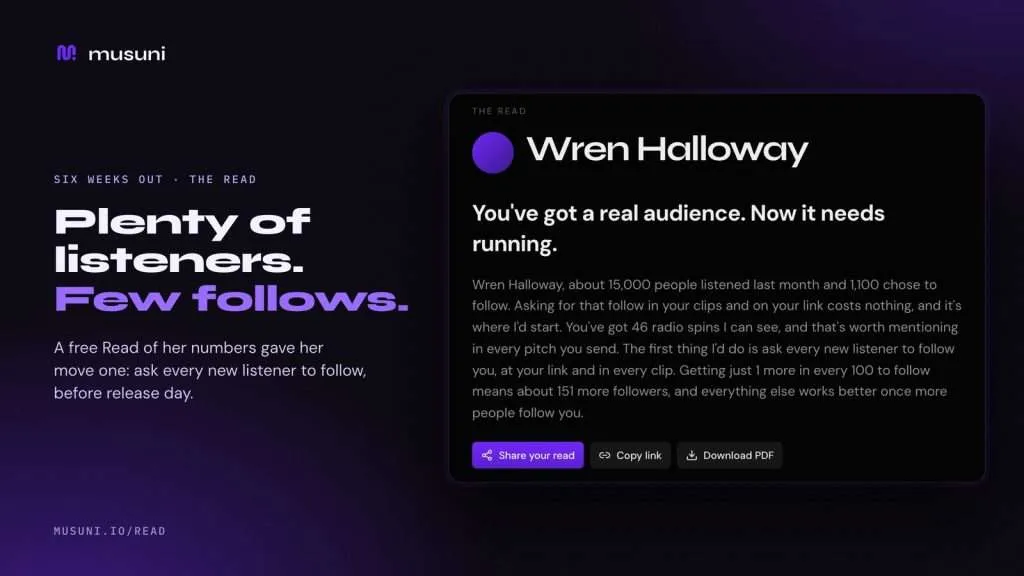
The free Read: plenty of listeners, few follows, and what to do first.
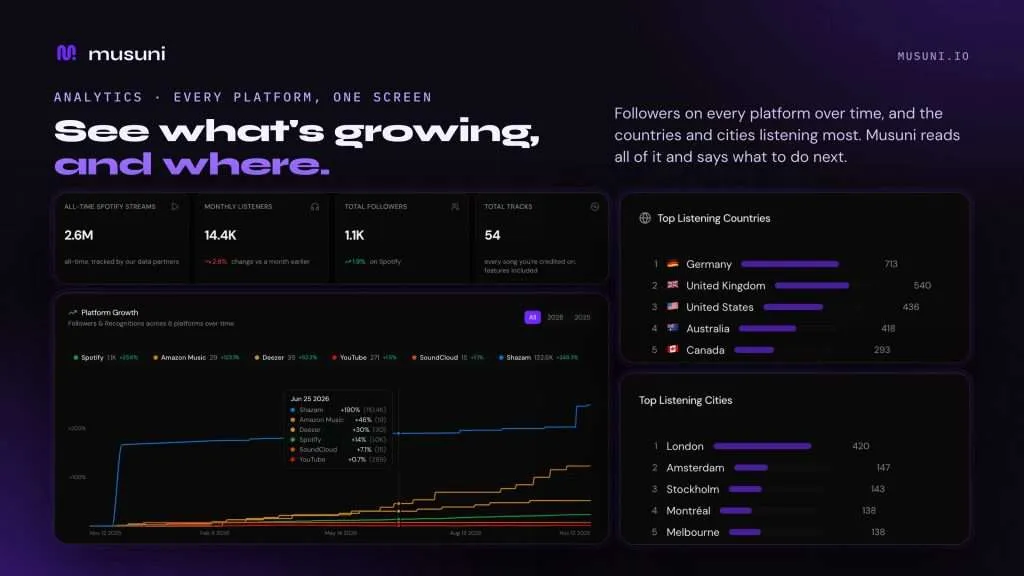
Do you know which city listens to you most? This artist’s answer was London, with Germany as the top country, and Shazam growing faster than any streaming platform. Musuni puts every platform, country and city on one screen. From my own artist account, with the name changed.
Five weeks out: put dates on it
She tells Manny the song title and release date once, and every conversation after that knows them. On the free plan, that becomes a campaign in phases with draft captions waiting in her content calendar.
If you want it done for your release, the paid Release Plan puts 14 dated steps on your calendar, starting up to eight weeks out, says who does each one, and drops the steps that can’t help anymore if you’re starting late. I review every plan myself within two days.
Four weeks out: the editorial pitch
The Spotify editorial pitch has to be in at least seven days before release for your followers’ Release Radar. Manny drafts it with you, under 500 characters plus the genre and mood tags Spotify asks for, and you submit it in Spotify for Artists, since only the artist can. If it’s still a draft eight days out, Manny reminds you.
Pitch every release, just don’t count on it. In our sample, fewer than one in five artists were on any editorial playlist.
This is also the week to put up a pre-save page. It switches to live streaming links on release day, and on paid plans every fan who left an email gets one note that the song is out.
Three weeks out: radio and curators
College and community radio is some of the most overlooked free outreach there is. Manny picks up to 30 stations that fit your sound and drafts a pitch for each, which you send from your own email. It drafts pitches to independent playlist curators too, and nothing goes out until you approve it.
Nobody can promise you streams or placements, and offers that do are one of the fastest ways to lose money and get a track flagged. If one lands in your DMs, paste it into the free checker at musuni.io/check to see the warning signs.
Two weeks out: post enough
Post often enough that people remember the song is coming. Daily isn’t required. When you’re stuck on what to film, pick one simple format, a hook and three shots, and film that. Ask Manny for the caption and it uses your real release date, or asks if it doesn’t have one.
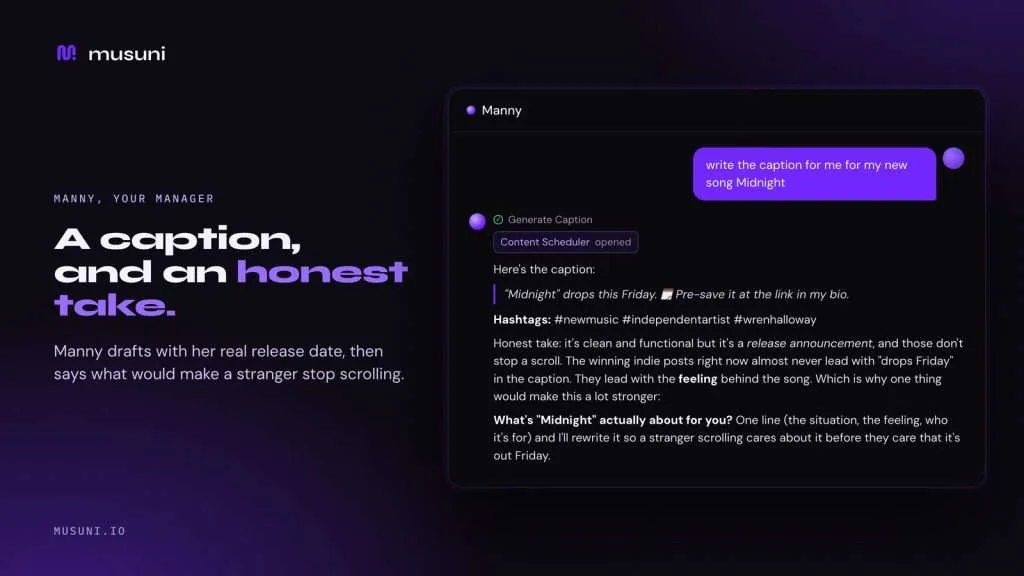
Manny drafts the caption with the real release date, then says how to make the first line stronger.
Release week: keep the new listeners
Share the link everywhere, pitch the playlists that only take released songs, answer every comment and DM the song brings in, and keep asking for the follow.
If you have a single coming
None of this is new. Managers have run releases this way for decades. I didn’t have one keeping me on schedule, so I built one.
Start with the free Read at musuni.io/read and see where your gap is. Musuni opens to everyone today, and if you want more than the Read, plans start at $19 a month. The first 500 artists keep that price for life.
What 304 artists’ numbers show
Growth is close to a coin flip. 38% were growing, 35% were shrinking and 23% were flat.
Playlists are common, editors are rare. The median artist was on about 100 playlists. Fewer than one in five was on an editorial one.
One in six had more followers than monthly listeners. Those fans are waiting, and a new release reaches them the week it comes out.
Method: one Read per artist, September to November 2026, medians. These are artists we looked up while building Musuni, so treat it as a snapshot.
Amah Ajavon is an independent artist and the founder of Musuni.