


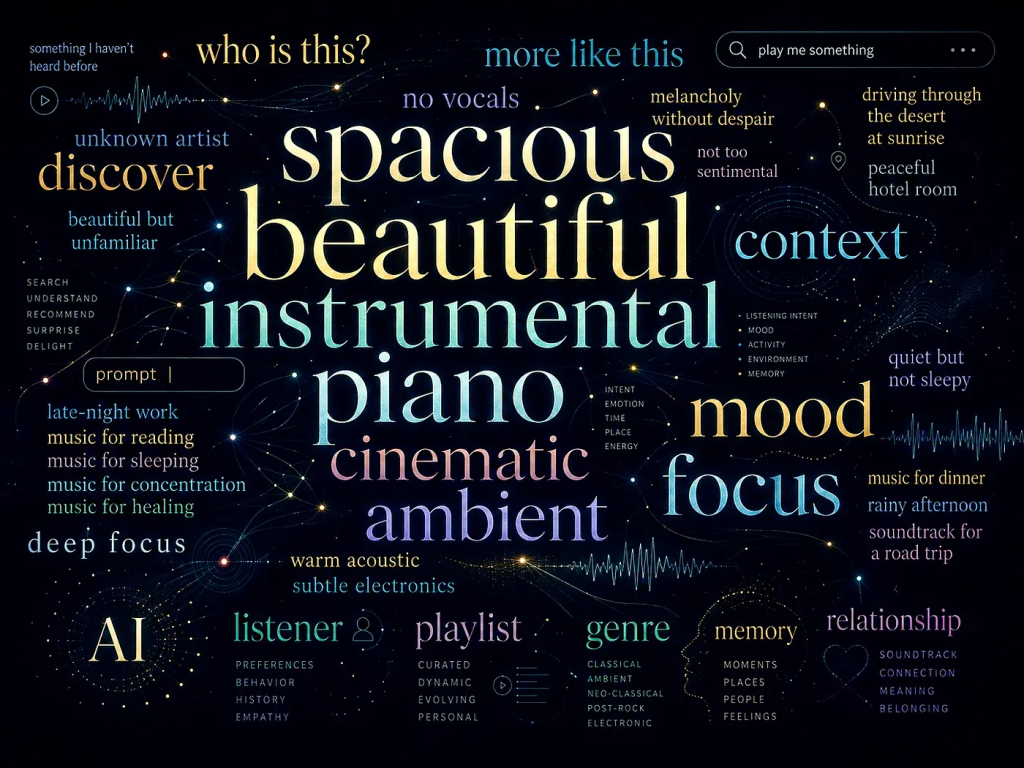


Imagine someone sitting at home late at night and saying, “Play me something spacious and beautiful that I haven’t heard before. No vocals. Piano is fine, but nothing too sentimental.” Who gets played? That question is about to become much more important than musicians realize.
The listener did not search for an artist. They did not type a song title, choose a genre, visit a playlist, read a review, scroll through album covers, ask a friend, follow a link from Instagram, or spend forty-five minutes staring at recommendations while somehow listening to nothing.
They simply described what they wanted, and then the machine decided which music answered the question. Welcome to the next music-discovery problem.
We Keep Changing the Gatekeeper
For most of the history of recorded music, discovery depended on somebody or something standing between the artist and the listener. The identity of that middleman changed, but the basic arrangement did not. First there was the record store. Somebody stocked the record, displayed it, recommended it, or put it in the correct bin. There was something wonderfully physical about the whole thing. You walked into a place full of music you did not know existed and surrendered a certain amount of control to whoever worked behind the counter.
Then radio became enormously powerful. A programmer, music director, DJ, promoter, record company, independent promotion person, or some unholy combination of all five decided what millions of people heard. If your record did not get through that system, you could have made Sgt. Pepper in your garage and your mother might still have been the only person who heard it.
MTV added another gatekeeper. Music magazines and newspapers had theirs. Record labels certainly had theirs. Retail had buyers. Distributors had salespeople. Everybody had an opinion, and somehow all of those opinions stood between the music and the public.
Then the internet arrived and promised to destroy the gatekeepers, which was adorable. We did not destroy the gatekeepers. We automated them. Search engines became gatekeepers. Social platforms became gatekeepers. Streaming services became gatekeepers. Playlists became gatekeepers. Recommendation systems became gatekeepers. An artist could theoretically release music to the entire world while remaining almost completely invisible to it. Progress.
Now we are about to install another gatekeeper, except this one is going to speak in complete sentences and act like your friend.
Search Required You to Know Something
Search was revolutionary because it allowed people to find almost anything, but traditional search contained an obvious requirement: you had to know something about what you were looking for. You needed a name. Maybe you knew the artist, the song, or the album. Maybe you knew enough to type “ambient piano music,” “1970s Brazilian jazz,” or “songs that sound like Peter Gabriel.” You supplied a relatively crude description, and the system tried to match it against information it understood.
Streaming algorithms changed the equation because they no longer required you to tell the machine very much. The platform could watch you. You listened to this, skipped that, saved this, abandoned that after twelve seconds, played one artist thirty times, and always listened to mellow instrumental music around midnight. You had absolutely no idea you were producing data, but congratulations, you were working for the recommendation system.
The machine inferred intent from behavior. That system became astonishingly sophisticated, but it was also fundamentally backward-looking. It knew what you had already done and tried to predict what you might want next. AI introduces something much simpler and, potentially, much more powerful: you can simply tell it.
We Are Moving From Inferred Intent to Declared Intent
This is the transition I think musicians need to understand. Instead of Spotify watching your behavior and guessing that you might want atmospheric instrumental music, you can say, “Give me long-form instrumental music that feels expansive but not sleepy, mostly acoustic with a little electronics, something I can write to for the next hour.”
That is not a genre. It is barely a search. It is a description of a situation containing purpose, emotion, aesthetic preference, instrumentation, duration, intensity, and context all at once. A recommendation system can combine that request with what it already knows about the listener and decide which music qualifies.
Spotify is already moving deeply into this territory with prompted playlists and conversational control. YouTube Music has been developing similar natural-language discovery. Amazon has experimented with prompt-based playlist creation. These companies have clearly noticed something embarrassingly obvious: ordinary people do not naturally think in metadata fields.
Nobody walks into the kitchen and says, “I require mid-tempo neo-classical instrumental content between 70 and 82 BPM with low vocal probability and moderate acousticness.” They say, “Put on something beautiful while we eat.” AI understands that sentence, and that is the breakthrough.
Your Listener May Never Open Spotify
This is where it gets bigger. Music discovery is beginning to move outside music applications entirely. Someone can be having a conversation about a road trip, dinner party, workout, vacation, relationship, film, book, city, or completely unrelated subject and suddenly decide that music would improve the situation.
The conversation might go something like this: “I’m driving through New Mexico tomorrow morning. Give me something cinematic and spacious, preferably instrumental, that doesn’t sound like spa music.” An AI can connect that request with music, and notice what disappeared from the process: the Spotify search box.
That is a profound change. The listener’s first interaction with music may happen inside a general-purpose intelligence that already understands what they are doing, what they are talking about, what kind of mood they are in, where they are going, and possibly what they have listened to previously. Music becomes an answer inside a larger conversation.
Your next fan may never search for you because searching for you assumes they already know you exist. They don’t. That has always been the problem.
The Artist Name May Come Last
Music marketing has traditionally been built around trying to make people remember names. Remember my artist name. Remember my album title. Remember my single. Remember my logo. Remember my face. Click my link. Follow me. Pre-save me. Subscribe to me. Please, for the love of God, remember anything about me.
AI discovery reverses the order. The listener might hear the music first because the system decided that the recording matched a need. Artist identity can come afterward, which could be extraordinarily powerful for unknown musicians and simultaneously disastrous for them.
Discovering a recording and discovering an artist are not the same thing. That distinction may become one of the central problems of the next generation of music discovery.
Genre Starts Losing Its Grip
One of the most interesting things about conversational discovery is that genre becomes less important. Genre has always been partly useful and partly ridiculous. It helps us organize music while forcing incredibly different artists into the same box because somebody at a distributor needs to choose something from a drop-down menu.
Ambient. Jazz. Classical. New age. Electronic. Singer-songwriter. Alternative. Contemporary instrumental. Wonderful. We have successfully described almost nothing.
Now consider a request like this: “Play instrumental music that makes an unfamiliar hotel room feel peaceful while I work late.” What genre is that? It could be ambient, piano, electronic, neo-classical, jazz, a film score, or music created thirty years ago in a category the listener has never heard of. The listener does not care. They described the function and emotional quality they wanted.
This could be incredibly liberating for artists whose work never fit comfortably inside one of the industry’s badly labeled cardboard boxes. A machine capable of understanding musical characteristics does not necessarily need to decide whether something is ambient or classical before deciding it belongs in a certain situation. Maybe genre does not disappear. Maybe it becomes just one signal among hundreds. That would be an improvement.
The Machine Is Learning to Listen
Here is the part that makes the shift more significant than simply better metadata. Artificial intelligence systems are increasingly capable of connecting audio with language. In other words, the machine can hear a piece of music and develop a representation of characteristics inside the recording: tempo, instrumentation, texture, mood, rhythmic activity, density, vocal presence, harmonic qualities, energy, structure, and sonic relationships.
Then those characteristics can be connected with ordinary human descriptions. Discovery does not have to rely completely on whether somebody accurately tagged your recording. The machine can increasingly hear that a piece is slow, sparse, piano-driven, atmospheric, gradually evolving, rhythmically ambiguous, harmonically warm, or electronically textured.
For years musicians have asked, “How do I describe my music?” Now there is another question: How does the machine describe my music? Those answers may not be the same, and that could become extremely important.
Welcome to Music Discovery Optimization
For the last twenty years, the internet trained everyone to obsess over SEO: Search Engine Optimization. Use these words. Put them in this headline. Repeat this phrase. Write the title this way. Structure the page this way. Please the search engine. Then we collectively wondered why so much of the internet began reading like it had been written by a depressed committee of appliances.
Music is about to get its own version, and some consultant is probably already designing the webinar: Seven Secret AI Discovery Hacks Spotify Doesn’t Want Musicians to Know. Only $997, and if you act now you will receive a downloadable PDF containing the words “mood,” “metadata,” and “authenticity” approximately forty times.
We know how this goes. Musicians will discover that conversational AI can recommend music based on language, and a certain percentage of them will immediately conclude that their artist biography should contain every conceivable phrase anyone might type: “Deep relaxing inspirational emotional cinematic spiritual peaceful focus meditation study sleeping atmospheric piano.”
That is not an artist description. It is a hostage note from somebody trapped inside the wellness section of Spotify.
The good news is that AI systems should eventually become harder to fool this way because they can increasingly consider the actual recording, listening behavior, relationships between artists, contextual information, and many other signals. The bad news is that this has never stopped humans from trying.
Don’t Optimize the Music for the Prompt
The real danger is not ugly biographies. It is ugly creative incentives.
Once artists realize listeners are requesting music according to situations, artists will inevitably begin making music for the requests. Music for sleeping. Music for studying. Music for running. Music for reading. Music for meditation. Music for dinner. Music for sadness. Music for healing. Music for focusing. Music for feeling sad but not too sad because apparently even despair needs proper market segmentation.
There is nothing inherently wrong with functional music. Musicians have created music for ceremonies, dancing, worship, theater, work, sleep, celebration, mourning, and countless other purposes for thousands of years. The problem begins when the platform’s discovery language starts quietly shaping artistic decisions.
If enough listeners ask for “peaceful instrumental piano for concentration,” somebody will begin optimizing arrangements for that request. Then labels will notice. Then producers will notice. Then playlist companies will notice. Eventually every piano track will be three minutes of emotionally non-threatening beige with a felt-piano preset and enough reverb to suggest an abandoned Scandinavian railway station.
We have already watched playlist culture influence track lengths, introductions, dynamics, song structures, and release strategies. Conversational discovery could go further. Instead of merely making music to fit a playlist, artists might begin making music to fit a sentence. At that point AI has not discovered your art. AI has quietly commissioned it.
Metadata Is About to Become More Interesting
There is, however, a practical lesson here for musicians who do not intend to become prompt prostitutes. Metadata matters.
For years metadata has felt like the boring paperwork attached to the exciting part. Song title. Artist. Album. Genre. Composer. Publisher. Release date. ISRC. Congratulations. You made art and were rewarded with data entry.
But descriptive metadata becomes more interesting when machines are attempting to understand how music relates to human intentions. Mood matters. Instrumentation matters. Whether the piece contains vocals matters. Musical culture matters. Tempo matters. Style matters. Credits matter. Collaborators matter. Context matters.
These are no longer merely filing-cabinet details. They help construct the network of information surrounding the work. The goal is not to manipulate the system. The goal is to describe the work accurately enough that it can be understood.
Credits May Become Discovery Paths
The old music business treated credits as something we buried in tiny type that nobody could read without a magnifying glass. Streaming initially managed to make the situation worse. We took twelve-inch album jackets full of musicians, producers, engineers, studios, songwriters, photographers, arrangers, and session information and replaced them with a 200-pixel square image and a button. Brilliant.
Now those relationships are becoming discoverable again. A producer connects one artist to another. A songwriter connects songs. A musician connects sessions. A sample connects generations. A cover connects interpretations. A collaboration creates another path through the catalog.
AI thrives on relationships, which means the seemingly boring connective tissue around music could become part of the discovery environment. Someone might discover an artist not because they searched for that artist, but because they asked for music connected to a producer, instrumentalist, record, era, location, sound, or scene. Maybe liner notes were metadata all along. We just needed computers powerful enough to care.
Your Public Identity May Need to Make Sense to Machines
This part gets delicate because musicians should not begin writing every sentence for robots. But if discovery becomes increasingly semantic, coherent context around an artist matters.
If your work genuinely revolves around cinematic instrumental music, acoustic piano, electronic texture, improvisation, meditation, spatial sound, orchestration, or some other identifiable aesthetic, that information should exist clearly somewhere around your work. Not seventeen contradictory artist bios. Not one website saying you are a “visionary cinematic neo-classical composer” while Spotify says “new age,” Instagram says “producer,” Bandcamp says “ambient,” and your latest press release calls you “genre-defying” because apparently nobody has invented another adjective since 1996.
Humans already struggle to understand incoherent positioning. Machines will inherit the same problem. Maybe one of the stranger side effects of AI discovery is that artists will finally need to become clearer about what they actually do. There are worse outcomes.
The Back Catalog Could Get a Second Life
This is one part of the future I genuinely like. Release culture has become absurdly obsessed with the new. New single. New campaign. New content. New reel. New playlist pitch. New release countdown. Three weeks later, apparently the song is archaeological material and everyone needs another one.
Streaming encouraged enormous catalogs while simultaneously training artists to behave as though anything older than ninety days had died. Conversational discovery has the potential to disrupt that.
A listener asks, “Give me beautiful instrumental music for driving through the desert at sunrise.” Why should the answer have been released Friday? The perfect track might have come out in 1998. It might be track nine from an overlooked record. It might have been ignored when released because the artist had no promotional budget. It might belong to somebody the listener has never heard of.
Semantic discovery does not inherently care whether the recording is new. It cares whether the recording answers the request. That could return value to deep catalogs in a way playlist culture has only partially accomplished. Artists with decades of work may suddenly possess thousands of potential answers to questions nobody previously knew how to ask.
The Cold-Start Problem Might Become Less Brutal
This could matter enormously for independent artists. Traditional recommendation systems love data. If thousands of listeners who like Artist A also like Artist B, recommending B to another fan of A is easy.
But what happens when nobody has listened to you yet? That has always been one of the cruel little jokes embedded inside algorithmic discovery. To get discovered, you need listeners. To get listeners, you need discovery. Good luck.
Semantic audio understanding potentially creates another pathway. If a system can actually analyze the music and determine that it matches a request, an unknown recording can theoretically compete based partly on its characteristics rather than solely on the behavioral history attached to it.
That does not mean the algorithms are suddenly going to become benevolent patrons of unknown musicians, so please do not start hugging your laptop. Popularity signals will still matter. Engagement will matter. Rights deals will matter. Commercial priorities will matter. Platform incentives will matter. Money will mysteriously continue to matter because civilization remains consistent in that regard.
Still, the possibility that an unknown track can be retrieved because it is musically appropriate rather than because it has already won the popularity contest is significant. That deserves attention.
The Invisible Gatekeeper Is Still a Gatekeeper
Now for the part nobody wants to put in the product demonstration. Conversational discovery feels incredibly open. Ask for anything. Tell the AI exactly what you want. The machine understands. Beautiful.
Then the machine returns twenty songs from a catalog containing tens of millions of recordings. Why those twenty?
Radio had programmers. You knew somebody was choosing. Magazine reviews had critics. There was a name attached to the opinion. Record stores had buyers and clerks. Editorial playlists at least theoretically had editors.
An AI response feels different. You ask, “Give me ten contemporary instrumental composers I should know,” and ten names appear with the smooth confidence of divine revelation. But those names were selected. Millions were excluded. Some ranking system decided what counted.
Signals were weighted. Commercial relationships existed. Data was incomplete. Training information had biases. Popularity may have influenced the result. Your history may have influenced the result. Platform priorities may have influenced the result.
The interface feels conversational and neutral. The machinery underneath it is neither. That could make the next generation of gatekeeping more powerful precisely because it is less visible. At least the radio DJ had a voice and a name. The AI just says, “Here are some artists you might enjoy.” How helpful.
What Happens When People Stop Browsing?
There is another loss buried in all this efficiency. Browsing matters.
Going into a record store and looking through things you did not intend to find mattered. Reading a magazine and encountering an artist because the review was next to something else mattered. Looking at album covers mattered. Watching opening acts mattered. Hearing somebody else’s music through the apartment wall mattered. Accidents mattered.
Discovery used to contain friction. You went looking for one thing and found another.
AI is extremely good at eliminating friction. That is what everyone loves about it, and it is also what worries me. If I can describe exactly what I want and receive it instantly, I may discover fewer things that I didn’t know I wanted.
A perfect recommendation engine risks becoming a cultural mirror. Give me more of me. More music appropriate for my mood. More music consistent with my taste. More things adjacent to things I already like. More comfort. More optimization.
Eventually we could create the most technologically advanced discovery system in history and use it primarily to make sure nobody ever hears anything genuinely irritating, confusing, difficult, or new. That would be an achievement.
Maybe Genre Dies and Mood Takes Over
There is another possibility that is both liberating and horrifying. Genre could gradually be replaced by emotional and functional categories, not completely, but substantially.
Instead of “jazz,” listeners ask for “music that feels sophisticated without demanding too much attention.” Instead of “ambient,” they ask for “something spacious enough to make the room feel bigger.” Instead of “classical,” they ask for “dramatic orchestral music that feels tragic but not depressing.”
This language is richer in some ways and brutally utilitarian in others. The artist becomes a provider of emotional outcomes. Need serenity? Click here. Need confidence? Here is fifteen minutes of algorithmically approved empowerment. Need existential dread with a moderate energy level? Premium subscribers get lossless existential dread.
Music has always affected emotion, but there is something slightly disturbing about turning emotional experience into an on-demand product specification. Maybe I do not want every piece of music to have a job. Some music should be allowed to stand in the corner and make absolutely no effort to improve my productivity.
Getting Discovered May Become Easier
Here is the paradox. AI might become unbelievably good at matching listeners with unfamiliar music, solving a problem that has frustrated musicians forever.
There are people somewhere in the world who would genuinely love your music if only they heard it. That sentence has launched approximately four billion independent-artist marketing campaigns. The problem has always been finding those people.
AI potentially gets much better at it. A listener describes a feeling, situation, sonic quality, or idea. The system understands the request, understands something about the music, understands something about the listener, and brings the two together.
Fantastic. Then what?
The song plays. They like it. Another song plays. They like that too. Then another. Two hours later the system has provided a flawless listening experience containing fifteen artists the listener cannot name.
Congratulations. Your music was discovered. You were not.
Discovery and Fandom Are Not the Same Thing
This distinction may become more important than almost anything else in the AI music conversation. Platforms talk constantly about discovery because discovery is measurable. The listener encountered the track. The track received a stream. The recommendation worked. Everybody high-fives the dashboard.
Artists need something more difficult: recognition, memory, curiosity, connection, and the moment when someone hears a piece and stops the endless flow long enough to ask, “Who is this?”
A fan is not simply somebody who failed to press Skip. A fan wants another record. A fan learns the artist’s name. A fan searches the catalog. A fan watches the interview. A fan buys the ticket. A fan follows the story. A fan cares what happens next.
AI may become brilliant at delivering exactly the right piece of music at exactly the right moment while making the individual artist almost irrelevant to the experience. You could become the perfect soundtrack to somebody’s life without ever becoming part of their life. That should concern musicians.
The Great Background-Music Trap
There is a particularly dangerous version of this for instrumental artists. Imagine an AI that knows your music is perfect for concentration, reflection, reading, meditation, sleeping, traveling, grieving, studying, relaxing, eating, bathing, exercising, or looking thoughtfully out of airplane windows.
Excellent. Your streams go up. Nobody knows who you are.
You have become highly efficient emotional furniture.
This has already happened to some degree through playlists, but conversational discovery could accelerate it dramatically because the listener may not even see the playlist. They ask for a feeling, music appears, the desired feeling occurs, and the transaction is complete. The artist becomes part of the infrastructure.
For some creators, that may be perfectly acceptable. There is nothing wrong with making functional music and getting paid for it. But artists interested in careers rather than streams need to understand the difference. Being useful is not the same as being loved. The algorithm does not care. You should.
The Hard Problem May Become Getting Remembered
For decades musicians have been told that getting discovered is the central challenge. Maybe that is about to change.
If AI becomes excellent at discovery, music can appear wherever it is contextually appropriate. The machine can keep feeding the listener unfamiliar material indefinitely. Discovery becomes abundant. Attention does not. Memory certainly does not.
That means the competitive question shifts from “How do I get heard?” to “What happens after I am heard?” Why would someone stop? Why would they care? Why would they remember your name? Why would they want to know the story behind the music? Why would they move from the perfectly personalized stream into your world?
That is the part no recommendation algorithm can solve for an artist, and I suspect it will become more important.
AI Could Make Artist Identity More Important, Not Less
At first glance, conversational discovery seems to weaken artist identity because the listener asks for music rather than musicians. But the opposite could happen at the other end.
If there is an effectively infinite supply of contextually appropriate music, then the music itself may no longer be enough to establish lasting value. There will always be another beautiful piano piece, another gorgeous voice, another ambient texture, another great guitar player, another competent producer, another composition matched perfectly to the moment.
What creates durability? Identity. Point of view. History. Personality. Body of work. Values. Story. Community. Relationship. The things marketers love to reduce to the word “brand” because apparently we need to make everything sound like toothpaste.
Artists may need stronger identities precisely because discovery becomes more frictionless. The machine gets you into the room. You still have to give people a reason to stay.
Then We Arrive at the Really Uncomfortable Question
There is one final problem hiding underneath everything we have discussed. Suppose I ask, “Play me twenty minutes of spacious instrumental music with acoustic piano, subtle electronics, slow harmonic movement, and a feeling of melancholy without despair.”
Why should the AI find an existing recording? Why not make one?
That is where conversational discovery collides with generative music. The same language that can retrieve music can increasingly create music. The distinction between search and generation begins to blur.
A listener wants a particular musical environment. The system has two options: search millions of recordings and find the best match, or generate something specifically for that listener, for that situation, for exactly twenty minutes, never heard before and possibly never heard again.
Now the musician’s competition is no longer merely every other recording ever made. It is music that did not exist until the listener requested it.
That is considerably more unsettling than whether your latest single made New Music Friday.
Why Retrieve When You Can Generate?
The economics will eventually make this question unavoidable. Recorded music involves rights holders, songwriters, publishers, artists, labels, distributors, licensing, royalties, territories, accounting, and contracts. Generative music has its own legal and economic complications, but technology companies have an extraordinary historical ability to look at a complicated value chain and ask whether fewer people could somehow be paid.
Imagine a platform determining that the user does not actually care which artist satisfies the request. The listener wants “peaceful piano for reading.” They do not ask for a person. They ask for a product characteristic.
At that moment the existing artist is vulnerable. If music is treated purely as utility, generated music has an obvious advantage. It can be custom-made, endless, instantly adjustable, and it never demands creative control. It never has a manager. It never gets older and makes a difficult experimental record nobody understands.
The more musicians allow themselves to be reduced to interchangeable providers of mood, the easier they are to replace with something manufactured specifically to deliver that mood. That is the trap.
Don’t Compete With the Machine at Being Generic
This might be the most practical advice in the entire article. If AI becomes incredibly good at producing generic competence, stop trying to win by being generically competent.
Being “good” is not enough when machines can generate technically impressive music by the truckload. Being appropriate to a playlist is not enough when software can manufacture music specifically for the playlist. Being relaxing, cinematic, atmospheric, or catchy is not enough. Those are characteristics. They are not identity.
The stronger artificial intelligence becomes at satisfying generic musical requests, the more valuable the things that cannot easily be reduced to a request may become: a recognizable point of view, a history, a personality, a relationship with an audience, a body of work whose meaning accumulates over time, and a reason for someone to care that you made this particular piece.
That is not anti-technology. It is basic differentiation.
The New Discovery Funnel
The old music-business fantasy went something like this: get signed, get on radio, sell records, become famous. That system was brutal but at least easy to diagram.
The current version is substantially more deranged. Release music. Pitch playlists. Generate content. Feed social media. Run ads. Build an email list. Create short-form video. Study analytics. Optimize conversion. Post constantly. Attempt to remain psychologically functional.
AI adds another stage. Now a machine may decide whether your recording corresponds to an intention expressed by somebody who does not know you exist.
The new funnel could look something like this: the listener expresses a need, the machine interprets the need, the system selects the music, the listener encounters the recording, the recording earns attention, the listener becomes curious, the artist becomes memorable, and the listener enters the artist’s world.
Only the first three stages are really an AI problem. Everything after that remains an artist problem. That distinction is critical.
Stop Worshipping Discovery
I have become increasingly suspicious of the word “discovery.” The music industry talks about discovery as though hearing something once is the equivalent of forming a meaningful relationship with it. It isn’t.
Discovery is the first five seconds. Care is what happens afterward.
We have spent years building systems capable of delivering more music to more people more efficiently, and somehow artists still struggle to build durable careers. Maybe distribution was never the whole problem. Maybe discoverability was never the whole problem.
Maybe the harder thing is creating work people choose to return to when 100 million other recordings are one click away and an infinite number of new ones can potentially be generated on demand.
AI can introduce you. It cannot force anyone to care. That remains irritatingly human.
So What Should Artists Actually Do?
First, make sure the information surrounding your music accurately reflects what the music is. Get the credits right. Get the metadata right. Describe the work clearly. Make your catalog understandable. Preserve connections between collaborators, recordings, projects, eras, and influences. Do not treat the administrative side of releases like garbage you grudgingly finish at midnight before distribution.
Machines increasingly depend on structured information and relationships, so give them good information. Think seriously about the language people might genuinely use to describe your work, but do not write music for those phrases. There is a difference between understanding how listeners experience your music and manufacturing music to satisfy search requests. One is useful. The other is how we end up with seventeen million songs called “Deep Sleep Piano Rain.”
Most importantly, develop an identity outside the individual track. Have a point of view. Tell the story. Build direct relationships. Give people somewhere to go after they hear the recording. Own a website. Own a mailing list. Create enough context around the music that curiosity has somewhere to land.
If AI gives you ten thousand new listeners and none of them can remember who made the music, you have successfully built somebody else’s product.
The Artist Still Has a Job
There is a tendency whenever AI enters a discussion to conclude that whatever humans were doing previously is about to become irrelevant. I do not believe that. I think some tasks become less important while other tasks become much more important.
Searching becomes less important. Filtering becomes more important. Generic description becomes less important. Clear identity becomes more important. Getting into the catalog becomes less difficult. Standing out inside the catalog becomes brutally difficult. Creating music becomes easier. Creating music that means something to somebody may not.
The machine can connect a listener with your recording. It can potentially explain who you are, recommend your catalog, build a playlist, identify similarities, and decide that your music matches an emotional request with extraordinary precision.
But at some point the listener either feels something or they do not. At some point they either become curious or they do not. At some point they either remember your name or they do not. No amount of metadata can manufacture that.
Your Next Fan May Never Search for You
That sentence sounded speculative to me when I first started thinking about this. It does not anymore.
Your next fan may be talking to an AI about something completely unrelated to music. They may be planning a trip, working late, recovering from something, cooking dinner, driving somewhere unfamiliar, trying to concentrate, trying not to concentrate, or simply trying to change the mood in a room.
Then they ask for music. The AI searches through a world of possibilities and somehow puts your recording in front of them.
That is extraordinary, but it is only the beginning. The real question is what happens thirty seconds later. Does your music become another perfectly selected sound that disappears into an endless personalized stream, or does something happen that makes the listener stop? Do they look at the screen? Do they ask, “Who is this?” Do they remember? Do they want another piece? Do they enter the catalog? Do they become interested in the person behind the music?
That is where discovery becomes a relationship. We have spent decades obsessing about getting people to find us, and artificial intelligence may eventually become exceptionally good at solving that problem. Which means musicians may finally have to confront the much harder one: once they find you, is there enough there to make them care?