
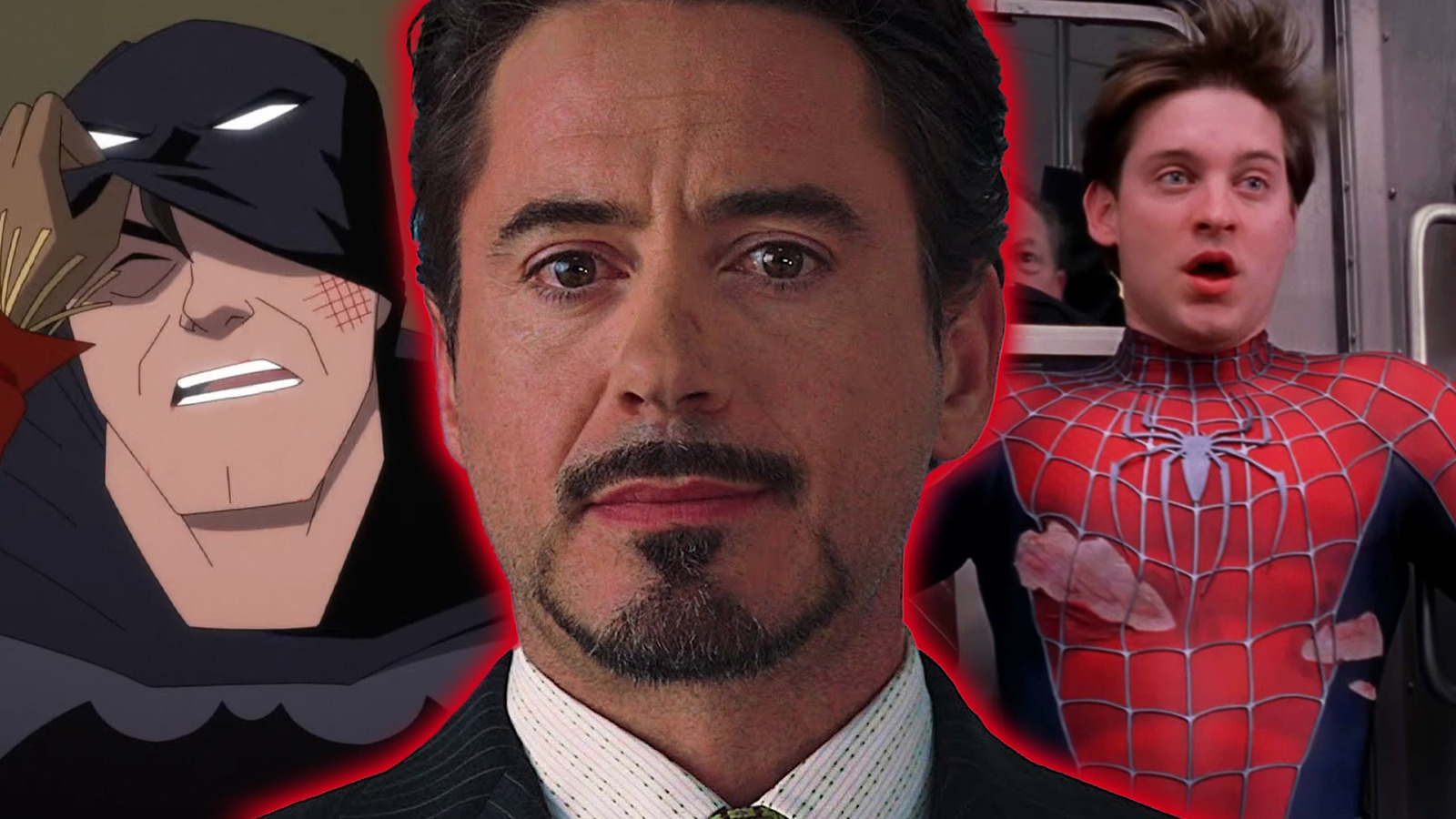
Before Robert Downey Jr. stepped out onto that stage and ended “Iron Man” with those four, infamous words, secret identities were core to the fantasy of the superhero genre. After all, what young comic book fan wouldn’t embrace the escapist thrill of an extraordinary, heroic alter ego — one that secretly turned their weaknesses into strengths or imbued them with glorious purpose and great responsibility?
As superheroes have become more popular in the wake of the Marvel Cinematic Universe’s success, the emphasis on this trope has significantly diminished. The heroes of the MCU are public figures, celebrities, and soldiers. Sony and Marvel had to orchestrate a multiversal event just to restore the defining dual-identity of the Spider-Man story. Even at DC, the double-life of David Corenswet’s Clark Kent is a relatively moot point in James Gunn’s “Superman,” solved by a pair of dorky glasses.
Maybe superhero stories really have moved beyond the secret identity trope. However, these 10 scenes from Marvel and DC Comics adaptations remind us why it can be such a vital part of any hero’s story, whether retold in the late-’90s or in our post-“Iron Man” world.
10. Officer Blake confronts Bruce Wayne (The Dark Knight Rises)
“Right when I saw you, I knew who you really were. I’d seen that look on your face before. It’s the same one I taught myself.”
“The Dark Knight Rises” remains a uniquely polarizing “Batman” film, struggling under the weight of both an expectedly complicated story from Jonathan and Christopher Nolan and the need to wrap-up a beloved trilogy in a satisfying way. Toward the latter goal, “Rises” needed to deconstruct the Batman legend by finally unmasking Bruce Wayne — and it wasted little time doing so.
Early in the film, with the Gotham City Police Department all but laughing off the grave warnings of a critically-injured Commissioner Gordon (Gary Oldman), young GCPD officer John Blake (Joseph Gordon-Levitt) brazenly decides to confront Bruce Wayne (Christian Bale) at his isolated mansion. He’s only able to get past Alfred (Michael Caine) by threatening to reopen the investigation into the murder of Harvey Dent — which Blake has surprisingly deduced Wayne, as the Batman, took the fall for. As he explains to the reclusive billionaire in his dim sitting room, Blake realized Wayne was hiding a secret identity when he visited Blake’s orphanage, recognizing a kindred, concealed rage masked behind Wayne’s playboy persona.
This scene was actually one of the many things that bothered folks about “The Dark Knight Rises” when it was first released, with people understandably questioning Blake’s superhuman leap in logic from “Bruce Wayne is an angry orphan just like me” to “Bruce Wayne dresses up like a bat in his free time.” That said, the monologue itself (powerfully delivered by Levitt) is impactful enough to earn a place at the bottom of this list.
9. Batman and Superman spy on each other (Superman: The Animated Series)
“You peeked.”
Batman and Superman might be the two characters in fiction fans are most consistently excited to see meet with one another (so much so that people immediately began trying to justify getting Robert Pattinson’s Caped Crusader to share the screen with David Corenswet Man of Steel after the release of James Gunn’s “Superman”). Admittedly, we’re all still hungry for a definitive live-action crossover after the broadly disappointing “Batman v. Superman: Dawn of Justice” in 2016. Meanwhile, in the world of animation, the two have enjoyed numerous memorable adventures together over the past several decades.
In a three-part 1997 episode of “Superman: The Animated Series” titled “World’s Finest,” the beloved DC Animated Universe versions of Superman (Tim Daly) and Batman (the late Kevin Conroy) meet for the first time when the Joker (Mark Hamill) offers to assassinate the Man of Steel on behalf of Lex Luthor (Clancy Brown). Though he’s no fan of the Clown Prince of Crime, Superman is customarily wary of Batman’s brutal vigilante crimefighting style — and when the two finally cross paths (and even exchange a few blows), he uses his x-ray vision to see underneath Batman’s cowl.
The reveal is especially amusing since Bruce Wayne had already been a thorn in Clark Kent’s side in Metropolis, working with Luthor and getting a bit too friendly with Lois Lane (Dana Delany). When the latter calls to humble-brag about her breakfast plans with the playboy, Kent happens to find a tracking device on his cape — then looks out his window to see a hilariously smug Batman peering into his apartment with binoculars. This exchange is a perfect example of how the duo’s early rivalry should feel: humorous, mutually misunderstood, and relatably petty.
8. Scarecrow unmasks Batman for the Joker (Harley Quinn)
“Where’s my g**d*** electric car, Bruce?!”
“Harley Quinn” has proven itself time and time again to be one of the most audacious comic book shows ever. As electrically violent and thrilling as any superhero series, and funnier than most of the adult animation scene at present, it is elevated even further by its writers’ obvious passion for DC Comics lore — which they then fearlessly twist, subvert, and reimagine to keep things refreshingly unpredictable for longtime fans.
The show first really put its stamp on the DC Universe in the season 1 finale “The Final Joke,” in which the Joker (Alan Tudyk) finally manages to take over Gotham City just in time for his 38th — or, rather, “25th” — birthday. Unsatisfied with all he has managed to accomplish (including trapping Batman in a flashy tower at the heart of the city) the Joker seems like he’s finally going to confront the empty terminus of his pathological need to control and manipulate everyone around him — then, the Scarecrow (Rahul Kohli) tries to cheer him up by unmasking the Dark Knight once and for all.
As fans might expect, the Joker is devastated to have the mystery of Batman’s secret identity ruined (the act only deepening the empty pain he feels in this context) and kills his well-meaning co-conspirator. What takes this scene from surprising and dramatically meaningful to one of the series’ best moments overall is how the Joker begins processing the banal reality of the news in the aftermath. Robbed of the relationship that once gave him purpose, he’s hilariously reduced to an annoyed Wayne Tech customer complaining about the wait on his long-promised electric car.
7. Barry Allen makes his father proud (The Flash)
“Dad… if I was the Flash, don’t you think you’d be the first to know about it?”
It’s an indescribable shame that “The Flash” suffered as sharp of a decline in quality as it did in its later seasons. And though the move was initially praised for using fan service as a means of keeping a beloved actor on the show past the end of his character arc, it seems in hindsight that hints of this decline began with the recasting of John Wesley Shipp as Jay Garrick.
Before the series wrapped him in leather, Shipp brought far more power to the series as Henry Allen, the wrongfully convicted father of Grant Gustin’s Barry Allen, whose presence in episodes like “Crazy For You” created some of the show’s strongest character beats. At the end of the season 1 episode, after assisting his son on a case for the Central City Police Department by working his connections in prison, Henry and Barry are finally able to share a moment together in the same room. When Henry (having noticed how both he and Barry’s adopted father have been conveniently saved by the Scarlet Speedster) implies that Barry is secretly a superhero, Barry heartbreakingly denies it — only for Shipp to deliver a beautiful speech about what he would say if his son were the Flash.
It’s an all-timer scene for the series that goes right up to the line without handing in a tidy resolution. It’s also paid off a few episodes later, when Barry finally unmasks himself after saving Henry. The simple, sheer incredulous joy of that moment wouldn’t have hit nearly as hard without the more complicated, unspoken acknowledgement in “Crazy For You.”
6. Lex Luthor swaps bodies with The Flash (Justice League Unlimited)
“… I have no idea who this is.”
As great as many of the reveals in “The Flash” might be, our favorite speedster unmasking of all time actually comes once again from the DC Animated Universe. And as an added treat for fans of Michael Rosenbaum’s Lex Luthor (the definitive portrayal of the character for those who grew up watching the CW drama “Smallville”), this scene features an oft forgotten performance made possible by one of the greatest — and strangest — episodes of “Justice League Unlimited.”
In the season 3 episode “The Great Brain Robbery,” the Justice League and the Legion of Doom are both thrown into chaos when their separate, simultaneous attempts to harness Gorilla Grodd’s (Powers Boothe) psychic powers unintentionally swap the brains of Lex Luthor (Clancy Brown) and the Flash (Rosenbaum). While the latter has the significantly more exciting task of maintaining his cover in the Legion without any super powers to bail him out, Lex’s confusion at waking up as one of his enemies is the highlight of the episode. Trying to calm himself down in the Watchtower men’s room, he remarks that he can at least use this mix-up as an opportunity to unmask the Flash once and for all — only to realize he has no idea who the red-headed man staring back at him is.
The DC animated series are often surprisingly funny, but this moment stands out in particular for pointing out the fact that, of all the secret identities in the Justice League, Wally West’s is arguably the least interesting. And, of course, Rosenbaum’s dry delivery of the punchline is pitch-perfect Lex Luthor.
5. Uncle Aaron unmasks and redeems himself (Spider-Man: Into the Spider-Verse)
“You’re the best of all of us, Miles. You’re on your way. Just keep going.”
The most heartbreaking entry on this list by far is the tragic way that the Prowler discovers the secret identity of his new archnemesis in “Spider-Man: Into the Spider-Verse.” In the revolutionary 2018 animated “Spider-Man” film, the technologically-advanced supervillain (voiced by Mahershala Ali) finds himself suddenly plagued by the antics of a young, inexperienced Spider-Man after helping his boss, the Kingpin (Liev Schreiber), murder Peter Parker’s Spider-Man (Chris Pine). When he is finally able to get the upper hand on his new adversary by tracking him to his apparent headquarters in Queens and coming just a squeeze away from squashing his second spider, he is devastated to hear the voice of his nephew, Miles Morales (Shameik Moore), struggling to escape his claws.
The audience had already seen Miles discover the Prowler in his Uncle Aaron’s apartment, the tragedy of this moment being that Aaron himself has failed to uphold what he wanted Miles to see in him. After spending much of his life trying to prove to Miles, his own brother Jefferson (Brian Tyree Henry), and likely even himself that he was more than a petty criminal, it took nearly killing someone he loves to realize how much of himself he’d lost. And just as he takes the first step toward the light (away from Miles, with his hands in the air), he’s gunned down by the man he sold his soul to. It’s a brilliantly scripted moment by screenwriters Phil Lord and Rodney Rothman, with Ali’s performance in the subsequent scene making it one of the film’s strongest sequences overall.
4. Adrian Toomes finds out his daughter is dating his archnemesis (Spider-Man: Homecoming)
“You head in there, gumdrop. I’m gonna give Peter the ‘dad-talk.'”
This may not have been the most physically brutal scene Tom Holland filmed for “Spider-Man: Homecoming,” but there’s still something remarkably vicious about how quickly his Peter Parker is picked apart by Michael Keaton’s Adrian Toomes during their drive to the homecoming dance. Director Jon Watts and his army of co-writers were able to subtly hide Toomes’ true nature for the majority of the film, allowing the audience to discover along with poor Peter that his crush’s dad just so happens to be the Vulture. (The priceless look on Holland’s face when Adrian swings open the door at his home earned quite a reaction the first time audiences saw it.)
Immediately, Peter, Adrian, and Liz Allen (Laura Harrier) are thrown into a cramped luxury car together, where Peter’s panicked stammering and some errant comments from Liz unfortunately give Adrian the pieces he needs to go from completely oblivious to dead certain. There’s an especially delicious moment when, having all but decided that Peter is Spider-Man due to the suspicious timeline of his disappearances and the webhead’s thwarting of Adrian’s robberies, Adrian’s memory of Spider-Man saving the decathlon forces him to nearly abandon his theory entirely. But of course, because he knows Liz will call him on it, Peter himself is forced to clarify that he wasn’t there when Spider-Man rescued them from the Washington Monument.
Even outside the parameters of this list, this is one of the Marvel Cinematic Universe’s best written and directed scenes, taking the audience on an unbelievably tense (and darkly comic) emotional rollercoaster through subtext alone. That it also sets the stage for a personal final battle is just icing on the cake.
3. Clark Kent finally tells all (Superman & Lois)
“Really, I’m just like anyone out there who loves their family and wants to be better for them.”
We’re likely far from the first outlet to tell you that “Superman & Lois” is probably the best and most underrated CW DC Comics series. Consistent in terms of quality season to season, and (like “Harley Quinn”) capable of taking smart, unexpected narrative risks that crack the boundaries of what you’d normally expect from a superhero show, it dared to imagine what the end of a “Superman” story might look like if it focused on Clark Kent (Tyler Hoechlin) as much as the man in the sky. To do so, the series had to give Clark the closure of finally letting go of the biggest secret anyone could ever keep.
Unlike many other iterations of the “Death of Superman” storyline (including Zack Snyder’s “Batman v. Superman,” which, amusingly, had the Daily Planet print Clark Kent’s obituary and headshot a page after its leading Superman eulogy), the public murder and subsequent resurrection of the Man of Steel realistically starts to shatter his myth, as Clark’s normal, unwitting friends can’t help but start to see the connections between the two. Throughout its final season, “Superman & Lois” explores unique angles on how Clark’s secret actually hurts the people he cares about, making innocent people question their perception of the world and imposing a lonely double life on his children.
In the end, tensions reach such a height that Clark reveals himself twice — first to Smallville, then to the entire world. His climactic national interview is moving, surprising, and a perfect thesis statement for a show that examines what it would be like for Superman to put his family before his heroism.
2. New Yorkers Heart Spidey (Spider-Man 2)
“He’s just a kid… no older than my son.”
There’s an argument to be made (and, of course, we’ve personally made it) that Sam Raimi’s “Spider-Man 2” is the best superhero movie of all time. There are several exceptional scenes throughout the film that would put most modern blockbusters to shame, but, for our purposes especially, it can’t be overstated how perfect the train sequence is. Thrilling, iconic, and packed with dynamic emotional beats, it’s a quintessential action set piece punctuated by a surprise unmasking that proves just how much Spider-Man means to the city he protects.
Though he’s momentarily handled Doc Ock (Alfred Molina), Spidey (Tobey Maguire) is forced to push his strength to its absolute limit in order to stop a runaway elevated subway car from plunging into the streets below. Victorious but totally spent by the feat, his unconscious and unmasked body is pulled into the vehicle by the average New Yorkers who witnessed it — all of whom agree not to share Peter Parker’s secret. Sure, it’s kind of a Wally West/Lex Luthor situation, but on top of being a remarkably sweet moment, it’s also a powerful reaffirmation of the faith Peter had lost in himself and his purpose. After all, these everyday folks embody the city he’d felt was against him the entire film.
1. Tony Stark sets the tone for the Marvel Cinematic Universe (Iron Man)
“The truth is … I am Iron Man.”
The ending of the first “Iron Man” movie is so ridiculously brilliant that it’s almost frustrating that Robert Downey Jr. improvised the final line during production. Originally, the film was supposed to have Downey Jr.’s Tony Stark claim that an anonymous, armored bodyguard had stopped Obadiah Stane (Jeff Bridges), maintaining the secret identity trope that had pervaded comics and their adaptations broadly since their inception. But Downey and director Jon Favreau knew instinctively that, for the superhero they’d built in that groundbreaking franchise-starter, he needed to do something entirely unexpected.
The scene not only cemented Stark as the coolest cinematic superhero of all time, it also established the tone for the Marvel Cinematic Universe at large. Even apart from Spider-Man, its heroes have explored more complex dynamics of identity beyond the separation of a public and private persona. Indeed, subsequent “Iron Man” films explored the celebrity and accountability brought on by Stark’s announcement; as one man, Steve Rogers (Chris Evans) had to learn how to be both a good Captain America and a good person; and even Thor’s (Chris Hemsworth) quest to prove his identity forced him to finally be worthy of it. On and off-screen, this was probably the most consequential unmasking in all of superhero cinema, and it remains a subversive example of why secret identities are still so exciting for fans of the genre.





Leave a Reply