
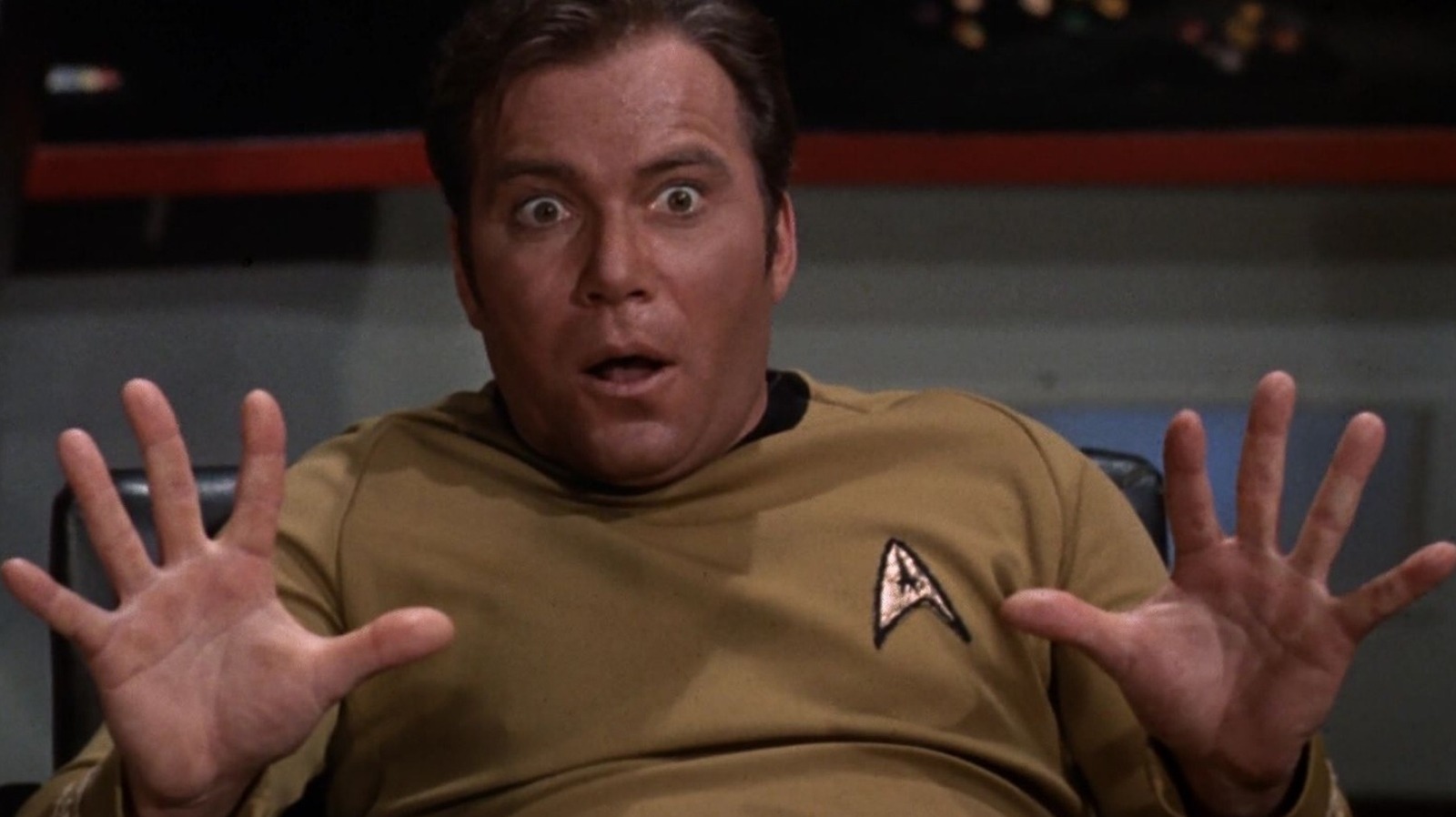
While “Star Trek” has been a staple in the science fiction genre since 1966, the franchise doesn’t have a perfect track record when avoiding cringey topics and dated themes. There are entire “Star Trek” storylines that have become unwatchable with age, with concepts that were once presumably acceptable not holding up decades later. This isn’t isolated to just “Star Trek: The Original Series” but also shows and movies produced in the 21st century. “Star Trek” may be the greatest sci-fi franchise of all time, but that doesn’t mean it’s remained sterling in its vision of the future.
More than just weak episodes and movies, there are specific scenes throughout the franchise that are uncomfortable to watch. Even seasoned fans may find themselves cringing or focusing on a distraction rather than revisiting these awkward moments. Simply put, there are scenes that can mar an entire viewing experience or better off just skipping entirely.
Here are the 10 most uncomfortable “Star Trek” scenes of all time in television and film.
Kirk proclaims himself a god (Star Trek: The Original Series, The Paradise Syndrome)
“Star Trek” has a history of its characters inspiring primitive societies with their advanced technology and enlightened ideals, particularly throughout “The Original Series.” The season 3 episode “The Paradise Syndrome” takes this distinction into even more uncomfortable and poorly aged territory. The Enterprise is assigned to deflect an incoming asteroid from striking a planet that refugees from North American indigenous tribes have settled on for centuries. Captain Kirk (William Shatner) is accidentally left behind and develops amnesia, with a local tribe mistaking him for a god named Kirok.
Seeing Kirk dressed up in Native American clothing and proclaim himself as Kirok before a crowd of indigenous characters is tone-deaf to the point of self-parody. “The Paradise Syndrome” is the clearest example of the white savior trope at work, with Kirk taking on the role of a presumed demigod. Though we can chalk this up to plot-convenient amnesia, it’s still a contrived plot element that doesn’t diminish the discomfort of Kirk’s godly proclamation. An all-around strange episode, “The Paradise Syndrome” showcases “Star Trek” no better at handling stories involving indigenous races than any number of contemporary ’60s Westerns.
Kirk is forced to act like a horse (Star Trek: The Original Series, Plato’s Stepchildren)
The “TOS” third season episode “Plato’s Stepchildren” may be better known for the first scripted interracial kiss in American primetime television, but the overall episode is a weaker effort. Kirk leads a landing party on a planet inspired by ancient Greek culture, with the ruling class possessing powerful telekinetic abilities. Kirk and his crew are forced to carry out increasingly humiliating acts to amuse their captors, disgusting the sympathetic little person Alexander (Michael Dunn). This culminates in Alexander’s fellow Platonians coercing him to ride Kirk around like a horse, complete with Kirk pretending to buck under his passenger.
Compared to preceding seasons, “The Original Series” veered into more childishly and cheaply conceived stories in its third season. Watching the entire ordeal that Kirk and the landing party endure at the hands of the Platonians provides plenty of secondhand embarrassment and cringe. Alexander being forced to ride on top of Kirk is the nadir point of what amounts to a thoroughly humiliating episode. British censors must have felt the same way, because “Plato’s Stepchildren” was banned in the U.K. for decades.
Lester throws a tantrum in Kirk’s body (Star Trek: The Original Series, Turnabout Intruder)
One last “TOS” episode highlighting how far the show had fallen in its third season is the series finale “Turnabout Intruder.” In the episode, Kirk reunites with former lover Janice Lester (Sandra Smith), who is frustrated and vengeful at being passed over for career opportunities in Starfleet for being a woman. Using a strange alien device, Lester swaps bodies with Kirk and tries to commandeer the Enterprise, but the crew notices the sudden change in personality. Unable to contain herself at having her authority questioned, Lester flies into an emotional fit in Kirk’s body in front of the crew.
Easily one of the worst “Star Trek” series finales, “Turnabout Intruder” suggests that career-minded women should stay in their lane or be regarded as difficult and hysterical. As far as Shatner’s reputation for overacting, it doesn’t get more notorious than how he portrays Lester in possession of Kirk’s body. Lester’s tantrums whenever her orders are not followed make for some truly uncomfortable viewing, and unfortunately, they happen more than once. Because of the show’s diminishing quality, Leonard Nimoy was glad “Star Trek” got cancelled and “Turnabout Intruder” is a prime example of the show’s cancellation being a mercy killing.
Yar is kidnapped by cultural stereotypes (Star Trek: The Next Generation, Code of Honor)
Even by 1987, with the premiere of “Star Trek: The Next Generation,” there were still cultural depictions in the franchise that were eyebrow-raising for all the wrong reasons. The worst of these was in the first season episode “Code of Honor,” with the Enterprise visiting a planet based on Sub-Saharan African society. This culture is based on stereotypes that felt outdated in 1987, made all the worse when its leader, Lutan (Jessie Lawrence Ferguson), takes an interest in Tasha Yar (Denise Crosby). Determined to make the Enterprise security chief his bride, Lutan has her kidnapped and forced to participate in a gladiatorial contest with his current spouse Yareena (Karole Selmon).
Jonathan Frakes wants “Code of Honor” removed from streaming platforms, and it’s easy to see why when revisiting the episode. Simply put, Lutan and the Ligonians that he leads are little more than racist caricatures that put a stain on the entire “TNG” legacy. That Lutan would then become enamored with and kidnap the crew’s most prominent blonde white woman reinforces a truly heinous stereotype. “Code of Honor” left Michael Dorn worried about the show’s future, and though “TNG” would significantly improve, the episode exemplifies how poorly conceived the first season was.
Yar gives an anti-drug speech (Star Trek: The Next Generation, Symbiosis)
Denise Crosby’s penultimate episode as a series regular on “The Next Generation” was the first season episode “Symbiosis.” The Enterprise agrees to transport a valuable medication to a planet with limited space travel capabilities overcome by an apparent plague. Upon inspecting the presumed medicinal substance, Beverly Crusher (Gates McFadden) discovers it is actually a highly addictive narcotic, and the plague is actually widespread withdrawal symptoms. When Wesley Crusher (Wil Wheaton) questions why a society would allow themselves to fall prey to drugs, Yar gives a monologue espousing the allure and dangers of controlled substances.
To put things in context, “Symbiosis” debuted when the United States’ Drug Abuse Resistance Education (D.A.R.E.) campaign was promoting anti-drug messaging nationwide. Yar’s monologue feels heavily inspired by this movement, and she’s practically addressing the audience directly during the scene. “Star Trek” has always featured prominent social commentary and political themes, but rarely has it been more overt and heavy-handed than it is here. “Symbiosis” doesn’t provide a great showcase for Crosby’s talents as Yar, who deserved far better, but by the next episode, “Skin of Evil,” the character was killed off rather unceremoniously.
The Enterprise transports Danilo Odell (Star Trek: The Next Generation, Up the Long Ladder)
While the second season of “The Next Generation” was markedly better than the first, there were still some occasional rough episodes. Such is the case with “Up the Long Ladder,” which sees the Enterprise transport a group of colonists to their new home. This society is modeled after early 20th century Irish culture, complete with rustic clothing, farm animals, and even more outdated stereotypes. Leading this ensemble is Danilo Odell (Barrie Ingham), a loud, boorish figure whose scenes are among the most cringe-inducing in the entire series.
“Up the Long Ladder” is tonally all over the place, with plenty of head-scratching scenes, including a disturbing sequence where Will Riker (Jonathan Frakes) destroys a clone of himself. But it’s the scenes with Danilo that really take the viewer out of the episode, lumbering into any sequence like he’s coming out of a ’50s comedy. This completely throws any sense of emotional investment or narrative legitimacy out the window, even in subplots where he’s not involved. “Up the Long Ladder” ranks among the worst “Star Trek” stories of all time, and a lot of that comes from the episode’s so-bad-it’s-funny inclusion of the Space Irish.
Troi and Crusher discuss sex while exercising (Star Trek: The Next Generation, The Price)
The Enterprise’s counselor Deanna Troi (Marina Sirtis) falls into a torrid romance with fellow empath Devinoni Ral (Matt McCoy) in the third season episode “The Price.” Meeting at a diplomatic reception, Troi and Ral’s love story is an intensely passionate one, though Troi develops misgivings about his diplomatic dealings. During a calisthenics session with Beverly Crusher in the Enterprise’s fitness center, Troi has a frank discussion about her new relationship. This occurs as the two women are dressed in unabashedly colorful and form-fitting ’80s exercise clothing and stretching together.
On the one hand, it feels refreshing and emotionally honest for Troi and Crusher to talk about their personal lives and sensuality, especially for an episode that aired in 1989. But the entire scene is so obtrusively and awkwardly staged compared to the rest of the episode that it undercuts any potential value. The animated comedy series “Star Trek: Lower Decks” skewered the scene in a brilliant deep cut, underscoring just how ridiculous the whole sequence is. The female characters in “TNG” usually didn’t get the same quality character development as their male counterparts, and “The Price” is a prime example of this disparity.
Crusher romances her grandmother’s ghostly lover (Star Trek: The Next Generation, Sub Rosa)
In regard to “TNG” female characters getting subpar plots, it doesn’t get more bizarrely head-scratching than the seventh season episode “Sub Rosa.” While visiting a planet to attend her grandmother’s funeral, Beverly Crusher discovers her relative had struck up a romance with a younger man. After hearing a ghostly voice, Crusher lights a candle she inherited from her grandmother, causing her lover Ronin (Duncan Regehr) to appear. Despite the icky implications, Crusher begins her own romantic relationship with the non-corporeal being before eventually coming to her senses.
While “Star Trek” has always been relatively malleable with its stories, a ghostly love story just feels like a step too far. Apparition or not, the idea of Crusher romancing someone who was also in a relationship with her grandmother is as uncomfortable as it gets. The scene of Crusher being seduced by Ronin’s lit candle is positioned like a bad trashy romance novel cover, and its narrative implications make it even more questionable. The worst thing that Crusher did in “The Next Generation,” “Sub Rosa” is the weakest episode in “TNG’s” final season.
Shinzon mentally violates Deanna Troi (Star Trek: Nemesis)
There are a lot of things that went wrong with “Star Trek: Nemesis,” the 2002 film that stood as the “TNG” crew’s final cinematic adventure. The movie opens with Picard’s evil clone Shinzon (Tom Hardy) staging a coup to seize control of the Romulan Empire. By interfacing with his second-in-command, an unnamed Reman viceroy (Ron Perlman), Shinzon is able to telepathically invade others’ minds. After meeting Deanna Troi, Shinzon takes an unhealthy interest in the Enterprise’s counselor and decides to use his viceroy’s abilities to assault her.
In one of the most disturbing scenes in any “Star Trek” movie, Shinzon interrupts an intimate moment between Troi and Riker, telepathically swapping himself for Riker in Troi’s mind. Troi describes the incident as a violation, and the scene is still the most overt depiction of sexual violence in a “Star Trek” film. Later in the movie, Troi uses this telepathic connection to strike back against Shinzon and the viceroy, but the scene still feels unnecessary. “Nemesis” officially brought an end to the “TNG” era, and scenes like this made it all the more of a disappointment, to say the least.
Trip grows an extra nipple (Star Trek: Enterprise, Unexpected)
The prequel series “Star Trek: Enterprise” could be hit-or-miss with some of its stories, especially in its uneven inaugural season. The season’s fifth episode, “Unexpected,” certainly ranks among the show’s most absurd, with chief engineer Trip Tucker (Connor Trinneer) accidentally being impregnated by an alien species. After a seemingly innocuous interaction with a visiting engineer, Trip notices a strange growth on his body. Doctor Phlox (John Billingsley) not only identifies it as an extra nipple but reveals that Trip is carrying an alien fetus.
Even “Star Trek: Enterprise” creator Brannon Braga admitted season 1’s writing had major problems, and the ludicrous “Unexpected” certainly supports that claim. Trip’s pregnancy is played for comedic effect, but the concept of being unwittingly impregnated and growing extra appendages is just terrifying. The scene also undercuts the more action-oriented story unfolding the episode at a play for laughs at Trip’s expense. Easily one of the worst episodes of “Star Trek: Enterprise,” “Unexpected” is a failed attempt at screwball comedy that veers into body horror.





Leave a Reply