
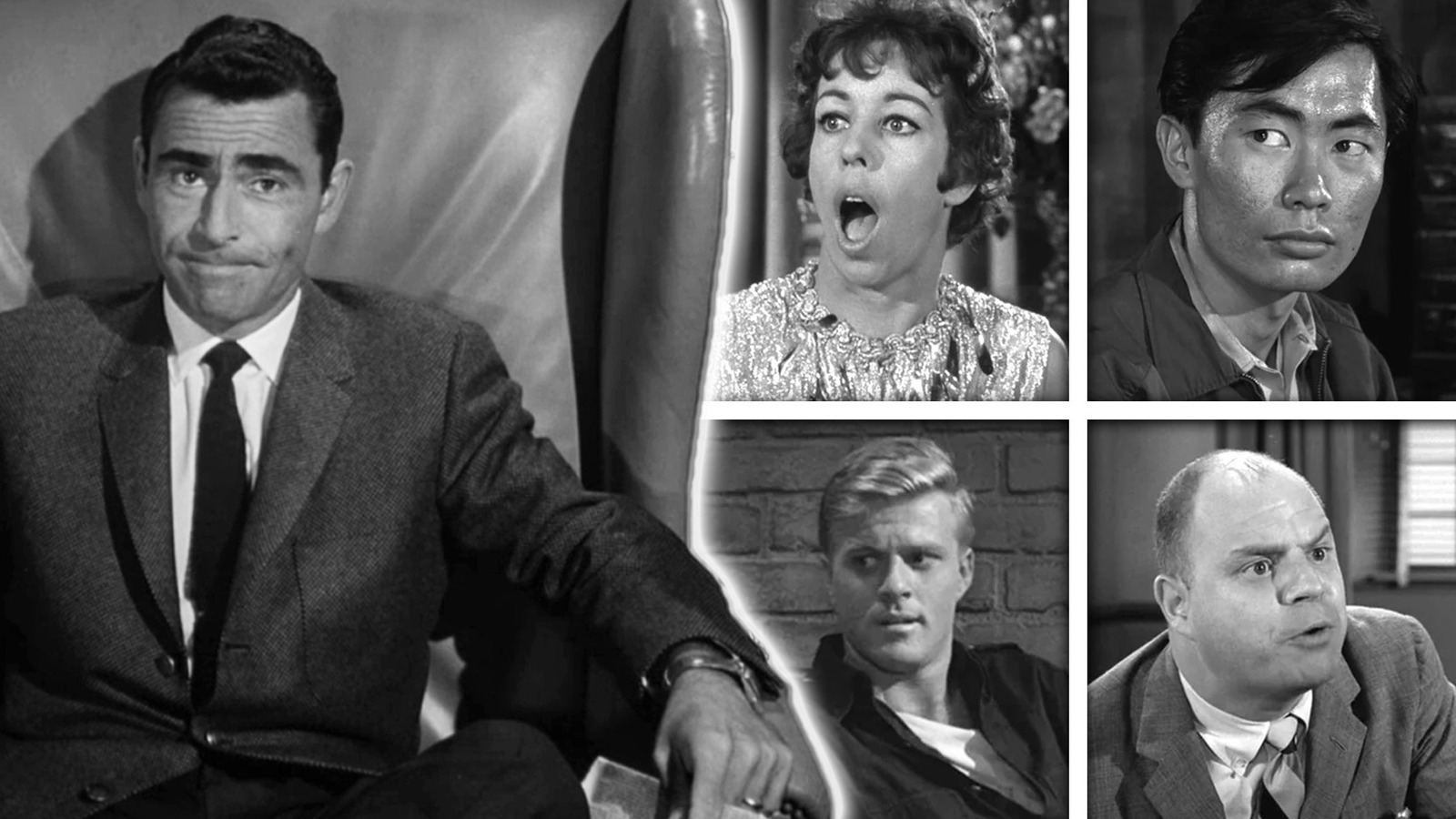
“The Twilight Zone” remains one of the most influential pieces of television ever. In the anthology series, every episode follows another fantastical, horrific, and/or thought-provoking storyline that’s separate from anything else in the show. Each installment stands on its own, typically offering some level of social commentary. In fact, censorship was the spark that inspired Rod Serling to create “The Twilight Zone” in the first place, as he could talk about important issues through the lens of science-fiction and fantasy without too much pushback.
The most essential “Twilight Zone” episodes still hold up to this day, and when you go back to watch the original series from the 1960s, you’re bound to find some familiar faces. Many actors got their start on the series or were already established names who decided to lend the show some credence. It’s a testament to the series’ impact that it managed to cram all of these famous faces (and plenty of others not mentioned here) into one iconic story after the next.
Robert Redford
Long before he was a household name for films like “Butch Cassidy and the Sundance Kid,” Robert Redford made one of his earliest screen appearances in a season 3 episode of “The Twilight Zone,” titled “Nothing in the Dark.” He plays a police officer shot outside of an old woman’s (Gladys Cooper) home, and she locks the two of them inside out of fear that Death is coming after her.
Of course, in classic “Twilight Zone” fashion, the twist is revealed that the cop was actually Death all along, but he’s nothing to be fearful of. He offers a kind face and a smile to guide souls to the next realm, making this one of the most poignantly beautiful “Twilight Zone” outings. It’s humorous to think a young Redford almost ruined an otherwise great “Twilight Zone” episode, as he was still pretty new to the whole “acting” thing at this point. His performance here isn’t quite on the same level as what we’d see in something like “All the President’s Men,” but it’s a fun starting point if you’re planning a Redford marathon to see just how far the actor came.
Ron Howard
Ron Howard is a great example of how child stars don’t always have to wind up on the wrong side of the tracks. While most audiences were probably first introduced to him in “The Andy Griffith Show,” one of his earliest appearances came in the first season of “The Twilight Zone,” in “Walking Distance.” Martin Sloan (Gig Young) realizes he’s gone back in time to 1934, and he has a brief conversation with a kid in his neighborhood, played by Howard when he was just a boy.
More substantial roles would follow, but in his later years, Howard would turn his attention to directing. The real reason Ron Howard stopped acting ultimately came down to protecting his mental health and wanting more control over the quality of the projects he worked on. He’ll still make brief cameos in shows like “The Studio,” but he’s mostly behind the camera these days. Fortunately, fans can still go back in time themselves with the numerous projects Howard worked on as a child performer.
Don Rickles
Not every “Twilight Zone” episode was a serious reflection on the human condition. They could occasionally get pretty goofy. Case in point: “Mr. Dingle, the Strong,” in which vacuum cleaner salesman Luther Dingle (Burgess Meredith) receives super-human strength from a two-headed alien and uses his powers to perform amazing feats to the wonderment of crowds. Meredith himself is a big name thanks to playing Penguin on the ’60s “Batman” series, but comedy aficionados will also recognize insult comic Don Rickles.
Rickles plays Bettor, a man who beats up Dingle early in the episode. Later, Dingle gets his revenge by shoving a cigar down Bettor’s throat and then lifting him in the air. It’s an episode with silly guys doing silly things, so when you need a break from Rod Serling’s pointed criticisms toward society, it’s a pleasant reprieve. Naturally, the alien’s disappointed that Dingle’s seemingly squandering his newfound talents and takes his strength away before a big stunt, so there is some kind of message in there, just one that’s fairly surface-level.
Dennis Hopper
Conversely, “goofy” definitely isn’t a word that can apply to “He’s Alive.” This episode sees Peter Vollmer, played by Dennis Hopper, trying to become a mouthpiece for American Nazism to no avail. However, he soon meets with a very much alive Adolf Hitler (Curt Conway), who teaches him to give objects of anger to his audience so that his message of hate can take hold. It’s a dark episode to watch today as the episode practically predicts the rise of American fascism.
It’s well-known that Hopper was deep within leftist movements of the 1960s before moving on to supporting Ronald Reagan in the ’80s. His politics were always shifting; he ultimately supported Barack Obama in 2008 before his death in 2010. It’s a shame he passed away before the modern political age, as it would’ve been fascinating to hear him dissect “He’s Alive” with everything that’s happened in the United States. The episode isn’t subtle with its messaging, but sadly, anyone who needs to heed its warning probably wouldn’t watch it to begin with.
Elizabeth Montgomery
Elizabeth Montgomery surely had a blast playing the magical Samantha Stephens on “Bewitched.” However, she would eventually state that her favorite role wasn’t “Bewitched,” but instead a “Twilight Zone” episode.
In season 4’s “Two,” Montgomery stars as a woman surviving in the aftermath of some kind of cataclysmic war. The only other survivor we see in this story is a man, played by Charles Bronson, and even though it’s clear any kind of war is over, the woman still wants to fight. It appears as though the two individuals were on opposite sides, and we only ever hear Montgomery speak Russian. Considering the episode came out in 1961, it’s clear this serves as commentary on the Cold War and how under the worst circumstances, the world could look like what we see in “Two.” Montgomery doesn’t have any jokes here; she’s a woman who’s ever only known violence and can’t seem to shake the idea that war is a constant.
Charles Bronson
The “Two” episode of “The Twilight Zone” is appropriately a two-person show, and with time spent discussing Elizabeth Montgomery playing against type, we’ll also draw attention to her co-star, Charles Bronson. From “The Dirty Dozen” to the “Death Wish” series, Bronson made a name for himself playing stereotypical tough guys. But leave it to “The Twilight Zone” to give him a chance to play against type and show a surprising amount of restraint.
What’s fascinating about “Two” is that the woman is the one always pulling a gun on the man. There’s a world-weariness to Bronson’s character, and he shows the woman kindness, like leaving her some chicken when he easily could’ve eaten it all himself. The woman still believes there’s a war out there to fight, and the man realizes there’s no point to trying to hate one another. Without the stakes of a feature-length film, “The Twilight Zone” could take some big chances and cast actors against type, sometimes resulting in the best performances of their careers.
William Shatner
William Shatner actually had two appearances on “The Twilight Zone.” He first showed up in season 2’s “Nick of Time,” where his character becomes obsessed with a fortune teller machine that’s seemingly accurate. However, Shatner was worried people would laugh at his most famous “Twilight Zone” episode. The truth is that the installment, season 5’s “Nightmare at 20,000 Feet,” became one of the show’s most iconic outings and a fantastic showcase of Shatner’s acting talents. He plays Robert, a man recovering from a nervous breakdown, who sees a gremlin (Nick Cravat) tearing apart a plane’s wing while it’s up in the air, but no one will believe him due to his mental health history.
There was some real pedigree on “Nightmare at 20,000 Feet” aside from Shatner. The episode was directed by Richard Donner, who’d go on to helm “Superman” and “The Goonies,” and it’s based on a short story from Richard Matheson (of “I Am Legend” fame), who also wrote the TV script. It’s no wonder “The Twilight Zone” has withstood the test of time with such people working on it.
Julie Newmar
In 2020, there was a news story of a millionaire starting over with nothing to prove he could earn a million dollars within a year, “proving” that accumulating wealth is all about mindset and not circumstances. He stopped the experiment early due to health reasons, but he could’ve saved himself a lot of trouble by just watching the “Of Late I Think of Cliffordville” episode of “The Twilight Zone,” starring “Batman” actress Julie Newmar.
Newmar plays Miss Devlin (an anagram for “Devil” but with an “N”), who offers a businessman an intriguing proposition. He’s become bored from achieving all his goals, so she offers him the chance to go back in time with the knowledge he has now so that he can go through the excitement of attaining a fortune again. The classic “Twilight Zone” ironic twist is alive and well here, as things don’t quite go his way. Newmar perfectly encapsulates this femme fatale version of Satan, setting her up well to play Catwoman later.
Carol Burnett
Carol Burnett is a comedy institution, so it’s no surprise she’s in one of the sillier “Twilight Zone” episodes, titled “Cavender is Coming.” She plays Agnes, a clumsy woman where nothing seems to go her way. To fix her life, heaven sends her a guardian angel, Harmon Cavender (Jesse White), to turn things around. He gives her a lavish mansion and highfalutin friends that aren’t quite her speed, and she just wants to go back to her old friends. By the end, nothing may have changed, but at least she has a newfound appreciation for where she is in life.
There’s no ironic twist or sense of karmic justice. It’s basically an episode of a sitcom that doesn’t exist, and Rod Serling apologized to Burnett after it came out. Fortunately, Burnett appears to have enjoyed the episode more than Serling, and there’s nothing wrong with “The Twilight Zone” getting a little silly now and then. It’s a nice reprieve from some of the darker installments.
Robert Duvall
Robert Duvall is one of those actors where the film he won an Oscar for, “Tender Mercies,” is far less noteworthy than many of his other works, which happen to include “The Godfather,” “Apocalypse Now,” “Network,” and “Days of Thunder,” to name a few. But before he was the toast of Hollywood, he gave a committed performance as Charley Parkes in the “Miniature” episode of “The Twilight Zone.”
“Miniature” is basically “Toy Story” if it was a psychological thriller. Charley sees a museum doll come to life, but no one believes him. He gets committed, but escapes to go back to the museum, where he himself turns into a doll to be with her. It’s an eerie episode of a man haunted by something no one else could possibly understand. “Miniature” was sadly taken out of syndication due to a lawsuit-happy scriptwriter burying “The Twilight Zone” episode for allegedly being too similar to a script they wrote. The case was eventually thrown out, so luckily, we still have this Duvall performance to enjoy.
Cloris Leachman
Many comedic performers, like Don Rickles and Carol Burnett, are in appropriately silly episodes of “The Twilight Zone.” But Cloris Leachman, despite mostly being known for comedies herself, is in one of the most truly horrific outings the original series ever ventured into. She plays Mrs. Fremont in “It’s a Good Life,” where an entire town is subjected to the whims of a monster that can alter reality, and that monster just so happens to be Mrs. Fremont’s six-year-old son, Anthony (Billy Mumy).
You might recognize this plot from being parodied on the “Treehouse of Horror II” episode of “The Simpsons,” where Bart has the godlike powers. It’s played for jokes there, but Leachman’s performance in “The Twilight Zone” is genuinely haunting. The way she forces a smile on her face that skews toward a grimace, just waiting for something awful to happen, is tough to watch, but highlights the living hell the town’s residents all find themselves in. And the frightening episode has a sequel you definitely never knew existed before.
George Takei
“The Twilight Zone” often used fantasy and science fiction as metaphors for societal ills. It was a way of telling complex stories that needed to be heard in a way that wouldn’t transparently upset the censors. However, season 5’s “The Encounter” tackles racial prejudice head-on. An American soldier, Fenton (Neville Brand), becomes trapped in an attic with a young Japanese-American man, Arthur (George Takei). Fenton has a sword he got from a Japanese soldier he killed, and the haunted relic causes the two men to lash out, consumed by Fenton’s personal trauma and Arthur’s guilt at what his father did during Pearl Harbor.
The episode certainly falters when it comes to its central discussion surrounding race, as any guilt Arthur has definitely isn’t on the same level as Fenton’s. But there’s no denying Takei’s committed performance, which brings much-needed diversity to “The Twilight Zone,” which goes without saying was predominantly cast with white people throughout the 1960s. Additionally, Takei joins William Shatner as some of the many “Star Trek” actors who guest starred on “The Twilight Zone.”
Martin Landau
Science fiction and horror are fertile genres for “The Twilight Zone,” but there’s also something to be said of the show’s rare Western episodes. In fact, the third episode in the entire series, “Mr. Denton on Doomsday,” is a great gunslinger tale with a twist. Al Denton (Dan Duryea) is a laughingstock after being a notable gunslinger, and he gets bullied by Dan Hotaling (Martin Landau) at the start of the story. But a mysterious salesman will soon restore Al’s astonishing gift…
Landau is excellent hamming it up as the heel, even if he doesn’t get a ton to do. He may be a supporting player in this installment, but he’d return to “The Twilight Zone” in season 5 for “The Jeopardy Room.” His star had risen between the two installments, thanks to a turn in “Cleopatra,” among other things, so he got a lead role on the second go-round as a political prisoner trying to make his way to freedom.
Richard Kiel
Depending on what generation you were born in, you might recognize Richard Kiel for different reasons. Baby boomers will undoubtedly known him as the henchman Jaws in several James Bond movies, like “The Spy Who Loved Me” and “Moonraker.” However, Gen X will never think of him as anything us other than Mr. Larson in “Happy Gilmore.” His huge frame, standing over seven feel tall, made him a natural match for any imposing figure, including the Kanamits in “The Twilight Zone” episode “To Serve Man.”
The premise is simple: An alien race offers to fix all of Earth’s problems, which they seemingly do. Everything is fine until we reach the conclusion, which is easily one of the best twist endings in “Twilight Zone” history. The Kanamits would return in the 2020 “Twilight Zone” revival episode “You Might Also Like,” written and directed by “Longlegs” helmer Osgood Perkins. However, the second episode, which doesn’t seem to be connected to the first outside of Kanamits contacting Earth, is a bit more convoluted than it needs to be. If there was one thing the original “Twilight Zone” was very good at, it was showing that less is sometimes more when it comes to crafting a terrifying twist.
Peter Falk
You’d be forgiven for never realizing “Columbo” star Peter Falk was in an episode of “The Twilight Zone.” It’s because he’s unrecognizable darker makeup and wearing a Fidel Castro-like beard in the season 3 episode, “The Mirror.” He plays Ramos Clemente, a revolutionary who works with others to overthrow an oppressive Central American regime. However, Ramos comes into possession of a mirror that tells him who his enemies are, and he turns on those who helped him ascend to power while executing any of his opponents.
It’s “Animal Farm” except instead of being an allegory for the rise of Joseph Stalin, it’s about Castro — but without the fun of talking pigs. It’s another example of a time “The Twilight Zone” wasn’t being subtle about the politics at hand. Falk would receive much better roles shortly after this stint, and it should go without saying that Falk isn’t Hispanic. His parents have Polish and Russian roots, so “The Mirror” is one episode that hasn’t really aged well.
Leave a Reply