
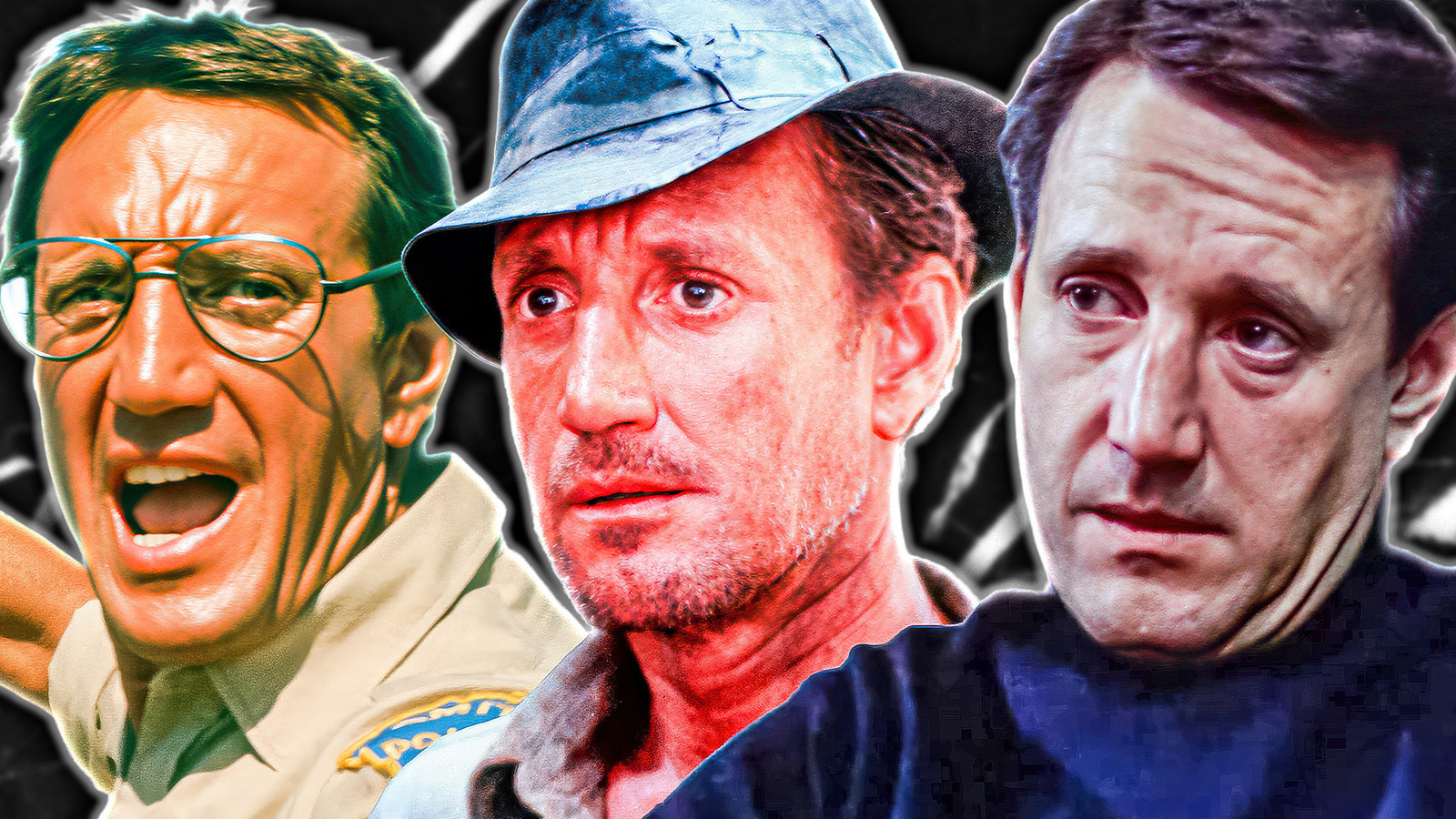
The 1970s delivered unto Hollywood some of the greatest actors in the history of film, and one that shouldn’t be forgotten is Roy Scheider. Born in New Jersey, Scheider worked as a boxer and served in the U.S. Air Force before becoming an actor. Those previous careers, which required staring danger straight in the face, come through in his screen presence; Scheider was a tough guy, but confident and mature enough that he didn’t need to be loud about it.
Basically, he was the perfect leading man for the New Hollywood, when the movies were moving towards naturalism and heroes didn’t have to be classic, square-jawed good guys. He was excellent at playing an everyman, because that’s exactly what he looked like. No one can stare with a look of quiet alarm like Scheider could.
The actor sadly passed away in 2008 at the age of 75; his last credited role, released posthumously, was the 2009 thriller “Beautiful Blue Eyes.” He never stopped working, but most Scheider aficionados would probably agree the 1970s were the peak of his career. Each film you’ll find on this list is from that decade, and each one is rightly recognized as a masterpiece.
5. Marathon Man
In 1980, Roy Scheider (for “All That Jazz”) and Dustin Hoffman (for “Kramer vs Kramer”) competed for Best Actor at the 52nd Oscars, with Hoffman winning. A few years prior, though, the two starred together as brothers in the same movie: 1976’s “Marathon Man.”
Hoffman is the lead of “Marathon Man” as Columbia University student Thomas “Babe” Levy. Scheider plays his older brother, Doc, who tells his little bro that he’s a businessman when he’s really an espionage agent for the U.S. government. Doc’s latest spy game drags Babe into a diamond smuggling ring run by an escaped Nazi war criminal, the terrifying Christian Szell (Laurence Olivier), one of the greatest movie villains of the 1970s.
Considering “Marathon Man” has been out for 50 years, I’m going to discuss some spoilers. Ready? Doc dies early on in the film, murdered by Szell, which kicks off the real plot. Babe is captured and interrogated by Szell’s men to learn what his brother told him, forcing Babe to step up as a reluctant hero. Doc’s death is an effective twist built in the same way as the famous death of Marion (Janet Leigh) in “Psycho”: a big star is built up as a main character, then they’re murdered and it throws the picture on its head. Scheider, who’d been Oscar-nominated and was coming off of “Jaws” in 1976, was absolutely the kind of actor whose casting makes Doc’s death surprising.
4. The French Connection
Roy Scheider broke out as an actor in 1971, when he starred in neo-noir “Klute” as well as William Friedkin’s “The French Connection.” The latter earned him an Oscar nomination for Best Supporting Actor.
Scheider stars as Buddy “Cloudy” Russo alongside Gene Hackman as Jimmy “Popeye” Doyle. They’re partnered New York police detectives working the narcotics beat and trying to bust a French heroin smuggling ring. “The French Connection” was based on a nonfiction book about real NYPD officers — Doyle and Russo are based on real detectives Eddie Egan and Sonny Grasso — so it’s hardly a flattering movie. The cops are foulmouthed, unpleasant people who rough up suspects and spit out slurs. The film doesn’t justify these methods as part of the job, either. In the end, Popeye Doyle does not get his man.
Casting Hackman and Scheider, similar tough guy actors who both actually look like they could be real working cops, helps the authenticity. Now, Scheider is undeniably playing second fiddle to Hackman, but we’d be remiss to act like Scheider still doesn’t bring a lot to “The French Connection.” He’s the relatively good cop to Popeye, the kind of straight man that any partnership or film needs for balance.
3. Sorcerer
After “The French Connection,” Scheider worked with William Friedkin again on the filmmaker’s next movie after “The Exorcist,” a survival thriller titled “Sorcerer.” (Don’t expect any spells, but there’s plenty of movie magic to be found.) “Sorcerer” was met with unenthusiastic reviews upon release and audiences ignored it, largely since it had the extraordinarily bad timing of opening against “Star Wars.”
But time has been kind to “Sorcerer,” which is now seen as a worthy companion to Friedkin’s other ’70s films. (Not for nothing, Stephen King has called “Sorcerer” his favorite film.) The movie adapts the French novel “Wages of Fear,” previously made into a French film in 1953. Set deep in rural South America, “Sorcerer” follows four fugitive men all living in a small village. Paid so little they’ve no hope of ever escaping, they accept a dangerous job for an oil company transporting old, unstable boxes of dynamite through the jungle.
Roy Scheider plays Jackie Scanlon, an Irish American criminal living under the name “Juan Domínguez.” Jackie is a man who’s had nothing but misfortune befall him lately. Scheider’s thousand yard stares, used to sell immediate danger and panic in “Jaws,” feel more unsettling here.
While “Sorcerer” gives equal weight to all four men at the start (with their own individual intro sequences about why they’re on the run), they’re whittled down until Jackie remains as the lead. Scheider’s performance was modeled on Humphrey Bogart’s in “The Treasure of Sierra Madre.” Broadly speaking, Scheider was a movie star in the image of Bogart. They didn’t just physically resemble each other, sharing lean and crinkled faces, but Scheider could play cynics and tough guys — both lucky and unlucky ones — with the same convincing grit Bogart had.
2. All That Jazz
Roy Scheider’s most famous roles are working class, salt of the earth kind of guys. But in “All That Jazz,” he plays a Broadway theater director and dance choreographer named Joe Gideon. Once you see how Joe spends his days, you’ll quickly realize why Scheider was cast.
“All That Jazz” is a semi-autobiography by director Bob Fosse, not to mention an act of cinematic self-flagellation. Gideon is a philanderer and an addict with no intention or resolve to change his ways, seemingly fine if he digs himself an early grave gorging on booze, drugs, and sex day in and day out. Throughout the movie, we see flashes of Joe inside his own imagination, literally flirting with Death (Jessica Lange). There’s an undercurrent to the movie that Joe dying might actually be more merciful to his loved ones than him living and continuing to lie and disappoint them.
Joe is almost never seen without a cigarette hanging out of the side of his mouth. His morning routine, shown repeatedly, shows him popping pills and painkillers before telling himself in the mirror — with wide eyes, a listless voice, and jazz hands — that “It’s showtime, folks!” Scheider easily convinces as a workaholic who has lost all his bright-eyed passion for show business.
The second hour of “All That Jazz” takes place primarily in a hospital, after Joe suffers a heart attack. Scheider, who looked like a man pushing himself too hard from the beginning, becomes pale and haggard. But in Joe’s dying fantasy, “Bye Bye Life,” he gets to show off his singing chops.
“All That Jazz” was Scheider’s second and final Oscar nomination, this time for Best Actor. Like the film itself not winning Best Picture, Scheider’s loss is remembered as a painful snub.
1. Jaws
“Jaws” rests on the back of three great actors. The second hour of the film is all Roy Scheider (Chief Brody), Richard Dreyfuss (Hooper), and Robert Shaw (Quint), with the three of them stuck on a boat trying to catch the shark attacking Amity Island. Who’s the best character to watch? Hooper’s funny, while Quint’s a badass and gets the show-stopping monologue about his time on the USS Indianapolis during World War II.
Brody is the undeniable hero of the movie. He’s the first of the three we meet, he gets the most screen time, and he’s the one who gets to kill the shark. (The great line, “Smile you son of a…”, is delivered not with an action hero’s smirking cleverness, but truer-to-life anger.) And while Brody, a newcomer to Amity Island who’s even afraid of water, feels out of place in the community, Scheider is totally convincing as a local police chief.
Yet Brody is also the straight-laced hero cop and family man, so he could be the dullest of the three to play. But Scheider keeps pace with his co-stars. The famously-improvised line when Brody tells Quint “you’re gonna need a bigger boat” after getting a glimpse of the shark? Without Scheider, we wouldn’t have that classic cinematic moment.
The movie gives Brody plenty of compelling material, too, especially in the first half when he’s dealing with pressure from Mayor Vaughn (Murray Hamilton) to keep the beaches open. Brody accedes at first, and gets his responsibility thrown in his face when the shark takes a little boy, Alex Kintner (Jeffrey Voorhees). Kintner’s mother (Lee Fierro) confronts Brody with a slap, and he can only stay silent in shame.
Of the three leads, Scheider was the only one to return for “Jaws 2,” but we won’t hold that paycheck role against him or “Jaws” itself.





Leave a Reply