
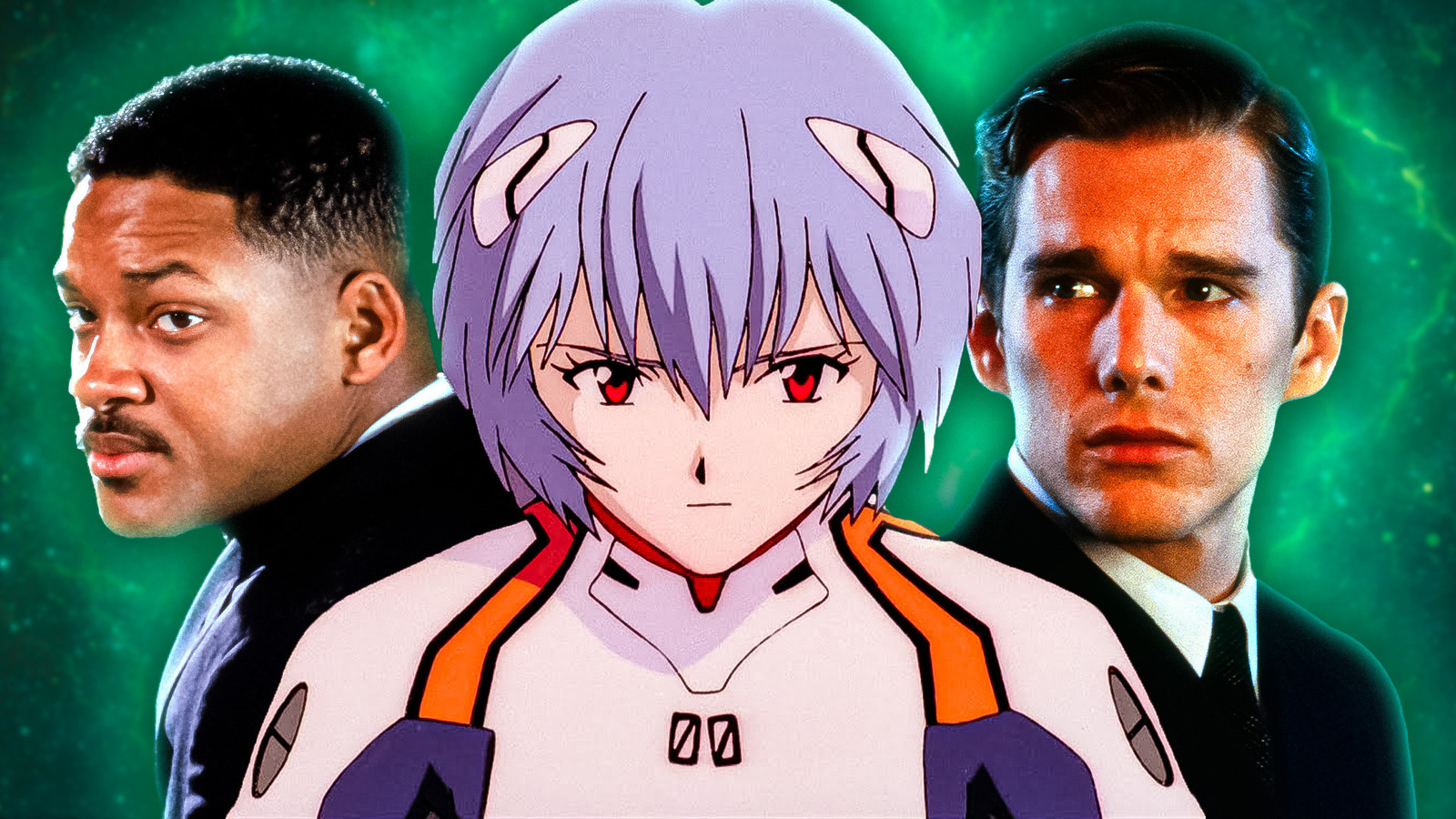
1997 was a truly stacked year for science fiction movies, to the point that only picking five feels unfair. The year saw the release of wacky blockbusters like “The Fifth Element,” more hard science-fiction like “Contact,” and franchise films like “The Lost World: Jurassic Park,” the only “Jurassic Park” sequel to capture some of the original’s Spielberg magic (maybe because Steven Spielberg came back as director).
It must also be said the most important genre work to debut in 1997 wasn’t a movie, but a TV show. That would be “Buffy the Vampire Slayer,” whose postmodern style and mix of serialized and episodic stories turned it into one of the most influential TV shows ever.
The 1990s were a decade of peace and prosperity, leading to the theory that humankind had reached “the end of history,” or at least humans had finally figured out the best way to run a civilization. If so, where else is there to go but the stars? At the end of history, the future seemed within our grasp, but you can begin to see cautious dissent in horror films that arrive near the end of the decades. There are satirical titles that caution about the kind of future we were building, as well as horror titles showing the great unknown as a scary place. As one final hint, I’ll just note it wasn’t only Hollywood making great sci-fi films in 1997.
5. Event Horizon
Paul W.S. Anderson is one of Hollywood’s foremost schlockmeisters, especially well known for directing the polarizing “Resident Evil” films. While Anderson’s reputation remains sharply divided between detractors and vulgar auteurist fans, the one movie of his most everyone agrees is good is 1997’s “Event Horizon,” one of the scariest sci-fi horror films ever.
Set in 2047, the film follows the crew of starship Lewis and Clark, sent to investigate a distress signal from a starship that disappeared several years prior, the Event Horizon. The Event Horizon had been testing a new “gravity drive” meant to enable faster-than-light travel. Upon reaching the ship, the Lewis and Clark crew find that saying the Event Horizon has “been through hell” may be a literal diagnosis.
Despite Anderson’s protestations otherwise, “Event Horizon” pulls a lot from “Alien,” down to the grimy starship sets, the characters traveling in cryo-pods, and the whole plot device of a starship answering a distress signal. But “Event Horizon” stands above most other “Alien” rip-offs with some genuinely gnarly violence rivaling its inspiration. The cast is also top-tier, led by Laurence Fishburne as the Lewis and Clark’s no-nonsense Captain Miller, as well as Sam Neill playing the Event Horizon’s designer, Dr. Weir.
The legacy of “Event Horizon” lives on in that it has inspired other sci-fi horror, like how “Alien” inspired it. For instance, “Star Trek: Strange New Worlds” featured “Event Horizon”-inspired episodes in “Through The Lens of Time” and “The Griffin Incident.”
4. Men in Black
Barry Sonnenfeld directed some of the most beloved high-concept comedies of the 1990s, such as “The Addams Family” duology and “Get Shorty.” But his finest may well be the original “Men in Black.” Loosely based on a Marvel comic, “Men in Black” borrows from the conspiracy that men in black suits and sunglasses work as secret agents keeping the public from learning Earth is teaming with alien visitors. But where the comic was dark and sinister, the movie is much lighter and funnier.
It’s basically a buddy cop movie, in the formula perfected by “Lethal Weapon,” just with a science fiction twist. To that formula, the movie lives on the stellar chemistry shared by Tommy Lee Jones (Agent K) and Will Smith (Agent J). Has there ever been better casting of “old curmudgeon” and “young rookie” for a buddy comedy than those two?
But that’s not the only great performance in “Men in Black.” Vincent D’Onofrio stars as the film’s villain, an insect-like alien wearing the skin of a farmer named Edgar as a (very unconvincing) disguise. To say D’Onofrio is “committed” to the performance, from his scrambled voice to his walking like a creature that doesn’t know to stand on only two legs, is an understatement. “Men in Black” also delivers one of the great movie gadgets: the memory-erasing neuralyzer, which stands alongside the lightsaber as a movie gadget with universal recognizability.
Smith, Jones, and Sonnenfeld returned for two “Men in Black” sequels, but the first film stands even better as a one-off with a perfectly closed loop of an ending.
3. Gattaca
Genetic engineering is a stock science fiction plot device, but it really took off in the 1990s, a trend intertwined with the public gaining greater understanding of real genetic science. DNA engineering is how dinosaurs were resurrected in the world of “Jurassic Park.” Marvel Comics’ “Ultimate Marvel” publication line, rebooting the company’s premier superheroes for the 21st century, presented genetic engineering as the nuclear physics of the 2000s, with Nick Fury warning, “The next war will be a genetic one.” (Yeah, that prediction didn’t really hold up.)
Science fiction is a genre to explore hypotheticals about world-shaping technology, and one of the best ones to explore genetic engineering is “Gattaca.” (The title comes from the first letters of four key components of DNA: guanine, adenine, thymine, and cytosine.) In a dystopian future, the normal mode of reproduction is parents using genetic selection to design their children from the ground up.
People born naturally, like the movie’s hero Vincent Freeman (Ethan Hawke), are deemed “invalid” and unofficially barred from anything but the lowest rungs of society. To complete his dream of becoming an astronaut, Vincent assumes the identity of a “valid” person, Jerome Morrow (Jude Law), using Jerome’s DNA samples to pass. Part of that satire is that while Vincent’s face doesn’t match Jerome’s, everyone overlooks that because the DNA does.
“Gattaca” reads as an update on Aldous Huxley’s 1932 novel “Brave New World,” a similar dystopian work about a genetically engineered society. Like that novel, it shows a “perfect” world is anything but.
2. Starship Troopers
Dutch filmmaker Paul Verhoeven grew up in the German-occupied Netherlands during World War 2, which gave him an early, indelible look at the evils of fascism. He brought those lessons with him when he made “Starship Troopers,” which isn’t an adaptation of Robert Heinlein’s militaristic novel so much as a parody of it.
“Starship Troopers” takes place in a dystopian future ruled by a military dictatorship, where young adults must serve as soldiers to become full citizens. Earth is at war with alien bugs, but here’s the thing: The humans are invaders, whereas the bugs are just defending their home. That reality gets smoothed over by patriotic imagery and painting the enemies as horrible monsters, the way the real propaganda works. Actor Casper Van Dien, playing lead Johnny Rico, is the kind of square-jawed specimen a military propagandist would salivate over — which is again, the whole point. (Here’s a fun game — as you watch “Starship Troopers,” try to guess which actors are in on the joke.)
But upon release, “Starship Troopers” was not acclaimed as the brilliant satire it is, to the point that later re-evaluations almost feel like an apology. Some critics read no deeper than the film’s surface, even Roger Ebert, who dismissed it as a “kiddie movie.” Others misread the intent and thought the movie was endorsing the fascistic themes — “We were accused by the Washington Post of being Neo-Nazis!” as Verhoeven told Empire in 2014. Nowadays, though, “Starship Troopers” has been recognized for what it is, and that it’s a smart movie wearing the mask of a dumb one — indeed, “Starship Troopers” was too smart for its own good at first.
1. The End of Evangelion
Mecha anime series “Neon Genesis Evangelion” wrapped up its 26-episode run in 1996 with a surreal finale unfolding inside the characters’ minds. Viewers did not respond favorably, so series creator Hideaki Anno followed up with a film (co-directed by himself and Kazuya Tsurumaki), “The End of Evangelion,” an alternate/parallel ending. It gave angry fans both an ending they wanted and one they might wish they could take back.
You don’t often get an artist laying their soul bare, warts and all, like Anno does in “The End of Evangelion.” “Neon Genesis Evangelion” used mecha versus kaiju fights as a vehicle for exploring depression. In “The End of Evangelion,” the characters’ psychological issues come tumbling down into disaster.
The movie has one of the most abrasive opening scenes ever. The severely depressed Shinji Ikari tries to wake up his comatose crush Asuka Langley Soryu. When Shinji shakes Asuka and accidentally tears her shirt off, he masturbates in front of her. Shinji uses people (and objectifies women) for his own gratification because he’s too scared to open up. The scene forces the audience, who should be repulsed by Shinji’s actions, to ask if they’ve done the same in less disgusting ways.
The movie’s first half, “Air,” is relatively normal structurally, just oppressively downbeat and violent. The second half, “Sincerely Yours,” becomes downright avant-garde, diving into Shinji’s shattered psyche. The angel Lilith absorbs all of mankind’s souls in a delirious sequence scored to the original song “Komm, Susser Tod” (“Come, Sweet Death”). It’s one of the most beautiful but nerve-wracking apocalypses put to film.
“The End of Evangelion” walks a very fine line in exploring suicidal thoughts and reaches honesty. Death is never the right answer, but choosing to live is only the first step to finding happiness.


Leave a Reply