

The Hotline mailbag publishes weekly. Send questions to wilnerhotline@
Would a college football super league create massive upheaval in basketball? With the football schools generating huge TV revenue, tens of millions could be funneled to basketball rosters. And presumably, many basketball blue bloods wouldn’t make the super league. — EGH
This topic is richer than Jeff Bezos, particularly when cast against the Protect College Sports Act, the Congressional legislation aimed, in part, at preventing a super league.
We should start by clarifying the construct of a super league. Contrary to popular assumptions, it’s not a combining of the SEC and Big Ten to form a 34-school entity.
Instead, a true super league requires the top football brands to leave the SEC and Big Ten and create something new, along with Notre Dame and a handful of schools from the ACC and perhaps the Big 12.
In our view, the new entity potentially could withstand antitrust challenges better than a simple combining of the two dominant conferences, especially if a promotion-and-relegation system creates a pathway to entry for the excluded schools. (Is the European soccer structure realistic in collegiate athletics? Perhaps not.)
Next, let’s play the percentages and assume the Protect College Sports Act either 1) does not become law or 2) is altered to the point that whatever law emerges allows for the possibility of a super league.
Finally, and for the sake of this exercise, we’ll assume the top football schools have both the motivation to create a super league and the contractual opening to execute their plan. (Every conference has media rights agreements, after all.) This could all unfold late in the 2020s or early in the 2030s.
In that scenario, there are anywhere from 28 to 36 schools involved in the new entity.
Yes, it would generate immense revenue, perhaps triple the amount Big Ten and SEC schools currently receive from their conference media deals.
And yes, a portion of that jackpot could be diverted to basketball to fund rosters.
But here’s a central question within the super league discussion: Where would the basketball programs compete?
Would they remain in the existing conferences? Probably not. The schools left behind in the Big Ten and SEC would be loath to offer homes to basketball programs from former football members.
And that, folks, brings us to a recent development many college sports fans might have missed.
During an appearance on ‘Face the Nation’ on CBS, NCAA president Charlie Baker offered perhaps the most illuminating comments to date on the future of college sports in the post-realignment world.
While acknowledging football’s unique logistics, Baker noted that administrators are discussing regionalized conferences for everything else.
“Most of the conversation I’ve heard, at least at the Division I level, is whether they should try to figure out a more regional approach to sports other than football,” Baker said. 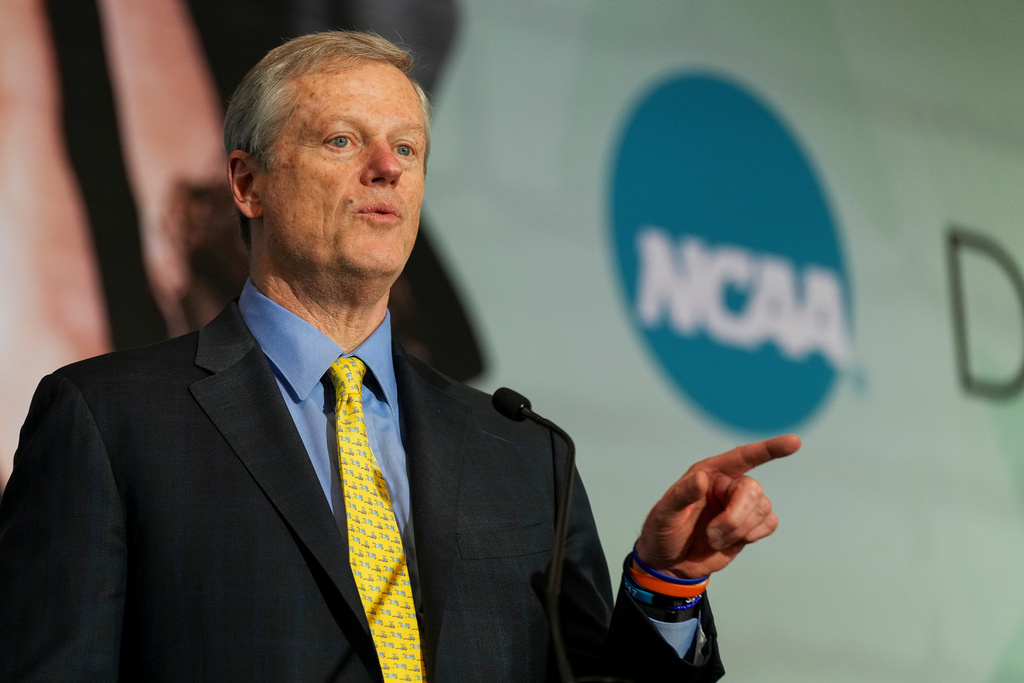
“Football is somewhere between 11 and 14 games in a season. You have many other sports, men’s and women’s sports, where you play 30, 40, 50, 60 games. And the conversation that people have started to have is whether there’s a way to think a little differently about how to schedule the football stuff and the way you schedule some of the other sports.
“A lot of these other sports, you’re playing mid-week, you’re playing the weekends, and (in) those sports the travel question becomes a much bigger challenge and much bigger issue.”
That’s not news, obviously.
Everyone in major college sports recognizes the insanity of Cal and Stanford competing in the ACC, especially for Olympic sports. The same is true of the West Coast schools in the Big Ten. And we see no reason that Arizona and UCF should share a conference (the Big 12) for basketball or baseball.
Football realignment can be justified without breaking the laws of logic. For the Olympic sports, the current structure is beyond ludicrous.
Host Ed O’Keefe then asked Baker a follow-up question: Did his comments about regionalized conferences for Olympic sports mean he was “suggesting” that football separate?
“No,” he responded. “I’m saying that schools and conferences have started to have conversations about whether or not there should be some thought put into whether or not it makes sense to think a little differently about sports that have huge numbers of games.”
News flash: It doesn’t make sense.
And Baker’s acknowledgment that discussions are underway about reorganizing conference affiliations for sports other than football offers hope that sanity might emerge sooner than later.
Is there anything to the rumors about Oregon State’s athletic director aggressively pursuing the Big 12? –@FiaCorvetta
If Kevin Griffin hasn’t attempted to back-channel with the Big 12 since taking charge in Corvallis earlier this month, he should start the process immediately — there’s no downside to outreach.
But unless there’s mutual interest, the Beavers are attempting to make water without hydrogen. And the Hotline has no indication (none, zero, zip) that the Big 12 wants Oregon State.
How would the Beavers add competitive or financial value to the existing 16 schools? Short answer: They wouldn’t.
In fact, there’s a strong case to make that OSU would devalue the Big 12 given the state of the football program and the school’s below-average media value. (We’re just being honest.)
Don’t believe the speculation on social media, where a realignment subculture frequently spews misinformation, at best, and absolute garbage, at worst.
Is the concern over losing conference championship game revenue a red herring authored by those who do not want a 24-team College Football Playoff? — Jon J
We usually view arguments for and against CFP expansion with a hefty dose of skepticism — after all, the Power Four commissioners are paid to think territorially. They don’t prioritize the best interests of the sport.
But on this particular topic, we agree: With a 24-team field, the conference championships would be wholly irrelevant.
It doesn’t matter where the title games are placed on the calendar, even on the final weekend of November (i.e., rivalry weekend). The matchups invariably would feature teams that had CFP bids locked up and no reason to play their starters. It would be a poor TV product.
That said, the financial concerns are real.
The SEC championship game is believed to be worth in excess of $75 million. If the added inventory of playoff games in a 24-team field — there would be 12 new games, all of them matching lower seeds — would not generate at least $75 million, why would the SEC agree to expansion?
To this point, there’s a distinct lack of clarity. The CFP has asked its media advisors for revenue projections, with a conclusion expected later this summer. (In theory, Fox and perhaps NBC and CBS would bid.)
And don’t forget: The financial piece is merely one obstacle. The CFP also must find space for 12 new games in the crowded December calendar.
As of July 1, where are the schools in the western U.S.? And what about changes for the 2027-28 academic year? — Niall A
All realignment moves in college sports are linked to the fiscal year, and 2026-27 was no exception. July 1 marked the start of the new era for a slew of conferences, all at the sub-Power Four level and most located in the western third of the country.
Here’s a primer, based on conference membership across the region (and excluding the former Pac-12 schools):
Big Sky: Cal Poly (football only), Eastern Washington, Idaho, Idaho State, Montana, Montana State, Northern Arizona, Northern Colorado, Portland State, Southern Utah, UC Davis (football only), Utah Tech and Weber State
Big West: Cal Baptist, Cal Poly, Cal State Bakersfield, Cal State Fullerton, Cal State Northridge, Long Beach State, Sacramento State, UC Irvine, UC Riverside, UC San Diego, UC Santa Barbara and Utah Valley
Mountain West: Air Force, Grand Canyon (non-football), Hawaii, Nevada, New Mexico, North Dakota State (football only), Northern Illinois (football only), San Jose State, UC Davis (non-football), UNLV, UTEP and Wyoming
Pac-12: Boise State, Colorado State, Fresno State, Gonzaga (non-football), Oregon State, San Diego State, Texas State, Utah State and Washington State.
West Coast: Denver, Loyola Marymount, Pacific, Pepperdine, Portland, Saint Mary’s, San Diego, San Francisco, Santa Clara and Seattle. (UC San Diego and UC Santa Barbara will join the conference for the 2027-28 season.)
In addition, we should note that Sacramento State’s football program will compete in the Mid-American Conference, because that’s how college sports rolls.
Washington believes it will receive a full share of Big Ten TV revenue in the next contract cycle. Do you agree? No way Rutgers deserves the same share as Ohio State or Michigan. Same for UW. — @MistUncle
First, I’m not sure every senior-level Washington athletic official believes the Huskies will receive full shares once the Big Ten’s next media rights cycle begins in 2030-31.
They are well aware of the potential for the conference to implement a distribution model of unequal revenue for the very reason stated in the question: The top football schools are weary of subsidizing the bottom feeders.
The Hotline shares that view, by the way. Unequal revenue distribution is the way of the present (hello, ACC) and the future. In the era of revenue sharing and NIL, the cost of talent acquisition and retention is such that the blue bloods are increasingly interested in eating what they kill.
Key point: The immense media revenue collected each year by the Big Ten and SEC is effectively generated by just four or five schools in each conference. The rest are piggybacking their way to riches.
Washington and Oregon agreed to join the Big Ten as half-share members, hoping they would attain full-share status in the 2030s. But the conference might not have full shares and half shares at that point. It could very well have performance-based revenue tiers.
We’re slightly skeptical the Huskies will earn their way onto the first tier. And they might not even make the second.
How long will it take for the legal system to obliterate the new NCAA eligibility rules? Do you give it weeks, months or years? — @MrEd315
Days, hours and minutes would constitute a more accurate timeline.
For those unfamiliar, the NCAA approved a five-for-five eligibility plan earlier this summer, giving athletes five years to play five seasons (with exceptions only for missionary work, pregnancies and military service).
The rule effectively eliminates the redshirting process even, it seems, if an athlete suffers multiple season-ending injuries.
However, the NCAA chose to exclude players who were seniors in 2025-26 and completed their fourth year of competition — they were not grandfathered in.
Naturally, that decision prompted immediate legal action, with an Ohio judge granting a preliminary injunction for 24 basketball players.
And this week, 11 more athletes filed a class-action lawsuit (in Colorado) against the NCAA’s five-for-five plan.
This was easy to see coming. Even the NCAA knew the rule would be challenged sooner than later. Sure, it could have included a pathway for the 2025-26 senior class to compete for a fifth year, but that would have created roster chaos.
As is usually the case, college sports’ governing body was faced with a slew of bad options thanks to years of arbitrary eligibility rulings.
The entire Formula 1 racing schedule is being streamed exclusively in the U.S. on Apple TV. The legacy Pac-12 collapsed, in part, due to dependence on streaming from Apple TV. Was the rejected deal ahead of its time, and were the university presidents short-sighted? — Scott K
Yes, the deal on the table for the 10 remaining Pac-12 schools in early August 2023 was, in fact, an all-in agreement with Apple and no guarantee of linear TV broadcasts for football and men’s basketball.
Clearly, there were benefits to partnering with the world’s most innovative company, and the cash component was not quite as dire as the media portrayed.
But the deal was so far ahead of its time as to be woefully behind. The campuses simply — and understandably — were not ready for the streaming plunge. (By 2030, that decision could prove to have been foolish. We’ll see how the media landscape unfolds.)
Of course, the details are particularly painful to some Pac-12 fans.
Oregon was on board with the Apple deal — Phil Knight saw the inherent value — but Washington was not. Specifically, coach Kalen DeBoer couldn’t support any media rights package that excluded linear TV. Exposure on ESPN and Fox was too important.
The Huskies refused to sign the grant-of-rights and left (with Oregon) for the Big Ten.
Five months later, DeBoer bolted for Alabama.
That said, we’d offer two reminders:
— Every school was to blame for the Pac-12’s demise, and no school was to blame.
— The destruction of a 100-year-old college sports institution cannot be traced to a single event.
The Pac-12 collapsed because of a series of strategic gaffes over the course of 12 years. Each time the conference had the opportunity to ensure its survival, it opted to remain on the road to the abyss.
*** Send suggestions, comments and tips (confidentiality guaranteed) to wilnerhotline@
*** Follow me on the social media platform X: @WilnerHotline



Leave a Reply