
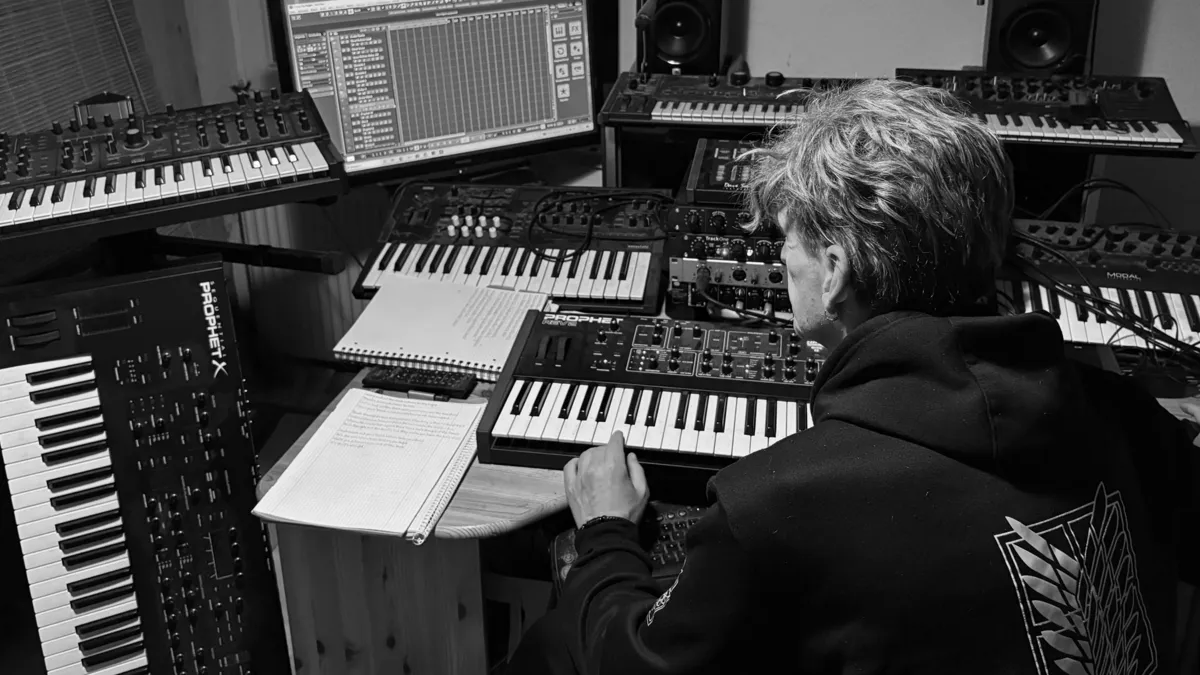

Photo Credit: André Grafert for International Artist Marketing (IAM)
AI detectors can brand handmade electro-synth-oriented tracks as AI music—even original tracks made in the 80s. What does this mean for indie artists?
The music industry has another big problem in the age of artificial intelligence: AI detectors. Tools designed to catch AI-generated “slop” before it reaches digital streaming platforms, or at least properly identifying it when it does, have had the unintended consequence of rampant false positives. The issue has particularly affected songs that incorporate the distinctive sounds of darkwave, electro, and post-punk, which were all prominent genres in the ’80s when the synthesizer was at its peak.
Unfortunately, any track using machine drums, precise sequencers, synthetic soundscapes, and altered voices is ripe for AI music detectors to improperly flag. In fact, evidence shows that AI music detectors, including SubmitHub, Let’s Submit, TrackVerifier, and ACRCloud, have all classified tracks with such features as “possibly artificially generated.” So what happens when a statistical estimate becomes a public accusation of fraud?
For independent artists, such a verdict as “89% possible AI detection” can be enough to lose their reputation, platform, and income, all because of the very tools designed to decide what is “real” and what is “fake.” For this genre in particular, such tools are getting it wrong alarmingly often.
According to Deezer, AI-generated tracks made up more than half of the music newly delivered each day for the first time in June 2026. At the same time, Bandcamp banned music that was generated wholly or in substantial part using AI. As a result, independent musicians who create handmade productions that intentionally sound electronic now face a significantly heightened risk of losing income or being completely removed from a platform.
Also in June 2026, Hamburg-based musician André Grafert, also known as Coloured Tears, released the fully handmade double album, DECAY / TIME — A Tribute to Twice a Man, 23 cover songs of the Swedish post-punk band from the ’80s, played, programmed, sung, and produced by Grafert himself, without the use of generative AI. Yet no sooner had the record been released than Grafert began facing public accusations of AI use.
To understand how such an accusation comes about, Ines Weidemann of International Artist Marketing (IAM) analyzed all 23 songs on SubmitHub and also spot-checked several other AI music detectors. Each of the 23 tracks was rated by SubmitHub as potentially AI-generated, while the other detectors predominantly rated them as being AI.
Afterward, Weidemann also tested original recordings by Twice a Man. Seven of these were rated by SubmitHub as “possible AI/hybrid,” and that’s for tracks that were created four decades ago. Two songs were even named as having used a specific AI platform: “Treblo_v3” for 1984’s “Across the Ocean,” and “ElevenLabs Music” for 1982’s “In My Mind.”
How is this possible? Well, ultimately, AI detectors prove nothing. They do not examine how a piece came to be; they merely estimate statistical probabilities. In fact, a recent study warns that detectors may also rely on incidental features such as sample rate and bitrate. The result is false positives.
“Suddenly, every independent musician and every young, up-and-coming band comes under pressure to justify themselves as soon as a track is professionally produced in a modern and clean way. It cannot be right that newcomer bands today have to prove with individual tracks that they are real people, while no one would ever doubt the big, established acts. I am not going down this path of mistrust,” said André Grafert.
“With me there are no text prompts, but real electricity and passion. My sound is created note by note by hand in Cubase and driven through my Sequential arsenal: the Prophet X, for sample, for cinematic depth. The Prophet 12 for dark and complex textures. The Pro 3 for raw, untamed energy and the Rev2 for timeless analog warmth. In addition, I use NI Kontakt and my own vocals.
But the spectral characteristics of synthesizers and other stylistic devices have been part of the musical DNA of EBM, electro, darkwave, and post-punk for decades. They are not a byproduct of generative AI but part of the history of these genres.
The economic consequences of false positives—the blocked accounts, blocked releases, and withheld royalties—in IAM’s assessment hit mainly the independent scene. The industry’s new labeling system, which is the voluntary standard of the IFPI, RIAA, A2IM, and many others, relies on voluntary self-disclosure by labels and distributors. But independent artists who depend on DIY distributors are running into automated filters and placed under general suspicion.
The fact that platforms are increasingly relying on labels and distributors for labeling suggests that audio analysis alone is insufficient. Until filters and appeal procedures are clarified, releasing modern independent productions remains an algorithmic game of chance.






Leave a Reply