
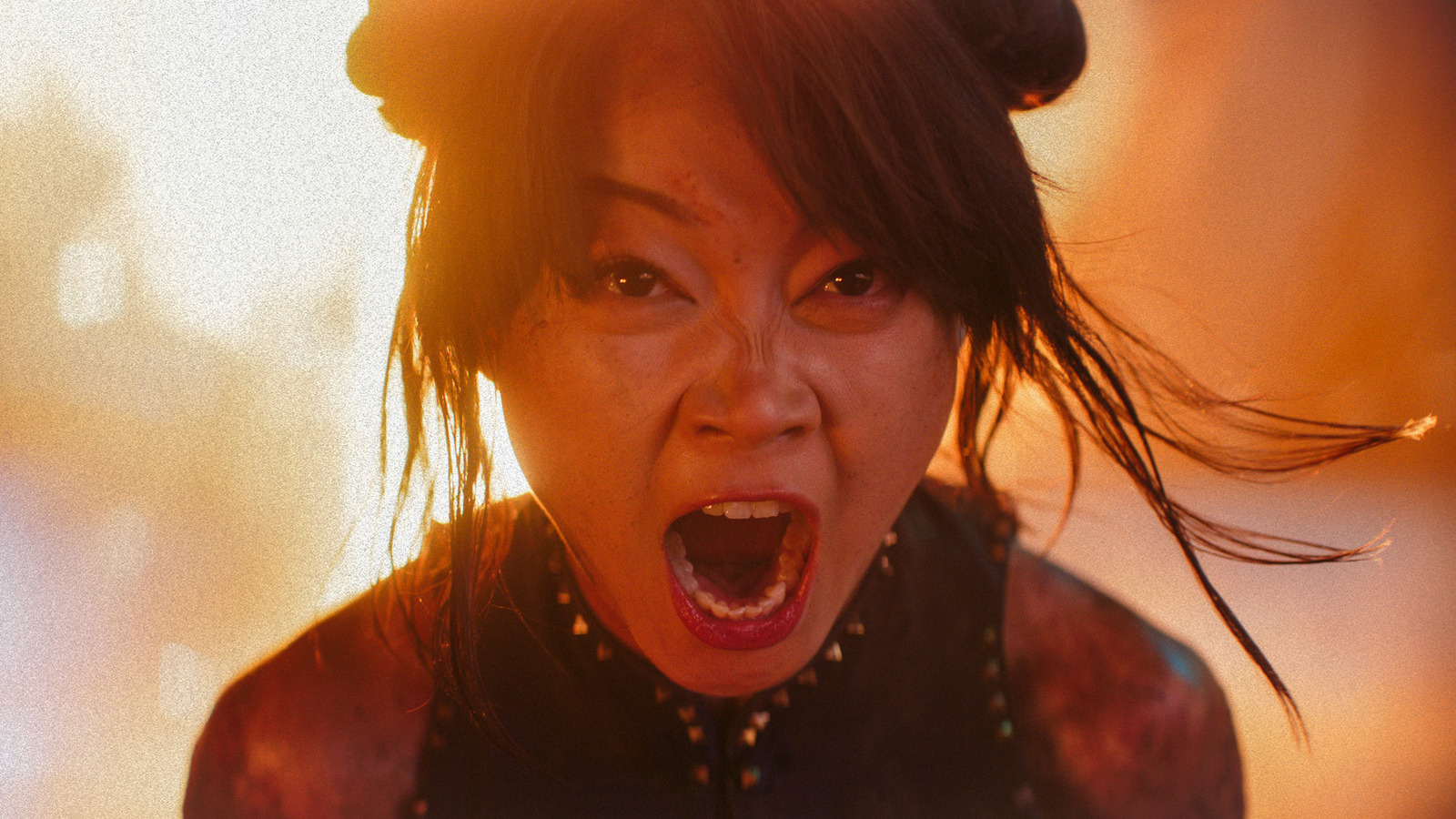
The “Street Fighter” video games are one of the foundational works of the medium. Sure, there had been a few fighting games made before it, but “Street Fighter” defined the subgenre so well that every subsequent fighting game owes it a massive debt. Originally made by the Japanese company Capcom for arcades, “Street Fighter” made a splash thanks to its colorful, diverse, and unique cast of characters. With the original designers Takashi Nishiyama and Hiroshi Matsumoto being inspired in part by martial arts movies of the ’70s like “Enter the Dragon” and “The Street Fighter” (whose name was borrowed for the game, natch), “Street Fighter” took off thanks to just how well it translated the feeling of those movies to the player.
Translating the games back to the big screen has proven a little trickier, however. Unlike the more intense “Mortal Kombat,” “Street Fighter” has generally distinguished itself as a more good-natured (yet still operatic) franchise. The 1994 live-action film starring Jean-Claude Van Damme and Raul Julia has its fans, but mostly for the film’s (somewhat unintentional) camp value. Meanwhile, people love to hate 2009’s bizarre “The Legend of Chun-Li.” This month, “Street Fighter” is back for a third round in live-action, with director Kitao Sakurai at the helm. Sakurai’s career thus far has been largely in comedy, with the great “Bad Trip” and “The Eric Andre Show” on his resume, along with some action and drama fare like “Twisted Metal” and “Beef.” He seems like an ideal candidate to get “Street Fighter” right, and visually at least, he does. Sadly, the film is saddled with a bizarre tonal mess of a script, one which keeps “Street Fighter” from being the knockout it could’ve been. It’s an attractive and engaging film that unfortunately leaves a bad aftertaste.
Street Fighter features a great cast, mixed medium visuals, and some inspired fighting sequences
“Street Fighter” captures attention from the get-go, flashing back to the 1987 World Warrior Tournament in which young Ryu (Andrew Koji), watched by his master Gouken (Don Lee) and brother-in-martial arts Ken (Noah Centineo), wins the championship. Yet this victory nearly costs Ryu his soul, for an evil demonic spirit known as the Hado, mastered by the evil Akuma (Joe “Roman Reigns” Anoa’i), threatens to take him over. The neat thing about this flashback, as with all the flashbacks in the film, is that it’s done in a Japanese anime style by the studio Titmouse, referencing the franchise’s tonal relationship to anime as well as prior animated “Street Fighter” films. From there, we jump forward to 1993, in which Chun-Li (Callina Liang) is recruiting fighters from around the world for a new World Warrior Tournament, hosted by (and rigged by) the evil dictator M. Bison (David Dastmalchian). Various subplots abound.
With all this, “Street Fighter” has enough gas in the tank to fuel its numerous fight sequences, and for the most part, it manages to make them worth the price of admission. Kitao Sakurai at least maintains a good pace and energy to these fights, so that even when they inevitably devolve into too many slow-mo peppered, CG-enhanced body blows, they’re still fun. One early fight, in which a reunited Ken and Ryu face off in the former’s hotel room, has the ingenuity of early Jackie Chan films, and the choreography is as nimble as Centineo and Koji’s moves. It’s a shame the film isn’t able to maintain that ingenuity, but it does buy “Street Fighter” some goodwill.
The humor in Street Fighter is too juvenile to be clever, ruining its attempts at self-awareness and sincerity
That goodwill is nearly totally depleted, however, by the movie’s baffling approach to humor. To be fair, “Street Fighter” understands that it can have fun while still taking its characters (or at least their goals) seriously, so it’s not as self-sabotaging as “Masters of the Universe.” Some gags even land in a big way, as intended. Yet a large portion of the humor is bizarrely juvenile, and it begins to border on distasteful. Blanka (Jason Momoa) scratches his armpits, smells his fingers, and then comments on the scent. Kyle Mooney plays Chun-Li’s Interpol agent partner, and he’s shown to be so openly covetous and creepy toward her that what must’ve began as a meta-commentary on the way Chun-Li has been treated by Caucasian straight white men gets too uncomfortably close to being misogynistic, especially when Bison joins in on the sniffing and comments on her body.
While by themselves these elements would be unfortunate but not movie-ruining, what makes it more of a systemic problem is realizing that Kitao Sakurai and the film’s screenwriters are openly suspicious, if not disdainful, of sincerity appearing in “Street Fighter.” As Sakurai told Polygon recently, part of his interest in using animation for the flashbacks was as a way of avoiding “something that might be cheesy.” Indeed, the use of animation for flashbacks helps keep the rawest emotions of Ken and Ryu at bay, which allows the film to remain jocular but also makes it lose what could’ve been a deeper connection with the audience. “Street Fighter” wants points for being clever, fun, and self-aware, but at the expense of embracing what’s made these games and these characters endure for nearly 40 years.
Street Fighter has no idea what story it’s telling
Even with that tonal Achilles’ heel, “Street Fighter” might’ve still gone the distance. That’s when the final blow lands, in which the film seems to abandon the antagonist it’s spent the last hour and change spending time with and instead subs in a ringer at the last possible moment. I’m being coy to avoid spoilers, of course, but imagine if, say, “Batman & Robin” had ended with Batman defeating Bane while Poison Ivy and Mr. Freeze got away. “Street Fighter” appears to think that it’s telling the story of Ryu and Ken, their past, and their present-day struggle with themselves and each other, but that’s ignoring how many other characters are involved and the significance they’re given throughout.
It all makes for a remarkably unsatisfying conclusion, one that’s abrupt at best and blatant sequel bait at worst. If Ryu and Ken were indeed the main focus here, why devote so much of their storyline to the animated flashbacks? Why deploy a twist within the film’s tournament structure that feels like it wants to be a cheer moment but ends up baffling in execution? Why have another character stick it to the Man and go rogue only to fail spectacularly?
“Street Fighter” is a highly watchable movie, and it’s not too hard to convince yourself you’re having fun while seeing it. Yet its aftertaste is so bitter and its center so hollow that it’s hard to recommend, and certainly not as an introduction to this world. There may be enough in the film’s attract mode to get me to press start, but I ended up not wanting to continue.
/Film Rating: 5.5 out of 10
“Street Fighter” opens in theaters October 16, 2026.






Leave a Reply