
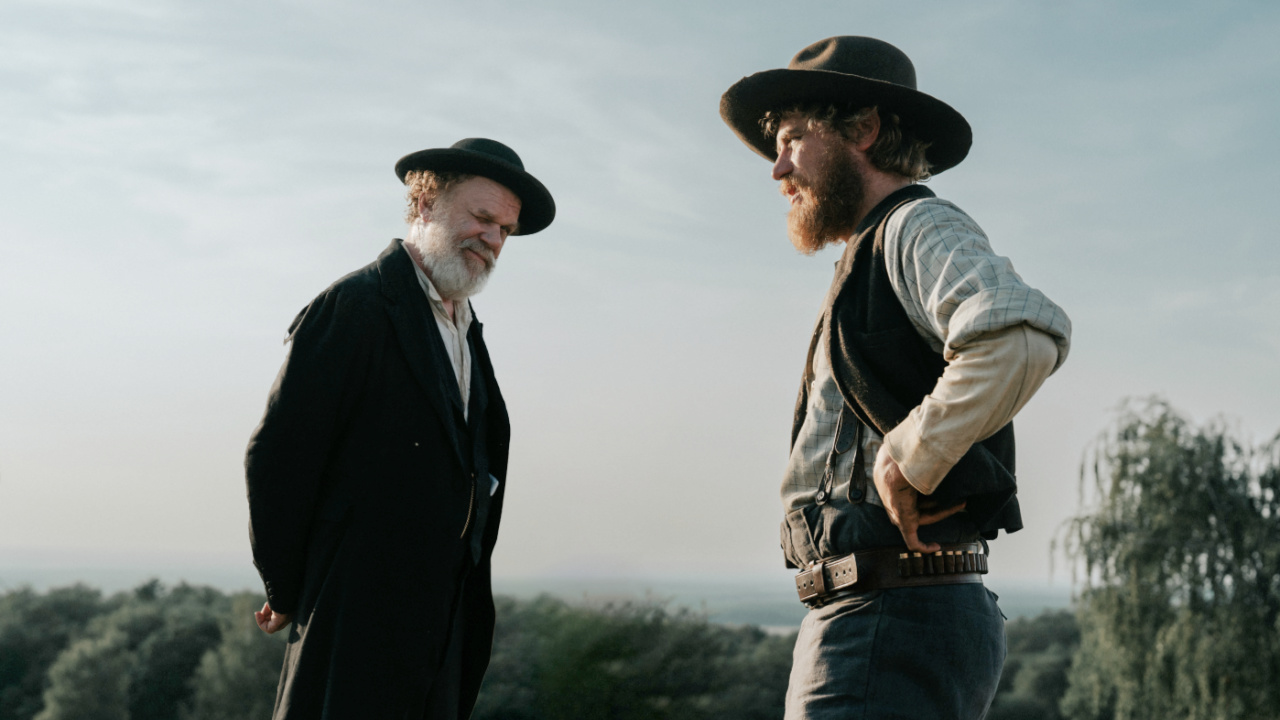

Opening in select theaters on October 19th is the new drama ‘A Prayer for the Dying‘, which is based on the novel of the same name and was written and directed by first time filmmaker Dara Van Dusen.

The film stars Johnny Flynn (‘The Outfit‘), John C. Reilly (‘Boogie Nights‘) and Kristine Kujath Thorp (‘Ninjababy‘).
Moviefone recently had the pleasure of speaking with Johnny Flynn and John C. Reilly about ‘A Prayer for the Dying’, their first reactions to the screenplay, their characters, working together on set, and collaborating with director Dara Van Dusen.

Moviefone: To begin with, Johnny, can you talk about your first reaction to the screenplay and what were some of the aspects of this story and this character that you were excited to explore on screen?
Johnny Flynn: It’s interesting. Honestly, it really grabbed me in a way that most scripts don’t from the first couple of pages. There’s a strangeness about it. There’s an eeriness. This character, the way this story is told and the way it has to be told, is that you might make assumptions about him and he seems like a good guy. Then you realize slowly that he’s dealing with a lot of stuff inside himself. Also, he has this obligation to the community and his family. That’s a conflict as well that is really interestingly explored in the script and the story. Then I met Dara Van Dusen and she was so amazing in the way she would speak about it. I thought this is such an interesting story to tell and its understanding of a level of humanity that comes from this experience that not many of us have had to face, but maybe people did at that time. There’s some resonances in terms of recent familiarity with COVID and things like that. But what if there was no chance of a vaccine and what if there was a fire coming? The book that it’s based on became one of my favorite novels of all time. It’s very short and it’s written completely inside his head and it’s in a tense that you don’t usually get in literature. It’s first person perfect or first person future or something. It’s amazing because it allows Stewart O’Nan, the writer to create this character that you slowly realize is not reliable in terms of his telling of the story. That’s what I think the film does as well. It’s really interesting from the beginning, and I personally love films and stories from America at that time.
MF: John, what was your first reaction to the screenplay, and why did you want to play this character?
John C. Reilly: Anytime you can find a script that explores a world that has a lot of true historical details that you were not aware of, that’s always a big draw for me personally, whether it’s Howard Hughes or whatever. This one, it’s hard to believe now with how advanced science has become that people didn’t know what bacteria was then. Most doctors didn’t know you should wash your hands between surgeries. Both my character and Johnny Flynn’s character were coming off of the Civil War, and medicine in the Civil War was like, “Bleed them or sever the limb. Get a saw and cut it off before they get gangrene.” That was most of the medicine. That was a really interesting part of it. The fact that despite that, how primitive things were then, we went through it all again with Covid. The dilemma that our characters face in ‘Prayer for the Dying’ was exactly the dilemma that Anthony Fauci was facing. Do we tell everyone and panic them, or do we wait until we figure this out a little bit? There’s no good choices when the bait of humanity is in your hands, and when you have very little information about what you’re actually dealing with. So I thought it was really prescient, the story. The book was written way before Covid happened. The truth of these people’s lives, this is just one story of a town. This happened all the time in these communities. The whole town just wiped out by smallpox, or wiped out by yellow fever. Luckily, the travel was so slow that it couldn’t spread the way things spread with air travel today. Luckily, things could be localized and it didn’t just decimate the entire state at once or the whole country. Anyway, it was fascinating to learn a lot of the details, and to take on the perspective of a doctor of this era.

MF: John, can you talk about your approach to playing your character, the situation he finds himself in, and the hard choices he has to make?
JCR: Well, there’s just the facts of the matter. We decided Doc was someone who actually was more advanced than most doctors. He realized if you touch someone that’s died for mysterious reasons, you should wash your hands afterwards. He’s not sure why, but somehow any contact with someone that has died from this could make you sick. That was a new idea then. Even though there’s so many examples of it in history, it’s just crazy that we went through the Black Plague in the Middle Ages and we were still trying to figure out how disease travels as late as the 1800s in Wisconsin. I think what my approach to playing a character comes down to, is what do they say to each other? What’s their perspective? Who do they love and what are their priorities? Those were really clear for Doc, and I found him to be a really noble character. In the same way that to this day I find all doctors, nurses, paramedics, policemen and firemen, people that are willing to suspend their own self-preservation in order to help people at large, a more evolved person. That takes a really special person, and it takes, to me, a more evolved person, someone of a higher mindset than just, “What’s in it for me?” It’s like someone who’s beyond the reptile stage of life. Priests are like that, too. They’re looking at the larger picture of things and what’s good for everybody, not just what’s good for them.
MF: Johnny, what it like working with director Dara Van Dusen and helping her execute her unique vision for this project?
JF: She was so collaborative in terms of inviting us into how she was going to shoot it and being very clear about the goal with it. Kate McCullough, the DP, and her were so tight in terms of their design for the look. They had worked it out for every scene. I mean, the film had way less money and less time than it would look from watching it. But the reason why it came out so good is because they worked so tightly with what they had to say. They didn’t shoot anything that they weren’t going to use in the cut. The camera becomes this very kind of conscious gaze. The way it moves from when you’re watching something and then the people carry on talking in the scene, but then it moves quickly. It’s looking 90 degrees to the right and it catches something else because the camera was moving, so there wasn’t traditional coverage in the way that you would have a stationary camera doing a master and then you’d move in and do it this way and that way. The camera was like this extra character and you could feel it moving. You knew when it was on you and when it wasn’t on you. I really liked that. I’d never done anything like that. Normally you’re like, “Oh, forget the camera’s there.” I’m in 1870 and I’m imagining that that’s some glitch in my vision and I’m playing this scene, but the camera was in our faces and moving around and it became quite a personified kind of character. I really enjoyed collaborating with the gaze of the camera. So it was a very conscious way of using what you are seeing. Those guys are brilliant. Kate and Dara were really fun and collaborative.

MF: John, what was your expierence like working with Dara, and did she discuss with you how the film was going to look visually, and how did that affect your performance?
JCR: Well, she didn’t talk to me about it beforehand, but I quickly realized they had a really distinct style, her and the DP who was brilliant too. My first day of shooting, there was a scene that I’m in and I have the first few lines in the scene. The camera was panning across the town while I was talking, and then it eventually lands on me on the porch. We did that a few times, and then she was like, “Okay, I think we’re ready to move on to the next scene.” I was like, “Wait, I have those three lines at the beginning of the scene. Aren’t you going to cover that part of the scene?” She was like, “No, we’re committed to this. That’s the way this is going to play.” I’m like, “Oh, but Dara, I’ve done over 80 movies. You might want to cover yourselves in case this pan across the town is too slow for the pace of the scene or something. You might want to just pop in and get this so that you have the ability to cut back and forth.” She’s like, “I respect your experience. I respect what you’re saying. But this is our game plan. In the time that we have, we’re committing to this approach, and please don’t be offended if your lines are not on camera at first, but this is the way we’re doing it.” I was like, “Wow, that is Baller.” For a first time director to be that committed to a concept like that was very impressive. Even though it was Dara’s first film, she was a script supervisor for years, which to me is the hardest job on any set. The script supervisor has to be aware of what the actors are doing, where the props went, what the camera’s doing, and which take the director liked. There’s a million things. You have to have this comprehensive knowledge of the entire set, so I thought that really prepared Dara very well. I don’t know if you saw her short film, it’s really brilliant too. So I knew I was in good hands. And then when she was that confident with the shooting style, I was like, “All right.” Even if it’s a risk, it’s a risk worth taking, instead of just trying to please everyone, or be like a bunch of other movies, or shoot a movie the way a movie is supposed to be shot. She was making a work of art from her own vision, which you can’t wish for more.
MF: Johnny, what was your experience like working with John C. Reilly?
JF: I love him. I was a huge fan of his acting and his comedy. But I really love his, I guess, non-comedic performances as well and the stuff he did with Paul Thomas Anderson. But he’s incredible. He has a strangeness about him. He’s a very soulful person and I really love him as a person. We became really good friends and we like the same music. We just did lots of singing together. We invented a band called The Brothers John, I think. We had a lot in common. It was cool to hang out with him and he’s such an incredible actor. I found it very powerful. He’d make me weep in a split second in the scenes. I believed in the friendship and this history between these two people that have been trying to lead the town through difficult times. Yeah, what a guy.
MF: Finally, John, can you talk about the relationship between these two characters and creating that on screen with Johnny?
JCR: I have to tell you, the set was a very intense place. We’re out there in this dusty hill in Slovakia, with these buildings that were built for that village. The whole thing was not there, and I think it was gone after we left. But Johnny, I already had great admiration for him as an actor and as a musician, and I really came to admire him as a person. I got to meet his family. I hung out with his family there, and we played music together. I’ve played a lot of intense, disturbed characters before, and I know what it’s like to be playing someone like that. It tends to carry on after the camera calls cut. In order to really stay focused and to stay in character, sometimes you have to be disturbed all the time in order to feel like you’re being consistent. Johnny did it with such grace. Johnny has such a natural attractiveness to him. I don’t mean that by the way that he looks, of course he is very handsome. But people are just drawn to Johnny. He’s kind to everyone, and he’s centered in a way that I haven’t seen in a lot of actors. Talk about seeing the larger picture and what’s good for everybody. Johnny, he really was a natural leader. It was a perfect role for him, I thought. Also, our characters connect in this way as veterans of the Civil War, which we don’t talk about in the movie, I don’t think explicitly, but it was something we were operating on all the time. We went through that together. I know what it’s like to have to chop someone’s leg off, and I know what it’s like to have to eat a horse or whatever. I think that was a really interesting detail. I couldn’t figure out at first, why is he riding a bike all the time? You don’t think of bikes so much in the 1800s. It was a new thing in the mid-1800s. Then you realize, “Oh no, he had some terrible experience with a horse, and he’ll never go near another horse.” So I thought there were all kinds of really interesting little details of the character that are not necessarily discussed, but made the movie really rich and real. But I was really impressed with Johnny.

What is the plot of ‘A Prayer for the Dying’?
Decisions of life and death are taken in the Scandinavian emigrant community in the 1870s town of Friendship, Wisconsin.
Who is in the cast of ‘A Prayer for the Dying’?
- Johnny Flynn as Jacob Hansen
- John C. Reilly as Doc
- Kristine Kujath Thorp as Marta
- Gustav Lindh as Harlow





Leave a Reply