
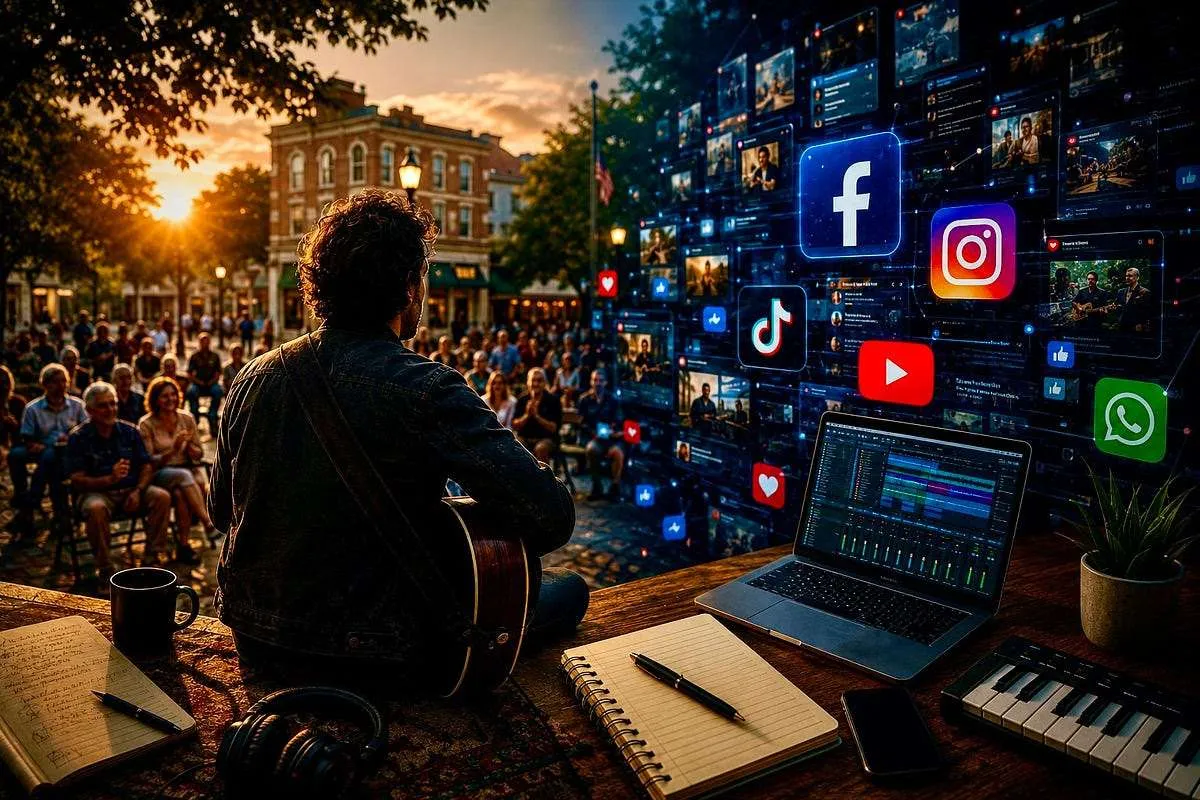

In June, I dumped my Facebook account. I did not deactivate it for a while or dramatically announce that I was taking a break. I deleted it because I had grown tired of the advertising, the clutter and, most of all, the lack of relevance. I was spending too much time scrolling past sponsored posts, suggested content, recycled memes and updates from people I had never chosen to follow, hoping to find the occasional post from someone I actually knew.
I think having Russian hackers take over my artist page in 2024 was really the end — but I just lingered for two more years hoping things would change. They didn’t.
At some point, the exchange no longer felt fair. Facebook continued asking for my time and attention, but it was providing less and less that felt meaningful to me. What had once seemed like an unruly but genuinely social place increasingly felt like a shopping mall in which the stores followed me from floor to floor.
Facebook is no longer our (digital) town square. For years, that metaphor made sense because so much of our online lives passed through one place: friends, families, musicians, businesses, photographs, political arguments, concert announcements, birthdays, fan clubs, local events and breaking news. It was often frustrating, but it was alive, and its relevance came from the people we had chosen to know.
That version of Facebook has largely disappeared. The modern platform is more heavily shaped by recommendations, short-form video, advertising, commerce and material selected by an algorithm because it is likely to hold attention. Facebook still connects people, but connection is no longer its only — or perhaps even its primary — purpose.
My decision to leave was personal. It would be a mistake, however, to assume that my loss of interest means Facebook has ceased to matter as a business or as a resource for musicians.
Less Relevant to Me, More Profitable for Meta
On July 29, 2026, the day before I wrote this, Meta reported another enormous financial quarter. The company generated $60.8 billion in second-quarter revenue, an increase of 28 percent over the previous year, and earned nearly $15.85 billion in net income during the three-month period. Meta also reported that advertising impressions across its family of apps increased 14 percent while the average price of an advertisement rose 12 percent.
Profit was 14 percent lower than a year earlier, but that decline was not caused by the advertising business suddenly failing. Meta’s expenses had risen dramatically, including legal charges, severance costs and massive investments in artificial-intelligence infrastructure. Free cash flow fell sharply as the company increased capital spending, but its advertising operation remained remarkably powerful.
There is no contradiction between those results and my decision to leave. Facebook can become less useful to an individual user while Meta becomes more successful at converting the attention of its enormous global audience into advertising revenue. The company does not need every person to love Facebook. It needs enough people to remain inside Facebook, Instagram, WhatsApp and Threads long enough to see, respond to or move past a growing inventory of advertising.
The reported 14 percent increase in ad impressions does not mean every Facebook user personally saw 14 percent more ads. Meta reports that figure across its entire family of apps, and impressions can grow because there are more users, more video views, more time spent inside the platforms or additional places in which ads can appear. Still, the figure helps explain why my own experience felt increasingly commercial. What seemed to me like clutter can appear on Meta’s earnings statement as inventory.
Facebook had not stopped working. It had simply stopped working for me in the way it once had.
Facebook Has Had Its Day, but It Is Not Dead
I believe Facebook has had its day as the defining social network of our culture. It no longer determines youth culture, musical discovery, visual style or online conversation in the way it once did. Those functions have been divided among TikTok, YouTube, Instagram, Reddit, streaming platforms, podcasts, messaging apps and private groups.
That fragmentation is particularly visible among younger people, but Facebook still reaches an enormous adult audience. Pew Research Center found that the middle age groups were the most likely Americans to use Facebook daily in 2025: 58 percent of adults between 30 and 49 and 54 percent of those between 50 and 64 said they visited it every day.
For a musician with a career spanning decades, that is not an irrelevant audience. It may include the people who bought the early albums, attended concerts, heard the music on radio or television, purchased physical recordings or followed the artist from one creative era into another. These listeners may not spend their days making TikTok videos, but they may possess something far more important than temporary visibility: a history with the music.
This is where the conversation about Facebook becomes more complicated for musicians. I may no longer want it in my personal life, but that does not automatically mean it has no professional value. An artist’s own media habits and the habits of the artist’s audience are not always the same.
The useful question is no longer whether musicians should embrace or reject Facebook. The useful question is what specific job Facebook can still perform.
Discovery Is Only the Beginning
The music business has become preoccupied with discovery. Artists are encouraged to pursue more views, followers, streams, impressions, playlist additions and algorithmic recommendations. Every release campaign seems to begin with the question of how to reach people who have never heard of the artist.
Of course, discovery matters. A career cannot grow unless new people encounter the music. But the industry’s focus on first contact has obscured an equally important responsibility: taking care of those who have already chosen to listen.
Not every listener has the same value to an artist’s career. Someone who passively hears part of a track in an automated playlist is counted alongside someone who owns several albums, attends concerts, shares the music with friends and has followed the artist’s work for 20 years. On a dashboard, both may appear as listeners. In the life of a career, they represent entirely different relationships.
Spotify’s research into what it calls “super listeners” makes this distinction visible. According to Spotify, these committed listeners represent, on average, only 2 percent of an artist’s monthly audience, yet they generate more than 18 percent of monthly streams. They also account for approximately half of the artist’s ticket sales made through Spotify and are nine times more likely than other listeners to share the artist’s music. More than half are still listening six months after discovering the artist.
These numbers come from Spotify’s own platform and should be understood in that context, but the underlying lesson is sound. A relatively small number of committed listeners can provide a disproportionate share of an artist’s repeat listening, ticket sales, merchandise purchases, recommendations and long-term support.
The value of a fan accumulates. It does not begin and end with one stream.
Taking Care of the People Who Stayed
Taking care of existing fans does not mean posting constantly, replying to every comment or making the artist’s private life available for public consumption. It means creating continuity so that listeners can remain connected to the music without having to rediscover the artist every few months.
The first requirement is reliability. Fans need at least one dependable way to hear from the artist. Following a Facebook Page, Instagram account or TikTok profile no longer guarantees that a person will see the next post. Recommendation-driven feeds increasingly decide what appears, even when users have deliberately chosen to follow particular creators. Patreon’s State of Create research found that creators who had spent years building audiences were seeing their reach decline and becoming less confident that followers would actually receive their work.
The second requirement is context. Streaming services divide albums into individual tracks, while social platforms divide careers into isolated posts. Musicians need spaces where they can reconnect those pieces and tell the larger story. Why was this album made? How does it relate to earlier work? What has changed? What did the artist learn? Where is the music going next?
Existing fans do not always need to be sold the artist again. They already know who the artist is. They want to be brought further into the work.
Recognition is also part of fan care. A thoughtful reply, a note of thanks after a purchase, an acknowledgment of a familiar name or a story involving longtime listeners can communicate that their support has registered. This does not require the artist to manufacture intimacy or pretend that every fan is a personal friend. It simply recognizes that loyalty is a human act, not a statistical category.
Participation can strengthen that connection. Fans can be invited to submit questions, share memories associated with a particular recording, attend an online listening session, discuss an older album or contribute photographs and stories from earlier concerts. They do not need control over the art, but they can be given ways to inhabit the world that has grown around it.
Musicians should also give fans appropriate opportunities to provide support. That support might mean buying a recording, attending a concert, purchasing sheet music, joining a membership, watching a complete video, sharing a song, writing a review or bringing another listener into the audience. The mistake is not offering something for sale. The mistake is appearing only when there is something to sell.
What Facebook Can Still Do
Facebook can remain useful as a fan-retention resource, particularly for artists with an established or older audience. Its role is less about becoming culturally fashionable and more about preserving contact with people whose relationship with the music may reach back many years.
The platform works well for memory. Album anniversaries, archival photographs, television appearances, stories about collaborators, older performances and reflections on the making of earlier projects can bring dormant listeners back into the catalog. A photograph from 20 years ago may not generate the explosive reach of a short-form video, but it may awaken a far more valuable emotional connection.
Facebook also remains relatively hospitable to longer conversations. A musician can write about the origins of a piece, a recording session, an instrument, a career turning point or the meaning of a project without compressing everything into a few seconds. The resulting post may reach fewer strangers while inspiring deeper exchanges with people who already understand the context.
Groups can be valuable, but only when they are genuine communities rather than second copies of an artist Page. A Page primarily broadcasts information. A good Group allows fans to interact with one another around shared interests, memories and experiences. For an established composer or recording artist, that could include discussions about particular albums, electronic instruments, film music, creative process, listening experiences and the ways certain pieces have accompanied important moments in people’s lives.
Facebook can also support concerts, livestreams, local events, targeted advertising and the reactivation of people who have gradually lost contact with the artist. None of these functions requires Facebook to become the center of the musician’s life. It can be maintained as an outpost, possibly by a manager or team member, while the artist’s deeper communication takes place elsewhere.
No Single Platform Can Replace the Town Square
The answer to Facebook’s decline is not to search for another company capable of becoming the new universal town square. TikTok, Instagram, YouTube, Spotify, Bandcamp, Patreon and email all perform different functions. Musicians need a connected system rather than another dependency.
The artist’s website should remain the stable source of truth. It is the place for the catalog, biography, current project, news, events, store, contact information and email signup. Social platforms can attract attention, but they should eventually lead people toward an address that the artist controls.
Email should provide continuity. A good newsletter can carry project updates, personal notes, essays, release information, advance access and invitations without relying on a feed to decide whether subscribers receive it. It should also remain active between sales campaigns so that every message does not arrive with a purchase button attached.
YouTube can serve as both a discovery platform and a living archive. Full performances, interviews, album commentaries, studio visits, restored videos and stories behind important recordings can remain searchable and useful long after a social post has disappeared from view.
Instagram, TikTok and Reels are effective for discovery, immediacy and short glimpses into the work. Their strongest role is often as an entrance. A short video should give an interested viewer somewhere meaningful to go next: a full performance, an album, the website, a concert, a newsletter or the larger catalog.
Streaming platforms are where much repeated listening occurs, but they provide only limited direct communication between artists and audiences. Musicians should keep their profiles, photographs, merchandise, concert information and catalog presentation current while recognizing that a monthly listener is not yet a relationship.
Bandcamp and direct stores give fans the opportunity to purchase, own and collect the work. Bandcamp automatically emails followers when an artist releases music or merchandise, and the company says these messages are among the largest drivers of artist revenue on the platform. It also allows artists to retain customer information and communicate directly with supporters.
Membership platforms can serve the smaller group that wants a deeper experience through advance listening, private discussions, workshops, archives, livestreams or special editions. A membership should not make ordinary fans feel excluded. It should provide additional depth for the people who actively want it.
Podcasts offer yet another kind of connection. They create space for complete thoughts about creativity, business, philosophy and experience. For musicians with knowledge extending beyond their recordings, a podcast can deepen trust in a way that short-form content rarely can.
A System That Does Not Consume the Artist
Musicians do not need to live on every platform. They do not need to create unrelated material every day for Facebook, Instagram, YouTube, TikTok and email. That approach turns communication into a second full-time occupation and eventually drains energy from the work itself.
A more sustainable system begins with something meaningful. A story about an older recording could become a complete newsletter, a shorter Facebook post, an Instagram photograph, a YouTube commentary and a brief video excerpt. One idea is being adapted rather than five disposable pieces of content being invented.
The goal is not omnipresence. It is consistency and coherence.
My own departure from Facebook does not change this conclusion. I left because the personal experience had become too commercial and too irrelevant for me. I do not miss the scrolling, the suggested posts or the feeling that I was searching through advertising to find evidence of the people I knew.
But musicians must sometimes maintain a presence in places they would not personally choose to spend their time. The decision should be based on whether the platform still serves the audience and the work, not on whether the artist enjoys browsing it.
A manager or team member can operate a professional Facebook presence while the artist remains personally absent. Posts created for newsletters, YouTube or other platforms can be adapted rather than invented specifically for Facebook. The Page can direct people toward the website and email list, preserve contact with longtime listeners and provide useful information without asking the artist to move back into the shopping mall.
The larger challenge is not deciding whether Facebook is good or bad. It is deciding how much authority any platform should have over the relationship between an artist and the people who care about the music.
Facebook is no longer the town square.
There is no new town square waiting to replace it.
Discovery attracts attention.
Care creates continuity.
Continuity builds a career…


Leave a Reply