
United States | 2026 | Drama | Survival
One Man Against the Desert
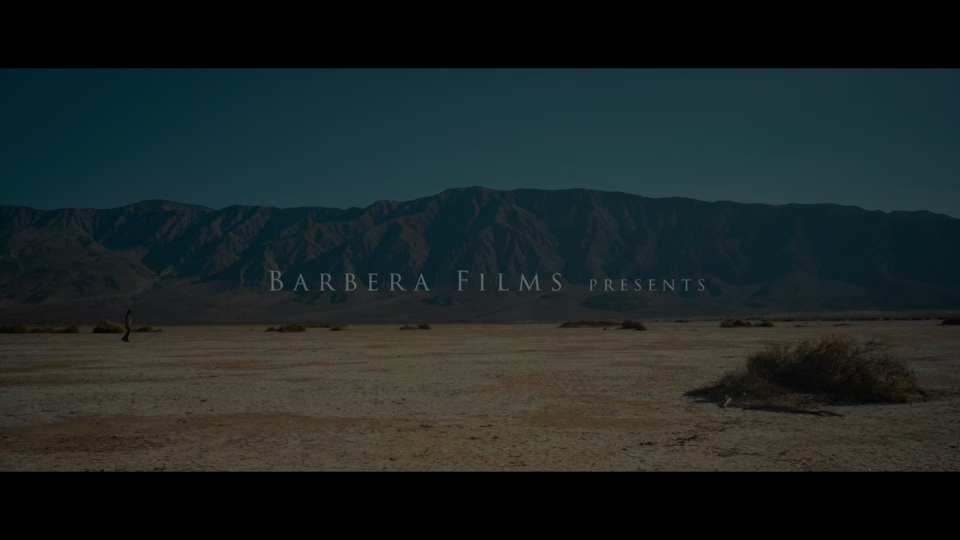
Agony strips survival cinema down to its most elemental conflict: one man, no water, no signal and seemingly no way out. Written and directed by Javier Barbera, the film follows Jonas (Jason Morciglio) after he becomes lost in the desert and is forced into an increasingly desperate fight to stay alive.
But physical survival is only the beginning. As isolation, dehydration and exhaustion intensify, Jonas is pushed toward the limits of both his body and mind, turning the desert into a psychological as well as physical threat.
Why This Movie Matters Right Now: Survival Cinema Gets Stripped Back
Agony belongs to a particularly minimalist form of survival storytelling. Instead of relying on a large ensemble, elaborate disaster scenario or constant action, it reduces the experience to a single person confronting an environment that offers almost no possibility of assistance.
That simplicity shifts attention toward psychological deterioration. Hunger, thirst, isolation and fear can transform the question from simply “Will he survive?” into “How much of himself can he preserve while trying?”
➡️ Key Takeaway: Agony reduces survival to its rawest physical and psychological elements. Isolation becomes part of the threat.
Why Everyone Is Talking About It: A One-Man Survival Story
The clearest hook is Jason Morciglio’s central performance as Jonas. With only one credited cast member in the information provided, the film places unusual weight on a single performer to sustain the audience’s attention and communicate the progressive physical and psychological consequences of being stranded.
Javier Barbera’s dual role as writer and director reinforces the film’s concentrated creative approach. There are few obvious distractions from Jonas, the landscape and the fundamental problem of staying alive.
➡️ Key Takeaway: Agony builds its identity around an extreme one-man survival scenario rather than spectacle or a large cast. Everything depends on Jonas surviving the next moment.
Recognition & Release: An Emerging Independent Survival Film
Unlike films with established festival, awards or box-office narratives, the supplied information does not yet show major awards recognition for Agony. Its strongest current positioning is therefore its independent filmmaking and minimalist survival concept, rather than external accolades.
Produced by Barbera Films and released in the United States in July 2026, it remains an emerging title whose wider critical, festival and streaming trajectory is still developing.
➡️ Key Takeaway: Agony currently stands on the strength of its concept rather than awards or chart success. Its simplicity is the selling point.
Why Agony Stands Out: Survival Becomes Psychological
The strongest reason to watch Agony is the severity of its setup. No water. No signal. No apparent rescue. Removing conventional escape routes allows the film to concentrate on what prolonged isolation and physical deterioration can do to a person’s mind.
That transforms the desert from a backdrop into the central adversary. Jonas is fighting exposure and dehydration, but he is also fighting the psychological consequences of realizing that nobody may be coming to save him.
➡️ Key Takeaway: Agony stands out by turning a simple desert survival scenario into a journey toward the limits of the human mind and body. The real battle is staying alive—and staying himself.
Movie Trend: Survival Drama — Isolation Turns Survival Into a Psychological Battle
Agony fits the Survival Drama trend by stripping the genre back to its essentials. Jonas is alone in the desert without water, communication or obvious help, meaning survival depends less on defeating a conventional antagonist and more on enduring an environment that is slowly breaking down his body.
The premise also pushes the story beyond physical survival. As exhaustion, dehydration and isolation intensify, the desert becomes a psychological test, creating tension around how long Jonas can continue functioning when both his body and perception are under pressure.
➡️ Key Takeaway: Agony makes survival both physical and psychological, using extreme isolation to test how far one person can endure. The mind becomes another battleground.
➡️ Movie Trend: Survival Drama
Who Should Watch It? (Audience Profile): Survival Thriller and Minimalist Drama Fans
|
Survival thriller and wilderness drama fans |
|
|
Independent and minimalist film viewers |
|
|
Broad film and streaming audience |
|
|
Viewers interested in intense, stripped-back and psychologically driven stories |
|
|
Audiences attracted to survival scenarios, solo performances and high-tension independent films |
The strongest audience is viewers who enjoy survival stories built around endurance rather than action spectacle. The absence of a large cast means the experience is concentrated almost entirely on Jonas and his changing physical and psychological condition.
It should also appeal to audiences interested in minimalist independent filmmaking. With Javier Barbera serving as writer and director and Jason Morciglio carrying the central role, Agony offers a particularly focused version of the survival-film formula.
➡️ Key Takeaway: Agony is best suited to viewers who enjoy intense survival stories, psychological isolation and performance-driven independent cinema. It is survival without distractions.
What This Movie Means for the Industry: Minimalist Concepts Can Create Maximum Tension
Agony illustrates the continuing appeal of high-concept, contained filmmaking. A desert, one principal character and a basic survival objective can create a complete dramatic framework without requiring an elaborate world or large ensemble.
For independent filmmakers, that simplicity can become a creative advantage. When spectacle is removed, atmosphere, performance, sound, landscape and psychological deterioration have to generate the tension, making execution more important than scale.
The concept is also immediately understandable to audiences: a man is stranded without water or communication and must survive. That clarity gives smaller films a strong discovery hook even without franchise recognition or major stars.
➡️ Key Takeaway: Agony shows how a simple survival premise can support an entire film when character, environment and psychological tension become the spectacle. Small scale can still feel extreme.
Creative Analysis: The Desert Turns Into the Enemy
Agony builds its tension from an elemental situation: Jonas is stranded in the desert without water, communication or an obvious route to safety. With no conventional villain required, the landscape itself becomes the antagonist, forcing him to confront heat, exhaustion, dehydration and the possibility that rescue may never arrive.
The minimalist setup also makes the story increasingly psychological. As Jonas’s physical condition deteriorates, survival becomes as much about maintaining control of his mind as finding a way out.
➡️ Key Takeaway: Agony turns the desert into both a physical threat and a psychological prison. There is nowhere to escape from the environment.
Storytelling: A Simple Goal Creates the Tension
The narrative begins with one immediately understandable objective: survive. Jonas needs water, orientation and some way of reaching civilization, giving even small decisions potentially life-or-death consequences.
That simplicity can make survival storytelling especially effective because audiences immediately understand what is at stake. Rather than depending on complicated exposition, tension comes from watching resources, strength and possibilities gradually disappear.
➡️ Key Takeaway: Agony creates suspense from the most basic human objective—staying alive. Every decision matters.
Direction & Tone: Javier Barbera Strips Away Distractions
As both writer and director, Javier Barbera builds Agony around a deliberately concentrated premise. The absence of a large ensemble or elaborate external storyline keeps attention on Jonas and his deteriorating situation.
That stripped-back approach suits a story about isolation. Silence, empty space and the overwhelming scale of the landscape can become as important to the experience as dialogue, emphasizing just how insignificant one person can feel when completely alone.
➡️ Key Takeaway: Barbera’s minimalist approach keeps the film concentrated on isolation, endurance and vulnerability. The emptiness creates tension.
Performance: Jason Morciglio Has to Carry the Film
Jason Morciglio plays Jonas and is the sole credited star in the information currently available. That places considerable responsibility on his performance: physical exhaustion, fear, determination and psychological deterioration need to communicate the progression of the story without a conventional ensemble surrounding him.
Solo survival films depend particularly heavily on physical acting. Changes in movement, energy and behavior can become visible measurements of how much longer a character might realistically endure.
➡️ Key Takeaway: Jason Morciglio becomes the film’s emotional and physical center, carrying the survival experience largely alone. His deterioration becomes the story.
Setting & Atmosphere: The Desert Makes Isolation Feel Absolute
The desert is particularly effective for this kind of survival story because its openness creates a paradox: Jonas can see enormous distances while still having nowhere meaningful to go. There are few resources, few landmarks and apparently no immediate signs of civilization.
That emptiness can also intensify the psychological dimension. When every direction looks equally hostile, deciding where to move becomes almost as difficult as finding the strength to continue.
➡️ Key Takeaway: The desert’s vastness makes Jonas’s isolation feel even more extreme. Open space becomes a trap.
Themes & Messages: What Remains When Survival Takes Everything Else Away?
The supplied synopsis explicitly describes Jonas’s ordeal as a journey toward the “edge of the mind and body.” That framing suggests Agony is interested not only in whether he survives but in what extreme deprivation does to a person’s sense of control.
With ordinary comforts, communication and social relationships removed, survival reduces existence to immediate necessities. Water, shade, movement and mental focus become more important than everything that defined life before the crisis.
➡️ Key Takeaway: Agony explores what happens when human existence is reduced almost entirely to endurance. Survival strips everything back.
What Makes This Movie Different?: One Man, No Water, No Signal, No Help
Agony’s strongest creative hook is its refusal to complicate the central danger. A man is lost in the desert with no water, no signal and apparently no hope of rescue. The simplicity makes the threat immediately understandable.
The more interesting question is what happens after the conventional survival options begin disappearing. The premise promises to push Jonas beyond practical problem-solving and toward the point where physical exhaustion starts affecting perception, judgment and identity.
➡️ Key Takeaway: Agony stands out through an uncompromising survival setup that pushes one man toward his physical and psychological limits. The simpler the premise becomes, the more intense the ordeal can feel.
If You Liked Agony (2026): More Extreme Survival and Psychological Isolation
Send Help (2026) by Sam Raimi
Send Help follows two colleagues who survive a plane crash and become stranded on a remote island, where their already difficult relationship develops into a dangerous struggle for survival and control. Sam Raimi combines physical survival with psychological conflict, gradually revealing what extreme circumstances can bring out in people.
It is a strong companion to Agony because both reduce their characters’ worlds to basic survival, isolation and diminishing possibilities of rescue. Send Help adds interpersonal conflict, while Agony takes the concept further toward complete solitude. Survival changes the mind as much as the body.
Eden (2025) by Ron Howard
Eden follows a group of outsiders who abandon civilization for an isolated existence on the Galápagos Islands, only to discover that escaping society does not mean escaping human conflict. Harsh conditions, limited resources and competing personalities gradually transform their supposed paradise into something much more dangerous.
For Agony viewers, the connection comes through environmental isolation and the psychological consequences of being cut off from ordinary life. The scale is larger and the story ensemble-driven, but both films ask what happens when conventional security disappears. Isolation exposes vulnerability.
The Damned (2024) by Thordur Palsson
The Damned places an isolated community in an unforgiving environment where survival decisions carry increasingly disturbing consequences. Its combination of extreme conditions, psychological pressure and uncertainty creates a darker, horror-inflected variation on the survival formula.
Like Agony, the landscape is more than scenery. Isolation removes easy solutions and forces characters toward physical and psychological limits, allowing the environment itself to generate much of the tension. Survival becomes increasingly mental.
Send Help combines survival with psychological conflict, Eden explores isolation through an ensemble, and The Damned pushes environmental survival toward horror. All three show how quickly isolation can transform human behavior. Extreme environments reveal what remains when ordinary life disappears.
Final Verdict: Minimalist Survival Turns the Desert Into a Psychological Prison
Agony has an immediately effective premise because almost everything unnecessary has been removed. One man is stranded in the desert without water, communication or obvious help, creating a survival story where the smallest physical decision can carry enormous consequences.
Jason Morciglio’s solo role also makes the film unusually dependent on performance. Without a large ensemble or conventional antagonist, Jonas’s exhaustion, fear and psychological deterioration must provide much of the drama while the desert becomes his primary opponent.
Its strongest potential lies in that simplicity. Rather than expanding the survival scenario through spectacle, Javier Barbera uses isolation to push the experience inward, exploring what happens when the struggle to remain physically alive begins threatening a person’s ability to remain psychologically intact.
➡️ Final Verdict: 3.5/5 — A stripped-back independent survival drama with a strong elemental premise and an emphasis on psychological endurance. The desert is the enemy, but the mind may become the greater threat.
Quick Facts: One Man Against the Desert
|
Isolation, endurance and psychological deterioration |
|
➡️ Key Takeaway: Agony reduces survival cinema to one man, one hostile landscape and the increasingly difficult task of staying alive. Its minimalism is its defining strength.



Leave a Reply