
Filmmaker Edgar Wright’s career arc leading up to “Last Night in Soho” — which debuted in theaters five years ago to the day — was interesting to witness. Starting in the late 1990s, he was a darling among Millennial nerds because he worked on “Spaced,” the cult sitcom co-created by his frequent collaborator Simon Pegg. Wright then preceded to break out with 2004’s “Shaun of the Dead,” a film that seamlessly blends comedic zombie gore and 20-something anti-maturity malaise. From there, he directed 2007’s “Hot Fuzz” and 2013’s “The World’s End” to round out his so-called Cornetto Trilogy, garnering even more acclaim. (See how we ranked Wright’s Cornetto Trilogy movies here.)
Between “Hot Fuzz” and “The World’s End,” Wright also made the 2010 box office bomb “Scott Pilgrim vs. the World,” which was quick to attract a cult following that adores the film’s savvy video game references and modern media-saturated thinking. After that, 2017’s “Baby Driver” saw the director pivot into genre experimentation, with Wright drawing heavily from Walter Hill’s “The Driver,” one of his favorite movies. That brings us back to “Last Night in Soho,” his stylish attempt to recreate a certain kind of “fallen woman” horror movie narrative, set in 1960s Swinging London, that was hip decades ago.
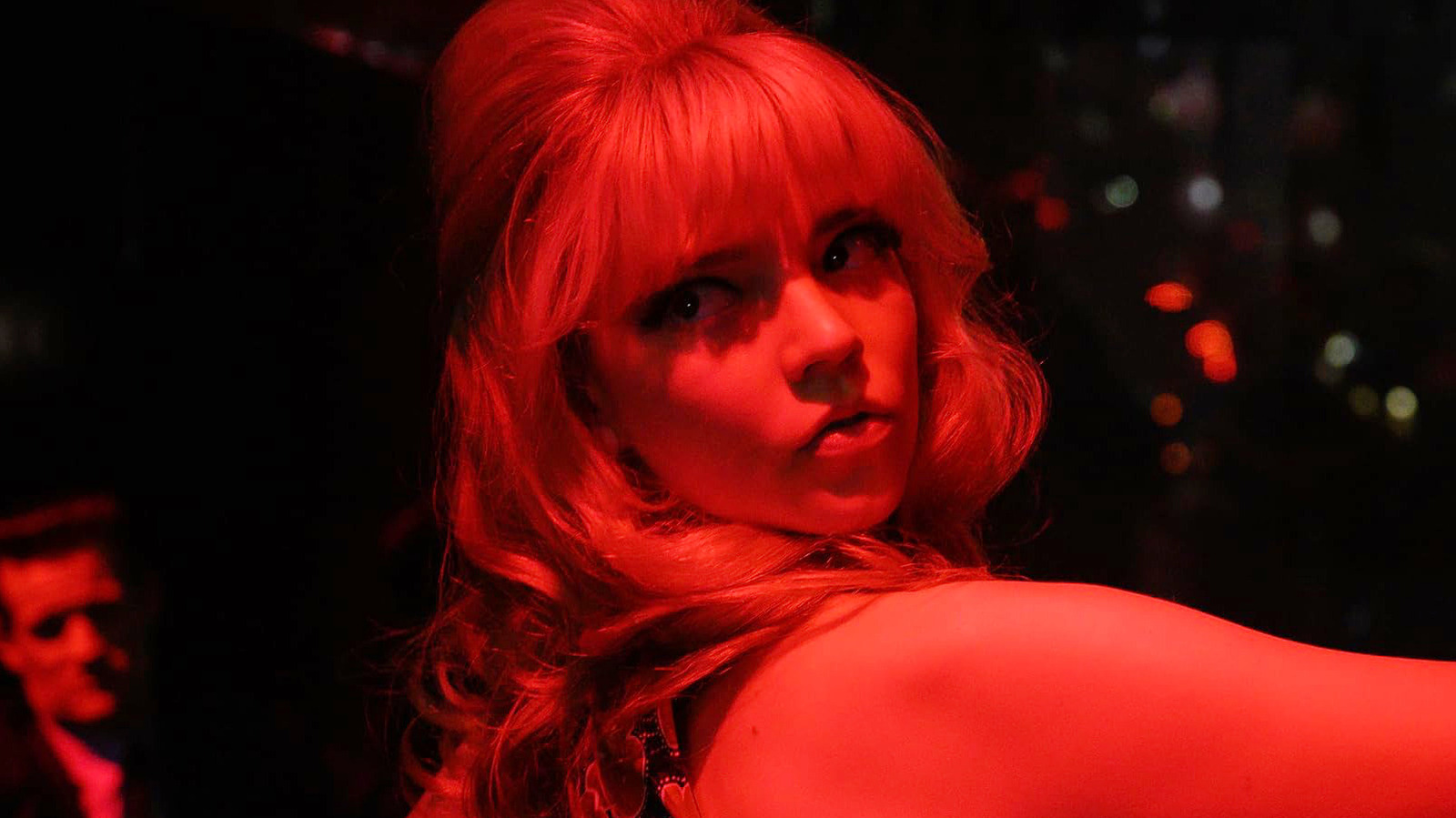
“Last Night in Soho” stars Thomasin McKenzie as Ellie, a modern-day fashion student who moves to London to study her craft … and to flee the ghost of her dead mother, whom she can see in mirrors. Dorm life proves to be oppressive, though, so Ellie moves to an old flat to get a little peace. It’s there that she begins having dreams about Sandie (Anya Taylor-Joy), an aspiring young musician who moved to Soho back in the 1960s, only to be abused by a social system that victimizes women.
Last Night in Soho has amazing production design
Ellie always loved the idea of Swinging London in the 1960s, so she’s inspired to create new retro-fashions every time she dreams about Sandie. Indeed, she even begins to dress like Sandie and dyes her hair to match. Ellie’s dreams, however, eventually reveal that Sandie’s fate was not so rosy, as it gradually becomes clear that Sandie was a real person that Ellie is somehow supernaturally dreaming about. In addition, Matt Smith plays a 1960s-era dandy who may or may not have had something to do with what happened to Sandie.
The present-day sequences in “Last Night in Soho” feature a lot of notable British acting veterans. The late Terence Stamp plays a mysterious figure credited as the Silver-Haired Gentleman, while Diana Rigg, in her own final film role, played Ellie’s landlady Ms. Collins. In addition, Rita Tushingham from the British classic “A Taste of Honey” and Richard Lester’s “The Knack …and How to Get It” plays Ellie’s grandmother. Clearly, Edgar Wright was trying to assemble as many legends as he could in one movie and evoke the British cinema of the 1960s.
It’s Wright and Krysty Wilson-Cairns’ script that falters. “Last Night in Soho” has a lot of temporal twists that reveal a somewhat tired cliché about sex work. Intentional or not, the film seems to look down its nose at the world’s oldest profession and has little sympathy (or, at least, a twisted sense of retrogressive judgment) for sex workers who are harmed. Where the movie succeeds is with its photography (by Chung Chung-hoon of “The Handmaiden” and “It” fame) and production design. It recreates the streets and fashions of Swinging London well without falling back on hackneyed images. Visually, the film works fine.
What did critics think of Last Night in Soho?
Critics were generally positive toward Edgar Wright’s horror thriller, as evidenced by its 75% approval rating on Rotten Tomatoes. /Film’s own “Last Night in Soho” review was very much in line with that number, giving it a 7.5 out of 10 and writing that it was exciting to witness Wright, then best known for genre movies and geekery, take a step away from his established brand.
Writing for iNews, Christina Newland noted that the style of “Last Night in Soho” was fun but argued that its politics are frustratingly regressive. As I mentioned above, Newland noticed the film’s weirdly judgmental attitudes about sex work, which causes the whole thing to flounder and fall apart. As she put it:
“It is a blunt-edged portrayal of sex work, taking away any sense of agency from Taylor-Joy’s character (…). Demonizing sex work as a trade which only ever can lead to misery and death is already pretty basic if you want to offer a rebuke to the patriarchy in your movie. But then the final big twist of ‘Last Night in Soho’ arrives (…) flipping the switch on the expected narrative of (Sandie’s) victimhood, but doing so in a manner that has zero sense of empowerment or forethought.”
Bilge Ebiri, on the other hand, enjoyed the movie, as he wrote about in his review for Vulture. He acknowledged the film’s narrative flimsiness but still felt it was an “intoxicating affair.” Unfortunately, “Last Night in Soho” would go on to bomb at the box office … and not just because it arrived at a point when theaters were still getting back on their feet after the 2020 Covid lockdowns. For Wright, sorry to say, the bloom is off the rose.






Leave a Reply