
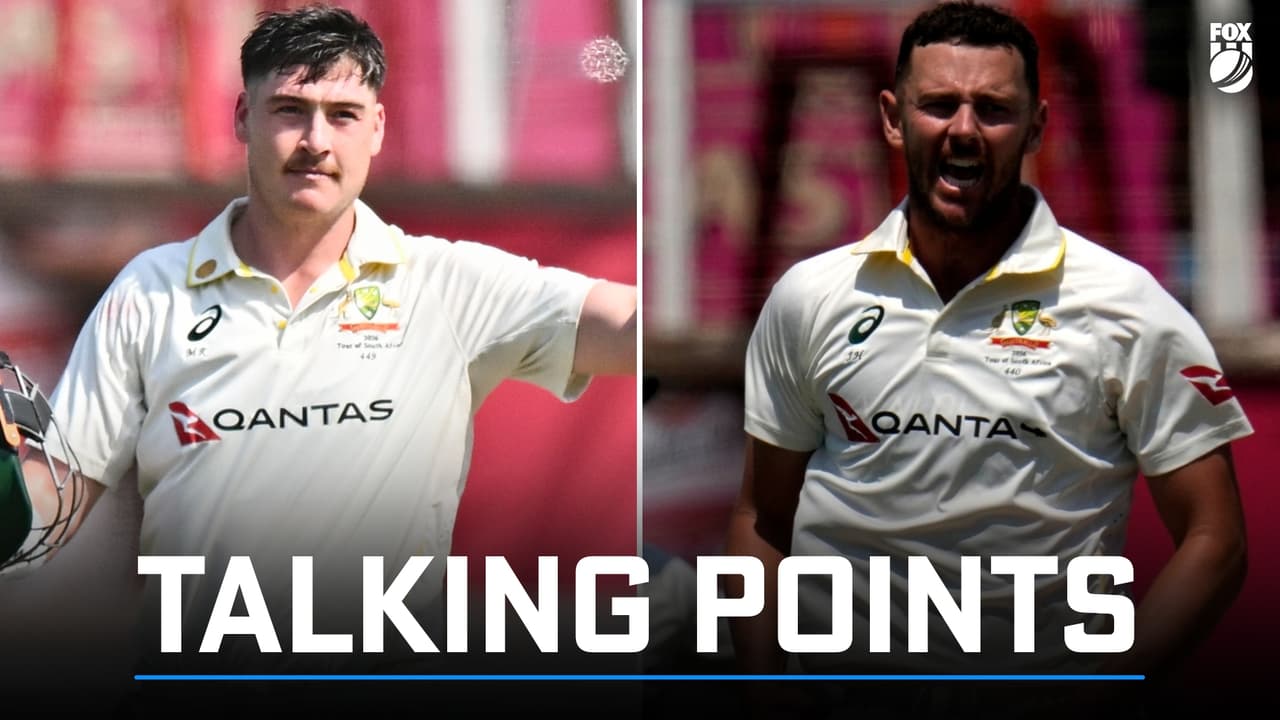
Josh Hazlewood delivered a bowling masterclass as Australia took a 1-0 lead over South Africa, but could history be about to repeat itself?
With the Proteas preparing to hit back, Kagiso Rabada’s return adding some fire and plenty of selection headaches ahead for the Aussies, there is plenty to unpack from the opening Test in Durban.
Watch Australia’s Tour of South Africa Live & Exclusive on Fox Cricket, available on Kayo Sports. Second Test begins October 18 in Gqeberha.

Scroll down for the biggest talking points from Australia’s win in Durban!
HAZLEWOOD’S MASTERCLASS
Watching Josh Hazlewood charging towards David Bedingham on Monday evening in Durban after a superb dart trapped him in front would have brought a wry smile to many.
The ‘Bullet from Bendemeer’ cuts a relaxed figure and is easy-going in most circles, but those who know him best understand the competitive fire that burns away within.
The 35-year-old, who finished with 6-49 in just under 17 overs in a brilliant bowling display, was gutted to miss the Ashes last year due to two different problems.
Those who had witnessed how well he was bowling in white-ball cricket in October were disappointed as well, for the accurate one was placing the ball on a dime and would have torched the ‘Bazballing’ English.
The champion has been injury prone but in a chat with Fox Cricket at the SCG last month, Hazlewood said he felt stronger than ever, and so far, so good in this stint in South Africa.
His second innings blitz was the 15th time in his 79 Test career that the New South Welshman has secured a five-wicket haul, and the eight wickets he took for the match were the most he has secured since the nine he took against the West Indies in Adelaide in 2024.
Hazlewood moved to eighth on the all-time list of Australian bowlers with the effort, going past Fox Cricket favourite Brett Lee when moving to 311 Test wickets.
He has an incredible 66 wickets at 14.98 since the start of 2024.
THIS IS FOLLOWING A SIMILAR SCRIPT…
Australia won the series opener in Durban and if it feels a little familiar, it is because this is what happened last time.
The infamous Sandpapergate series of 2018 kicked off with an Australian victory at Kingsmead by 118 runs.
No visiting batter matched Matt Renshaw’s heroics on that occasion but Mitchell Marsh’s 96 similarly dug Australia out of a hole on day one before Mitchell Starc, Josh Hazlewood, Pat Cummins and Nathan Lyon went to work with the ball.
The wickets were more shared around this time after Starc had the Kookaburra reverse swinging around corners on his way to a nine-wicket haul.
The scars of that demolition job eight years ago were present still as South African great Shaun Pollock sounded a touch fearful in the commentary box when Starc was getting the old ball to reserve a fraction in each innings.
But the impact it had on the game paled in comparison to eight years ago with former Australian captain Alyssa Healy pointing out on Kayo Sports that the reverse swing “seemed to die down once the spinners got their sweaty hands all over it again”.
Regardless, Durban has become a happy hunting ground for Australia.
Since the Proteas ran down 335 against an incredible Australian bowling attack of Glenn McGrath, Jason Gillespie, Brett Lee and Shane Warne in 2002, Australia have won four straight Tests in the coastal city.
Twins tons from Ricky Ponting led Australia to victory in 2006 and the late Phil Hughes pulled off the same feat in 2009.
Australia have also made a happy knack of being fast starters in South Africa.
The tourists lead 1-0 in the previous tours in 2018 and 2014.
Banking an early victory is crucial for the current side, who have developed a reputation for being slow starters in recent years.
They lost to Bangladesh in Darwin in August, were behind after the first day of the Ashes in Perth, lost the World Test Championship final against South Africa at Lord’s last year and were smashed by India in Perth in the opening Test of the 2024/25 summer.
But based on recent history in South Africa, the challenge now is withstand the Proteas’ fight back in Gqeberha (formerly Port Elizabeth).
An AB De Villiers century and, the quick who shoulder charged Steve Smith, Kagiso Rabada’s 11-wicket haul levelled the series in 2018.
Four years earlier, tons from De Villiers and JP Duminy before Dale Steyn ran riot with a reverse swinging ball in the second innings.
Now, the Australians must buck the trend in front of famous band that plays from the grandstands in Gqeberha.
But if the script writers are following a similar story to past series, a blockbuster deciding Test in Cape Town – the scene of the Sandpaper crime – between the two best team’s in the world would certainly be mouth-watering.
READ MORE
AUS V SA WRAP: The Renshaw Test! Hoff’s career-best cleans up RSA tail for unforgettable Aussie win
NIC MADDINSON: Even he was ‘shocked’ by Aussie call-up. It took a 3yo’s sledge to make Maddinson see the truth
FIERY PROTEA’S ‘BIG ONE’ AWAITS
When it comes to hotel names, The Protea Fire and Ice in Durban evokes all manner of imagery and feels a fitting description for what Australia has done and is about to face.
With a professional and disciplined performance, Australia showed great resilience to rebound from a perilous position on Day 1 and iced South Africa out for the rest of the Test.
But the fire awaits, with the brilliant and feisty fast bowler Kagiso Rabada poised to return to the fray in Gqeberha for the second Test of the series beginning on Sunday.
On the eve of the Test, a Fox Cricket reporter and a colleague from another website stepped into a lift at The Fire and Ice to be greeted by the smiling face of Rabada and South African captain Temba Bavuma, with the hotel playing host to both teams.
A question was fired between the journalists regarding plans for the evening and a sage response offered; “It will not be a big one.” It is always best to get some sleep before a Test.
Despite being ruled out of the Test, Rabada was quick to seize an opportunity to strike.
On hearing the answer, the South African superstar quipped; “Mine will be.”
It is not certain whether he followed through on his promise at one of the many fine restaurants and bars in Uhmlanga, but one thing is certain about Rabada.
When he steps out against the Aussies next week, he will be determined to “have a big one”.
As former South African skipper Dean Elgar told Fox Cricket’s The Follow On podcast last month, the sight of a Baggy Green on the field tends to spark the best from the 31-year-old.
“He gets so fired up and we saw that in 2018,” Elgar said.
“Having him in that team, with that mentality, is like having four players, which is awesome. Like I said, he gets out of bed (to play Australia).”
Rabada, who suffered a significant hamstring tear in August, has been in the nets at the back of Kingsmead Stadium over the past few days and barring any setbacks, will play.
How South Africa shapes the rest of its team will be interesting.
Anrich Nortje was impressive in his return to Test cricket, bowling with serious venom and giving Steve Smith a massive shake when striking him on the head on Monday.
But the 32-year-old had not bowled more than eight overs in an innings in three years and sent down 40 in this Test, though only a dozen came in the second innings.
It will be intriguing to see how he pulls up and whether he is rested given his injury history.
Wiaan Mulder crashed into the fence and appeared to hurt his shoulder when fielding on Day 4 of the Test, but he was able to bat and was the pick of the Proteas bowlers in the first Test.
The batting line-up is a concern, as Kayo Sports’ expert analyst Mark Waugh noted.
“They’ve got good players but they don’t have a world class batsman,” he said.
“That’s what they’re lacking. They average 35. That might be their level. Are they any better than that?“
Aiden Markram batted with distinction once again. He is another who saves his best for Australia, having been the hero in the World Test Championship decider at Lord’s last June.
David Bedingham also batted with verve when falling just sort of half-centuries in both innings. Mulder and Marco Jansen receive pass marks for their performances.
But brace for at least a couple of changes as South Africa seeks to keep the series alive.
Renshaw’s stellar Test continues! | 00:52
UNEXPECTED AUSSIE ‘DOMINATION’
For all their flaws with the bat, this current Australian team regularly score more runs than their opponents and often find a way to back themselves out of a corner.
Travis Head flipped the Ashes on its head in Perth last summer after breaking Indian hearts a year earlier to regain the ascendancy in the Border Gavaskar Trophy.
While captain Pat Cummins almost always stands up in his team’s hour of need and did so again with bat and ball in Durban.
But the clouds surrounding Australia’s batting after their Darwin debacle against Bangladesh, and several low first innings totals in recent times that have forced the bowlers to pick up the slack, meant that the general consensus on day one was that the tourists were in big trouble.
With many regarding South Africa as a favourites in this series, no one would have imagined how the remainder of the Test played out after Cummins walked to the crease at 6/124 in the first innings.
Australian great Mark Waugh admitted as much.
“Not really, that’s a great effort by Australia to come back,” he replied on Kayo Sports when asked by former teammate Brendon Julian if he expected the Australians to be going into day five on the cusp of victory.
“Bavuma may have missed the chance by not bowling Nortje to Pat Cummins, but since then it’s been domination by the Australians with the bat and the ball.”
Cummins’ men bossed the game for the next four days.
The skipper dug in to provide valuable support to Matt Renshaw – who in his second Test back in the side unexpectedly became the nation’s new hero.
Renshaw was surprisingly recast at No.5 with Nic Maddinson coming in at the top of the order and despite the latter’s 33-ball duck in the first innings it proved to be masterstroke.
Renshaw’s 190 will go down in folklore as one of the finest Australian knocks on foreign soil in this generation, but crucially, it also laid down a marker for a marathon year of Test cricket to come.
Renshaw reflects on stunning 190 | 10:11
The Australian public has become accustom fast forward Test cricket in recent times.
A combination of grassy pitches, high quality pace bowling and at times suspect batting techniques have led to three of Australia’s last seven Tests on home soils being done in two days.
Renshaw’s method of success via a war of attrition and the old-fashioned nature of the Durban Test hopefully showed that short Tests can go down as a fad.
Australia’s fast scoring on day four to charge towards a declaration showed that the skills of modern white-ball cricket can enhance the longest format, but the beauty of this contest was the blend of skills.
If batters learn from Renshaw and curators learn from the grounds staff at Kingsmead, Australia has plenty more to-and-fro battles to come at home against New Zealand, in India, in the 150th anniversary Test and in England within the next roughly nine months.
Maddo talks Test call-up with Howie | 07:01
WHAT WILL THE AUSSIE BATTING LINE UP LOOK LIKE NEXT?
It required great patience to secure a win over South Africa and kudos must be extended to the Proteas for their fierce resistance on the final day of a quality Test match.
They made the Australians sweat in steamy conditions – it was another testing day under the scorching sun in Durban – which will have sapped some energy from the bowling attack.
But the tough win aside, the Aussies had further reason to smile with Steve Smith able to field after passing concussion Tests following the nasty knock he received when batting.
Meanwhile, at lunch, Cameron Green was out in the middle completing a series of sprints in the surest sign yet he is edging closer to fitness as he recovers from an abdominal injury.
It was felt at the start of this Test that Josh Inglis, who rejoined the squad midway through the match after recovering from a finger injury, was closer to full fitness than Green.
But much can change in a week or, in the case of Kagiso Rabada, a month, for the South African speedster was initially ruled out of the series after injuring his hamstring.
With Smith easing concerns, the question is whether Australia will make any changes to its batting order for the second Test in Gqeberha.
Do they risk fielding a player not at full fitness? And if so, who makes way?
Nic Maddinson’s rapid-fire 48 in the second innings suggests that if Green, in particular, is not fit, he will remain as opener for the match.
The Aussies will also consider how much influence spin might have in the second Test, which may yet place Beau Webster under some pressure despite his unbeaten 39 on Monday.
The effectiveness of Renshaw, who bowled 13 overs in the second innings when snaring two wickets, is a bonus for the Aussies and adds another arm to the part-timers they can turn to.
He bowled nine more overs than Webster, the all-rounder, while even Maddinson was used more than the tall Tasmanian in the second innings.
RSA v Australia T1 D4 Highlights | 15:51
The caveat is that the “slug from Snug” offers both spin and medium-pace options and can pick up the load should any of the champion quartet of bowlers suffer a problem mid-match.
“There’s obviously going to be some conjecture going into every Test about what the lineup is,” Webster said.
“I try to stay away from that unless the phone rings with ‘Bails’ (George Bailey) name on it. It’s probably not a good sign, and it didn’t.
“I’ve got a start in this Test and (am) looking to contribute in any way I can, with bat, ball or in the field.
“As always, when picked, I’ll be trying my best to do the best I can and win games for Australia.”
READ MORE
‘DONT BE SCARED’: Legend fires up over cricket ‘stigma’ as Test shake-up debate reignited
‘IN AWE’: Truth behind shock 77% Smith stat… and why it exposes glaring cricket problem
WHAT’S THE PLAN MR BAILEY?
With such a frantic schedule ahead for Australia, the ‘big four’ of Pat Cummins, Mitchell Starc, Nathan Lyon and Josh Hazlewood are all walk-up starters.
But with plenty of cricket still to come, how will the selectors manage their ageing stars?
Australia have already played two Tests against Bangladesh and completed the first of three matches against South Africa, but there are still 17 Tests remaining on the schedule.
The big four have featured in all three matches so far, showing exactly why they continue to be the first names picked.
But looking back at their careers, just how many of the remaining matches can they realistically play, and who can step in to give them the rest they will almost certainly need?
Lyon’s busiest stretch came in 2015-16, when he played 15 Tests in just 262 days.
Hazlewood’s biggest stretch also came during that period, featuring in 14 of those 15 matches, while Cummins and Starc experienced their busiest periods in 2023-24.
Cummins played 13 Tests during that stretch, while Starc featured in 12, missing just one match.
Those numbers highlight just how demanding the upcoming schedule could be for Australia’s experienced bowling attack.
And with 17 scheduled Tests still to come, plus a potential World Test Championship final, the workload is only going to get tougher.
On the final day of the first Test against South Africa, the Proteas continued to fight before eventually falling late in their innings, something Alyssa Healy suggested could have an impact on Australia’s bowlers moving forward.
“The next Test rolls around on the weekend, will Australia make changes or they don’t, it doesn’t matter,” Healy said.
“Make them think about that by keeping their bowlers coming back and back for more and more spells.”
Scott Boland, Michael Neser and Matthew Kuhnemann are all in Australia’s squad and could offer some much-needed relief for the quartet that has been so important to the side for so long.
Boland is currently ranked the eighth-best Test bowler in the world, behind Starc (No. 1) and Cummins (No. 5), but ahead of Hazlewood (No. 9).
Cummins hits 3 sixes before declaration | 00:58
Despite his performances whenever called upon, the Victorian has struggled to secure a regular place in the side.
Neser last played for Australia in Sydney during the Ashes in January, taking five wickets for the match.
Meanwhile, Kuhnemann’s last Test came against Sri Lanka in 2025, when he claimed seven wickets in his final appearance.
Other names who could come into the mix throughout the busy schedule include Todd Murphy, Brendan Doggett and Jhye Richardson, giving Australia’s selectors plenty to think about.
But leaving any of the big four out is going to be easier said than done.
During the opening Test against South Africa, the quartet became the first four-man bowling attack in Test history to claim 600 wickets together when playing in the same match.
There are also the upcoming three-match ODI series against England in November, where some of Australia’s biggest names could feature before the Test series against New Zealand.
Healy believes the ODI series could actually work in Australia’s favour, with the matches potentially helping the bowlers prepare for another demanding stretch of Test cricket.
“Well, I mean, when you think about it and play the long game a little bit, they actually use one-day cricket to prep themselves for test cricket at times,” Healy said.
“So, it wouldn’t actually be a bad lead-in to that series, and then they’d probably have a little bit of a break around that T20, so they might actually want to play that ODI series to keep going.”
But Healy also acknowledged those decisions would ultimately come down to how the players recover from the South Africa series, saying it would depend on “how they pull up”.
The big four have been the backbone of Australia’s bowling attack for years, and with so much cricket still to come, keeping them fit and firing will be one of the biggest challenges facing George Bailey and the selectors over the next nine months.






Leave a Reply