
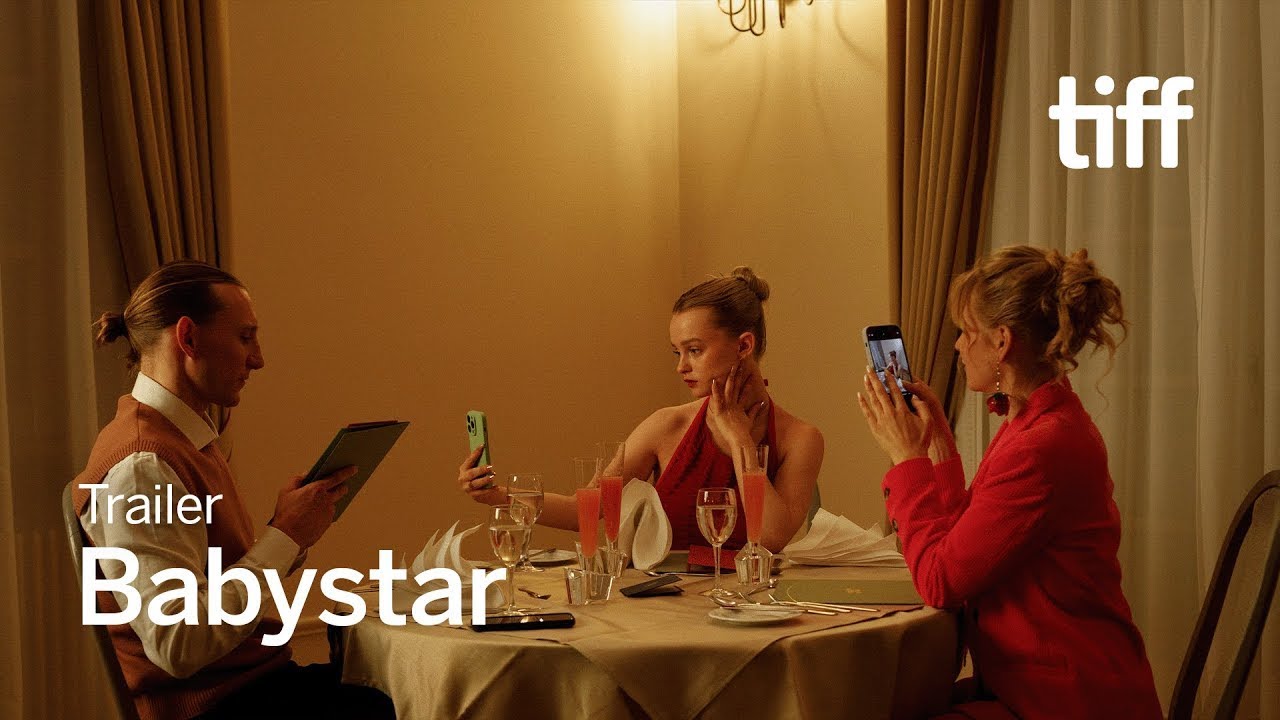
Germany | 2025 | 98 min | Drama, Satire
➡️ Where to Watch: DE
Growing Up Means Discovering That Your Life Was Never Entirely Yours
Sixteen-year-old Luca has lived almost her entire existence in front of an audience. Her parents turned family life into an influencer business, transforming childhood milestones, intimate conversations and everyday experiences into content consumed by millions of followers.
The problem becomes visible when her parents decide to have another child. What initially resembles jealousy gradually exposes something deeper: Luca begins recognizing that the identity everyone knows belongs partly to her parents, their audience, sponsors and the commercial system built around her.
BIRTH → DOCUMENTATION → AUDIENCE → MONETIZATION → LOSS OF PRIVACY → RESISTANCE → RECLAIMING IDENTITY
➡️ Trend Insight: Babystar turns the traditional coming-of-age search for identity into a digital-age problem: how do you discover who you are when your identity was filmed, branded and monetized before you were old enough to choose it?
Why This Movie Matters Right Now: Childhood Is Becoming a Digital Archive
Previous generations could leave much of childhood behind. Luca cannot. Her development has become an archive of searchable, reproducible content controlled within a family business.
Director Joscha Bongard approaches that problem from direct knowledge of influencer culture. Before moving into fiction, he worked around YouTube creators and explored adjacent questions of intimacy and commercialization in his documentary Pornfluencer. In discussing Babystar, he has connected social-media culture directly with a capitalist system that encourages people to monetize increasingly intimate areas of life.
That makes the movie’s central problem larger than embarrassing childhood videos. Luca must confront the possibility that the distinction between her private self and her commercial identity has almost disappeared.
➡️ Movie Insight: For a generation raised online, coming of age may increasingly involve not creating a public identity but establishing where that public identity ends.
Should You Watch It?: A Digital Coming-of-Age Story Disguised as Influencer Satire
Watch Babystar if you are interested in contemporary coming-of-age cinema, social-media culture, digital identity and films that turn familiar technology into something quietly unsettling.
Rather than portraying Luca’s parents as exaggerated internet monsters, the film makes their behavior disturbingly normalized. Content creation is simply how the household functions. Cameras, sponsorships, followers and performance have become embedded in family relationships.
Maja Bons is crucial to making that approach work. Luca can appear comfortable with influencer culture because she has never experienced another life, while small expressions of loneliness and irritation gradually expose the gap between the persona audiences consume and the teenager underneath it.
➡️ Viewing Recommendation: Best for viewers interested in films about technology that focus less on futuristic machines and more on how digital systems are already changing identity, family and privacy.
Why Everyone Is Talking About It: Family Influencing Becomes a Coming-of-Age Dystopia
Babystar premiered in TIFF’s Discovery programme in 2025 before continuing through Zurich, Warsaw, Hamburg, Stockholm and an extensive international festival run. Its festival trajectory reflects how strongly its subject travels beyond Germany: family influencing is local in execution but global in recognition.
The timing is especially effective because the movie does not imagine a distant technological dystopia. Luca’s world is built from recognizable behaviors—family channels, followers, sponsorships, short-form video, audience metrics and AI-generated identity.
That familiarity creates the discomfort. What might have looked like science fiction twenty years ago can now resemble an extension of everyday digital life.
➡️ Viral Potential: Babystar has a naturally discussion-driven premise because viewers already participate in the culture it examines. Parents, influencers, followers and platforms all become part of the same uncomfortable question: when does sharing a child’s life become taking ownership of it?
Why Babystar Stands Out: Everyone Knows Luca Except Luca
The film’s most powerful contradiction is simple:
4.3 MILLION FOLLOWERS ↔ NO CLEAR PRIVATE SELF
Luca is extraordinarily visible but emotionally isolated. People recognize her, ask intimate questions and believe they know her because they have watched her grow up. Yet that familiarity is constructed from content selected, edited and commercialized by her family.
The film therefore reverses one of social media’s fundamental promises. Visibility is supposed to create recognition. For Luca, extreme visibility instead contributes to alienation because the person being recognized is partly a product.
➡️ Cinema Insight: Babystar turns fame into an identity trap. The more completely Luca has been documented, the harder it becomes for her to determine which parts of herself were ever private.
Movie Trend: Digital Coming-of-Age: Reclaiming Your Online Identity — Adolescence Becomes a Fight for Ownership of Self
ASSIGNED DIGITAL IDENTITY → AWARENESS → RESISTANCE → SEPARATION → SELF-DEFINITION → AUTONOMY
Traditional coming-of-age stories ask teenagers to separate from identities created by parents, schools and communities. Digital coming-of-age adds another layer: an identity can now exist publicly before the individual has developed enough autonomy to shape it.
Luca therefore inherits something previous coming-of-age protagonists rarely faced—a pre-existing public version of herself. Her childhood has already been transformed into media, and millions of strangers have relationships with that version.
Her rebellion is consequently not just against her parents. It is against an entire identity architecture built around her.
LUCA THE PERSON ↔ NUNKI THE PRODUCT
➡️ Movie Trend Insight: Digital coming-of-age stories increasingly ask whether adulthood requires taking control of the digital person that already exists before the private person has finished developing.
Broad Trend: The Search for Privacy — Visibility Is Creating a New Desire to Disappear
EXPOSURE → VISIBILITY → MONETIZATION → OVEREXPOSURE → BOUNDARIES → PRIVACY → CONTROL
Privacy in Babystar is not simply about hiding information. It is about having the authority to decide which parts of life become public in the first place.
Luca never possessed that authority during childhood. Her parents made the original decision, followers rewarded it with attention and commercial partners transformed that attention into economic value. Privacy therefore becomes connected to power.
MAXIMUM VISIBILITY ↔ MINIMUM CONTROL
As digital culture encourages increasingly continuous documentation, privacy can become something people actively seek rather than passively possess.
➡️ Broad Trend Insight: The Search for Privacy emerges when visibility stops feeling empowering and begins feeling compulsory. The new luxury may not be being seen—it may be deciding when not to be seen at all.
Why Digital Coming-of-Age Is Growing: The Internet Remembers the Childhood You Outgrow
Children growing up online increasingly inherit digital histories they did not necessarily create themselves. Photographs, videos, family posts and commercial content can survive long after the child has changed.
That creates a new coming-of-age tension. Adolescence has traditionally allowed experimentation: identities are tested, abandoned and reinvented. A permanent digital archive makes that process more difficult because previous versions remain retrievable.
Babystar takes this problem to its extreme. Luca does not merely have a digital footprint.
HER DIGITAL FOOTPRINT IS THE FAMILY BUSINESS.
➡️ Audience Motivation: IDENTITY + PRIVACY + AUTONOMY + RECOGNITION. The film connects because the extreme version of Luca’s experience reflects a familiar everyday tension: the difference between living an experience and immediately turning it into something to share.
Viewer Profile: Who Babystar Is Most Likely to Reach
|
Growing up with permanent digital identities |
||
|
Luca’s struggle for independence |
||
|
Questions around children, consent and online sharing |
||
|
The gap between online presentation and private life |
||
|
Creator-Economy Audiences |
Family influencing as commercial infrastructure |
|
|
AI avatars and ownership of digital identity |
||
|
Festival / Indie Audiences |
Cold visual satire and contemporary subject matter |
|
|
Marketing / Media Professionals |
Attention, sponsorship and monetized intimacy |
➡️ Audience Insight: Different generations can recognize different sides of Babystar. Younger viewers may identify with being documented; parents confront responsibility for documentation; media professionals recognize the commercial machinery turning that visibility into value.
What This Movie Means for the Industry: The Creator Economy Is Becoming Material for Cinema
Babystar shows that influencer culture has matured enough to become more than background decoration in contemporary movies. The creator economy itself can now function as a dramatic system—with its own labor relationships, power structures, commercial incentives and psychological consequences.
Bongard’s background strengthens that perspective. His experience around YouTube management gives the movie familiarity with the mechanics of influencer culture, while the story expands those mechanics into questions about capitalism, intimacy and ownership.
The family home consequently becomes several things simultaneously:
HOME + STUDIO + BRAND + WORKPLACE + DISTRIBUTION CHANNEL
The child can likewise become:
DAUGHTER + PERFORMER + INFLUENCER + INTELLECTUAL PROPERTY + PRODUCT
➡️ Industry Insight: Influencer stories are moving beyond satire about narcissism. The more interesting emerging territory examines the economic infrastructure underneath visibility—who owns the image, who earns from it and who gets to stop performing.
Creative Analysis: Digital Perfection Becomes an Emotional Prison
Storytelling: A New Baby Turns Jealousy Into an Identity Crisis
The decision to have another child provides an effective narrative trigger because Luca’s initial reaction can easily be mistaken for ordinary sibling jealousy.
Gradually, something more unsettling emerges. A new baby threatens Luca’s position inside the family’s attention economy while simultaneously forcing her to understand what happened to her own childhood.
Protecting the next child and understanding herself therefore become connected.
Direction: Cold Observation Makes Influencer Life Feel Normal Before It Feels Disturbing
Joscha Bongard avoids turning the family into broad caricatures. Their behavior has been normalized by repetition and rewarded by audiences, making the environment more disturbing precisely because everyone inside it understands it as ordinary.
His restrained approach also prevents Luca from becoming simply an innocent victim escaping obviously evil parents. She has internalized the culture that created her, meaning liberation cannot happen through one dramatic rejection.
The system exists inside her as well as around her.
Performances: Maja Bons Separates the Influencer From the Teenager Beneath Her
Maja Bons builds Luca through the contrast between effortless public performance and increasingly visible private disorientation.
Luca knows how to answer followers, position herself for cameras and perform the personality expected of her. Those skills demonstrate competence, but they also expose how completely performance has become embedded in her identity.
The emotional question becomes whether there is still a Luca who exists without an audience.
Visual Style: The Perfect Influencer Home Begins to Look Like Surveillance
The family’s minimalist luxury initially represents success. Gradually, the same environment begins feeling sterile, controlled and strangely empty.
Bongard frequently uses elevated and fixed perspectives that resemble surveillance cameras, visually connecting the architecture of the home with Luca’s permanent visibility. The beautiful house therefore carries a contradiction:
DREAM HOME ↔ DIGITAL PANOPTICON
The more aesthetically perfect the environment becomes, the less private it feels.
Themes: Maximum Visibility Produces Minimum Control
Privacy, identity, capitalism, family, attention, consent, AI and loneliness converge around one central tension:
EVERYONE CAN SEE LUCA ↔ LUCA CANNOT FULLY SEE HERSELF
The movie suggests that visibility and recognition are not synonymous. Millions of people can know an image of someone without knowing the person represented by that image.
Privacy therefore becomes necessary not because Luca has something to hide, but because identity requires spaces where performance is unnecessary.
What Makes It Different: The Child Star Never Had to Leave Home
Traditional child-star narratives require an entertainment industry: studios, agents, producers, sets and audiences.
Babystar collapses that entire infrastructure into the family home.
PARENTS = PRODUCERSHOME = STUDIOCHILDHOOD = CONTENTFOLLOWERS = AUDIENCESPONSORS = REVENUELUCA = PRODUCT
That is what makes the premise distinctly contemporary. Exploitation no longer requires Hollywood. A smartphone, platform and sufficiently large audience can reproduce parts of the same commercial relationship inside an ordinary family.
➡️ Creative Insight: Babystar updates the child-star story for the creator economy. The studio has disappeared because the family itself has become the studio.
If You Liked Babystar: Digital Identity, Visibility and Life Online
Feed (2026) by Marco van Belle: Influencer Culture Turns Visibility Into Vulnerability
Five social-media influencers travel to a remote forest retreat, where their content-driven world collides with a supernatural threat. While the film moves into horror rather than the social satire of Babystar, both use influencer culture to explore lives organized around constant visibility.
➡️ Why It Connects: Babystar examines what happens when a child grows up as content; Feed places adults who have deliberately built identities around content inside a world where that visibility becomes part of their vulnerability. Both reflect how the distinction between living and performing can disappear when an audience is always imagined.
IDENTITY → CONTENT → AUDIENCE → VISIBILITY → VULNERABILITY
Lurker (2025) by Alex Russell: Attention Becomes a Form of Social Power
Matthew, a retail worker, gradually enters the inner circle of rising musician Oliver, discovering that proximity to fame can provide identity, status and belonging. His desire to become part of someone else’s world develops into an increasingly dangerous struggle for access.
➡️ Why It Connects: Luca suffers because she has been given too much visibility, while Matthew desperately wants access to it. Together the films expose opposite sides of the attention economy: one character wants to escape a public identity while another believes proximity to fame can create one.
OBSCURITY → ACCESS → PROXIMITY → ATTENTION → STATUS → IDENTITY
The Remarkable Life of Ibelin (2024) by Benjamin Ree: Digital Identity Can Reveal the Self Rather Than Replace It
After Mats Steen dies, his parents discover the extensive friendships and community he created through World of Warcraft. The documentary reveals a digital identity that allowed an important part of Mats’ life to become visible to people who knew him online.
➡️ Why It Connects: The film provides a powerful counterpoint to Babystar. Luca’s imposed digital identity threatens to obscure her private self, while Mats’ chosen digital identity gives him another space in which to express himself and form meaningful relationships.
PRIVATE SELF → DIGITAL IDENTITY → CONNECTION → COMMUNITY → RECOGNITION
➡️ If You Liked Insight: These films show three very different relationships with digital identity: Luca wants to reclaim herself from visibility, Matthew wants visibility to give him identity, and Mats uses a digital identity to express a part of himself that others could not fully see offline. Together they reveal the central question behind the digital-self trend: IDENTITY → VISIBILITY → OWNERSHIP → CONTROL → AUTONOMY.
Final Verdict: The Most Valuable Thing Luca Has Never Owned Is Her Privacy
Babystar works best when it treats influencer culture not as bizarre behavior practiced by unusual people but as an intensified version of something increasingly normal: documenting experiences because their visibility appears to give them value.
Luca’s coming-of-age therefore becomes unusually contemporary. She does not simply need independence from her parents. She needs separation from an identity infrastructure that has existed almost as long as she has.
➡️ Final Verdict Insight: Growing up traditionally means becoming the author of your own life. Babystar asks what happens when someone else has already been publishing it.
Quick Facts: Childhood, Visibility and the Fight to Own Your Identity
|
Joscha Bongard, Nicole Rüthers |
|
|
Maja Bons, Bea Brocks, Liliom Lewald |
|
|
Digital Coming-of-Age: Reclaiming Your Online Identity |
|
|
Toronto International Film Festival 2025 — Discovery |
|
|
Zurich Film Festival; Warsaw Film Festival |
|
|
BIRTH → DOCUMENTATION → AUDIENCE → MONETIZATION → LOSS OF PRIVACY → RESISTANCE → RECLAIMING IDENTITY |
Final Insights: Privacy Is Becoming Part of Growing Up
Digital culture has changed the relationship between childhood and memory. Moments that once disappeared into private family histories can now become permanent media objects—stored, shared, copied, monetized and consumed by audiences the child never chose. Babystar pushes that transformation to its logical extreme by asking what happens when the digital archive becomes more economically valuable than the private life behind it.
That makes The Search for Privacy increasingly important as a cultural trend. The next stage of digital identity may not revolve around becoming more visible but around regaining control over visibility: deciding what remains public, what disappears and which versions of ourselves belong exclusively to us.
➡️ Final Insight: The first era of social media taught people how to make themselves visible. The next may be about learning how to create boundaries around that visibility. Babystar captures that reversal through Luca’s coming-of-age journey: VISIBILITY → OVEREXPOSURE → AWARENESS → BOUNDARIES → PRIVACY → IDENTITY.




Leave a Reply