
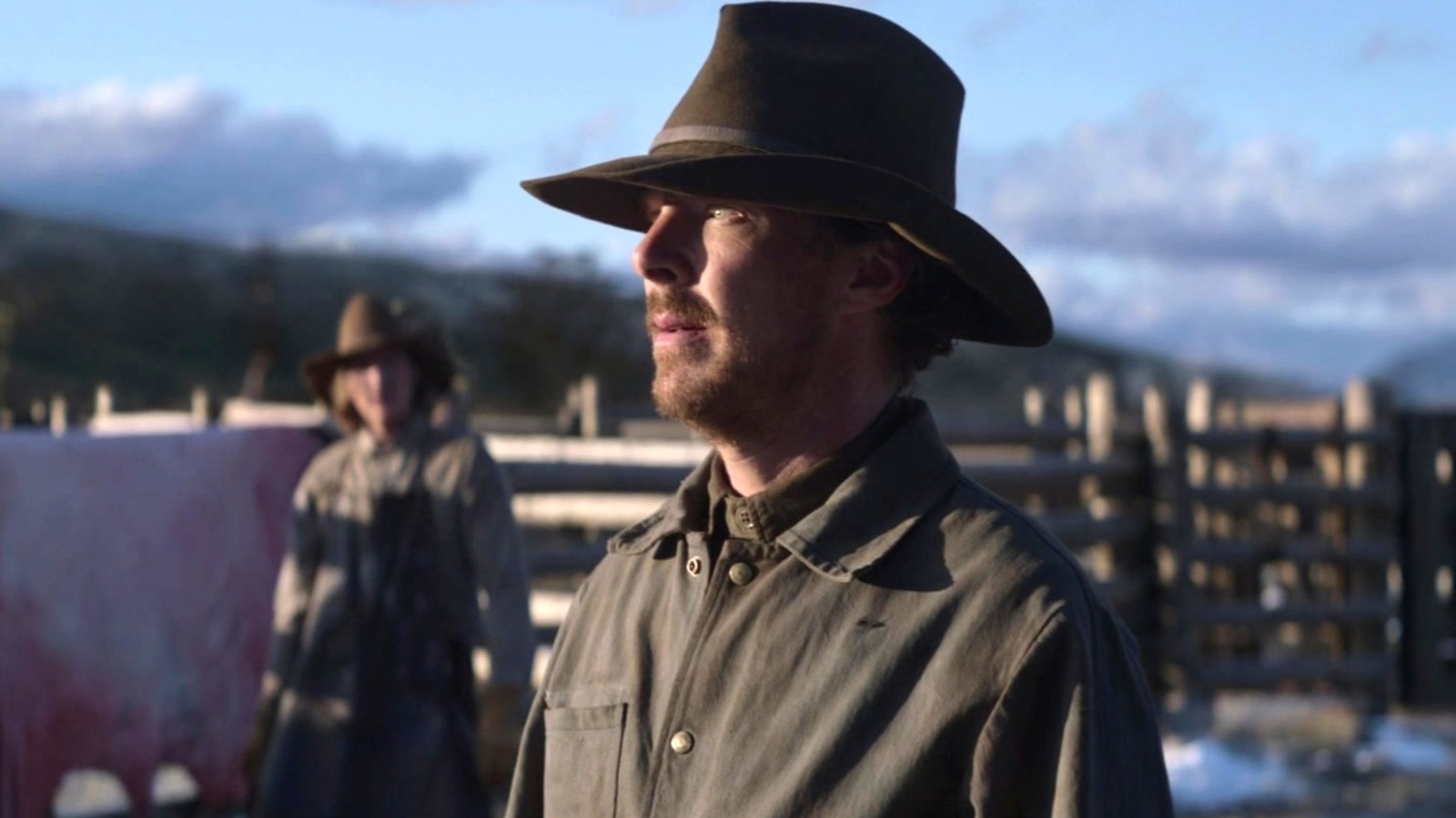
Jane Campion’s 2021 film “The Power of the Dog,” released five years ago this month, was one of the best films of its year. It was widely praised by critics and by the Academy, despite earning a tiny handful of cash during its not-very-wide theatrical release. The film was nominated for an astonishing 12 Academy Awards, including Best Picture, making it the seventh Netflix film in four years to be nominated in the top category (other nominees included “Roma,” “The Irishman,” “Marriage Story,” “Mank,” “The Trial of the Chicago 7,” and “Don’t Look Up”). “The Power of the Dog” ultimately only won one Oscar, for Best Director.
The film takes place on a ranch in Montana in the mid-1920s, owned by brothers Phil and George Burbank (Benedict Cumberbatch and Jesse Plemons). Kirsten Dunst plays Rose, the proprietress of a local inn, who is raising her teenage son Peter (Kodi Smit-McPhee) by herself. Early in the film, Phil admires that Rose’s dining tables are decorated with paper flowers, but becomes a little grossed out when he learns that Peter was the one who constructed them. This little observation kicks off the movie’s powerful themes about traditional masculinity, gender dynamics, and the place of queerness on the open frontier.
These four characters get swirled together when George marries Rose and Phil’s cruel nature reveals itself. While the young Peter leaves to go to medical school, Rose finds herself under pressure — more from Phil than from George — to be a “woman of the house.” Phil insists, for instance, that Rose play the piano at a fancy dinner party, something she can’t bear to do. By the time Peter comes home for a break, Rose has begun to hit the bottle.
The Power of the Dog is a great film about the masks society can force us to wear
We soon learn that both Phil and the young Peter are likely queer. Peter is more openly so, as he becomes fascinated by a secret stash of magazines full of hunky dudes. Phil, meanwhile, is very fond of a scarf that once belonged to the now-dead Bronco Henry, his former mentor … and possibly more. Eventually, Phil begins to take Peter under his wing. Later in the film, Phil tacitly admits that Bronco Henry once saved his life during a blizzard by holding their nude bodies together. It’s all but stated outright that Phil and Bronco Henry were lovers. This is the 1920s in rural Montana, however, so these men don’t seem to have the freedom, nor even the vocabulary, to express their queerness.
At home, meanwhile, Rose’s life is falling apart. She’s drinking more and more, and her relationship with Phil is fraught. Although Phil eventually warms to Peter, he seems to place all his self-hate onto Rose, mocking her and making her life as miserable as possible. Phil is blaming Rose, it seems, for forcing him to reckon with his attraction to men. This leads to a late-film twist about rope-making and anthrax that leaves the film on a very dark note indeed.
“The Power of the Dog” is a marvelous tragedy of pain, self-denial, and gender roles. Rose cannot be the “sweet little wife,” and Phil masks his need to be gentle and “soft” by affecting a “grizzled” exterior. Cumberbatch is fantastic in the role of Phil, capturing both his character’s cruelty and his hidden gentleness. The film’s title comes from Psalms, 22:20: “Deliver my soul from the sword, my precious life from the power of wild dogs.”
What did critics think of The Power of the Dog?
Jane Campion’s filmography is full of bangers, going back to her early films like “Sweetie” and “An Angel at My Table,” through “The Piano” and “Portrait of a Lady,” and up to “Bright Star” and “The Power of the Dog.” This has been her most recent film to date.
Critics loved this movie, which earned a 94% approval rating on Rotten Tomatoes based on 363 reviews. /Film wrote that Cumberbatch delivered a career-best performance. Meanwhile, The New York Times‘ Manohla Dargis loved the sweep of the film as well as its treatment of the Phil character, a man who, she observed, had been “playing” a cowboy for decades of his life. About the film’s visuals, Dargis wrote:
“A bold visual stylist, Campion introduces this world and its people with sweep and precision, with soaring eagle-eye aerial shots and her characteristic attention to voluptuary detail (and with New Zealand doubling for an unspoiled Montana). She fluently sets the western milieu, with its swirling dust and thundering cattle, and catches the boisterous camaraderie of the ranch hands, the playfulness of their jostling with its easy, unselfconscious physicality and intimacy.”
/Film’s Joshua Meyer wrote a full explanation of the ending of “The Power of the Dog,” realizing that it’s a tale of emotional terrorism and that it may be freeing to wriggle out from under the masculine lifestyle Phil was trying to perpetuate. “The Power of the Dog” was based on the novel by Thomas Savage, and Campion, who also wrote the adaptation, changed the ending (we think for the better). In Campion’s version, the themes are incredibly clear, very moving, and pointedly righteous.






Leave a Reply