
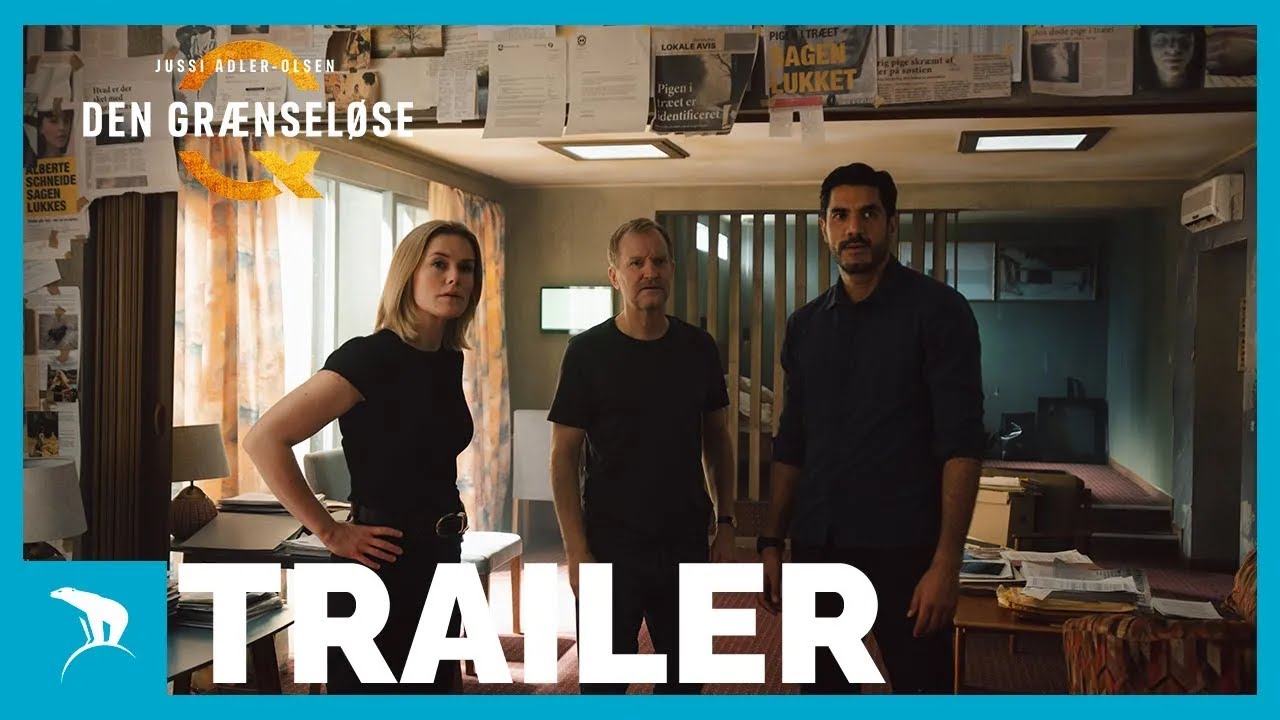
DK, DE, EE | 2024 | 121 min | Crime, Drama, Thriller
When a Forgotten Murder Leads Somewhere Much Darker
A cold case is supposed to belong to the past, but Boundless turns an unresolved death into the entrance to something much larger. Detective Carl Mørck and Department Q travel to the Danish island of Bornholm to reopen the death of a young woman, only for the investigation to pull them toward a mysterious cult and a disturbing trail of missing women.
Directed by Ole Christian Madsen, the sixth Department Q film combines the familiar mechanics of Scandinavian detective fiction with the more unsettling territory of psychological manipulation and closed communities. The investigation becomes more dangerous as the team realizes that solving one death means understanding the belief system and people surrounding it.
➡️ Movie Insight: Boundless begins with the familiar appeal of an unsolved murder and steadily expands the threat. The cold case becomes a doorway into a secretive community where influence and belief make the investigation harder to control. That escalation gives the film its strongest crime-thriller identity.
Why This Movie Matters Right Now: Cold Cases Are Becoming Bigger Conspiracies
Cold-case thrillers work because they begin with something apparently fixed: a crime happened, the evidence has aged and the truth has survived somewhere beneath years of silence. Boundless uses that familiar structure but refuses to keep its mystery contained to one victim.
The investigation connects a girl’s death with a cult and missing women, transforming the case from a search for an individual killer into an attempt to understand a larger hidden environment. Carl’s need to confront his own past adds another layer, making the reopening of the case both investigative and personal.
➡️ Why It Matters: Boundless shows why cold-case stories remain effective contemporary thrillers. Every recovered clue can reveal that the original crime was only the visible part of something larger. The past becomes dangerous precisely because somebody has worked hard to keep it buried.
Should You Watch It?: Nordic Crime for Viewers Who Want a Dark Investigation
Boundless is best suited to audiences who enjoy procedural mysteries that gradually move into darker psychological territory. Rather than relying exclusively on action, it builds suspense around interviews, old evidence, missing connections and the increasingly disturbing world surrounding the original death.
It also carries the continuity of the Department Q franchise, with Carl Mørck, Rose and Assad returning as the investigative team. Ulrich Thomsen leads as Carl, with Sofie Torp as Rose and Afshin Firouzi as Assad.
➡️ Viewing Recommendation: Watch Boundless for a dark Scandinavian cold-case mystery with cult-thriller elements. It works particularly well for audiences attracted to detectives uncovering crimes that have survived for years beneath apparently ordinary communities. Existing Department Q viewers will also find another investigation built around the franchise’s defining obsession with unresolved cases.
Why Everyone Is Talking About It?: Department Q Goes Deeper Into Psychological Crime
Boundless arrives with the built-in recognition of Jussi Adler-Olsen’s Department Q universe, but its appeal comes from taking the familiar cold-case formula somewhere more psychologically unsettling. The investigation moves away from a straightforward murder mystery and toward questions of influence, belief, disappearance and control.
The production also attracted significant recognition within Danish cinema. The supplied awards material records seven nominations, including Robert nominations for adapted screenplay, supporting performances and sound, reinforcing its position as a substantial continuation of the long-running Danish crime franchise.
➡️ Viral Potential: Cult mysteries immediately create conversation because every new revelation can change what audiences believe about the case. Department Q adds an established detective universe and a recognizable Nordic-noir identity. Boundless therefore combines franchise familiarity with the darker attraction of entering a community where nothing can initially be taken at face value.
Why Boundless Stands Out: The Investigation Enters a Closed World
The strongest shift occurs when the case stops being only about reconstructing a death. Carl and his team must penetrate a social environment shaped by its own beliefs, relationships and loyalties, turning the investigation into a confrontation with a world that operates according to different rules.
Bornholm also gives the story a geographically contained quality. The island setting separates the investigators from their usual environment and strengthens the feeling that they are entering a place where the past has been allowed to develop beyond their control. The supplied production information confirms Bornholm as a filming location.
➡️ Cinema Insight: Crime thrillers become more immersive when the detectives are forced to investigate an entire environment rather than simply identify a suspect. Boundless makes location, community and belief part of the mystery. Solving the crime therefore requires understanding the world that allowed it to remain hidden.
Movie Trend: Crime Thriller — When a Cold Case Reveals a Hidden Cult
Using the Festival Scope-style taxonomy, Crime / Thriller provides the clearest movie category, while Investigation, Crime, Religion, Mystery and Trauma describe the content surrounding it. The trend is therefore not simply “cult stories”; it is the way the cold-case structure increasingly opens into a much larger psychological threat.
Boundless demonstrates the pattern clearly. A girl’s unexplained death provides the investigative entry point, but the story expands toward a cult and missing women. The appeal comes from that widening circle: each answer makes the original case more disturbing rather than simpler.
➡️ Movie Trend: Crime Thriller remains the film category, while the hidden cult gives this particular investigation its distinctive content hook. The cold case provides the mystery and the closed community expands the danger. Boundless turns solving one forgotten death into uncovering an entire hidden system.
Viewer Profile: Nordic Crime Fans Looking for a Dark Mystery
The core audience is Nordic Crime Investigators—viewers who want clues, interrogation, buried evidence and the satisfaction of watching detectives reconstruct a mystery piece by piece. They are looking for suspense driven by discovery rather than constant action.
A second audience is Dark Mystery Viewers, especially those drawn to cults, secret communities, psychological manipulation and stories where entering an unfamiliar environment creates additional danger. For them, the strongest attraction is discovering how far the mystery extends beyond the original victim.
|
Nordic Crime Investigators — viewers looking for cold cases, clues and dark procedural mysteries |
|
|
Dark Mystery Viewers — audiences attracted to cults, hidden communities and psychological suspense |
|
|
Primarily adult crime and thriller audiences |
|
|
Broad appeal across established crime-thriller audiences |
|
|
Broad; content preference matters more than income |
|
|
Viewers interested in Nordic noir, detective fiction, crime novels and serialized mysteries |
|
|
Choose crime stories for investigation, atmosphere, recurring detectives and gradually escalating revelations |
➡️ Audience Insight: Boundless is primarily entertainment for viewers who enjoy trying to solve a mystery alongside the investigators. Its cult element adds psychological danger to the procedural experience. The strongest audience promise is simple: an old case keeps getting darker the further Department Q investigates.
What This Movie Means for the Industry: Crime Franchises Can Expand Without Abandoning Their Formula
Department Q demonstrates the durability of crime franchises built around a repeatable investigative engine rather than one continuous conspiracy. The detectives can return while each new cold case provides a different setting, victim, social environment and form of danger.
Boundless pushes that model toward cult mystery while remaining recognizably Department Q. That balance is valuable for long-running crime properties: audiences receive the procedural structure they expect while each installment can introduce a different subgenre or thematic world.
➡️ Industry Insight: Detective franchises remain durable because the central characters can stay familiar while the crime constantly changes. Cold-case formats are particularly flexible because every investigation can open a completely different world. Boundless shows how an established crime series can move into cult-thriller territory without losing its core identity.
Creative Analysis: Turning a Cold Case Into a Cult Mystery
Ole Christian Madsen directs from a screenplay credited to Jakob Weis, based on Jussi Adler-Olsen’s Department Q material. The story uses the established procedural framework to move from a historical crime toward a more psychologically charged mystery.
At 121 minutes, the film has room to combine investigative progression with the personal pressures surrounding Carl and his team. Its creative identity comes from balancing franchise continuity with a case whose threat extends beyond a conventional suspect.
Storytelling: One Death Opens a Larger Mystery
The narrative begins with a recognizable cold-case question: what actually happened to the young woman who died years earlier? That gives the investigation a clear initial objective.
The story then expands through the connection to a cult and missing women. The structure makes discovery itself the engine of suspense because each piece of information increases rather than reduces the scale of the mystery.
Direction: Building Suspense Through Investigation
Madsen keeps the investigative process at the center of the film. The tension comes from moving deeper into a case whose implications become increasingly uncomfortable.
The Bornholm setting helps give the investigation its own identity within the franchise. Rather than feeling like another routine police case, the island creates the impression of Department Q entering an unfamiliar and potentially closed environment.
Performances: A Familiar Detective Team Under Pressure
Ulrich Thomsen’s Carl Mørck remains the emotional center, carrying both the demands of the investigation and unresolved elements of his personal life. The character’s past becomes important because the case forces him to confront more than external evidence.
Sofie Torp’s Rose and Afshin Firouzi’s Assad complete the investigative unit. The team dynamic provides continuity even as the case takes them into unfamiliar psychological territory.
Visual Style: Nordic Noir Moves to an Island
Bornholm gives the film a distinctive physical setting, separating this investigation from a generic urban police thriller. The location reinforces isolation and makes the search feel increasingly contained.
That geographical distance works naturally with the cult-mystery structure. Closed communities become more threatening when the investigators appear to be entering somebody else’s territory rather than controlling the environment themselves.
Themes: Investigation, Belief and Trauma
Using the Festival Scope-style thematic guide, Investigation, Crime, Religion and Trauma provide the clearest content framework. The cult element brings belief and manipulation into direct contact with conventional detective work.
Carl’s personal struggle adds another dimension. Investigating the past becomes inseparable from confronting it, connecting the unresolved crime with the unresolved emotional histories carried by the detectives themselves.
What Makes It Different: The Suspect Is Not the Whole Mystery
A conventional whodunit asks who committed the crime. Boundless becomes more interesting when the question expands toward the environment surrounding the crime.
The cult therefore functions as more than a collection of possible suspects. It creates a system of belief, influence and secrecy that Department Q has to understand before the old death can fully make sense.
➡️ Creative Insight: Boundless is strongest when the investigation grows beyond the identity of one criminal. The cult turns the case into an exploration of the environment that allowed secrets to survive. That shift gives the familiar Department Q formula a darker psychological dimension.
If You Liked Boundless (2024): Dark Investigations That Reveal Something Bigger
These films connect through investigations that begin with individual crimes but gradually expose larger organizations, hidden motives or dangerous systems.
The Order (2024) by Justin Kurzel: When an Investigation Reveals an Extremist Network
A veteran FBI agent investigates a series of robberies and violent crimes in the Pacific Northwest and discovers that the perpetrators are connected to a far-right terrorist organization. Like Boundless, the investigation expands from individual criminal acts toward the hidden ideology connecting them.
➡️ Why It Connects: Both films follow investigators who realize the visible crime is only the beginning. Each uses a secretive group to make the investigation progressively more dangerous. The suspense comes from discovering the system behind the crime rather than simply identifying one perpetrator.
The Quiet Ones (2024) by Frederik Louis Hviid: Danish Crime Built Around a Dangerous Plan
A boxer with limited prospects becomes involved in planning one of Denmark’s largest robberies, drawing him into a criminal operation whose scale extends far beyond his ordinary life. Its Danish setting and dark crime atmosphere make it a strong recent companion for viewers seeking another contemporary Scandinavian crime film.
➡️ Why It Connects: Both films build suspense around people entering worlds governed by hidden rules and dangerous loyalties. Boundless approaches that territory through police investigation, while The Quiet Ones enters it from inside a criminal operation. Both use Scandinavian crime cinema to make ordinary environments feel increasingly threatening.
➡️ Where to Watch: US
The Keeper of Lost Causes (2013) by Mikkel Nørgaard: The Department Q Cold Case That Established the Formula
Carl Mørck and Assad investigate the disappearance of politician Merete Lynggaard, who vanished years earlier while traveling on a ferry. It is older than the preferred 2024–2026 recommendation window, but it remains the strongest direct companion because it establishes the Department Q cold-case formula that Boundless continues.
➡️ Why It Connects: This is the clearest choice for viewers who want more of Carl Mørck and Department Q. Both stories turn forgotten cases into active threats through persistent investigation. Watching it also reveals the core cold-case structure on which the later franchise is built.
➡️ If You Liked Insight: These films share the pleasure of watching an apparently contained crime reveal a much larger threat. The investigation becomes more compelling as the hidden structure behind the crime emerges. Boundless belongs to a crime-thriller tradition where finding the truth means discovering how deep the case really goes.
Final Verdict: A Cold Case That Keeps Expanding
Boundless delivers its clearest appeal through escalation. What begins with Department Q reopening the death of a young woman develops into a mystery involving a cult, missing women and Carl Mørck’s own unresolved past.
For viewers already invested in Scandinavian crime, that combination is immediately recognizable but still effective. The film keeps the procedural foundation of Department Q while allowing this particular investigation to move toward darker psychological and cult-thriller territory.
➡️ Final Verdict: Boundless is a Nordic crime thriller built for viewers who enjoy cold cases that become larger the deeper investigators dig. Its strongest hook is the movement from one unresolved death toward a hidden community and multiple disappearances. The result is a familiar Department Q investigation with a darker psychological edge.
Quick Facts: Boundless at a Glance
|
Jussi Adler-Olsen, Jakob Weis |
|
|
Department Q / Jussi Adler-Olsen |
|
|
Ulrich Thomsen, Sofie Torp, Afshin Firouzi |
|
|
Nordisk Film Production, Nadcon Film, ZDF |
|
|
Seven nominations recorded, including Danish Film Awards recognition |
|
|
Crime Thriller — When a Cold Case Reveals a Hidden Cult |
|
|
Department Q reopens a girl’s death and uncovers connections to a cult and missing women |
|
|
A cold-case investigation expands into a psychological cult mystery |
|
|
Investigation, Crime, Religion, Trauma, Missing Persons, The Past |
|
|
Dark Nordic detective storytelling where every new clue makes the mystery bigger |
Final Insights: Cold Cases Are Becoming Gateways Into Hidden Worlds
The continuing strength of the cold-case thriller comes from its ability to make the past feel active. A forgotten murder can reveal a family secret, an institution, an ideology or an entire community that has survived because nobody successfully connected the evidence before.
Boundless pushes that formula toward the cult thriller. Its larger trend is therefore not simply about unsolved murders but about investigations that expose hidden systems. Crime cinema gains momentum when solving the original case is no longer the end of the mystery—it is the beginning of understanding everything that surrounded it.
➡️ Final Insight: The strongest cold-case thrillers make every answer open another door. Boundless begins with one death and discovers a much larger hidden world behind it. Crime Thriller — When a Cold Case Reveals a Hidden Cult captures that expansion while keeping the trend firmly inside recognizable movie language.






Leave a Reply