
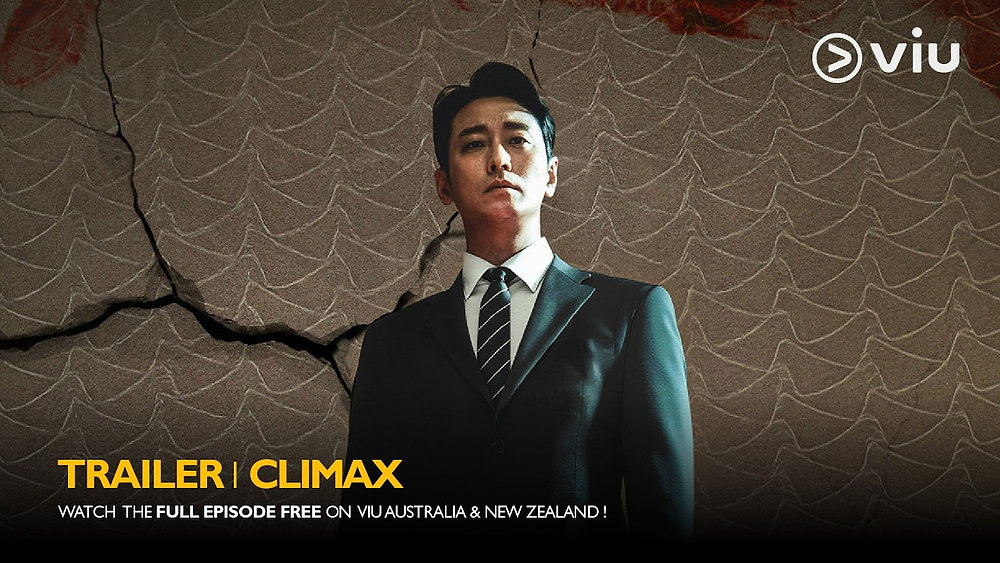
KR | 2026 | 10 Episodes | Political Thriller, Drama, Noir
When the Person Beside You Wants the Top Just as Much as You Do
Bang Tae-seop is an ambitious prosecutor determined to climb to the highest levels of South Korean power. Beside him is his wife Chu Sang-a, a former top actress fighting to protect her own status in an entertainment industry where fame can disappear almost as quickly as it arrives. Together they look like a formidable power couple, but their marriage is built on secrets, calculation and two people whose ambitions do not always point in the same direction.
Their world stretches far beyond one marriage. Politics, conglomerates, prosecutors, celebrities and entertainment executives form an interconnected power network where careers can be created or destroyed through influence, scandal and manipulation. As Tae-seop pursues political power and Sang-a fights for her position, love becomes increasingly difficult to separate from strategy.
➡️ Series Insight: Climax turns a marriage into another arena in the battle for power. Tae-seop and Sang-a can be partners, rivals and liabilities to one another at the same time. The closer they get to the top, the harder it becomes to know whether their relationship can survive the climb.
Why This Series Matters Right Now: Success Can Turn Relationships Into Competition
Climax taps into the fascination with stories about ambitious people who refuse to accept the limits imposed on them. Tae-seop comes from outside the elite circles he wants to conquer, while Sang-a understands that celebrity status offers enormous influence without guaranteeing permanent security.
Their marriage gives that ambition an intimate dimension. Each understands how useful the other can be, but each also has personal interests worth protecting. The series asks what happens when two people supposedly building a life together begin measuring success according to who controls the next move.
➡️ Why It Matters: Ambition becomes more complicated when the person closest to you wants power too. Climax shows how status can transform love, loyalty and marriage into strategic assets. Its power couple is compelling precisely because partnership and competition are never completely separate.
Should You Watch It?: Watch for a Fast-Moving K-Drama About Power, Marriage and Betrayal
Climax is built for viewers who enjoy political thrillers, corporate intrigue and high-society K-dramas filled with characters constantly calculating their next move. The story moves across prosecution offices, political campaigns, conglomerate circles and the entertainment industry while revealing how each world depends on access to the others.
The cast is another major attraction. Ju Ji-hoon gives Tae-seop controlled ambition, Ha Ji-won makes Sang-a far more than the politician’s celebrity wife, while Nana, Oh Jung-se and Cha Joo-young expand the battle into competing networks of information, money and influence.
➡️ Viewing Recommendation: Watch Climax if you like ambitious characters who are difficult to trust. Its pleasures come from shifting alliances, hidden motives and escalating power struggles. The marriage at its centre makes every political victory potentially personal.
Why Everyone Is Talking About It?: Power, Showbiz and Marriage Create an Explosive Combination
Climax generated attention by bringing together Ju Ji-hoon and Ha Ji-won in a glossy political survival thriller alongside Nana, Oh Jung-se and Cha Joo-young. Early episodes quickly expanded Tae-seop’s personal ambition into a much larger struggle involving politics, finance and entertainment, while contemporary coverage highlighted the drama’s rapid pacing and constantly shifting power relationships.
The series also attracted conversation because it pushes into darker territory involving sexual blackmail, media manipulation, celebrity scandals and the transactional relationships connecting powerful institutions. That makes its entertainment-industry storyline more than glamorous background: fame itself becomes another currency that politicians and business figures can exploit.
➡️ Viral Potential: Climax gives audiences characters whose next betrayal is difficult to predict. Its mixture of celebrity scandal, political ambition and marital warfare naturally generates episode-by-episode debate. The central question is irresistible: how far will this couple go before reaching the top means destroying each other?
Why Climax Stands Out: Marriage Becomes Another Power Game
Political dramas frequently build tension around elections, corruption and competing elites, but Climax gives those conflicts a particularly intimate centre. Tae-seop and Sang-a understand each other’s weaknesses because they share a life, making information inside their marriage potentially more dangerous than anything their public enemies possess.
The series also refuses to make Sang-a simply collateral damage in her husband’s rise. Her celebrity, history, relationships and instincts give her an independent position inside the story, creating a marriage where both partners can alter the balance of power.
➡️ Cinema Insight: Climax understands that the most dangerous rival may be someone who knows everything about you. Marriage gives Tae-seop and Sang-a intimacy but also extraordinary leverage over one another. Their relationship turns the traditional power couple into something much more unstable.
Movie Trend: Power Couple — When Love Becomes a Race to the Top
Power-couple stories are becoming darker as screen relationships move beyond two successful people supporting each other’s ambitions. The more provocative version asks what happens when both partners want status badly enough that shared success gradually becomes individual competition.
Climax takes that idea directly into politics and entertainment. Tae-seop needs influence to climb politically, Sang-a needs power to survive professionally, and their marriage gives each access to a world the other can use. Success binds them together even as ambition threatens to separate them.
➡️ Movie Trend: Power Couple stories turn romantic partnership into a contest over influence and control. Love remains important, but ambition continually tests how much loyalty each person is willing to sacrifice. Climax pushes that tension to its extreme by making marriage part of the machinery of power.
Viewer Profile: Audiences Who Love Ambition, Betrayal and Elite Power Games
Climax is particularly well positioned for K-drama viewers attracted to darker thrillers rather than conventional romance. Its political intrigue and conglomerate warfare should appeal to audiences who enjoy watching intelligent characters manipulate complicated systems while constantly changing alliances.
The entertainment-industry storyline gives it another audience entry point. Celebrity culture, image management, scandal and behind-the-scenes influence make the series relevant to viewers fascinated by what happens when fame intersects with political and financial power.
|
K-drama viewers who enjoy political thrillers, noir and high-stakes power struggles |
|
|
Viewers interested in celebrity culture, conglomerate families, corruption and complicated marriages |
|
|
Broad middle-income, professional and internationally oriented audiences |
|
|
Streaming-first viewers, K-culture audiences and fans of sophisticated serialized thrillers |
|
|
Political K-dramas, revenge dramas, corporate thrillers, celebrity stories and twist-heavy serialized television |
➡️ Audience Insight: Climax appeals to viewers who enjoy watching ambitious characters make dangerous decisions. The political thriller provides scale while the marriage provides emotional immediacy. Every victory matters more because professional ambition can immediately reshape personal relationships.
What This Series Means for the Industry: K-Dramas Are Making Power Thrillers Bigger and More Interconnected
Climax reflects the ability of Korean television to combine several familiar genres inside one high-concept serialized drama. Political thriller, celebrity melodrama, conglomerate intrigue, crime and marital conflict operate within the same story instead of functioning as separate worlds.
Its international distribution also demonstrates how Korean dramas can build stories around specifically Korean institutions while remaining accessible to global audiences. The details of prosecution, conglomerate power and entertainment-industry influence are culturally specific, but the hunger for status and fear of losing it require little translation.
➡️ Industry Insight: Political thrillers become more accessible when institutional power is connected to recognizable personal desires. Celebrity, marriage and ambition give audiences emotional routes into a complicated political story. Climax shows how K-drama can package institutional corruption inside an addictive character-driven survival game.
Creative Analysis: Every Relationship Has a Price
Climax constructs a world in which relationships rarely exist outside systems of exchange. Political connections create opportunity, celebrity creates leverage, corporate wealth creates access and private information creates power over somebody else.
That transactional environment makes Tae-seop and Sang-a the ideal central couple. Their marriage can provide genuine attachment while simultaneously functioning as a partnership through which both people acquire something they need.
Storytelling: Personal Ambition Expands Into a Battle for the Entire Power System
The series begins with Tae-seop’s determination to climb and rapidly reveals that political advancement cannot be separated from the people controlling money, media and entertainment. One strategic move therefore creates consequences across several apparently different worlds.
Flashbacks gradually complicate the present by exposing the histories underneath relationships and scandals. The structure makes power feel cumulative: today’s manipulation often depends on something somebody buried years earlier.
Direction: Lee Ji-won Turns Ambition Into Constant Forward Momentum
Lee Ji-won approaches the series as a survival thriller in which characters rarely have the luxury of remaining passive. Tae-seop’s decisions create countermoves, alliances create enemies and revelations repeatedly force the characters to recalculate their positions.
That momentum complements the series’ larger theme. Nobody at the top can remain secure because another ambitious person is already looking for the weakness that might bring them down.
Performances: Ju Ji-hoon and Ha Ji-won Make Ambition Personal
Ju Ji-hoon plays Tae-seop with a controlled exterior that makes his hunger for power more unsettling. His intelligence and confidence help explain how a man from outside elite circles could convince himself that the next strategic move will finally put him beyond everyone else’s control.
Ha Ji-won’s Sang-a provides a different form of power. Her vulnerability as a celebrity whose position has weakened exists alongside sharp survival instincts, allowing her to shift between someone being used by powerful people and someone capable of manipulating the game herself.
Visual Style: Dark Glamour Hides a Corrupt Power Structure
Climax uses polished elite environments while surrounding them with darker tones, greys and blues. The visual contrast suits characters whose public lives depend on immaculate appearances while their private decisions become increasingly compromised.
Celebrity glamour is particularly important because appearances function as economic and political assets. A perfect image can create influence, while one scandal can remove it almost instantly.
Themes: Ambition, Marriage, Greed, Image and Betrayal
Ambition drives almost every major relationship. Characters want political office, corporate control, celebrity relevance or access to the people who possess those things, creating an environment where affection and loyalty constantly compete with self-interest.
Image is equally important. Politicians and celebrities depend on public perception, meaning private behaviour becomes dangerous whenever someone else can transform it into public scandal.
What Makes It Different: The Power Couple Can Destroy Itself
The most interesting conflict does not require Tae-seop and Sang-a to become straightforward enemies. They can help each other in one moment and undermine one another in the next because their individual ambitions continually change what cooperation is worth.
That makes the marriage unpredictable. Their shared history keeps pulling them together while the possibility of greater power repeatedly gives each of them reasons to choose themselves.
➡️ Creative Insight: Climax makes ambition strongest when it becomes personal. Political maneuvering matters because every strategic move can damage a marriage, career or carefully protected identity. Its power couple becomes the perfect expression of a world where nobody can separate what they want from whom they are willing to use.
If You Liked Climax (2026): More Recent K-Dramas About Ambition, Power and Dangerous Games
These recent Korean series similarly place ambitious characters inside worlds where careers, money and relationships become instruments of power. Each offers a different route into the same fascination with people determined to win even when success demands increasingly dangerous compromises.
The Art of Negotiation (2025): When Winning Depends on Reading Everyone in the Room
A legendary mergers-and-acquisitions specialist returns to lead a corporate team through high-stakes negotiations where money, strategy and human weakness become inseparable. The boardroom becomes a battlefield in which understanding what other people truly want can matter more than financial numbers.
➡️ Why It Connects: The Art of Negotiation and Climax both make intelligence a form of power. Their protagonists succeed by reading institutions, exploiting leverage and anticipating how rivals will respond. Both transform professional advancement into a strategic game where every relationship can become part of the negotiation.
The Price of Confession (2025): When Trust Becomes the Most Dangerous Bargain
A woman accused of murdering her husband becomes entangled with a mysterious prisoner who offers a path out of her impossible situation. Their relationship develops through secrets, suspicion and an agreement whose true cost becomes increasingly difficult to calculate.
➡️ Why It Connects: The Price of Confession and Climax build tension around people who cannot afford to trust blindly. Alliances provide opportunities while simultaneously creating new vulnerabilities. Both understand that the person offering to help you may eventually become the person with the greatest power over you.
The Art of Sarah (2026): When Reinventing Yourself Becomes a Dangerous Game
At the centre of The Art of Sarah is a woman whose carefully constructed identity becomes inseparable from ambition, deception and the desire to enter a world that promises a different life. As that identity comes under pressure, success becomes increasingly dependent on controlling what other people believe.
➡️ Why It Connects: The Art of Sarah and Climax are fascinated by people who understand that status depends partly on performance. Both connect ambition to image, secrecy and social power rather than treating success as a straightforward reward for talent. Their characters discover that climbing higher also creates more ways to fall.
➡️ If You Liked Insight: The Art of Negotiation turns professional ambition into strategy, The Price of Confession makes trust a dangerous transaction and The Art of Sarah connects status with identity and deception. Each explores people entering systems where intelligence and manipulation can become routes to survival. Together with Climax, they show how contemporary Korean thrillers are turning the pursuit of success into increasingly personal power games.
Final Verdict: Getting to the Top Is Only Half the Battle
Climax succeeds by making institutional power feel intensely personal. Tae-seop’s political rise, Sang-a’s fight for relevance and the competing ambitions surrounding conglomerate and entertainment power all eventually return to the same question: what is somebody willing to sacrifice to get what they want?
The marriage at its centre gives that question its strongest expression. Tae-seop and Sang-a understand each other’s ambitions better than almost anyone else, yet that intimacy means they also know exactly where the other’s vulnerabilities lie.
➡️ Final Verdict: Climax is an addictive political survival drama built around ambition without comfortable limits. Ju Ji-hoon and Ha Ji-won turn its central marriage into a constantly shifting mixture of partnership, suspicion and competition. The higher their characters climb, the more compelling the possibility becomes that success itself will tear them apart.
Quick Facts: Climax at a Glance
|
Ju Ji-hoon as Bang Tae-seop; Ha Ji-won as Chu Sang-a |
|
|
Nana (Im Jin-ah) as Hwang Jeong-won, Oh Jung-se as Kwon Jong-uk, Cha Joo-young as Lee Yang-mi, Joo Jin-mo as Son Gook-won |
|
|
Approximately 60 min per episode |
|
|
Political Thriller, Drama, Noir |
|
|
Hive Media Corp, SLL, TME Group |
|
|
Disney+, Rakuten Viki, Viu |
|
|
Power Couple — When Love Becomes a Race to the Top |
|
|
Bang Tae-seop and Chu Sang-a |
|
|
An ambitious prosecutor and his actress wife pursue power and survival inside interconnected political, corporate and entertainment worlds |
|
|
A power couple’s marriage becomes part of the battle as both partners pursue their own ambitions |
|
|
Ambition, power, marriage, betrayal, corruption, celebrity, image, greed, survival |
|
|
A fast-moving Korean political thriller where marriage, celebrity and institutional power become part of the same ruthless game |
Final Insights: Power Couples Are Becoming Power Rivals
The traditional power couple represents two successful people whose combined influence makes them stronger. Contemporary dramas are increasingly interested in the darker possibility: once both partners become ambitious enough, the relationship that helped them rise can become another obstacle standing between each person and the top.
That gives the Power Couple trend enormous dramatic potential. Romance, marriage, career and rivalry can coexist inside the same relationship, allowing every professional decision to carry emotional consequences and every intimate secret to become potential leverage.
➡️ Final Insight: Power-couple stories are becoming less about shared success and more about what happens when ambition stops being shared. Love becomes unstable when both partners believe they deserve the greater prize. Climax captures that shift by turning marriage itself into one of the most dangerous contests for power.






Leave a Reply