
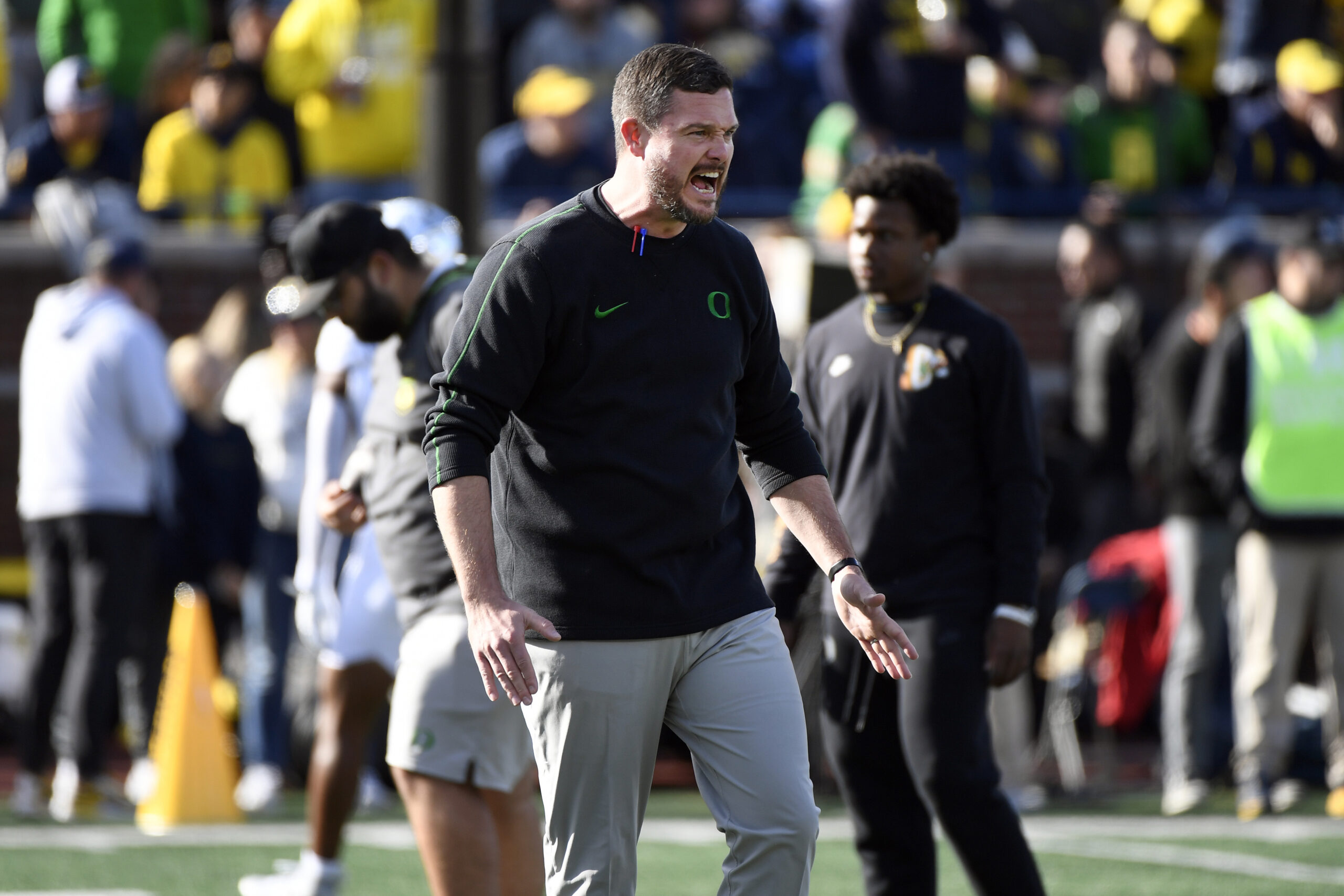
Welcome to a Hotline series examining head coaches under various forms of pressure in the 2026 season. The first installment focused on USC’s Lincoln Riley, followed by our look at Washington’s Jedd Fisch and then Utah’s Morgan Scalley.
For Dan Lanning, it’s a one-game season. The only missing element in the calculation is Oregon’s opponent.
We know the date will be either Jan. 14 in the Orange Bowl or Jan. 15 in the Sugar Bowl, otherwise known as the College Football Playoff semifinals.
After lopsided losses in the quarterfinals and semifinals the past two years, Lanning’s mission is clear: Anything short of an appearance in the championship game would constitute stagnation for a coach with all the resources necessary to avoid stagnation.
What happens if he doesn’t lead the Ducks, ranked No. 2 in the AP preseason poll, into the championship?
Nothing, and something.
Before NIL and the transfer portal became the pillars of roster construction and college football lurched to the edge of a great restructuring, the term Hot Seat carried a simple definition: Win or be fired. And that remains the case in certain situations. For example, USC coach Lincoln Riley seemingly is coaching for his job this season after repeatedly failing to make the CFP.
But the pressures associated with coaching have expanded and, with that, our definition of Hot Seat has gained nuance.
For Utah coach Morgan Scalley, there is Year 1 pressure to maintain the existing standard of success in order to potentially gain admission to a super league or expanded Big Ten. The Utes simply cannot afford to lose relevance while the future of the sport plays out in the halls of Congress and the back channels of realignment.
For Washington coach Jedd Fisch, there is Year 3 pressure to motivate his constituency to provide the NIL dollars needed for the Huskies to climb onto the top tier of the Big Ten. Without a leap forward this fall, UW risks a prolonged stretch of mediocrity.
And what of Lanning? The fifth-year coach has everything needed to win the Big Ten and secure a high seed in the CFP.
Except he has already accomplished both.
In 2024, the Ducks blasted their way to the conference title, earned the No. 1 seed and were summarily run off the field in the quarterfinals by an opponent (Ohio State) they had defeated during the regular season.
In 2025, the Ducks lost just once, claimed the No. 5 seed and were embarrassed in the semifinals by an opponent (Indiana) they played competitively during the regular season.
That’s the curiosity at the heart of Lanning’s tenure: Why does Oregon perform so much worse in the playoff than it does in the regular season against the same opponents? Ohio State and Indiana were peaking at the right time; Oregon, at the wrong time.
Lanning must change the trajectory. It doesn’t matter if Oregon wins the Big Ten or secures a high seed or home game in the CFP. The Ducks need to play their best when the spotlight is brightest and take that next step into the championship game.
Or what?
Nothing, and something.
Lanning isn’t getting fired. In the traditional sense, his seat temperature is somewhere between liquid nitrogen and the dark side of Pluto.
Oregon’s administration loves him; the players love him; the donors and fans love him. His four-year record is 48-8, after all. What’s not to love?
In that regard, nothing will happen if Oregon falls short of the CFP championship game.
And yet, we suspect something could happen to Lanning’s aura. It won’t evaporate if the Ducks don’t take that next step, but it could begin to wane ever so slightly.
For the first time, whispers and questions could materialize within the passionate, desperate Oregon football community: Can he get Oregon the championship it covets? Is he a builder, not a finisher?
In our view, Year 5 marks the tipping point.
Either Lanning takes the step that ensures he remains in Eugene as long as desired, or he falls short and impatience sets in — impatience that, for so many coaches, accelerates the timeline for departure.
Forever becomes five years.
Five years becomes three years.
Three years becomes one year.
To this point, Lanning has been Oregon’s forever coach, a perfect fit for the school and the community worthy of all the contract extensions the Ducks have offered and all the dollars they have devoted to building a championship-worthy roster.
But if they lose early in the CFP, or if they lose badly, the forever timeline could turn into a ticking clock that, for the first time, allows us to envision a future in which Lanning and the Ducks go their separate ways.
So yes, he has something on the line this season even though there’s nothing at stake.
*** Send suggestions, comments and tips (confidentiality guaranteed) to wilnerhotline@
*** Follow me on the social media platform X: @WilnerHotline




Leave a Reply