
IR / IT / FR / DE / TR | 2025 | 98 min | Comedy / Drama / Political Satire
➡️ Where to Watch: IT
When Showing Your Movie Becomes Harder Than Making It
Bahram is an Iranian-Azeri filmmaker whose work repeatedly fails to receive permission for public exhibition in Iran. When his latest Turkish-Azeri-language film is rejected again, he and his producer Sadaf refuse to accept another invisible movie and begin searching Tehran for another way to get it in front of an audience.
That sounds like the setup for an angry political drama. Ali Asgari chooses something much more playful. Bahram’s journey becomes an urban comic odyssey filled with bureaucrats, cinema owners, compromised artists and increasingly strange encounters. The system may control the screen, but it cannot completely control how filmmakers laugh at it.
➡️ Movie Insight: Divine Comedy understands that censorship can become so irrational that realism starts looking like satire. Bahram does not need to exaggerate the system to make it funny; he mostly needs to keep asking reasonable questions. The absurdity does the rest.
Why This Movie Matters Right Now: Resistance Cinema Is Learning to Laugh
Political resistance cinema often arrives carrying enormous dramatic weight. Oppression, censorship and authoritarian control naturally encourage serious storytelling. Divine Comedy finds another route: instead of making power look intimidating, it makes power look ridiculous.
That creates a different kind of resistance movie. Bahram cannot easily defeat the system, but he can expose its contradictions simply by moving through it. Every nonsensical conversation and bureaucratic obstacle removes a little of the authority surrounding the people telling him what he can and cannot create.
➡️ Why It Matters: Humor changes the power relationship. The moment audiences laugh at an irrational rule, the institution enforcing it looks a little less untouchable. Divine Comedy turns that laughter into its quiet form of rebellion.
Should You Watch It?: Political Cinema Without the Homework Feeling
You do not need detailed knowledge of Iranian censorship to understand Bahram’s frustration. Anyone who has dealt with pointless bureaucracy, gatekeepers or rules that seem to exist only because someone decided they should will recognize the basic comedy immediately.
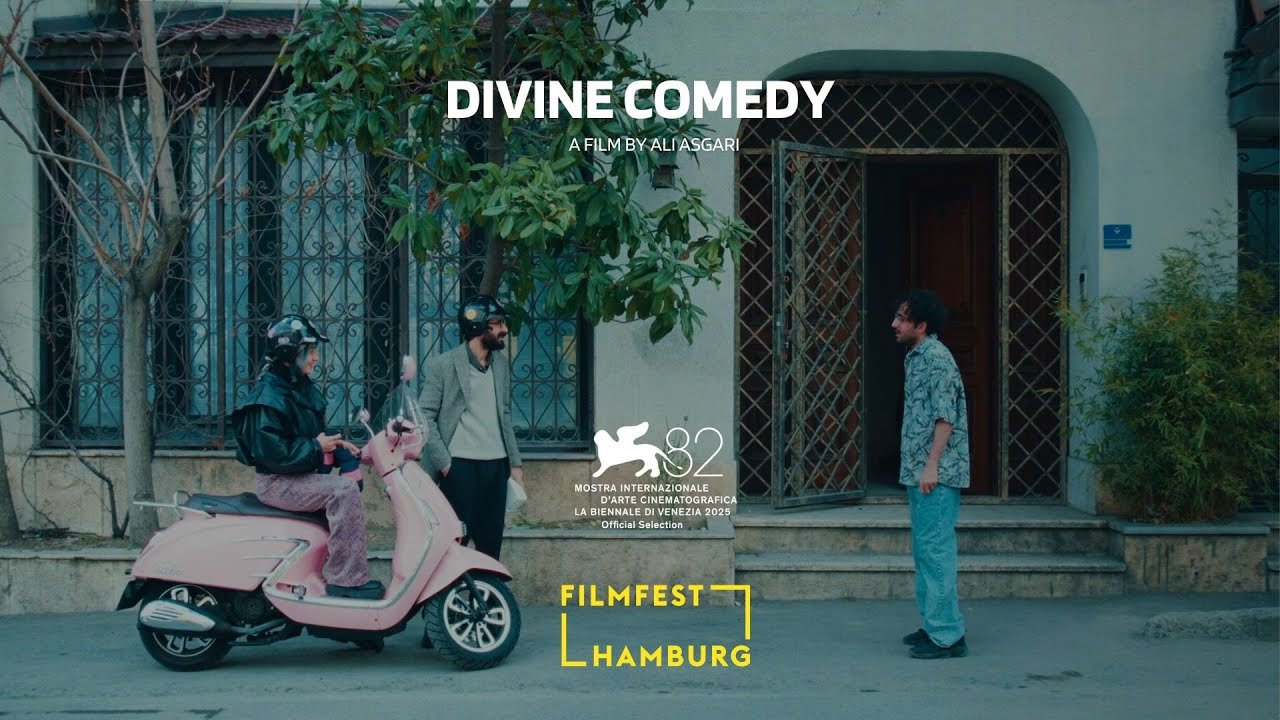
The movie is also more relaxed than its political subject might suggest. Bahram and Sadaf travel around Tehran on a pink Vespa, encountering different corners of the filmmaking world while the story keeps bouncing between frustration and humor. The result feels closer to a strange day in the life of a filmmaker than a traditional political lecture.
➡️ Viewing Recommendation: Watch it if you like smart comedies where the jokes reveal something uncomfortable underneath. It should particularly connect with filmmakers, festival audiences and anyone who enjoys political cinema that can make a serious point without constantly announcing how serious it is.
Why Everyone Is Talking About It?: A Censored Filmmaker Makes a Comedy About Censorship
The film premiered in the Orizzonti section of the 82nd Venice International Film Festival, giving its meta premise an especially sharp edge. Asgari has personally dealt with restrictions on his filmmaking, while Bahram Ark, who plays a fictionalized filmmaker inside the movie, brings his own relationship with censorship into the role. Asgari has explained that the production itself was filmed in Tehran under restrictive conditions, blurring the boundary between the comedy and the circumstances that produced it.
That makes Divine Comedy unusually easy to talk about after the credits. Audiences watch a filmmaker struggling to get permission to show a movie while knowing that the filmmakers making this movie were themselves working around restrictions. The joke keeps escaping the screen.
➡️ Viral Potential: “A filmmaker censored by the system makes a comedy about being censored by the system” is already a great conversation starter. The pink Vespa, absurd encounters and ridiculous censorship logic give the story memorable moments audiences can easily describe and share. The real-world circumstances behind the production make the punchline even stronger.
Why Divine Comedy Stands Out: The System Becomes the Joke
Asgari rarely needs a traditionally threatening villain. One of the smartest early choices is keeping the censor largely outside the image while Bahram sits inside the frame answering increasingly strange objections. Power exists, but the movie refuses to give it the visual importance audiences might expect.
That approach continues throughout the story. Instead of transforming officials and gatekeepers into cinematic monsters, Asgari exposes them through conversation, contradiction and repetition. Bahram keeps encountering people who have learned different ways of living with the system: cooperate, compromise, make something safer, find money, stay quiet—or somehow sneak around it.
➡️ Cinema Insight: Political cinema often makes oppressive systems look enormous. Divine Comedy discovers something more subversive: make them look stupid. Once authority becomes ridiculous, laughter itself starts feeling rebellious.
Movie Trend: The New Resistance Comedy — Laughing at Systems That Want Control
A fresher kind of political movie is emerging from a simple realization: resistance does not always need to look angry. Comedy, irony, absurdism and deadpan humor can expose power by showing audiences how strange its rules become when examined closely.
That approach also makes political cinema more accessible. Instead of beginning with ideology, filmmakers can begin with something everyone understands—a frustrating conversation, an impossible rule, an official who makes no sense, a system that keeps sending someone in circles. Audiences laugh first and recognize the larger problem immediately afterward.
➡️ Movie Trend: The New Resistance Comedy — Laughing at Systems That Want Control turns humor into a way of shrinking authority. These movies do not ignore serious political realities; they reveal how absurd those realities can become. The joke becomes another way of refusing to play by the system’s rules.
Viewer Profile: Audiences Who Want Political Movies With Personality
Divine Comedy naturally fits festival and international-cinema audiences, but its humor gives it room to reach viewers who might normally avoid overtly political films. The filmmaking story also creates another audience: directors, writers, producers and creatives who immediately understand the frustration of trying to move work through institutions and gatekeepers.
|
International cinema, political satire, arthouse and festival audiences |
|
|
Filmmakers, creatives, comedy audiences and viewers interested in contemporary Iranian cinema |
|
|
Primarily young adults and adults |
|
|
Broad, with strongest appeal among culturally engaged audiences |
|
|
Creative, culturally curious, socially aware and interested in international perspectives |
|
|
Festival discoveries, political comedy, Iranian cinema, international arthouse and filmmaker-focused stories |
➡️ Audience Insight: The sweet spot is the viewer who wants political cinema without feeling like they are being given a lecture. Humor becomes the invitation; censorship, artistic freedom and institutional control become the conversation that follows.
What This Movie Means for the Industry: Serious Movies Can Be Easier to Enter
Divine Comedy demonstrates why comedy can be such a useful tool for filmmakers dealing with difficult subjects. Censorship sounds politically specific; trying to convince an unreasonable gatekeeper to let you do your job feels universal. Humor creates the bridge between those two experiences.
There is also an important filmmaking lesson inside its meta structure. Asgari takes the obstacles surrounding cinema itself—permits, censorship, exhibition, commercial pressure—and turns them into entertainment. The industry problem becomes the story instead of something hidden behind production.
➡️ Industry Insight: Political filmmakers do not necessarily need to make their message louder to make it travel further. Humor can make difficult subjects more accessible without making them less meaningful. Divine Comedy shows how resistance cinema can become more audience-friendly while remaining unmistakably political.
Creative Analysis: Turning Censorship Into a Comedy
Asgari builds Divine Comedy around an appealing contradiction: the situation is serious, but the people and rules surrounding it are increasingly funny. Instead of forcing jokes onto the political material, he allows comedy to emerge from bureaucracy itself.
The approach gives the movie a deceptively light surface. Bahram and Sadaf can ride around Tehran, argue, meet strange people and keep searching for somewhere to screen the film, while underneath that journey sits a much darker reality: an artist cannot freely show his own work.
Storytelling: The Fight to Show the Movie Becomes the Movie
The premise is beautifully circular. Bahram has already made his film, but audiences cannot see it. Therefore, the dramatic adventure begins exactly where most movies about filmmakers would normally end.
His search for a screening becomes a chain of encounters, giving the story an episodic structure. Each new person represents another possible route through—or accommodation with—the system.
Performances: Bahram Ark Makes Frustration Funny
Bahram Ark’s performance works because Bahram rarely behaves like a heroic political rebel. He is frustrated, neurotic, stubborn and occasionally snobbish, which prevents the character from becoming a simple symbol of artistic freedom.
His bewilderment becomes part of the comedy. The stranger the logic surrounding him becomes, the more recognizable his reactions feel. He becomes the audience’s increasingly exhausted guide through bureaucratic nonsense.
Sadaf Asgari: The Energy That Keeps the Story Moving
Sadaf brings a different rhythm to the journey. Where Bahram can become trapped inside frustration, she keeps pushing forward, helping transform what could have been a series of complaints into an actual adventure through Tehran.
Their chemistry also keeps the political ideas grounded in character. They are not simply representatives of “artists versus censorship.” They are two people trying to solve a practical problem while the world keeps making the solution unnecessarily complicated.
Direction & Vision: Ali Asgari Lets Absurdity Speak for Itself
Asgari frequently avoids visually overexplaining the joke. Long, controlled compositions allow conversations to develop until the logic inside them begins collapsing under its own weight.
That restraint is important. The movie does not need frantic editing or exaggerated comic performances to tell audiences something is ridiculous. Often, simply watching a reasonable person remain trapped inside an unreasonable conversation is enough.
Cinematography & Visual Language: The Camera Watches the Trap
Amin Jafari’s cinematography frequently favors controlled, static compositions rather than constantly chasing characters around the city. That creates an interesting contrast with Bahram’s situation: he desperately wants to move forward while institutions keep holding him in place.
The recurring Vespa journey offers the opposite energy. Bahram and Sadaf are physically moving through Tehran, creating a playful visual symbol of their refusal to remain stuck.
Sound & Music: Giving Resistance a Lighter Rhythm
Hossein Mirzagholi’s music helps prevent the film from settling into the mood audiences might expect from a censorship drama. The journey has bounce and personality even when Bahram’s situation remains serious.
That lighter rhythm matters to the trend. Resistance comedy works when audiences feel that humor is not simply decorating the political argument—it is changing how the characters experience the struggle.
Editing & Rhythm: Bureaucracy Becomes a Series of Comic Encounters
Ehsan Veseghi’s editing allows the film to move between encounters without turning them into disconnected sketches. Each new stop pushes Bahram toward another version of the same basic question: what are you willing to do to get your movie shown?
The repetition becomes part of the humor. Every apparent solution creates another complication, making bureaucracy resemble an elaborate comedy machine.
Themes & Subtext: Who Gets to Decide What Audiences Can See?
Underneath every joke sits a basic argument about cultural power. Bahram has created something, but creation does not guarantee visibility. Someone else controls whether his work can officially reach the people it was made for.
That turns censorship into a larger question about gatekeeping. Whoever controls distribution, exhibition or permission also influences which stories become part of public culture.
Emotional Impact: Laughing Because the Alternative Is Giving Up
The comedy never completely removes the frustration underneath Bahram’s journey. That tension is essential. If censorship were merely ridiculous, there would be nothing meaningful at stake.
Humor instead becomes a survival mechanism. Bahram keeps moving, complaining, arguing and trying another route because accepting invisibility would mean allowing the system to finish the job.
What Makes It Different: Resistance Without the Hero Pose
Bahram is not transformed into an untouchable resistance icon. He is messy, funny, annoyed and deeply human. That makes his refusal to stop more relatable.
The movie suggests that resistance can sometimes be surprisingly ordinary: keep making things, keep asking questions, keep finding audiences and keep refusing to behave as though irrational rules are normal.
➡️ Creative Insight: Divine Comedy does not turn censorship into comedy because censorship is harmless. It uses comedy because ridicule takes away some of power’s mystique. Every laugh says the same thing in a different way: just because a system has authority does not mean its logic deserves respect.
If You Liked Divine Comedy: Laughing at Systems That Make No Sense
These movies also turn systems of control, bureaucracy and social pressure into stories where absurdity becomes part of the resistance. Like Divine Comedy, they show ordinary people discovering that following the rules can become increasingly ridiculous when the rules themselves are designed to protect the system.
No Other Choice (2025) by Park Chan-wook: The Job Market Becomes a Dark Joke
After spending 25 years working for the same paper company, Man-su suddenly loses his job and discovers that finding another one means competing inside an increasingly brutal employment system. Park Chan-wook turns his desperation into a wicked black comedy where economic insecurity pushes supposedly normal behavior toward complete absurdity.
➡️ Why It Connects: Like Divine Comedy, No Other Choice takes a recognizable system and keeps following its logic until that logic becomes ridiculous. Bahram battles cultural gatekeepers while Man-su battles the job market, but both movies use dark humor to expose systems that expect individuals to adapt no matter how unreasonable the rules become.
Two Prosecutors (2025) by Sergei Loznitsa: Following the Rules Becomes the Trap
In Stalin’s Soviet Union, a young prosecutor receives evidence that a prisoner has been abused and believes the official justice system should investigate. His attempt to follow the proper procedure instead takes him deeper into an institution whose bureaucracy exists to protect the very power he is questioning.
➡️ Why It Connects: Two Prosecutors is much darker than Divine Comedy, but both understand the strange dramatic power of bureaucracy. Their protagonists keep approaching institutions as though reasonable behavior should produce reasonable answers, only to discover that the system operates according to a completely different logic.
A Simple Accident (2025) by Jafar Panahi: Political Resistance Gets Darkly Absurd
A chance encounter leads an Iranian mechanic to believe he has recognized the man who tortured him while he was imprisoned, pulling several former political prisoners into an increasingly complicated question of revenge and certainty. Jafar Panahi mixes political trauma with uncomfortable humor and absurd situations, allowing resistance to remain messy, human and unpredictable.
➡️ Why It Connects: Panahi and Asgari both refuse to make Iranian resistance cinema emotionally one-note. Anger and political criticism remain underneath the stories, but humor gives ordinary people another way to confront systems that have controlled their lives.
➡️ Where to Watch: Availability varies by market; I’m leaving the country links out rather than inserting unverified JustWatch pages.
➡️ If You Liked Insight: These movies connect because they understand that resistance does not always have to look heroic or angry. Sometimes the strongest way to expose a system is to follow its logic until audiences can see how ridiculous that logic has become. Divine Comedy pushes this idea directly into comedy, turning censorship from an intimidating force into something audiences are invited to laugh at.
Quick Facts: Divine Comedy at a Glance
|
Ali Asgari, Alireza Khatami, Bahram Ark, Bahman Ark |
|
|
Faezeh Rad, Amirreza Ranjbaran, Hossein Soleimani, Mohammad Souri |
|
|
Comedy / Drama / Political Satire |
|
|
Venice Film Festival 2025 — Orizzonti |
|
|
The New Resistance Comedy — Laughing at Systems That Want Control |
|
|
Bahram, a filmmaker repeatedly prevented from screening his work in Iran |
|
|
Getting a censored film in front of an audience |
|
|
Bureaucracy becomes so irrational that the system practically writes the jokes itself |
|
|
Censorship, artistic freedom, bureaucracy, resistance, gatekeeping and creative independence |
|
|
A political resistance movie that fights censorship with absurdity, personality and humor |
Final Verdict: Sometimes the Best Way to Fight the System Is to Laugh at It
Divine Comedy takes a subject that could easily become heavy—censorship, artistic restriction and institutional control—and turns it into something funny, strange and surprisingly easy to enter. Ali Asgari never pretends Bahram’s situation is harmless. Instead, he discovers comedy in the ridiculous logic surrounding it, making every rejection, conversation and new obstacle another opportunity to expose how absurd control can become.
That is what makes the film feel fresh within political cinema. Bahram does not need to become a traditional resistance hero, and the movie does not need a huge confrontation to make its point. He keeps moving through Tehran, keeps trying to show his film and keeps refusing to accept that irrational rules should be treated as normal. Sometimes persistence itself is the rebellion.
➡️ Final Verdict: Divine Comedy proves political cinema can be serious without acting serious every second. Its deadpan humor turns censorship and bureaucracy into something audiences can laugh at while still understanding the freedom being taken away. For viewers who want resistance cinema with personality, wit and a little chaos, this is exactly where political comedy gets interesting.
These details are verified against the Venice Film Festival listing and current film materials.
For the published version, per your format, those citations should not appear beside the editorial text; the sources belong in the existing Sources section at the end.
Final Insights: The Revolution Might Have a Punchline
Resistance comedy works because humor can do something anger cannot always accomplish: it can make authority look small. A rule may have enormous consequences, but once audiences see how irrational it is, the people enforcing it lose some of their aura of inevitability. Comedy exposes the distance between having power and deserving respect.
That gives filmmakers a huge creative opportunity. Political cinema can become funnier, stranger, more character-driven and more accessible without abandoning its seriousness. Divine Comedy points toward resistance stories where the audience does not simply leave angry—they leave laughing at the people who expected never to become the joke.
➡️ Final Insight: The new resistance movie does not always shout at power; sometimes it laughs at it. Humor turns bureaucracy, censorship and control into things audiences can immediately recognize and question. Divine Comedy shows why one of cinema’s sharpest acts of rebellion can be refusing to let the people making the rules control the tone of the story too.


Leave a Reply