
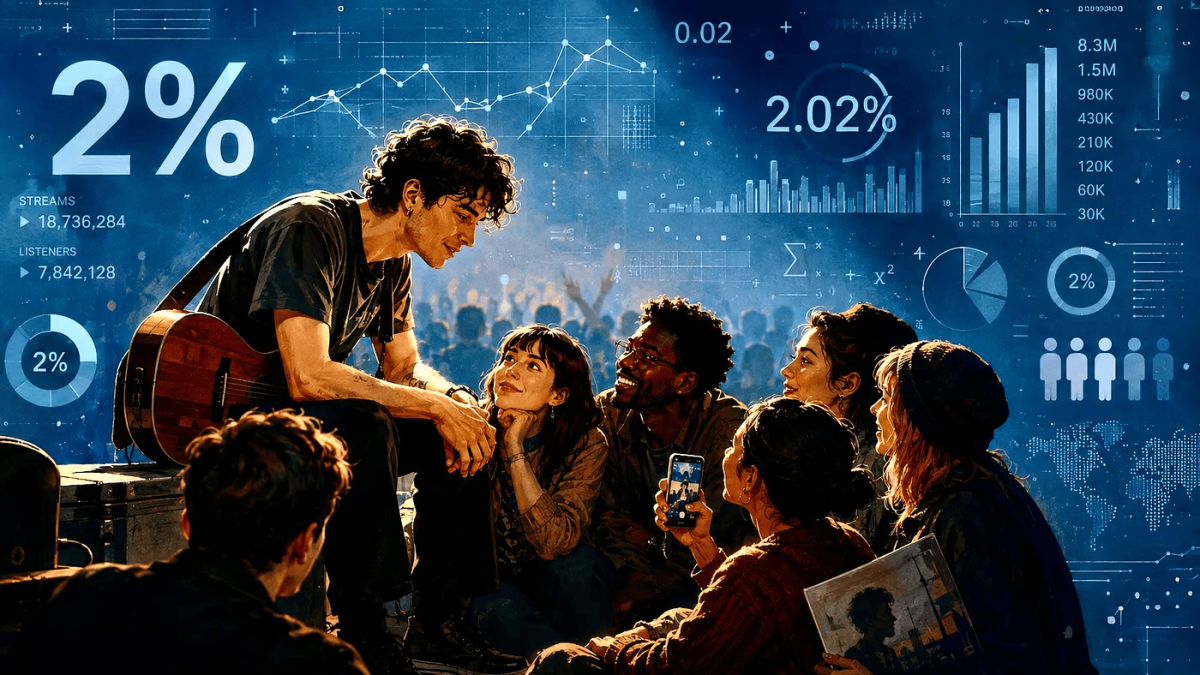
Each fan and listener you have matters. Seriously.
Why building a music career depends less on reach than on return.
The music business has become very good at giving artists numbers. Monthly listeners. Followers. Views. Streams. Impressions. Subscribers. We watch them because they are visible, measurable and easy to compare. When they go up, it feels like progress. When they go down, it can feel like something is wrong.
But those numbers don’t always tell us whether an artist is actually building a career.
One of the most interesting statistics I’ve seen recently comes from Spotify. Across artists of all sizes, the platform’s most engaged listeners — the people it calls “super listeners” — average only about 2% of an artist’s monthly audience. These are people who have intentionally played an artist at least 15 times during a 28-day period. They aren’t simply encountering a song because it appeared in a playlist or autoplay. They have made a choice to come back.
That relatively small group generates more than 18% of an artist’s streams, accounts for roughly half of ticket purchases made through Spotify and is far more likely to share the music with somebody else. More than half are still listening six months after discovering the artist.
I don’t think the lesson is that every musician needs exactly 2% of anything. Two percent isn’t a magic formula, and reducing fandom to another target number would miss the point. What interests me is the behavior behind the statistic.
There is a major difference between somebody hearing your music and somebody choosing to hear it again.
That difference may be one of the most useful ways to think about building an audience today.
Reach Is Only the Beginning
Imagine an artist with 100,000 monthly listeners. That’s an impressive number, but by itself it doesn’t tell us much about the relationship between those listeners and the artist.
How many encountered one song through a playlist? How many intentionally searched for another track? How many saved the album? How many came back several times? How many joined the mailing list, bought a ticket, purchased a record or told a friend?
The 100,000 listeners matter. Every committed fan begins as somebody who doesn’t know you, so discovery is essential. Artists need streaming, playlists, social media, publicity, touring and all the other mechanisms that put music in front of new people.
But reach is the beginning of the process, not the end of it. The more revealing question is what happens after somebody discovers you.
A listener hears a song and perhaps listens again. They visit your artist page. They save a track. They watch a video. They look at your website. Maybe they buy a ticket, sign up for an email list or come to another show. Eventually they may start telling other people about you.
There isn’t one precise moment when a listener officially becomes a fan. People move toward artists gradually and in different ways. What matters is that some of them are moving.
So instead of asking only, “How many people did I reach?”, I think artists should also ask, “How many people came back?”
The Second Listen May Matter More Than the First
Streaming data increasingly shows how differently intentional listeners behave from passive listeners.
A programmed listener may encounter your song because somebody else’s playlist, radio station or recommendation system placed it there. An active listener deliberately chooses you. Within that active group are people who listen once or twice, people who return regularly and the small group who keep coming back again and again.
Those active listeners represent a much smaller percentage of the total audience, but they generate a disproportionate amount of listening, ticket buying, merchandise purchasing and sharing.
This doesn’t mean passive listening is somehow inferior. Passive discovery is often how the entire relationship begins. The important thing is understanding that the job isn’t finished when somebody hears the song.
The opportunity is to give that person a reason to take another step.
That reason might simply be another great song. It could be an interesting story about the music, a compelling live performance, a beautiful physical product, a thoughtful newsletter or a strong enough artistic identity that the listener becomes curious about what else you have done.
We spend enormous amounts of energy trying to get attention. Building a career also requires giving that attention somewhere to go.
Chappell Roan: Building The World Before the Crowd Arrives
Chappell Roan is one of the clearest recent examples.
Her explosion into the mainstream looked incredibly fast from the outside. Suddenly the songs seemed to be everywhere, the festival crowds were enormous and millions of people knew who she was.
The work leading to that moment was anything but sudden.
She had been developing for years. There was an early record deal, disappointment, being dropped, ordinary jobs and a long process of discovering what Chappell Roan actually meant as an artist. Before the massive breakthrough, she had already started building a distinctive culture around the music.
Her headline shows were selling out before most people knew her name. Fans came dressed according to themes. Drag performers opened the shows. There was a visual language, a sense of humor, a point of view and a feeling that the audience was participating in something rather than simply watching it.
When the larger audience eventually arrived, there was already a world waiting for them.
That’s the part I find interesting. The breakthrough didn’t suddenly create the relationship between Chappell Roan and her audience. A smaller group of people had already responded deeply enough to the music and the experience to help establish what that relationship could be.
The lesson isn’t that every artist needs themed costumes or an elaborate concept. The lesson is that identity can become clearer while an audience is still small. Those early listeners are often the first people to tell us, through their behavior, what is resonating.
Noah Kahan: What Happens Before the Breakthrough
Noah Kahan offers another version of the same story.
Stick Season became so successful that it would be easy to imagine everything beginning with that record. By the time the larger audience arrived, however, Kahan had already spent years writing, releasing music and playing small and midsize rooms.
Those years are easy to minimize after the fact. They shouldn’t be.
Playing for a few hundred people teaches an artist things that are difficult to learn any other way. You discover where people lean in. You find out which songs they remember. You learn how to communicate without enormous production, cultural momentum or thousands of people already telling the audience that you matter.
You also learn how to continue when the numbers aren’t spectacular, and that may be one of the hardest parts of building a career. The work comes before the validation. An artist can spend years writing, touring, posting, recording, emailing, promoting and trying to grow an audience without knowing whether any of it will eventually lead to a larger opportunity.
Once success arrives, those years get rewritten as part of an inevitable journey. They never feel inevitable while you’re living them.
Noah Kahan’s earlier audience mattered because those listeners were evidence that something was already connecting. The larger audience didn’t create that connection. It multiplied it.
Brandi Carlile: A Career Before Mass Recognition
Brandi Carlile’s career may illustrate this idea even better because it reminds us that fame and a career are not the same thing.
Long before the major Grammy moments and wider cultural recognition, Carlile was already doing the work. She was playing small venues, touring, making records and developing an audience that kept coming back.
By the time much of the general public “discovered” her, she wasn’t a new artist learning how to build a career. She already had one.
I think that’s an important distinction, particularly for independent musicians. We talk about discovery as though there is some moment when the larger music business officially validates the work and everything before that was merely preparation.
It doesn’t have to work that way.
There are musicians everywhere with real audiences and meaningful careers who aren’t household names. Their listeners may number in the hundreds or thousands instead of millions. The venues may be smaller. Their music may exist outside whatever style happens to be receiving the most attention at the moment.
The relationship between those artists and their fans is still real. Sometimes, as happened with Brandi Carlile, that established relationship becomes the foundation for something much larger.
Building Even A Small Audience Is Hard
I don’t want to romanticize this process.
“Build a loyal fanbase” is one of those pieces of music-business advice that sounds wonderfully simple until you’re the person trying to do it.
An independent artist may already be writing, practicing, recording, performing, booking shows, editing video, managing social media, creating artwork, sending email, shipping merchandise, pitching music and trying to understand royalty statements. Then somebody tells them they also need to build a community around their work.
That requires time, patience and emotional energy, and there is no guarantee that an audience will grow at the speed the artist hopes.
People also have an extraordinary number of choices. They have families, jobs, obligations, entertainment options and more music available to them than at any point in history. Nobody owes us attention because we worked hard on a record.
That reality makes the people who do care especially meaningful.
If 40 people come to a show, 40 people made a decision to spend part of their evening with you. If 200 people consistently open your newsletter, 200 people have given you permission to communicate with them. If somebody has bought your last four records, there is already a relationship there that deserves at least as much attention as the stranger you’re trying to reach with the next Instagram post.
We can become so focused on the audience we don’t yet have that we overlook the audience standing directly in front of us.
Don’t Turn Fandom into An Extraction Strategy
The music business is increasingly interested in “superfans,” and understandably so. Highly engaged listeners buy tickets, merchandise, vinyl, special editions and experiences.
But there is a danger in immediately translating deeper fandom into a question of how much more we can sell somebody.
There is nothing wrong with selling things to fans. Artists deserve to earn money, and committed listeners often genuinely want more ways to participate. They may want the signed edition, the better seat, the private event or the deluxe package.
The order matters.
The relationship should create the transaction rather than the transaction being used to manufacture the relationship.
A more useful question than “What else can I sell these people?” is “What would make their connection with the music more meaningful?”
Sometimes the answer will be something they can buy. Sometimes it will be a story, a demo, an alternate version, a live performance, a thoughtful email or a moment of genuine communication. Not every interaction needs a price attached to it.
Give The Relationship Somewhere to Go
Streaming services and social media are extraordinary tools for discovery. They can place music in front of listeners an artist could never reach independently, and there is no reason to reject that.
But discovery and relationship are different jobs.
Whenever possible, artists should have some way for interested listeners to move closer without depending entirely on the next algorithmic recommendation. A website still matters. An email list matters. Live performance matters. Direct communication matters. Physical music can matter. A community can matter.
The point isn’t to get everybody off Spotify, YouTube, TikTok or Instagram. The point is to make sure that people who want more can find more.
The path might look something like this:
Discovery → Interest → Return → Connection → Participation → Advocacy
Nobody has to travel the entire path. Most people won’t. But the next step should exist.
And this is where the conversation about the 2% starts becoming much more interesting than the statistic itself. We are really talking about creating enough opportunities for a listener to move from hearing the work to having some kind of relationship with the person who made it.
The Other 98% Still Matters
Calling this “The 2% That Matters” intentionally focuses attention on the smallest part of the audience, but the other 98% matters enormously.
They are the source of future fans.
Casual listeners matter. Playlists matter. Someone hearing a song once matters. Social media impressions matter. A person sending a track to somebody who has never heard of you matters.
An artist needs the outer circle as well as the inner circle. One creates discovery; the other creates continuity.
The mistake is not caring about reach. The mistake is assuming reach alone tells us whether a career is becoming stronger.
A million people hearing one song once can be an extraordinary opportunity. A thousand people continuing to care after the moment has passed may be what turns that opportunity into something sustainable.
What The 2% Really Means
Chappell Roan, Noah Kahan and Brandi Carlile have very different music, careers and audiences, but their stories share something important. The largest audience didn’t arrive first. There were smaller rooms before bigger ones, earlier records before breakthrough records and listeners who cared deeply before the wider culture was paying attention.
From a distance, we call that an overnight success. From inside the career, it looks very different. It looks like years of individual encounters accumulating: somebody hears a song and comes back, somebody buys a ticket, somebody brings a friend, somebody remembers the words, somebody keeps listening even when the artist isn’t the subject of the moment.
That’s why I don’t think this is really an article about 2%.
The number gets our attention because it reveals something we should have understood all along. Music careers aren’t built entirely out of impressions, followers or streams. They’re built out of relationships. The technology used to reach listeners keeps changing, but that part hasn’t changed very much at all.
Before streaming, an artist might have known the names and faces of the people who kept coming back to a club. They might have recognized the person who bought every record, joined the mailing list, brought friends to a show or drove to another city to see the band again. Today, those same relationships may first appear to us as data points on a dashboard: an active listener, a repeat stream, an email subscriber, a returning ticket buyer.
The dashboard can tell us that somebody came back. It cannot tell us everything about why.
That’s still our job.
We have to make music worth returning to. We have to give people something to believe in, identify with, talk about and share. We have to communicate when there isn’t a new release to sell. We have to recognize that a person who has listened to our music for ten years is more than a consumer segment. They have allowed our work to become some small part of their life.
That is an extraordinary privilege.
Perhaps this is where the obsession with bigger numbers has led us slightly off course. Of course we want more listeners. Of course we want the audience to grow. Every artist wants the opportunity to have the work heard by as many people as possible.
But growth doesn’t have to mean constantly looking past the people who are already there. It can also mean deepening what already exists.
A listener becomes a repeat listener. A repeat listener becomes a fan. A fan becomes someone who shows up. Someone who shows up tells somebody else. Over time, hundreds become thousands and sometimes thousands become millions. Sometimes they don’t. Either way, something real has been built.
So maybe the most important lesson inside the 2% isn’t that we should find a tiny fraction of our audience and concentrate on them. It’s that every large audience begins with a small number of people deciding to care.
Our job is to keep reaching outward while never losing sight of that simple human exchange at the center of everything we do: an artist makes something meaningful, another person hears it, and for reasons neither side can completely explain, they want to hear it again.
Algorithms can help make the introduction. Marketing can create the opportunity. Data can show us what happened.
But the thing that turns an audience into a career is something much older and much harder to manufacture.
A relationship…





Leave a Reply