
FR / LB | 2026 | 22 min | Drama, Psychological Drama, Short
When the Promise of a Better Life Becomes a Negotiation
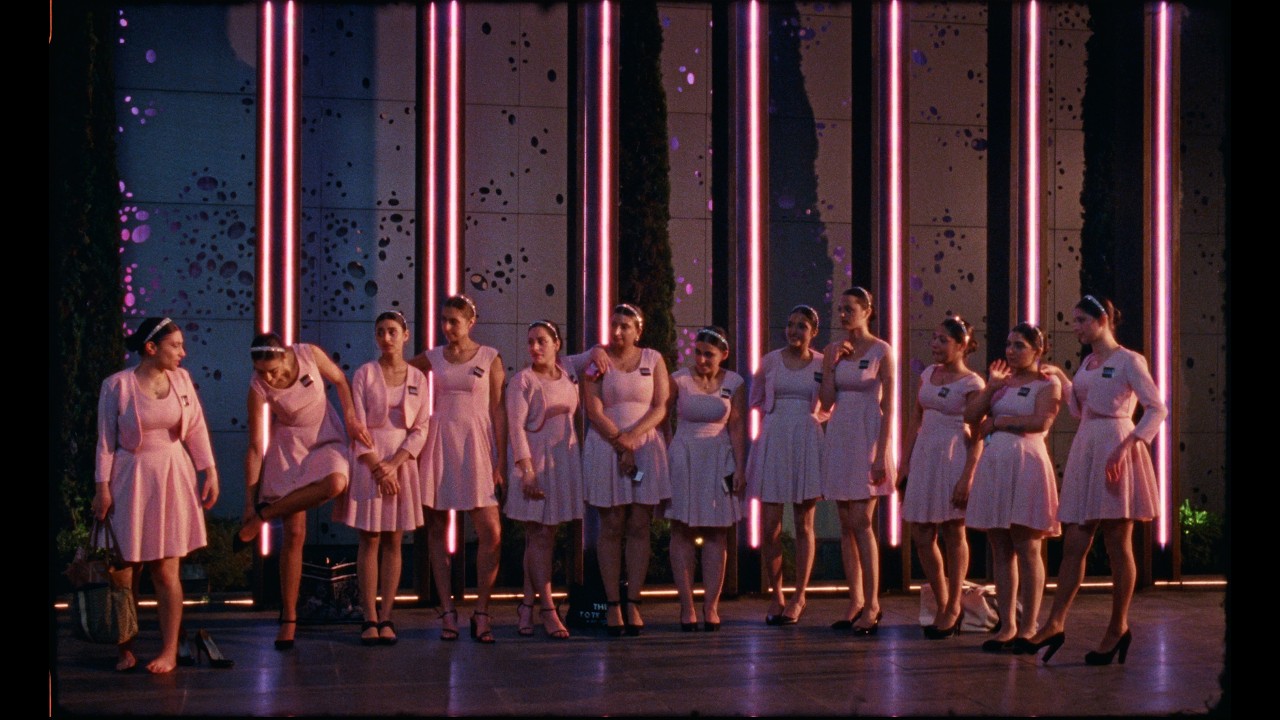
Mireille takes her young son Johnny to what he believes is an audition, feeding his excitement with the possibility of appearing on the big screen. But the performance is already happening before they arrive: the audition is not really for Johnny, and Mireille understands far more about the encounter than he does.
The truth turns the promise of stardom into something much more unsettling. Mireille is actually considering becoming a surrogate for a European couple, hoping the money can provide a route out of Lebanon. Director Jessy Moussallem transforms that transaction into a compact psychological drama about economic desperation, ambition, motherhood and the compromises that appear possible when ordinary routes to a better future begin disappearing.
➡️ Movie Insight: Faux Bijoux turns aspiration into a mechanism of concealment. The fantasy of being discovered hides a transaction shaped by economic inequality and unequal choices. What appears to be an audition gradually reveals itself as a negotiation over bodies, money and escape.
Why This Movie Matters Right Now: Economic Pressure Changes the Meaning of Choice
Faux Bijoux is particularly relevant because it questions what genuine choice means when financial circumstances become extreme. Mireille technically enters the negotiation herself, but her willingness cannot be separated from the economic conditions surrounding her or her determination to find a way out of Lebanon. The film therefore avoids reducing exploitation to a simple confrontation between an obvious victim and villain.
Moussallem has connected the film’s origins to Lebanon’s economic crisis and to the social pressure of maintaining appearances even when life is collapsing underneath them. That context makes Mireille’s deception essential rather than incidental: she is not simply hiding the truth of the audition from Johnny and her family, but constructing a version of success that allows her to preserve dignity while considering an increasingly intimate economic transaction.
➡️ Why It Matters: Faux Bijoux asks whether opportunity remains freedom when desperation determines which opportunities appear possible. Mireille’s ambition is inseparable from the economic system narrowing her choices. The film turns one private decision into a larger examination of class, migration and the price attached to escape.
Should You Watch It?: A Short Drama That Changes Meaning as It Unfolds
Faux Bijoux is especially effective for viewers who enjoy short films built around gradual revelation. The opening promise of an acting opportunity establishes one expectation, while the real purpose of the meeting forces the audience to reinterpret Mireille’s behavior, Johnny’s excitement and the power relationship between everyone in the room.
At around 22 minutes, the film does not need to turn its themes into an extended argument. Instead, it concentrates economic inequality, motherhood, ambition and cross-border privilege inside a single negotiation. The result is a psychologically tense drama where the most important conflict comes from understanding why a character might accept circumstances that initially appear impossible.
➡️ Viewing Recommendation: Watch Faux Bijoux for a compact psychological drama where the central reveal opens a much larger social question. Its strongest tension comes from the distance between what Johnny believes is happening and what Mireille knows is actually being negotiated. The short format makes every shift in power, expectation and desire more concentrated.
Why Everyone Is Talking About It?: Festival Momentum Is Turning a Small Story Into a Bigger Conversation
Faux Bijoux has built significant momentum across the international short-film circuit. It premiered at the 2026 Sundance Film Festival, competed at Clermont-Ferrand and Brussels, and continued through festivals including Short Shorts Film Festival & Asia, Krakow Film Festival and Vancouver International Film Festival. Its festival trajectory places a highly specific Lebanese story inside a much broader international conversation about economic inequality and the commodification of opportunity.
The Brussels Short Film Festival provided the clearest recognition. Faux Bijoux won the International Grand Prize, while Maria Shmouri and Seidi Haarla shared the festival’s female performance award for their work in the film. That combination is significant because the movie’s social argument depends heavily on performance: the tension is generated not simply by what is being negotiated, but by the different kinds of need each woman brings into the room.
➡️ Viral Potential: Faux Bijoux has the kind of reveal that encourages discussion after the film ends rather than simply providing a twist. The surrogate negotiation immediately opens debates around money, motherhood, privilege, migration and consent. Its growing festival visibility gives those questions an international audience far beyond the specific circumstances of Mireille’s life.
Why Faux Bijoux Stands Out: Nobody Enters the Room With Equal Power
The film’s strongest idea is that everyone wants something, but not everyone has the same ability to negotiate. Mireille needs money and the possibility of leaving Lebanon. The European couple wants a child. Johnny wants recognition and the fantasy of appearing on screen. These desires coexist, but the economic and geographic circumstances behind them are radically different.
That imbalance prevents the transaction from becoming morally simple. The prospective parents have emotional needs of their own, while Mireille possesses agency and understands what she is considering. Yet economic necessity changes the meaning of that agency. Faux Bijoux becomes most provocative when it refuses to resolve that contradiction and instead asks what happens when one person’s financial desperation meets another person’s ability to pay.
➡️ Cinema Insight: Faux Bijoux creates tension through unequal bargaining power rather than conventional confrontation. Every character wants something, but their ability to obtain it is determined by very different circumstances. The film’s psychological complexity comes from showing how need can exist on both sides of a transaction without making the transaction equal.
Movie Trend: Psychological Drama — When Ambition Makes Someone Easy to Manipulate
Psychological Drama provides the strongest professional foundation for Faux Bijoux because the film builds its tension around perception, concealment, desire and unequal knowledge. Its broader content moves through Psychology + Economy + Motherhood + Migration + Fame + Exploitation + Body Autonomy, with the audition functioning as the dramatic mechanism connecting those themes.
The emerging content pattern is ambition becoming vulnerability. Mireille wants economic escape while Johnny dreams about the visibility and validation of the big screen. Those desires make the promise of opportunity unusually powerful. Faux Bijoux belongs to a strand of contemporary psychological drama examining situations where people are not manipulated primarily through threats, but through access to something they desperately want.
➡️ Movie Trend: Psychological Drama — When Ambition Makes Someone Easy to Manipulate captures the film’s genre foundation and its central content shift. Opportunity becomes dangerous when another person understands how urgently it is needed. Ambition therefore stops functioning only as motivation and becomes a source of psychological and economic vulnerability.
Viewer Profile: Power Drama Audience
Power Drama Audience — viewers drawn to character-driven films where relationships are shaped by control, manipulation and unequal power. They respond to psychologically tense stories in which apparently ordinary encounters gradually reveal who holds influence and who is vulnerable.
A secondary profile is the Festival Short Film Audience — viewers who appreciate concise, distinctive filmmaking and stories capable of establishing complex character dynamics within a limited runtime. This fits Faux Bijoux particularly well as a 21-minute short that has circulated through major international short-film festivals.
|
Power Drama Audience — character-driven stories centered on control, manipulation and unequal relationships |
|
|
Festival Short Film Audience — distinctive, concentrated storytelling and emerging filmmaking voices |
|
|
25–54 — adult viewers with a strong fit for psychologically complex stories about power, personal choices and unequal relationships |
|
|
Broad audience across genders |
|
|
Broad; viewing preference is more relevant than income |
|
|
Arthouse, independent and festival-cinema audiences |
|
|
Psychological dramas, character-driven shorts, independent cinema and curated festival discoveries |
➡️ Audience Insight: The strongest audience definition for Faux Bijoux comes from viewing taste rather than generation. Power Drama audiences respond to stories where relationships become tests of control and vulnerability. Its compact short-film format makes it particularly suited to festival and curated audiences who value concentrated psychological storytelling.
What This Movie Means for the Industry: Short Films Can Turn One Transaction Into a Global Story
Faux Bijoux demonstrates why short filmmaking remains an important space for socially engaged cinema. Rather than constructing an expansive portrait of Lebanon’s economic crisis, Moussallem compresses its consequences into a single room and one intensely personal decision. The economic system is therefore experienced through character rather than explained through exposition.
Its festival trajectory also shows how internationally legible themes can travel when cultural specificity remains intact. The film is rooted in Lebanon and in Mireille’s desire to leave, yet the underlying questions around economic mobility, reproductive labor and unequal opportunity extend across borders. The involvement of cinematographer Robbie Ryan further gives the project a high-level creative profile while maintaining the immediacy of a short-film discovery.
➡️ Industry Insight: Faux Bijoux shows how short cinema can translate large structural issues into intimate dramatic situations. Cultural specificity gives the story identity while economic inequality gives it international relevance. Its festival momentum demonstrates how a 22-minute film can become a calling card for both a filmmaker and a larger social conversation.
Creative Analysis: Turning an Audition Into a Marketplace
Moussallem and co-writer Jihad Hojeily construct the film around misdirection. Johnny’s belief that he is approaching the possibility of stardom gives the opening a recognizable language of aspiration, but that language gradually becomes uncomfortable as the real purpose of the encounter emerges.
The filmmaking supports that transition without needing to radically change the story’s scale. Robbie Ryan handles cinematography, Esther Lowe and Nicolas Desmaison edit, and Amine Bouhafa provides the original music. The result is a contained short in which performance, withholding and negotiation carry more dramatic weight than plot mechanics.
Storytelling: The Reveal Changes Everything That Came Before
The central storytelling device is the difference between appearance and reality. Johnny understands the meeting through the fantasy of cinema, while Mireille understands it as a possible economic exit. The audience initially occupies the gap between those perspectives.
Once surrogacy is revealed, the meaning of the audition changes completely. Stardom was never the real opportunity; it was a story capable of making a more uncomfortable truth socially acceptable. The film therefore uses deception not merely to create surprise but to explore the psychological necessity of maintaining appearances.
Direction: Keeping Judgment Outside the Frame
Moussallem’s direction is strongest when the film observes rather than announces its moral position. Mireille’s decision can be understood as desperate without being stripped of agency, while the European couple’s desire for a child does not erase the economic imbalance defining the negotiation.
That restraint makes the encounter more disturbing. A simpler film could tell the audience exactly who is exploiting whom. Faux Bijoux instead concentrates on a system where individual needs intersect with unequal resources, allowing discomfort to emerge from the transaction itself.
Performances: Different Forms of Need Occupy the Same Room
Maria Shmouri’s Mireille carries the film’s most difficult emotional contradiction: she must appear capable and determined while the circumstances driving her decision reveal profound vulnerability. Her performance helped earn her a shared Best Actress award at Brussels.
Seidi Haarla’s performance on the other side of the transaction is equally important because the prospective parent cannot simply function as an antagonist. Haarla and Shmouri shared the Brussels performance prize, reinforcing how much the film depends on creating two emotionally credible forms of desire inside a materially unequal negotiation.
Visual Style: Restraint Makes the Transaction More Uncomfortable
Robbie Ryan’s cinematography supports a film where observation matters more than visual spectacle. The contained setting and emphasis on faces allow shifts in confidence, hesitation and control to become part of the visual storytelling.
That restraint also prevents the social themes from overwhelming the characters. Rather than visually announcing exploitation, the film allows the imbalance to emerge through bodies occupying the same space while possessing radically different economic possibilities.
Themes: Ambition, Economic Inequality and the Price of Escape
The central themes are Psychology, Economy, Motherhood, Migration, Fame, Body Autonomy, Exploitation and Social Mobility. They intersect through one question: what becomes negotiable when leaving an existing life feels more urgent than protecting the boundaries that once appeared fixed?
The film also examines appearance. Mireille tells one story to her family, another to Johnny and participates in another reality inside the audition. Success itself becomes performative, suggesting that maintaining dignity can require people to construct convincing versions of lives they do not actually possess.
What Makes It Different: Stardom Is the Decoy, Not the Destination
The acting-audition premise initially positions Faux Bijoux as a story about fame and opportunity. The surrogate reveal deliberately dismantles that expectation. What Johnny imagines as entry into the entertainment industry is actually the cover for an entirely different transaction involving his mother’s body and the family’s economic future.
That collision gives the film its distinctive hook. Fame, migration and reproductive labor might initially appear to belong to separate stories, but Faux Bijoux connects them through the idea of being chosen. Johnny wants to be chosen for the screen, Mireille wants to be chosen for an opportunity to escape, and the prospective parents are choosing the woman who may carry their child.
➡️ Creative Insight: Faux Bijoux turns the desire to be chosen into the connective tissue between fame, migration and reproductive labor. The audition is effective because it makes aspiration and transaction initially look like the same thing. Once the difference becomes visible, the film’s entire power structure changes.
If You Liked Faux Bijoux (2026): Stories Where Survival Changes the Meaning of Choice
These films expand on different elements inside Faux Bijoux: reproductive vulnerability, economic precarity, migration, secrecy and the pressure to perform a socially acceptable version of life. Each examines characters whose decisions cannot be separated from the systems limiting the alternatives available to them.
The Girl with the Needle (2024) by Magnus von Horn: When Reproductive Vulnerability Becomes a Marketplace
A pregnant and economically vulnerable young woman in post-World War I Copenhagen becomes connected to a woman operating an underground adoption agency. Magnus von Horn uses pregnancy, poverty and social exclusion to explore what happens when reproductive choices become entangled with survival.
➡️ Why It Connects: Both films place economically vulnerable women inside systems where pregnancy and motherhood acquire financial value. Personal choice exists, but poverty changes the conditions under which that choice is made. The Girl with the Needle is the strongest companion film for Faux Bijoux’s intersection of reproductive labor, economic desperation and female agency.
➡️ Where to Watch: | | | | |
Souleymane’s Story (2024) by Boris Lojkine: When Survival Requires Performing the Right Story
Souleymane races through Paris working as a food-delivery rider while preparing for the asylum interview that could determine whether he can remain in France. His survival increasingly depends on presenting a version of himself capable of satisfying a system whose rules control his future.
➡️ Why It Connects: Mireille and Souleymane both live under economic and geographic pressures that turn self-presentation into a survival strategy. Each character must perform a story because the truth alone does not appear sufficient to produce the future they need. Both films connect migration with the uncomfortable question of what people are prepared to change, hide or trade for the possibility of remaining somewhere—or escaping somewhere else.
➡️ Where to Watch: | | | | |
The Seed of the Sacred Fig (2024) by Mohammad Rasoulof: When Social Pressure Enters the Family
Against political unrest in Tehran, a newly promoted investigating judge becomes increasingly suspicious of his wife and daughters after his service weapon disappears. Institutional pressure gradually enters the household, transforming private relationships into extensions of a larger political system.
➡️ Why It Connects: Both films make structural pressure visible through intimate relationships rather than abstract political explanation. Faux Bijoux brings economic inequality into a negotiation over motherhood, while The Seed of the Sacred Fig brings state power into a family home. Each demonstrates how external systems become most dramatically powerful when they begin changing how people behave toward those closest to them.
➡️ Where to Watch: | | | | | | |
➡️ If You Liked Insight: These films examine choices made inside circumstances where freedom is already constrained by money, migration, gender or political power. Their characters are not simply deciding what they want; they are calculating what survival allows. Faux Bijoux belongs to this broader cinema of compromised choice, where the most important drama lies in the conditions surrounding a decision.
Final Verdict: A Psychological Drama Where Opportunity Has a Price
Faux Bijoux begins with the familiar language of ambition and then systematically makes that language uncomfortable. An audition promises visibility, recognition and the possibility of another life, yet the real negotiation reveals that the commodity being discussed is not talent but reproductive labor.
Moussallem’s achievement is keeping the film human while exploring that transaction. Mireille is neither reduced to a victim nor romanticized as someone completely free to choose. Her decision exists inside economic desperation, maternal responsibility and the desire to escape, making Faux Bijoux a sharp example of psychological drama built around the unequal conditions behind apparently voluntary choices.
➡️ Final Verdict: Faux Bijoux turns ambition into a psychologically complex form of vulnerability. Its surrogate negotiation transforms a personal decision into a story about economic inequality, migration and the value placed on bodies. In just over 20 minutes, the film makes the promise of opportunity feel simultaneously hopeful, necessary and dangerous.
Quick Facts: Faux Bijoux at a Glance
|
Jessy Moussallem, Jihad Hojeily |
|
|
Maria Shmouri, Akram Nayef |
|
|
Samer El Sayyed, Seidi Haarla, Jarkko Lahti |
|
|
2026 festival circulation |
|
|
Drama, Psychological Drama, Short |
|
|
Esther Lowe, Nicolas Desmaison |
|
|
Jean-Baptiste Savary, Jessy Moussallem, Olivier Muller, Gary Farkas, Clément Lepoutre |
|
|
Distribution / Film Contact |
|
|
Sundance, Clermont-Ferrand, Brussels Short Film Festival, Short Shorts Film Festival & Asia, Krakow Film Festival, VIFF |
|
|
Brussels International Grand Prize; shared female performance award for Maria Shmouri and Seidi Haarla |
|
|
Psychological Drama — When Ambition Makes Someone Easy to Manipulate |
|
|
Mireille considers surrogacy as a route toward economic escape while disguising the transaction as an acting audition |
|
|
A supposed audition gradually reveals itself as a negotiation over reproductive labor |
|
|
Ambition, Psychology, Economic Inequality, Motherhood, Migration, Exploitation, Body Autonomy, Fame |
|
|
A tightly constructed short that turns one deceptive audition into a complex examination of money, desire and unequal choice |
Final Insights: Psychological Drama Is Turning Opportunity Into a Source of Vulnerability
Psychological Drama — When Ambition Makes Someone Easy to Manipulate reflects a wider storytelling shift in which danger does not necessarily arrive through obvious coercion. Instead, characters encounter people and systems capable of offering exactly what they desperately need: money, mobility, recognition, security or escape. The dramatic tension comes from recognizing that an opportunity can simultaneously be real and exploitative.
Faux Bijoux makes this particularly effective by connecting ambition to economic inequality. Mireille’s desire for another life is genuine, but the conditions surrounding that desire determine what she is willing to negotiate. That creates fertile territory for contemporary psychological drama, where power increasingly operates through access rather than force and where the person controlling the opportunity may also control the terms.
➡️ Final Insight: Contemporary psychological drama is increasingly finding tension in opportunities that arrive with unequal conditions attached. Ambition becomes vulnerability when access to a better future depends on someone else’s rules. Faux Bijoux captures that shift by transforming the promise of being chosen into a negotiation over how much a person is prepared to give in return.




Leave a Reply