
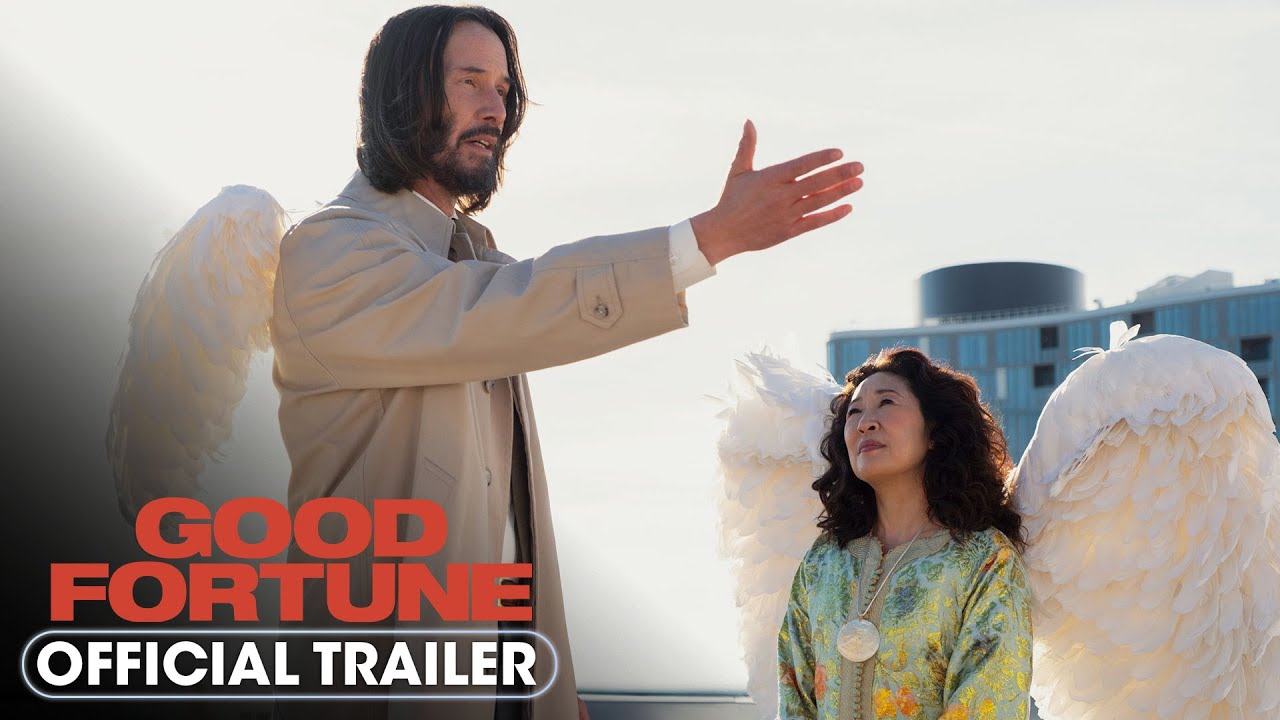
United States | 2025 | 97 min | Comedy
An Inept Angel. Two Lives. One Money Experiment Gone Wrong.
Why a Life-Swap Comedy Turns the Gig-Work Divide Into a Modern Fantasy
Aziz Ansari turns the familiar life-swap comedy into a contemporary story about gig work, wealth and whether money really can solve most of life’s problems.
Good Fortune follows Arj, a struggling gig worker whose precarious existence attracts the attention of Gabriel, a well-meaning but decidedly inept angel. Hoping to prove that wealth will not solve Arj’s problems, Gabriel swaps his life with that of Jeff, a wealthy venture capitalist. There is one problem: Arj discovers that being rich actually solves quite a lot, sending Gabriel’s supposedly simple moral lesson spectacularly off course. The film’s premise places class difference and contemporary working life inside an accessible high-concept fantasy comedy.
Written and directed by Aziz Ansari in his feature directorial debut, the film brings together Ansari as Arj, Seth Rogen as Jeff, Keanu Reeves as Gabriel and Keke Palmer as Elena, with Sandra Oh and Stephen McKinley Henderson in supporting roles. Reeves is particularly important to the movie’s identity: instead of his familiar action persona, he plays an awkward supernatural figure whose attempt to improve someone’s life creates an even bigger mess.
➡️ Movie Insight: Good Fortune refreshes the life-swap formula by asking a distinctly contemporary question: what happens when an angel tries to prove that money cannot buy happiness—and accidentally demonstrates just how many everyday problems money actually can solve?
Should You Watch It?: A Feel-Good Fantasy Comedy With More Social Bite Than Its Angelic Premise Suggests
Good Fortune is an easy recommendation for viewers who like mainstream comedy with a recognizable social reality underneath the jokes. Its supernatural mechanism is deliberately accessible: take a struggling worker, give him access to a wealthy man’s life and wait for the expected moral revelation. Ansari’s cleverest move is refusing to make that revelation entirely predictable.
Arj’s financial insecurity gives the fantasy real-world weight. The movie acknowledges the pressures of gig work, unstable employment and economic inequality, allowing the difference between Arj and Jeff’s lives to involve more than expensive possessions. For someone struggling to maintain basic stability, money does not simply provide luxury—it can remove problems that consume enormous amounts of everyday energy.
That tension appears repeatedly in audience reactions. IMDb reviewers praise the film for balancing comedy with observations about precarious work and homelessness, while others appreciate that it does not simply repeat the familiar message that wealth is irrelevant to happiness. The film currently carries a 6.4 IMDb user rating and 61 Metascore in the supplied material.
➡️ Viewing Takeaway: Watch Good Fortune for a warm, accessible comedy that uses an absurd supernatural experiment to ask surprisingly practical questions about money, work and how radically financial security can change everyday life.
Why Everyone Is Talking About It?: Keanu Reeves Turns an Inept Angel Into the Movie’s Unexpected Comic Weapon
Keanu Reeves as Gabriel gives Good Fortune its most immediately marketable twist. Audiences accustomed to seeing Reeves as the controlled action hero of John Wick or the philosophical center of The Matrix instead encounter him as an angel whose supposedly straightforward intervention in human affairs becomes an escalating mistake.
Ansari has described Reeves as becoming the “soul” of the movie, while also emphasizing how naturally he adapted to working alongside experienced comedy performers Ansari and Rogen. (People.com) That casting reversal helps the film stand apart from a conventional social comedy: Gabriel can observe inequality from an outsider’s perspective while remaining hilariously ill-equipped to understand how human life actually works.
The film also represents an important career moment for Ansari. After his planned first directorial feature Being Mortal was suspended in 2022, he moved forward with Good Fortune, retaining Keke Palmer and Seth Rogen for the new project. The result became his eventual feature directing debut.
➡️ Buzz Insight: Good Fortune gets much of its personality from turning Keanu Reeves’ familiar sincerity into comedy, while giving Aziz Ansari a high-concept vehicle for his long-delayed feature directorial debut.
Awards & Recognition: Comedy, Performance and Audience Appeal Have All Earned Attention
Good Fortune has received five nominations across festival, critics and industry organizations, giving the film recognition in unusually varied areas: audience response, comedy, supporting performance, location management and even its marketing campaign. (IMDb)
Its most prominent acting recognition belongs to Keanu Reeves, nominated for the 2026 Astra Award for Best Supporting Actor in a Motion Picture Comedy or Musical for Gabriel. The film was also nominated for Best Comedy Film by the St. Louis Film Critics Association, reinforcing its positioning as a comedy rather than simply a fantasy vehicle. (IMDb)
The full nomination profile includes:
-
2025 Warsaw International Film Festival — Encounters nominee, Polish Film Institute Award (Audience Award) — Aziz Ansari
-
2024 California on Location Awards — Location Manager of the Year – Studio Feature Film — Jay Traynor
-
2025 St. Louis Film Critics Association — Best Comedy Film
-
2026 Astra Film Awards — Best Supporting Actor in a Motion Picture Comedy or Musical — Keanu Reeves
-
2025 Astra Creative Arts Awards — Best Marketing Campaign (IMDb)
The spread of nominations is revealing. Good Fortune was not recognized around one narrow prestige element; instead, attention extends from Reeves’ performance and the film’s comedy to audience appeal and commercial presentation. That suits a movie whose strength lies in making socially conscious ideas accessible through recognizable stars and mainstream entertainment.
➡️ Awards Insight: Good Fortune’s five nominations reinforce its crossover identity: a commercially accessible fantasy comedy that earned recognition for its humor, Keanu Reeves’ performance, audience appeal and the campaign used to sell it.
Why Good Fortune Stands Out: It Challenges the Simplest Version of “Money Can’t Buy Happiness”
The most interesting element of Good Fortune is not the body/life swap itself. Cinema has used that device repeatedly. What matters is that Gabriel’s intended lesson does not initially work.
Gabriel wants Arj to understand that wealth cannot solve everything. But Arj’s experience complicates that philosophy because many of his difficulties are directly connected to financial insecurity. One of the film’s exchanges crystallizes the joke: Gabriel admits that wealth appears to have solved most of Arj’s problems.
That gives the comedy more contemporary relevance than a conventional morality tale in which a rich lifestyle inevitably proves empty. Good Fortune can acknowledge that relationships, community and purpose matter while simultaneously recognizing that financial stability profoundly affects quality of life.
The movie therefore becomes less about deciding whether money is good or bad than exposing the inadequacy of simplistic answers. Wealth cannot manufacture every form of fulfillment, but poverty and precarious employment create very real obstacles that inspirational slogans cannot remove.
➡️ Standout Insight: Good Fortune updates the life-swap comedy by refusing its easiest moral lesson: money may not guarantee a meaningful life, but pretending financial security does not dramatically improve people’s lives is its own kind of fantasy.
Movie Trend: Social Fantasy Comedy — High-Concept Entertainment Is Making Everyday Inequality Easier to Explore
Good Fortune belongs to a form of social fantasy that uses impossible situations to make ordinary problems newly visible. Rather than constructing an elaborate fantasy universe, Ansari introduces one supernatural intervention into recognizable contemporary Los Angeles and lets that disruption expose differences in work, wealth and opportunity.
The combination is strategically effective because comedy prevents the social commentary from becoming didactic. Gig work, housing insecurity, corporate wealth and class difference can be difficult subjects for mainstream entertainment, but a confused angel swapping the lives of Aziz Ansari and Seth Rogen creates an accessible route into those conversations.
IMDb itself categorizes the film around buddy comedy, dark comedy, high-concept comedy, satire and fantasy, reflecting the way Ansari combines several familiar entertainment forms around a more socially observant core.
➡️ Movie Trend Insight: Good Fortune demonstrates how high-concept fantasy can turn structural social problems into mainstream entertainment, using an impossible life swap to make very real differences in everyday opportunity immediately visible.
➡️ Movie Trend: Social Fantasy & Class Comedy
Who Should Watch It? (Audience Profile): For Viewers Who Want Their Feel-Good Comedy to Have Something to Say
|
Mainstream comedy and contemporary social-comedy viewers |
|
|
Keanu Reeves, Aziz Ansari, Seth Rogen and Keke Palmer fans |
|
|
Broad, with particular relevance to younger working and middle-income audiences |
|
|
Urban, digitally connected, culturally aware and familiar with contemporary work pressures |
|
|
Streaming comedies, star-driven films, fantasy comedies and socially observant entertainment |
The movie should resonate especially strongly with audiences familiar with gig work, unstable employment and the widening gap between financial survival and financial freedom. Its comedy exaggerates those differences, but the underlying frustration is deliberately recognizable.
At the same time, Good Fortune remains broadly accessible because viewers do not need to approach it as a social satire. Reeves’ angel, Rogen and Ansari’s contrasting lives and the fantasy swap provide enough conventional comedy machinery for the film to function simply as entertaining mainstream fare.
➡️ Audience Insight: Good Fortune is designed for viewers who want accessible star-driven comedy but appreciate when the laughs emerge from recognizable contemporary anxieties about work, money and the unequal freedom financial security provides.
What This Movie Means for the Industry: Social Commentary Can Still Wear the Clothes of a Mainstream Studio Comedy
Good Fortune demonstrates that socially observant filmmaking does not have to abandon recognizable mainstream entertainment structures. Lionsgate backed a $30 million comedy built around established stars, a supernatural hook and a familiar life-swap mechanism while allowing Ansari to address gig work and economic inequality underneath it. The supplied IMDb data lists $16.59 million in U.S./Canada gross and $26.38 million worldwide against that estimated $30 million production budget.
Those numbers also illustrate the challenge facing mid-budget theatrical comedy. A recognizable ensemble including Reeves, Rogen, Palmer and Ansari did not automatically turn the film into a major box-office breakout. Yet the movie’s continuing availability across international digital and subscription platforms gives it a much longer commercial discovery window than theatrical receipts alone suggest. (JustWatch)
Creatively, the more interesting lesson is that high concept remains valuable when it can be communicated instantly. “An angel swaps a struggling gig worker with a rich capitalist” simultaneously explains the comedy, fantasy mechanism, central conflict and social theme.
➡️ Industry Insight: Good Fortune shows both the creative potential and commercial difficulty of the modern mid-budget comedy: a strong cast and instantly understandable concept can create cultural visibility, but theatrical success is no longer guaranteed even when mainstream entertainment and contemporary relevance align.
Creative Analysis: Good Fortune Uses a Life Swap to Ask What Money Actually Changes
Good Fortune takes a familiar fantasy-comedy device and gives it a contemporary social purpose. Aziz Ansari uses Gabriel’s supernatural intervention to place a struggling gig worker and a wealthy venture capitalist on opposite sides of the same experiment, allowing each lifestyle to become visible through contrast rather than abstract discussion.
The clever twist is that Gabriel begins with the answer already decided. He assumes Arj will discover that wealth cannot solve his problems, only to find that money genuinely removes many of the pressures making Arj’s life difficult. That failed lesson gives the movie both its comedy and its sharper social perspective.
➡️ Creative Insight: Good Fortune works because the fantasy does not simply swap two lives—it tests a familiar cultural belief about money against the realities of contemporary financial insecurity.
Storytelling: The Life Swap Turns Class Difference Into Something Characters Can Experience
The screenplay creates an immediately understandable contrast between Arj’s precarious gig-worker existence and Jeff’s wealthy venture-capitalist lifestyle. Gabriel believes exchanging those lives will teach Arj gratitude, but the experiment becomes much messier when Arj discovers the practical freedoms that wealth provides.
That reversal keeps the familiar life-swap formula from following its most predictable path. The question becomes less “Will Arj learn that money does not matter?” and more “What happens when Gabriel discovers that his lesson was based on an oversimplification?”
The supernatural premise also gives Ansari a way to dramatize inequality without turning the movie into a conventional issue-driven drama. Instead of characters discussing what wealth changes, the film allows them to experience those differences directly.
➡️ Storytelling Insight: The life swap makes inequality tangible, transforming differences in money, security and opportunity into experiences the characters—and audience—can immediately compare.
Direction: Aziz Ansari Makes Social Observation Feel Like Mainstream Comedy
Good Fortune marks Aziz Ansari’s feature directing debut, following the suspension of his earlier planned feature Being Mortal. Ansari retained Seth Rogen and Keke Palmer from that project and developed a very different vehicle around them.
His approach is deliberately accessible. The movie combines buddy comedy, high-concept comedy, satire, fantasy and romance, allowing its observations about work and wealth to exist inside recognizable mainstream entertainment rather than dominating it.
That balance is important because Good Fortune does not appear interested in delivering a simple ideological lecture. Its comedy comes partly from discovering that reality is more complicated than Gabriel’s supposedly enlightened assumptions.
➡️ Direction Insight: Ansari uses fantasy and star-driven comedy as an accessible delivery system for social observation, allowing serious questions about financial security to emerge naturally from an absurd situation.
Performances: Keanu Reeves Turns Sincerity Into Comedy
Keanu Reeves as Gabriel is the film’s most inspired piece of casting. His familiar sincerity suits an angel genuinely convinced that he understands what humans need, while his understated delivery makes Gabriel’s increasing realization that he has badly misjudged the situation even funnier.
Aziz Ansari and Seth Rogen provide the human contrast. Arj experiences life from the perspective of someone accustomed to financial insecurity, while Jeff represents a level of wealth where many everyday constraints have effectively disappeared. Keke Palmer as Elena adds another important perspective to the movie’s working-life environment, while Sandra Oh and Stephen McKinley Henderson extend its supernatural side.
The ensemble was one of the elements audiences responded to most positively. IMDb reviews repeatedly highlight the central trio’s chemistry, humor and warmth, while Reeves’ performance ultimately earned an Astra supporting-actor nomination.
➡️ Performance Insight: Reeves provides the comic surprise, while Ansari and Rogen make the movie’s wealth divide human—the humor works because each performer approaches the same experiment from a completely different understanding of what constitutes a good life.
Comedy & Tone: The Movie Finds Humor in an Angel Discovering How Expensive Human Life Is
Good Fortune’s funniest conceptual joke may be that Gabriel understands morality better than material reality. He believes money should not determine happiness because he has never experienced what it means to struggle without it.
Once the supernatural observer becomes exposed to ordinary working life, the philosophical experiment becomes practical. Housing, food, employment and financial security complicate Gabriel’s simplistic assumption that Arj merely needs to change his perspective.
That tonal strategy allows the movie to move between feel-good fantasy and darker social observation. IMDb audience reactions reflect this balance: viewers describe laughing while simultaneously responding emotionally to the film’s depiction of gig work, housing insecurity and financial struggle.
➡️ Comedy Insight: Good Fortune finds its sharpest humor in the gap between inspirational ideas about happiness and the much less inspirational reality of trying to survive without enough money.
Themes & Messages: Money Cannot Buy Everything—but Financial Security Changes Almost Everything
The movie’s most interesting thematic choice is refusing to repeat “money can’t buy happiness” without qualification.
Gabriel expects wealth to leave Arj fundamentally unfulfilled. Instead, the experiment demonstrates that money can eliminate many practical sources of stress. The film even turns this contradiction into a joke when Gabriel acknowledges that wealth appears to have solved most of Arj’s problems.
That does not mean Good Fortune argues that wealth automatically creates meaning. Relationships, purpose and human connection still matter. But it separates those emotional needs from material insecurity rather than pretending they are interchangeable.
This gives the movie a more contemporary message: money may not create happiness directly, but having enough of it can create the stability, time and freedom necessary to pursue happiness.
➡️ Theme Insight: Good Fortune replaces “money doesn’t matter” with a more nuanced idea: wealth cannot guarantee fulfillment, but financial insecurity can make fulfillment considerably harder to reach.
What Makes This Movie Different?: The Angel Learns the Lesson Instead of the Poor Man
Traditional morality tales usually send the disadvantaged character through an experience designed to teach gratitude. Good Fortune cleverly shifts that learning process toward Gabriel.
He begins as the supernatural authority who believes he understands human happiness. Arj is supposed to be the subject of his lesson. But once the experiment starts producing unexpected results, Gabriel’s certainty becomes part of the problem.
That reversal changes the power dynamic of the familiar fantasy structure. The struggling worker does not simply need to become more appreciative of what he already has; the supposedly enlightened outsider must recognize how material circumstances shape human possibility.
➡️ Difference Insight: Good Fortune refreshes the life-swap formula by making the angel’s worldview the thing that needs correcting, turning a familiar lesson about gratitude into a more contemporary argument about financial security.
If You Liked Good Fortune (2025): Recent Comedies Where Fantasy and Reinvention Reveal What Really Makes Life Better
If Good Fortune works for you because it combines comedy, personal reinvention and bigger questions about happiness, these recent films explore similar ideas through different high-concept situations. Each uses an unusual disruption—fantasy, role-playing or a radically different way of living—to make characters reconsider success, identity, relationships and what they actually need from life.
➡️ Recommendation Insight: These films share Good Fortune’s ability to wrap emotional and social questions inside accessible entertainment. Start with My Old Ass for fantasy-driven perspective, Rental Family for purpose and human connection, and A Different Man for a darker examination of whether changing your circumstances can really change how you feel about yourself.
My Old Ass (2024) by Megan Park
My Old Ass gives 18-year-old Elliott an impossible opportunity to meet her 39-year-old future self, turning a playful fantasy premise into a story about family, relationships and appreciating parts of life that seem ordinary until you understand they will not last forever.
Like Good Fortune, the supernatural disruption initially appears capable of providing easy answers. Instead, it complicates the protagonist’s understanding of what constitutes a better life. Both films use fantasy not to escape everyday reality but to make everyday choices suddenly look more meaningful.
➡️ Similarity Insight: Watch My Old Ass for another warm high-concept comedy where an impossible intervention forces someone to reconsider what happiness actually means.
Rental Family (2025) by Hikari
Rental Family follows an American actor in Tokyo who finds unexpected purpose working for an agency where performers are hired to play substitute family members. Like Good Fortune, it uses a commercially accessible premise to explore a more fundamental question: what gives people a sense of belonging and purpose when conventional measures of success are no longer enough?
The films approach fulfillment from complementary directions. Good Fortune examines what financial security can change; Rental Family looks more closely at emotional connection and usefulness. Together they complicate the idea that any single ingredient—money, career success or relationships—automatically creates a meaningful life.
➡️ Similarity Insight: Watch Rental Family for another warm contemporary comedy-drama that uses an unusual job to explore loneliness, purpose and the human connections that make everyday life meaningful.
A Different Man (2024) by Aaron Schimberg
A Different Man takes the question of transformation somewhere considerably darker. Edward undergoes a radical physical change that appears capable of giving him the life he wants, only to discover that altering external circumstances does not automatically resolve the dissatisfaction underneath them.
That creates an interesting counterpoint to Good Fortune. Ansari’s film argues that material circumstances genuinely matter, while Aaron Schimberg’s dark comedy asks what happens when someone receives the transformation they believed would solve everything and remains psychologically trapped.
➡️ Similarity Insight: Watch A Different Man for a darker and more unsettling variation on Good Fortune’s central question: if you finally get the life you thought you wanted, will you actually become happier?
Final Verdict: A Familiar Fantasy Comedy With a Smarter Question About Money
Good Fortune works because Aziz Ansari takes a familiar cinematic lesson and refuses to accept its simplest conclusion. Gabriel wants to demonstrate that money cannot solve Arj’s problems, but the movie understands that financial security really does change housing, work, stress, freedom and the amount of control someone has over everyday life.
That gives the comedy more substance than its playful angel-and-life-swap premise initially suggests. Keanu Reeves brings warmth and comic innocence to Gabriel, Seth Rogen makes privilege entertainingly tangible, and Ansari gives Arj enough frustration to keep the fantasy grounded in recognizable working life.
The film is less successful when its social satire stops short of fully interrogating the structural issues it introduces—a limitation also identified by some audience responses. But its refusal to reduce inequality to an inspirational slogan remains refreshing.
Ultimately, Good Fortune does not argue that money buys happiness. It makes a more useful distinction: having enough money can remove many of the obstacles standing between people and the opportunity to pursue it.
➡️ Final Verdict: 4.0/5 — A warm, funny and unexpectedly perceptive high-concept comedy elevated by Keanu Reeves’ comic performance and a refreshingly nuanced understanding of what financial security actually changes.
Quick Facts: Good Fortune at a Glance
|
Wealth, gig work, inequality, happiness, purpose and second chances |
|
|
Seth Rogen, Aziz Ansari, Keke Palmer, Keanu Reeves |
|
|
Lionsgate, Media Capital Technologies, Oh Brudder Productions |
|
|
Social Fantasy & Class Comedy |
The supplied IMDb material confirms the runtime, production companies, budget and worldwide box office.
➡️ Final Insight: Good Fortune turns a supernatural life swap into a timely reminder that happiness may not have a price tag, but security, freedom and opportunity certainly do.





Leave a Reply