
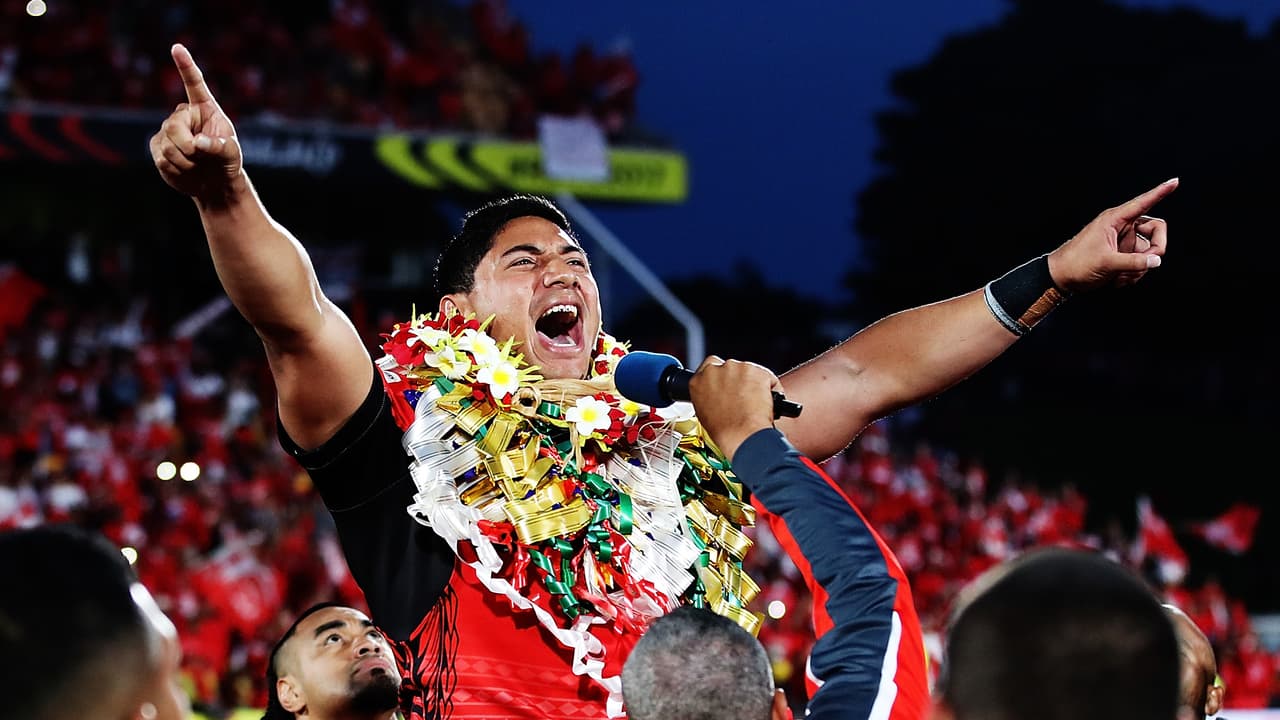
It was hailed as the “greatest” moment in Tongan sporting history.
When Jason Taumalolo, having turned his back on New Zealand, led Mate Ma’a to World Cup history as Tonga became the first tier-two rugby league nation to defeat a top-tier team.
Gallen v Asofa-Solomona | Friday November 6 from 7pm AEDT | Australian sporting icon and crossover boxing king returns to the ring to face his biggest opponent yet, Nelson ‘Big Nasty’ Asofa-Solomona. | Order now on Kayo Sports.
Just a month earlier Taumalolo was at the centre of a World Cup storm.
He was accused by Benji Marshall of being “a bit disrespectful to the jersey” while Adam Blair said it felt like the Kiwis had “been let down a lot”.
“So do we let them back in the team?” Blair told NewstalkZB at the time.
“You’re going to have to find some way to be able to trust them again but does that cause issues and problems that we don’t need?”
In an exclusive column for foxsports.com.au, Taumalolo revealed that he was called a “defector” and “traitor”.
But his decision to represent Tonga over New Zealand was about so much more than himself. It was about a little village called Lapaha, where his family came from, and a coach in Kristian Woolf whose role in this revolution has gone “unnoticed” according to Isaiya Katoa.
Mal Meninga called Taumalolo a “pioneer” and based on who followed his lead, and the way Tonga has transformed into a powerhouse since, it is hard to argue.
Now, nearly nine years on from that historic win over New Zealand, foxsports.com.au looks back on how Taumalolo changed rugby league on the international stage as he prepares to face the Kiwis once more on Saturday night.
Get all the latest NRL news, highlights and analysis delivered straight to your inbox with Fox Sports Sportmail. Sign up now!!!

INSIDE THE SHOCK PHONE CALL… AND BACKLASH THAT FOLLOWED
Konrad Hurrell still remembers the moment Woolf told him and the rest of the playing group that Taumalolo was defecting from New Zealand.
“It was like an early celebration,” Hurrell told foxsports.com.au.
But in typical Woolf fashion, the Tonga coach was quick to remind his players that this was “just the beginning”. “It’s not the end,” he added.
Now, at that point Woolf was speaking in the context of the upcoming World Cup. He didn’t want his players to get too far ahead of themselves or forget the end goal.
Taumalolo had taken a powerful stand for a reason. He envisioned a world where CommBank Stadium could be nothing but a sea of red and blue, like it was last Sunday.
But he couldn’t realise that vision alone, and as it turned out it definitely was “not the end”.
Tonga v Samoa lives up to expectations! | 03:04
Siosiua Taukeiaho had got a phone call from then Kiwis coach David Kidwell telling him he had made the team when the 2017 NRL season finished.
So, it was business as usual for him at that point and he went to Fiji for a quick holiday before landing back in Sydney only to find his phone was going off with the news that Taumalolo had switched to Tonga.
He could hardly believe it, so he texted Taumalolo who tried to convince Taukeiaho to join him. He was just three years into his NRL career at that point though, so the extra money on offer with the Kiwis was too tempting.
That was, until Taukeiaho gave it a little bit more thought and before he had even left the airport decided to switch to Tonga.
So, he picked up the phone again and this time called Kidwell.
As Taukeiaho recalled to Terrell May on his podcast last year, Kidwell then told him “you’re never going to put the Kiwi jersey on”.
And he didn’t. Neither did David Fusitu’a or Manu Ma’u. Taukeiaho called both of them after Kidwell and within a matter of hours, a Tongan movement had started.
The next day, Andrew Fifita famously followed suit and then within a month, Tonga had beat the might of New Zealand.
All this, remember, was because of a phone call that Woolf admitted he thought was a drunken prank.
“Looking back it was a pretty funny conversation because I did come off a mad Monday, and he thought that I was still tipsy,” Taumalolo said in 2024.
“But I told him, ‘No, I’m sober’. Obviously I talked to a few other boys, and the rest is history.”
What followed was plenty of criticism, not only for the decision itself but the way Taumalolo went about it.
Kiwis selector Tawera Nikau said at the time that he hadn’t been able to have a conversation with Taumalolo, face-to-face or on the phone, before he was fronting the media to answer questions.
“I think that’s the most disappointing thing, I respect his decision but I think a conversation between myself and him would have been a good thing to do,” he said.
So confident was New Zealand that Taumalolo would be representing them at the World Cup that they had been using photos of the then joint reigning Dally M medallist in his Kiwis jersey to promote their game with Tonga the following month.
Marshall called Taumalolo’s last-minute switch “a bit disrespectful to the jersey” in an interview with Radio Sport NZ.
“If you really think that, the decision could have been made seven or eight weeks ago,” he added.
Although Taumalolo had only just finished a gruelling season with the Cowboys, which saw them go all the way to the grand final, when he made the phone call to Woolf.
It wasn’t emotional like Fifita’s, who Woolf said was “torn” and had “anguish” in his voice when he had to call Meninga.
But that didn’t mean Taumalolo hadn’t put plenty of thought into it.
“He didn’t make it lightly,” as Hurrell put it.
“If you know Jase, you know how chill he is. If he made a decision, we all knew the decision he made.”
As for the timing of it all, Woolf found that whole conversation unfair.
“Jason has copped a lot of flak for his so-called lack of communication during this process. I don’t buy that,” he wrote in a column for Athletes Voice.
“From my point of view, if he was making calls on his international future during the NRL finals, he would have been doing the wrong thing by the Cowboys. His coach would’ve had every right to be filthy with him.”
Instead, it was a different coach that was left filthy when he heard rumours Taumalolo was switching allegiances and tried calling him only to hear nothing back.
The Cowboys hadn’t heard anything either, neither had his manager Chris Orr.
TALKING POINTS: Theory on Latrell snub; ‘nuts’ scenes to spark NRL’s next US move
Grant departure could spell disaster | 05:48
Taumalolo later revealed he was too drunk to answer calls from Kidwell, admitting he “definitely could have handled it a lot better” and the miscommunication was probably his “biggest (regret)”.
His decision was labelled “brave” and “courageous” by some, while then Sydney Morning Herald reporter Andrew Webster called it “weak”, writing “representing your country is not your undies: you don’t just change them whenever you want”.
Well, any suggestion that Taumalolo had hastily made the decision looks foolish after Taumalolo went on to instead become the figurehead of Tonga’s transformation into a genuine threat against the Kiwis and Kangaroos.
But it just goes to show how much Taumalolo, and so many others, sacrificed. It wasn’t just their reputation. There was a financial cost too.
At the time Taumalolo defected to Tonga he could have collected $3,000 if they won the World Cup. Kiwi players, on the other hand, stood to earn $50,000.
“Ask yourself this: how many times in your life have you heard of people turning their back on something in the vicinity of $50,000 for their heritage?” Woolf asked at the time.
“I’ve heard people say, ‘Sure, but they’re well paid.’
“Consider this then. Most of their families left Tonga behind in search of a better life in New Zealand or Australia. They came over with nothing and worked in low-paying jobs to give their kids a shot.
“So these players aren’t just earning money for themselves now. They’re supporting their broader families. The ones who gave up everything so they could have a better life.
“That kind of money goes a bloody long way.”
Which goes back to Woolf’s message right from the very start when he first told the team Taumalolo was joining them.
This was just the start. The sacrifice that Taumalolo, and those who followed him, would make was only worth it if they followed his lead on the field.
And Taumalolo literally did before the World Cup win over New Zealand in 2017, leading the Tongan Sipi Tau in an emotional moment that will forever go down in history.
Two years later, Taumalolo and Tonga made more history as they became the first team in 41 years other than New Zealand, Great Britain or England to defeat Australia.
Hurrell later got a first-ever tattoo on his left quad to commemorate the win: “TNG XIII VS AUS 16-12 02.11.19.”
“It was just something that I wanted to put on me because I know this is one memory I will never forget,” he said.
Taumalolo, meanwhile, proudly declared it “one better than the premiership” and “the highlight of my career”.
But as many plaudits as Taumalolo receives, and deservedly so, there is another hero in this story that goes underrated according to Tonga’s players.
Tino embracing heritage ahead of clash | 02:12
THE UNDERRATED ‘PILLAR’ IN TONGA’S REVOLUTION
While Taumalolo’s brave call in 2017 may be viewed as the moment behind Tonga’s rugby league revolution, it also goes further back to a promise he made to coach Kristian Woolf.
The two first connected when Woolf was coaching under-20s at the Cowboys, while Tonga made his Tonga debut in 2013 while Woolf was an assistant coach.
All of this is to say the pair had a longstanding relationship well before Tonga appeared to be on the verge of something special, when a Test match between Mate Ma’a and Toa Samoa at Penrith drew 10,143 people.
So, when Taumalolo first got the call-up to New Zealand he made a promise to Woolf: that he wouldn’t only come back to Tonga when he was older and no longer getting picked by the Kiwis.
Instead, he returned in his prime, fresh off standing alongside legendary halfback Cooper Cronk as a joint Dally M winner.
And yet, Taumalolo said Woolf is the “pillar” behind where Mate Ma’a finds itself now.
Hurrell, who now works as media manager for the Tongan national team, agrees.
He saw it first-hand as a player.
He saw it in the way Woolf “cleaned up a few things behind closed doors”.
“What he’s brought in is the professional way of how to run things, how to train the boys and when to recover,” Hurrell said.
“How the team was run before it was not nice but we still all put our hands up to come in.
“But what he’s brought is the professionalism in how to treat the boys, trying to get some money to the boys, trying to get sponsors in and now Tonga is in a great spot.”
He still sees it now in his new role too. How everyone is so connected by culture when they first enter camp under Woolf’s watch.
“There’s no Roosters players. There’s no Parramatta players. There’s no Warriors players,” he said.
“We all come in together and I think the thing that opened up Woolfy’s mind as well was when we went back to Tonga and saw our people, how we live and how much they can support us and how much they back the boys.
“I think it opened up his mind and his eyes to see how crazy it is that people will give everything just to back the boys.
“Everything that Woolfy relates to us, he always try to take it back to Tonga. That’s a special thing because we’re not just here to play for each other… we have to carry our little nation.
“For all 100,000 people at home, it’s probably like one TV for 20 people to watch. He always makes sure it’s a Tongan camp, it’s not an NRL camp.”
Yeo & Cleary set to stay in Penrith | 00:38
And for all the talk about sacrifice, that extends to Woolf too. There was a lot of work he and the rest of the coaching staff were doing behind the scenes in those formative years before 2017.
“And they were doing it for free,” Hurrell said.
“It’s crazy because my first World Cup was 2013. Obviously he was in the staff… I think he saw something special in the group there and then after that we didn’t have a Tongan coach for (an) ongoing (period) and Woolfy put his hand up and from that World Cup in 2013 he knew that we had nothing and he still put his hand up to go out his way.
“Obviously he was already assistant coach at NRL teams but he sacrificed his time with his family in the offseason because as soon as we had the World Cup and all the Tests he had two week’s break and went straight back into coaching.
“It’s all what the white boy has done for us.”
HOW THE IMPACT OF TAUMALOLO’S DECISION IS STILL FELT TODAY
But even if Woolf laid the foundations, Tonga wouldn’t be in the position it is now — still underdogs but far from written off against New Zealand — if it wasn’t for one man.
Taumalolo’s legacy is already secure regardless of what happens at this year’s World Cup.
He inspired a club to their maiden premiership and then he inspired an entire nation.
So much so that they named their national rugby league competition after him in 2017.
Even now, as the next generation of Tongan superstars led by halfback Isaiya Katoa prepare to go to battle, they still look to Jason Taumalolo. Both their literal captain and spiritual leader.
“You take it all the way back to 2017,” Katoa told Channel 7 last week.
“Guys like Jason and Andrew started that whole movement of wanting to play for Tonga and sacrificing everything you get to play for New Zealand or Australia.
“They showed how much they care about this jersey.”
It isn’t just Tonga either. Taumalolo’s bravery also inspired the likes of Jarome Luai, Brian To’o and Stephen Crichton to represent Samoa while a similar revolution is happening in the women’s game.
“The World Cup we see now is on the back of what one man did and a lot followed,” premiership-winning Roosters coach Trent Robinson said.
That doesn’t just include players either. 29,411 people attended Sunday night’s blockbuster group stage game between Tonga and Samoa — an all-time record for CommBank Stadium.
This, keep in mind, is a venue that regularly plays host to the Battle of the West, annual Easter Monday game and NRL semi-finals.
Tonga, little tiny Tonga as Hurrell would put it, beat them all and along with Samoa has helped create something international rugby league needed: genuine competition.
So, all those years ago when Woolf gathered Tonga’s playing group together and let them know Taumalolo would soon be joining them, did they understand the gravity of it all?
Of what one man’s bravery would and will continue to do?
“We did think it was going to be big. But we didn’t think it was going to be that big up to now,” Hurrell said.
“We didn’t know it was going to be that crazy. So it’s crazy to see that everything is changing for the best for the game.
“Even seeing all these young players choosing Tonga, they easily could get picked for Australia right now. These kids have sacrificed a lot of money. It’s just they see what Jason and the others have done.
“They want to be part of that special group too.”

Leave a Reply