

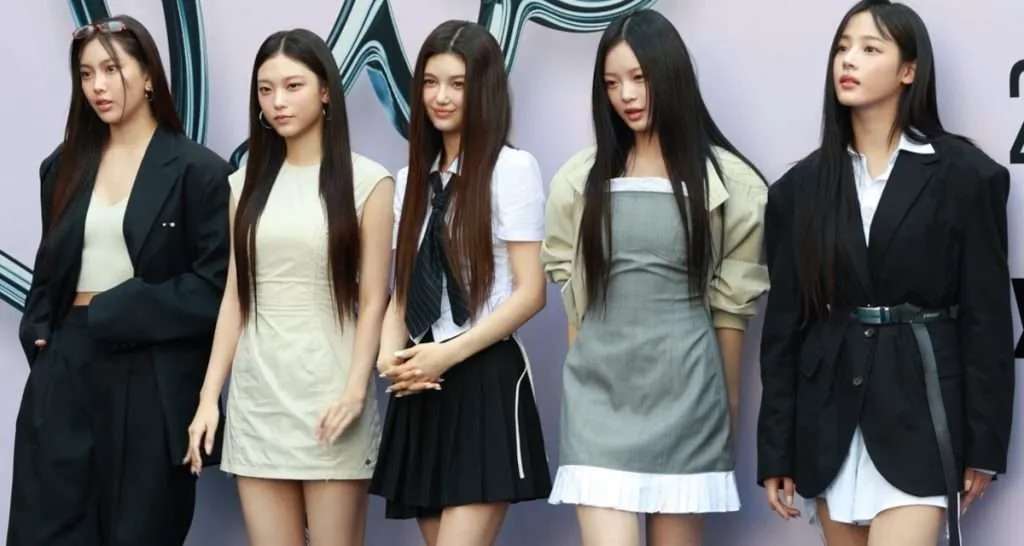
Photo Credit: TV10
The Korea Popmusic Industry Association (KPIA) has officially responded to the New York Times’ report on NewJeans members’ “unusually restrictive contracts,” criticizing the coverage as “a one-sided and biased assessment.”
KPIA, which reps K-pop giants including Hybe, SM, JYP, and YG, reached out with a more than 800-word retort today. And the lengthy response arrives after the Times late last week shed light on the specifics of NewJeans members’ deals with Hybe-owned Ador.
Admittedly, the generally restrictive and all-encompassing nature of K-pop agreements isn’t a secret, nor are the involved professionals’ rigorous routines. Without digging too far into the multifaceted subject here, an apt reminder of the facts surfaced during a late-night livestream in February, when BTS member Jungkook told fans he’d quit smoking.
While the information seemed inconsequential, the 29-year-old also predicted that Hybe would “make a fuss” over the disclosure and spelled out that “if it weren’t for the company, I would have told everything.”
Put one way, restrictions of this nature wouldn’t fly in the West, where artists can and often do say all sorts of things that would be better left unsaid.
But even by these standards – and when factoring for the initial investment associated with getting K-pop groups off the ground – the Times piece pointed to some disconcerting alleged contractual terms.
This includes but isn’t limited to a ban on NewJeans’ members entering into “inappropriate romantic relationships,” making critical remarks about the company, or having an “insincere attitude” – besides the presence of “steep exit clauses” and a sizable tour-income cut for the company.
Alleged clauses requiring members to repay a “significant” portion of what the agency had spent on their plastic surgery when they were trainees – and well under the age of 18 – likewise stand out.
Perhaps most problematically of all, the deals are said to afford Hybe/Ador the right to continue exploiting the NewJeans members’ names, images, and voices “indefinitely” even after the contested contracts’ 2029 expiration.
Especially as the youngest of these members, Hyein, is only 18, the latter alleged clause in particular could be considered problematic. And more generally, the deep dive isn’t a good look for Hybe (which fired back against the article) or the wider K-pop space.
Enter KPIA’s aforesaid response, which defends the contracts as just that, meaning legitimate deals between willing parties, and frames the underlying talent-development model as having “contributed to K-pop’s growth into a global industry.”
“The K-pop industry, celebrated around the world today, is the result of a collaborative partnership between entertainment companies and artists,” the response reads, proceeding to note efforts, spearheaded with the South Korean government, designed to protect artists’ rights.
Moreover, the NewJeans’ contracts don’t tell the whole story – for the group or K-pop itself – owing to, among other things, the existence of “supplementary agreements,” per the organization.
Unsurprisingly, the response also underscores the entity’s “deep concern” about the publication of exclusive contract terms; one much-discussed dispute later, each NewJeans member save Danielle has rejoined the group.
But Danielle as well as ex-Ador head Min Hee-jin remain embroiled in an ugly legal battle with the K-pop mainstay.
Here’s the Korea Popmusic Industry Association’s full response to the NYT’s NewJeans contracts article:
“The Korea Popmusic Industry Association (KPIA), led by Chairman Woo Seonghyun, expresses deep concern over recent reporting by The New York Times (NYT) citing the exclusive contract of a particular K-pop artist. We believe the report offers a one-sided and biased assessment that fails to adequately consider the legality and legitimacy of contracts entered into under South Korea’s legal and regulatory framework, as well as the distinctive characteristics and value of the artist training and development system that has contributed to K-pop’s growth into a global industry.
The K-pop industry, celebrated around the world today, is the result of a collaborative partnership between entertainment companies and artists. This partnership is institutionally supported by the Korean government’s Standard Exclusive Contract for Popular Culture Artists and the Popular Culture and Arts Industry Development Act. Together, these frameworks establish balanced principles that protect entertainment companies that assume substantial financial risks and make significant investments, while also safeguarding the rights and interests of artists, who may be in a relatively vulnerable position. Today, entertainment companies and artists across Korea respect the principles of the standard contract and work together under the framework of the Popular Culture and Arts Industry Development Act to discuss, jointly draft, and mutually agree on the terms of their contracts, which they then honor as they pursue mutual growth. The numerous artists who have renewed their contracts after their original agreements expired demonstrate this principle in practice. Protecting artists’ rights remains an important issue that K-pop companies and the Korean government have long addressed through sustained attention and efforts to pursue institutional and practical improvements.
Nevertheless, we regret that NYT has taken the controversy surrounding an individual contract and interpreted it as a structural problem affecting the K-pop industry as a whole, without sufficiently acknowledging regulatory progress and the industry’s efforts to improve its own practices. The fairness and legality of exclusive contracts must be assessed comprehensively, taking into account not only individual provisions but also supplementary agreements, applicable laws, the circumstances surrounding how the contracts were entered into, and whether the contractual obligations have actually been fulfilled. Failing to do so risks spreading a distorted perception of the K-pop industry and unfairly undermining the achievements and trust it has built over many years.
Protecting artists’ rights and respecting entertainment companies’ legitimate rights are not conflicting principles. The rights of minor artists must be protected. At the same time, entertainment companies’ legitimate investments and contractual rights must also be safeguarded. The industry has grown through long-term investment by entertainment companies and the creative work of artists. Lawfully executed contracts and judicial decisions must be respected.
K-pop companies have already implemented various measures in accordance with applicable laws to protect young trainees and active artists. Major K-pop companies, including HYBE, have entered into the government’s standard supplementary agreement for minors with all their trainees. These agreements include provisions protecting their personal rights and their rights to sleep, education, and rest. In addition, major K-pop companies that are members of the Association have designated youth protection officers in accordance with applicable laws and continue to oversee the implementation of relevant protective measures.
The K-pop training and development system is a distinctive model of talent development with its own characteristics and competitive strengths, and should not be judged solely through a Western lens. Major K-pop companies operate comprehensive artist care programs, in some cases employing in-house medical professionals, to carefully protect artists’ health, well-being, and personal rights. This dedicated approach to artist management and upfront investment represents a distinctive Korean industry ecosystem that should not be belittled as ‘oppressive control.’ It is within this ecosystem that globally celebrated boy groups and girl groups have emerged, and where countless trainees continue to work tirelessly toward their dreams of becoming the next generation of K-pop stars.
Finally, the Korea Popmusic Industry Association expresses deep concern that the contents of an exclusive contract at the center of an ongoing legal dispute have been disclosed through foreign media despite being subject to confidentiality obligations between the parties, and that one-sided claims and public opinion campaigns are spreading based on this disclosure. We must guard against unverified allegations or one party’s perspective being accepted as objective fact in the course of a dispute, or issues arising from individual disputes being used to cast the entire K-pop industry in a negative light.
The Korea Popmusic Industry Association remains committed to protecting artists’ rights and establishing fair and sound contractual practices so that the K-pop ecosystem can continue to thrive as a resilient system, unshaken by distorted external perceptions or the misconduct of any individual. At the same time, we will respond firmly to prevent distorted public opinion campaigns and inappropriate conduct driven by private interests from taking root and undermining the trust and standing of the industry as a whole.”


Leave a Reply