
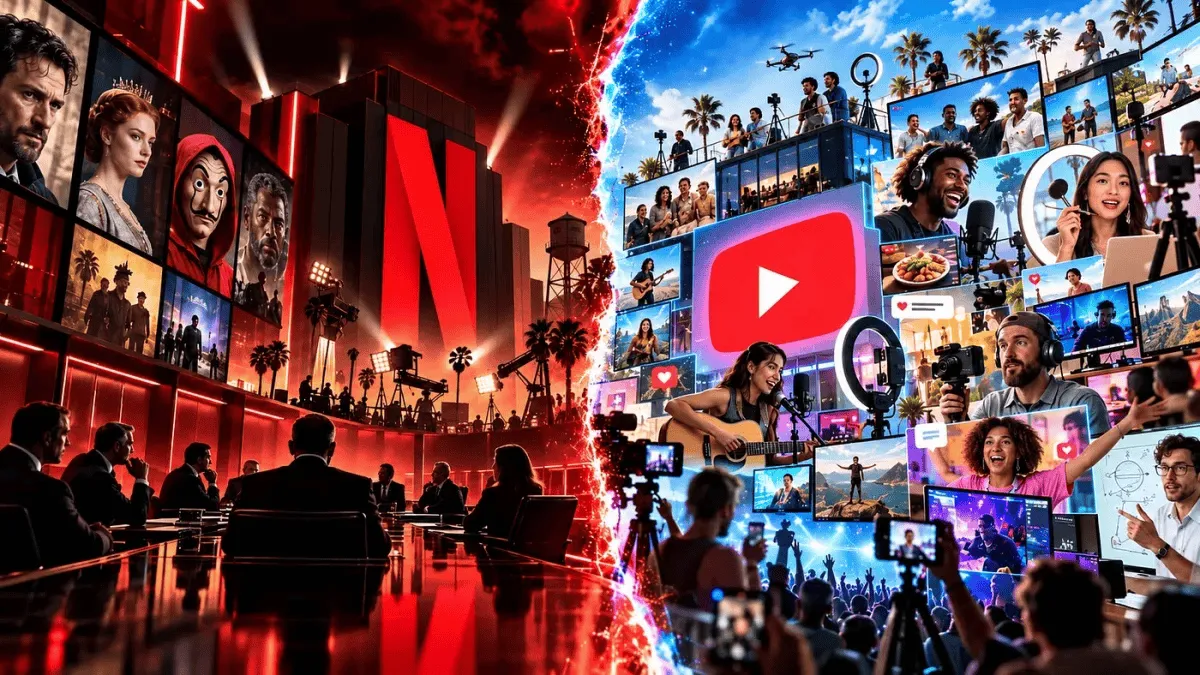
YouTube might be running away with the next iteration of “The Streaming Wars”. Photo Credit by Michael Whalen
Netflix is betting on Hollywood’s old playbook. YouTube is building the future by letting everybody play.
Netflix isn’t dying. But it may be facing something almost as dangerous: becoming just another big, boring media company. For a business that practically invented the modern streaming industry and turned Hollywood upside down, that would be an incredible irony.
The recent shakeup at Netflix is hard to ignore. Roughly 1,000 employees are being laid off, chief content officer Bela Bajaria is out, film chief Dan Lin is leaving, and former Disney and Fox executive Peter Rice has been brought in to oversee content. These are major changes for a company with more than 325 million subscribers worldwide and billions in profits.
Then there’s the Warner Bros. mess. Netflix made a serious run at acquiring Warner’s studio and streaming businesses before walking away when Paramount Skydance came in with a bigger offer. Paramount got Warner Bros., HBO, an extraordinary content library and some of the most valuable entertainment franchises in the world. Netflix got to keep its money, but it also got a very uncomfortable question to answer.
What exactly does Netflix want to be when it grows up?
The conventional wisdom is that Netflix needs bigger movies, better series, more hit franchises and a few executives who understand the magic of Hollywood. Maybe. But I think that misses the larger problem entirely.
Netflix is still fighting the streaming wars against Disney, Paramount, Amazon and Apple. Meanwhile, YouTube has figured out how to play a completely different game, and it’s eating everyone’s lunch.
YouTube Is Eating Netflix’s Lunch
Here’s a number that should keep every Netflix executive awake at night. In July 2026, YouTube accounted for 14.2% of all television viewing in the United States. Netflix had about 7.8%. That’s nearly twice the share of television viewing, and we’re talking about actual television sets, not teenagers watching videos on their phones.
There’s something almost hilarious about this. Netflix spends roughly $20 billion a year producing and acquiring content, employs armies of creative executives and negotiates enormous talent deals. YouTube has built an entertainment empire where millions of people show up every day and make the programming themselves.
Think about how crazy that is. Hollywood has spent a century convincing us that entertainment must be developed, financed, approved, produced and marketed by professional gatekeepers. YouTube looked at that system and essentially said, “What if we just let people make stuff and see what happens?”
And it worked. Spectacularly.
YouTube doesn’t need to greenlight a cooking show, an interview series, a jazz performance, a documentary about World War II or a video explaining how to repair an old synthesizer. Somebody somewhere is already making it. If people like it, they watch it, share it and come back for more.
But the genius of YouTube goes much deeper than allowing anyone to upload a video. YouTube has democratized the opportunity to create and distribute entertainment on a global scale. It has dismantled many of the barriers that once separated professional content producers from everyone else.
You don’t need to know a studio executive. You don’t need a network deal, an agent or a multimillion-dollar production budget. You need an idea, the ability to execute it and an audience that finds it interesting.
Obviously, that doesn’t mean everyone gets equal attention or makes money. YouTube’s algorithms are powerful gatekeepers themselves, and the economics can be brutal for creators. But the opportunity to enter the marketplace is radically more open than the traditional television business ever was.
And that’s what makes YouTube so threatening.
Netflix is a media company powered by technology. YouTube is a technology company that powers an entire universe of media.
That distinction changes everything.
YouTube doesn’t have to decide what kind of entertainment company it wants to be. It can be a music network, a sports destination, a university, a comedy club, a news source, a podcast platform and a documentary channel simultaneously. Its creators make those decisions based on their interests and the interests of their audiences.
The platform doesn’t have to reinvent itself every time tastes change. Its users do much of that work naturally, and YouTube’s technology adapts to whatever they create.
That’s a structural advantage no traditional studio can easily copy.
I’ve Seen This Movie Before. It Was Called the Music Business.
As a composer, producer and independent recording artist, I’ve watched almost exactly this transformation happen in music. For decades, record labels controlled nearly everything: who got signed, what got recorded, which songs got promoted and which artists were allowed anywhere near a mainstream audience.
The gatekeepers made some terrific decisions. They also made plenty of terrible ones, and countless talented musicians never got heard because they didn’t fit somebody’s idea of what would sell.
Then technology blew the doors off the building.
Today, a musician can make an album in a home studio, distribute it around the world, reach an audience directly and build an entire career without asking a major label for permission. Having spent decades making and releasing music, I find that freedom extraordinary. It has changed not just how music is distributed, but what music gets made in the first place.
Of course, there’s a catch. There is more music available than anyone could possibly listen to, and making a living as an independent artist remains difficult. The platforms and algorithms that replaced the old gatekeepers have plenty of problems of their own.
But the basic revolution is irreversible. The people who make the music no longer need to be chosen by a small group of executives before an audience gets to decide whether it matters.
YouTube has done something similar to television, only on an almost unimaginable scale. Some of the most interesting people working in video today aren’t employed by studios or networks. They’re independent creators who have built their own audiences, developed their own formats and, in some cases, created businesses worth millions of dollars.
Many have absolutely no interest in getting discovered by Hollywood. They’ve already found their audience, and they have something incredibly valuable: a direct relationship with the people who care about their work.
I see the same thing happening with independent musicians. The strongest artist careers aren’t necessarily built around a single hit song anymore. They’re built around ongoing relationships with listeners who want to follow the artist’s creative journey.
There’s a lesson there for every entertainment company, including Netflix. The next generation of entertainment stars may not need Hollywood at all. And if they don’t need Hollywood, why would they need Netflix?
Peter Rice Isn’t the Problem. He’s the Question.
Peter Rice is a talented, experienced executive who knows Hollywood. After years at Fox and Disney, he understands creative talent, programming and the studio business. Netflix could certainly use that expertise. But there’s a real irony in bringing in an old-school Hollywood veteran to lead content at a company that made its name by breaking Hollywood’s rules.
The question isn’t whether Rice can deliver bigger hits. He probably can. It’s whether he’s been hired to improve the existing machine or help build something new. If his mandate is simply better shows, bigger stars and more franchises, Netflix risks becoming a more efficient version of the companies it once disrupted. His real opportunity is to combine his creative judgment with the courage to rethink how entertainment gets made, discovered and shared.
The Warner Bros. Deal and the Problem With Looking Backward
Netflix’s attempt to buy Warner Bros. says a lot about the company’s thinking. Warner has an extraordinary collection of films, television shows, characters and franchises. HBO is one of the most respected brands in entertainment. Owning those assets would have given Netflix a deeper library and valuable intellectual property it could exploit for decades.
I understand the attraction. And walking away when the price became too high may have been a smart financial decision. But would buying a traditional Hollywood studio have helped Netflix invent the next generation of entertainment, or simply made it a much bigger version of an old-fashioned media company?
Disney has its franchises. The newly combined Paramount and Warner Bros. organization has an enormous library, major studios, sports, news and television networks. Amazon and Apple can support their entertainment investments with much larger businesses.
Netflix could spend the next decade competing with all of them for the same talent, intellectual property and production resources. It could become a spectacularly successful traditional entertainment company with an enormous streaming audience.
But that would also mean accepting the basic economics of the traditional entertainment business: escalating production costs, expensive talent deals, unpredictable hits and an endless need to replace programming that has lost its audience.
Meanwhile, YouTube’s underlying business can keep expanding without owning the shows, hiring the stars or betting the company on the next blockbuster.
The competitive threat isn’t simply that YouTube is attracting more viewers. It’s that YouTube has built an extraordinarily adaptable system for generating entertainment without having to behave like an entertainment studio.
Netflix should be studying that difference very carefully.
What If Netflix Actually Learned Something From the Creator Economy?
I don’t think Netflix should try to become YouTube. That would be ridiculous. YouTube already exists, and Netflix isn’t going to beat it by creating a more expensive imitation.
But why couldn’t Netflix take some of the best ideas behind the creator economy and build something entirely new?
Imagine Netflix becoming a creative home for independent filmmakers, musicians, documentarians, comedians and other creators who already have loyal audiences. Instead of forcing every project through the traditional studio development process, Netflix could establish partnerships that combine independent creative talent with professional production support and global distribution.
I’m not talking about filling Netflix with random homemade videos. I’m talking about building a professionally curated creator ecosystem inside a premium entertainment service.
What if independent creators could develop recurring programming, build relationships with subscribers and participate more directly in the financial success of their work? What if Netflix used its technology to discover promising talent earlier, experiment with new formats and help small productions grow into something much bigger?
And what if Netflix stopped thinking of creators simply as people to hire or projects to acquire, and started thinking of them as genuine partners in building an entertainment community?
As an artist, that possibility interests me far more than another billion-dollar content acquisition.
There are enormous challenges, of course. Compensation, ownership, discovery, quality control and the economics of a subscription service would all need to be worked out. Netflix would also have to protect the premium experience that makes its service worth paying for.
But those are problems worth solving, and Netflix has nearly everything it would need to experiment with a new approach: money, technology, distribution, production expertise and a worldwide audience.
What it needs is the willingness to challenge some of its assumptions about who creates entertainment, who controls it and who benefits from its success.
Adding podcasts, games or live events to the programming menu isn’t reinvention. It’s diversification. The more interesting opportunity is to change the relationship between the platform, the creators and the audience.
That’s a much bigger idea. And Netflix used to be very good at big ideas.
Netflix’s Biggest Enemy Might Be Its Own Success
The entertainment business has a terrible habit of confusing success with permanence.
Record labels thought they controlled music. Television networks thought they controlled audiences. Cable companies thought people would always pay for bundles of channels they barely watched.
Each of those assumptions seemed perfectly reasonable until the world changed.
Netflix was one of the companies that proved those assumptions wrong. It had the imagination and the nerve to challenge an established business model, even when powerful companies insisted that the old way of doing things would never disappear.
Now Netflix is the establishment.
It has the subscribers, the budgets, the executives, the corporate structure and the enormous responsibility of keeping Wall Street happy. It’s a very different company from the disruptive little upstart that mailed DVDs to people’s homes and eventually convinced the world to stream movies over the internet.
And here’s what should really worry Netflix. YouTube doesn’t need to grow up and become a traditional media company. Its business model gives it every reason to remain a technology platform. The more creative people who participate, the more programming it can offer, the more audiences it can serve and the more valuable its platform can become.
Of course, YouTube could make terrible strategic decisions, and it will face its own challenges with regulation, creator compensation and the growing power of algorithms. No technology company is guaranteed permanent success.
But YouTube doesn’t need to transform itself into a Hollywood studio to grow its entertainment business. That’s the beauty of the model. Its growth comes from enabling people to create, not from controlling every creative decision.
Traditional media companies have always tried to own the content and control the audience. YouTube is demonstrating that owning the platform and giving creators access to an audience can be an even more powerful business.
It’s a model that can evolve with its users rather than constantly trying to predict what they want next.
I think that is the real lesson of this moment. Netflix’s biggest danger isn’t that its business will suddenly collapse. It’s that the company will become so busy protecting what it has built that it forgets how to invent something new.
The next entertainment revolution may not be about bigger studios, bigger budgets or bigger stars. It may be about giving creative people more freedom, better tools and a more direct connection to the audiences who appreciate what they do.
YouTube isn’t waiting for the entertainment industry to figure that out. It’s already happening there, every day, on millions of channels.
Netflix changed the world by giving people the freedom to watch whatever they wanted. YouTube went further by giving people the freedom to make whatever they wanted.
That’s not just another round of the streaming wars. It’s a fundamental shift in who controls entertainment and how it gets created.
Netflix doesn’t need to become another Hollywood studio. It needs to remember what made it dangerous to Hollywood in the first place.
Because the company that once disrupted the entire entertainment business now faces a much more uncomfortable possibility.
This time, Netflix might be the company getting disrupted…






Leave a Reply