
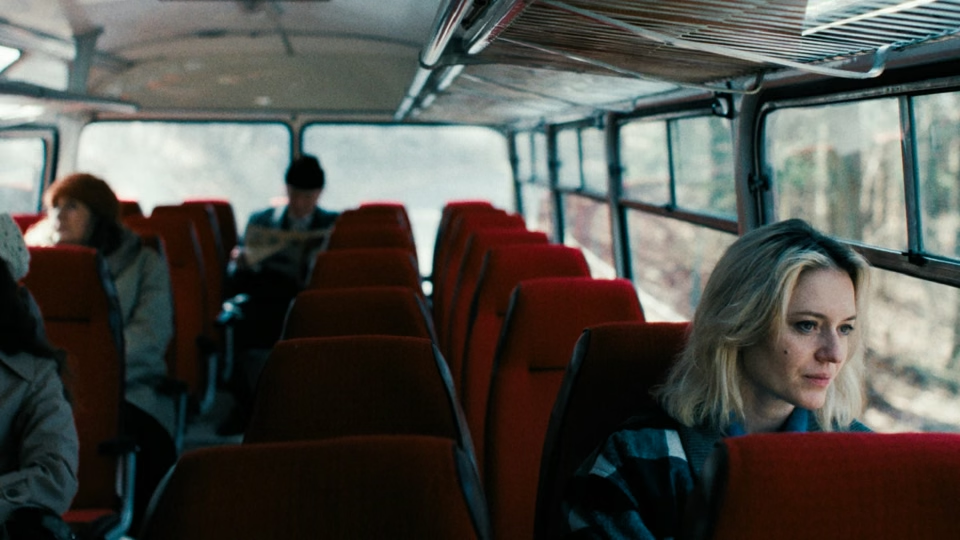
The Austrian-Slovak Iron Curtain Drama About the Cost of a Life Built at Someone Else’s Expense — Autobiographically Rooted, Formally Precise, and Anchored by Rebeka Poláková’s Career-Best Performance
Vienna, 1981. Perla is a painter, a mother, and a woman who has carefully constructed a new identity from the ruins of everything she left behind. Her daughter Julia is a gifted pianist. Her partner Josef is devoted. Her work is reaching New York. Then a phone call from Czechoslovakia: Andrej, Julia’s father, is out of prison and dying of cancer. He wants to meet his daughter. Perla, using an Austrian passport with an assumed name, travels with Josef and Julia back across the Iron Curtain to Košice — the city she fled pregnant and under interrogation. What she finds there is not closure but confrontation. The inspiration is Makarová’s own mother — a Slovak artist and single parent living in Vienna whose paintings were used in the film to represent Perla’s work. Written and directed by Makarová. Cinematography by Georg Weiss — Vienna scenes deliberately lit in colour, Slovakia scenes in deliberate darkness. Costume design by Monika Buttinger. Production design by Klaudia Kiczak. World premiere IFFR Tiger Competition February 3, 2025. Austrian domestic release July 24, 2025.
Why It Is Trending: 10 Wins and 29 Nominations Across 18 Festivals — Austrian Film Award Best Film and Best Director Nominee — Diagonale Audience Award, Vienna Film Award, Leeds Best Film, Marseille Best Director
Perla accumulated one of Austrian cinema’s most sustained 2025 festival circuits: Hollywood Reporter’s Jordan Mintzner praised “the way Makarova recreates the fraught emotional atmosphere of life at the end of the Cold War” and called Kiczak’s set design “uncanny — convincingly recreating the muted colour tones of the era.” Sight and Sound described it as a “quietly subversive portrayal of motherhood.” Screen Daily called it “taut and satisfying.” ICS Film praised Makarová for “a keen eye for storytelling — a compelling portrait of a woman confronting her past to forge a path to her future.”
Elements Driving the Trend: The Assault Scene in One Long Static Take, the Colour-Coded Dual Geography, and the Subversive Motherhood Portrait
-
The pivotal assault scene — shot in one long, static take — “pays dividends to the portrayal of the relationship afterward”; without its intensity, Perla’s continued pull toward Andrej “would have been harder to swallow.”
-
Makarová’s deliberate dual lighting — Vienna in colour, Slovakia in darkness — functions as a formal argument about what freedom and oppression look like from the inside rather than from political description.
-
Sight and Sound identified the film’s most formally radical quality: “a quietly subversive portrayal of motherhood — Perla is more like a sister than a mother to Julia; she loves her daughter, but does she love her enough, and in the right way?”
-
East European Film Bulletin: “the film’s most disquieting tension emerges not from the past that haunts Perla, but from her ambivalent role as both caregiver and autonomous subject — rather than portraying motherhood as a site of sacrifice or virtue, Makarová allows her protagonist to be contradictory.”
Virality: The Austrian Film Award’s 5 Nominations and the Romy Gala Best Film Win
-
The Romy Gala Best Film win — Austrian television and film’s most prominent popular award — gives the film its widest domestic visibility within Austria’s mainstream culture circuit.
-
Simon Schwarz’s Romy for Favourite Actor gives the film’s most established Austrian cast member his most commercially powerful institutional validation for the role.
Critics Reception: Consistently Strong — the Stylistic Control the One Debated Quality
-
Screen Daily: “taut and satisfying Iron Curtain drama; Makarova’s sure hand as a director is evident in the terrific scene where Perla shares the news with Josef, seated in the piano recital audience.”
-
Sight and Sound: “stylish and disquieting — Makarová refuses sentimental answers, a resolve which makes this disquieting film all the more powerful.”
-
Journey Into Cinema (dissenting): “Austro-Slovak Tiger Competition entry — certainly well-made, it might carry the very definition of ‘handsomely mounted’ — yet this technically gifted aesthetic distracts from what should be a deeply harrowing tale.”
-
Cinema Austriaco: “particularly complex and well-written — each character is multi-faceted; everyone can be considered both victim and perpetrator simultaneously.” IMDb 7.0 from 278 viewers. 37 critic reviews.
Awards and Recognitions: 10 Wins and 29 Nominations — Austrian Film Award Best Film, Best Director, Best Actress, Best Actor, Best Screenplay Nominee
-
Major wins: Romy Gala Best Film and Best Actor (Schwarz). Viennale Vienna Film Award Best Austrian Film. Leeds International Film Festival Best Film. Diagonale Audience Award and Costume Design and Production Design awards. Art Film Festival FIPRESCI Prize and Special Mention Best Female Performance (Poláková). Marseille Best Director.
-
Major nominations: Austrian Film Award (5 nominations). Rotterdam Tiger Award. Karlovy Vary Audience Award. Stockholm Bronze Horse. IFFR Tiger.
-
World premiere IFFR February 3, 2025. Austrian domestic release July 24, 2025.
Director and Cast: A Slovak-Austrian Filmmaker Making Her Most Personally Exposed Feature — With Autobiographical Material That Reaches Back to Her Grandmother
-
Alexandra Makarová — Slovak-born, Vienna-based; Crush My Heart (2018) — dedicated the film to her grandmother: “Her passion for life and determination to choose her own path were unforgettable. This film is about the right to decide for oneself — even when that decision comes at a cost.”
-
Rebeka Poláková (Perla) — previously starred in The Auschwitz Report — delivers a performance of quietly devastating complexity: contradictory, withholding, impulsive, and entirely human in every register.
-
Simon Schwarz (Josef) — Romy Award winner — plays the devoted husband whose tolerance is tested by the return of the man whose history with Perla he cannot fully understand.
-
Noel Czuczor (Andrej) — the ex-lover whose sense of entitlement and Perla’s guilt draw them together into a psychologically complex collision that culminates in “a moment of very raw sex which gives Perla the closure that Andrej can’t reach.”
-
Georg Weiss (cinematographer) and Klaudia Kiczak (production design) — the technical collaboration whose dual-register colour coding and period recreation earned Diagonale and Austrian Film Award recognition.
Conclusion: An Austrian Cinema Debut of International Scope That Confirmed Makarová as a Formally Rigorous and Autobiographically Authoritative Voice — and Introduced Poláková to the Widest Available European Festival Audience
The 10-win festival circuit confirms that Perla achieved the dual validation that European arthouse drama requires: institutional jury recognition (Viennale, FIPRESCI, Marseille) and audience recognition (Diagonale, Leeds). Makarová’s autobiographical authority gives the film its most formally irreducible quality. Poláková’s performance is the film’s most durable international legacy.
What Movie Trend Is Followed: The Iron Curtain Exile Drama Refuses the Nostalgia Register and Centres the Ambivalent Mother Rather Than the Heroic Dissident
Perla belongs to the Central European Cold War exile drama tradition — Barbara, Transit, Christian Petzold’s border-crossing psychological thrillers — in which the political context functions not as backdrop but as the system that shaped the specific emotional damage the characters carry. Makarová’s specific formal contribution is the refusal of conventional maternal narrative: Perla is not the self-sacrificing mother of melodrama but a woman whose autonomy, artistic ambition, and emotional contradictions coexist uncomfortably with her role as a parent — a portrait that “challenges viewers’ gendered assumptions.”
Trend Drivers: The Dual Guilt Structure, the Return Across the Iron Curtain, and the “You’ve Built Your Life at My Expense” Accusation
-
Sight and Sound identified the film’s structural spine: “You’ve built your life at my expense” — Andrej’s accusation outlines the question at the heart of the drama, framing Perla’s Vienna freedom as a debt extracted from his imprisonment.
-
The return journey — using a false passport, crossing a border that could end her freedom — gives the film its most formally concentrated thriller sequence and its most politically specific dramatic stakes.
-
The film’s ambivalence extends to the question of guilt’s distribution: “if the real perpetrators were war, dictatorship, anyone eager for power” — the personal and the political are formally inseparable in the film’s most complex sequences.
-
The 4:3 aspect ratio — rare in contemporary European arthouse — gives the film its most deliberate formal statement about confinement, period specificity, and the framing of a woman within the systems that define her choices.
What Is Influencing Trend: The Austrian Film Award Season and Golden Girls Filmproduktion’s Arthouse Infrastructure
-
The Austrian Film Award’s five nominations give the film its most commercially significant domestic industry validation and the most extensive platform for reaching the Austrian theatrical audience.
-
Golden Girls Filmproduktion — one of Austrian arthouse cinema’s most active production companies — gives Perla the institutional infrastructure that a Slovak-Austrian co-production requires to navigate both markets simultaneously.
-
The Petzold comparison — raised by multiple reviewers — positions the film within an internationally legible Central European arthouse tradition that has a consistent and loyal critical community.
Macro Trends Influencing: Post-Soviet Generational Memory and the Ambivalent Motherhood Cinema Wave
-
The generational reckoning with communist-era displacement — children and grandchildren of exiles examining what their families built and what was left behind — is one of European arthouse cinema’s most active and most formally specific 2024-2026 subjects.
-
The ambivalent motherhood portrait — Perla as neither martyr nor monster but a genuinely contradictory human being — connects the film to a specific wave of European cinema that refuses to simplify the maternal subject.
-
The 1980s Vienna setting gives the film a specific Cold War geography — the city as the front line between liberation and surveillance — that Czech, Slovak, and Austrian cinema has consistently found productive.
Consumer Trends Influencing: The European Arthouse Circuit and the Austrian-Slovak Diaspora Audience
-
The dual Austrian and Slovak production origin gives the film simultaneous access to both countries’ domestic arthouse audiences and diaspora communities across Europe.
-
The festival circuit breadth — Rotterdam, Karlovy Vary, Sarajevo, Viennale, Stockholm, Jerusalem, Seville, Rotterdam, Leeds — covers the maximum available European arthouse discovery geography.
-
Poláková’s profile — established in Slovak and Czech cinema — gives the film a pre-converted Slovak-Czech audience that the Karlovy Vary and Diagonale screenings most directly activated.
Audience Analysis: European Arthouse Drama Audiences, Cold War History Communities, and Slovak-Austrian Diaspora Viewers
The core audience is 30–65 — European arthouse drama audiences who follow the Petzold-adjacent Central European psychological thriller tradition, Cold War history communities for whom the specific Czechoslovak 1968-1981 political context carries immediate cultural resonance, and the Slovak-Austrian diaspora for whom Makarová’s autobiographical material carries personal recognition.
Conclusion: A Formally Assured Austrian-Slovak Drama That Earned Its Sustained Festival Circuit Through the Specificity of Its Political Geography and the Ambivalence of Its Maternal Portrait
Perla earns its 10-win circuit not through a single landmark award but through the consistency of its formal discipline across audience juries (Diagonale, Leeds) and critical juries (FIPRESCI, Marseille, Viennale) simultaneously — a dual validation that confirms the film functions at both registers with equal authority.
Final Verdict: A Formally Controlled, Autobiographically Grounded Cold War Drama That Refuses the Comfort of Either Heroism or Victimhood — Anchored by Poláková’s Most Demanding and Most Precise Screen Performance
Makarová delivers a second feature of complete formal maturity: the 4:3 frame, the dual colour register, the static single-take assault scene, and the refusal to provide any character — Perla, Andrej, Josef — with an uncomplicated moral position. The film’s most formally radical decision is Sight and Sound’s most precise observation: refusing sentimental answers about motherhood makes it “all the more powerful.” The “handsomely mounted” dissent from Journey Into Cinema is accurate as a description of the film’s visual polish — whether that polish distances the viewer from the harrowing content is a matter of individual critical response.
Audience Relevance: For European Arthouse Drama Audiences Who Respond to Psychological Complexity Over Emotional Directness
Works best for viewers who respond to Central European psychological drama in the Petzold register — characters whose motivations are layered rather than legible, political context as emotional architecture rather than historical backdrop.
What Is the Message of Movie: The Right to Choose One’s Own Path Always Costs Someone Else Something — and the Film Refuses to Decide Whether That Cost Was Worth It
Makarová’s dedication to her grandmother — “This film is about the right to decide for oneself, even when that decision comes at a cost” — is the film’s most honest thematic statement. The cost falls on Andrej, on Josef, on Julia, and on Perla herself. The film’s formal discipline is its refusal to rank those costs or assign blame cleanly.
Relevance to Audience: A Film That Gives the Slovak-Austrian Diaspora Experience Its Most Formally Sophisticated and Most Autobiographically Grounded Cinematic Treatment
Makarová’s own biography — Slovak-born, Vienna-raised, living the same displacement her protagonist navigates — gives the film an autobiographical authority that distinguishes it from externally researched period drama.
Social Relevance: Communist-Era Displacement and the Gendered Cost of Choosing Freedom When the Choice Must Be Made Alone
The rape during the border crossing — the reason Andrej went to prison while Perla eventually escaped — is the film’s most politically specific and most formally significant backstory element. The patriarchal systems of communist Czechoslovakia and liberated Vienna are both implicated in different ways in the constraints Perla navigates.
Performance: Poláková Carries the Film’s Moral Complexity Without Resolution — Schwarz’s Devotion Is Its Most Emotionally Accessible Register
Poláková’s Perla — never fully explained, never fully sympathetic, never fully condemned — is the film’s most formally demanding and most accomplished single element. Schwarz gives Josef a devotion and an increasing frustration that anchors the film’s most emotionally accessible relationship. Czuczor’s Andrej — entitled, genuinely wounded, genuinely dying — is the film’s most formally ambivalent presence.
Legacy: A Second Feature That Confirmed Makarová as One of Austrian Cinema’s Most Formally Rigorous and Most Personally Committed Directors — and a Sustained Festival Circuit That Positions Her Third Feature as One of the Most Anticipated in the Central European Arthouse Calendar
Perla will be remembered as the film that introduced Rebeka Poláková’s performance range to the widest available European festival audience and that confirmed Makarová’s formal identity as a filmmaker whose autobiographical material produces her most authoritative and most formally controlled work.
Success: 10 Wins and 29 Nominations — Romy Best Film, Viennale Best Austrian Film, Leeds Best Film, Marseille Best Director, Austrian Film Award 5 Nominations
-
Key wins: Romy Best Film and Best Actor, Viennale Vienna Film Award, Leeds Best Film, Diagonale Audience Award and two craft awards, Art Film Festival FIPRESCI, Marseille Best Director.
-
Major nominations: Austrian Film Award (5), Rotterdam Tiger, Karlovy Vary Audience, Stockholm Bronze Horse, Jerusalem Spirit of Freedom, Munich, Seville, Stockholm, Taipei, Sarajevo.
-
World premiere IFFR Tiger Competition February 3, 2025. Austrian domestic release July 24, 2025.
Perla confirms that the most formally honest Cold War exile dramas are the ones that refuse to make the dissident a hero — and that Alexandra Makarová’s most authoritative creative resource is the story she inherited rather than invented.
Insights: A formally rigorous Austrian-Slovak Cold War drama that earned its 10-win festival circuit through the consistency of its dual institutional and audience validation — the Petzold-adjacent psychological precision, Poláková’s career-best performance, and the autobiographical authority of a director filming her own family’s history give the film a formal credibility that distinguishes it from the period drama’s most generic entries. Industry Insight: The Austrian Film Award’s five nominations — Best Film, Best Director, Best Actress, Best Actor, Best Screenplay — confirm that the Austrian film industry recognised Perla as the most comprehensive formal achievement in domestic production of the 2025 cycle; the simultaneous Romy Gala wins for Best Film and Favourite Actor demonstrate that the popular and critical Austrian reception aligned, a combination that gives the film its most commercially productive domestic validation. Audience Insight: Poláková’s FIPRESCI Special Mention at Art Film Festival and her Austrian Film Award Best Actress nomination collectively constitute the international and domestic critical community’s dual endorsement of a performance that carries the film’s entire moral architecture — her profile, amplified by the film’s festival circuit, is the most reliable discovery asset for European arthouse audiences encountering the film through streaming or theatrical programmers. Social Insight: A film in which a woman’s freedom was purchased at the cost of a man’s imprisonment — and in which the film refuses to determine whether that exchange was just, unjust, or simply the way that communist systems imposed impossible choices on ordinary people — is making one of European cinema’s most formally specific and most ethically precise observations about the gendered distribution of political consequences under authoritarian regimes. Cultural Insight: Perla positions Alexandra Makarová as one of Austrian cinema’s most formally serious and most personally invested directors — a filmmaker whose autobiographical material, when channelled through her formal precision, produces work that earns recognition across audience juries, critical juries, and industry awards simultaneously, a convergence that confirms the second feature as the decisive confirmation of a distinctive and durable directorial voice.
Conclusion: A Formally Mature Austrian-Slovak Drama That Earned Its Sustained Festival Recognition Through the Precision of Its Moral Architecture and the Authority of Poláková’s Performance — Confirming Makarová as a Director Whose Next Feature Will Be Among Austrian Cinema’s Most Closely Anticipated
Perla earns its place within the Central European arthouse tradition through the formal qualities that distinguish the most rigorous entries from the merely competent: a dual colour register that functions as political argument, a 4:3 frame that encloses rather than liberates, and a maternal portrait that refuses every sentimental resolution the genre typically provides. Makarová’s third feature, informed by this film’s formal discipline and autobiographical authority, represents a significant marker in Austrian cinema’s international development.
Summary: One Painter, One Phone Call, One False Passport, and the Journey Back Across the Iron Curtain That Changes Everything She Built
-
Movie themes: The cost distributed unequally when one person chooses freedom while another goes to prison, the ambivalent mother who refuses to be simplified into sacrifice or autonomy, exile as an identity permanently suspended between the world left behind and the world constructed in its absence, and the right to choose one’s own path when that choice is made at someone else’s expense.
-
Movie director: Alexandra Makarová — Slovak-born, Vienna-based; Crush My Heart (2018) — makes her most formally mature and most autobiographically specific film, drawing directly from her grandmother’s experience and filming in the Vienna and Košice locations her own family’s history inhabits.
-
Top casting: Poláková’s Perla is the film’s moral and formal foundation — contradictory, withholding, impulsive, and never simplified. Schwarz’s Josef is its most emotionally accessible register. Czuczor’s Andrej is its most formally ambivalent presence. Weiss and Kiczak’s technical collaboration is its most formally awarded craft contribution.
-
Awards and recognition: 10 wins and 29 nominations. Major wins: Romy Best Film and Best Actor, Viennale Best Austrian Film, Leeds Best Film, Diagonale Audience Award, Art Film Festival FIPRESCI, Marseille Best Director. Austrian Film Award 5 nominations. World premiere IFFR Tiger Competition February 3, 2025. Austrian domestic release July 24, 2025.
-
Why to watch: The Austrian-Slovak Cold War drama that refuses to make its protagonist a heroine or a villain — built on Poláková’s most demanding screen performance, Makarová’s autobiographical authority, and a formal architecture that uses the Iron Curtain not as history but as the system that shaped every choice the film’s characters are capable of making.
-
Key success factors: Makarová’s autobiographical authority plus Poláková’s career-best performance plus Weiss’s dual colour cinematography plus Kiczak’s period-specific production design plus Golden Girls Filmproduktion’s arthouse infrastructure plus the sustained 18-festival circuit validation.
-
Where to watch: Austrian domestic theatrical from July 24, 2025. Check JustWatch for international streaming availability by territory.
Conclusion: An Austrian-Slovak Drama of Formal Precision and Autobiographical Authority That Earned Its 10-Win International Circuit Through the Consistency of Its Moral Rigour — Confirming Makarová as One of Central European Cinema’s Most Formally Serious and Most Promising Directors
Perla demonstrates that the most authoritative Cold War exile dramas are those filmed by directors who inherited the history rather than researched it. Makarová’s formal discipline — the 4:3 frame, the dual colour register, the refusal of sentimental resolution — reflects the inheritance with complete integrity. The film’s sustained festival circuit, from Rotterdam’s Tiger Competition to the Leeds Best Film award, confirms a formal achievement that crosses the boundaries between critical and popular recognition with equal consistency.




Leave a Reply