
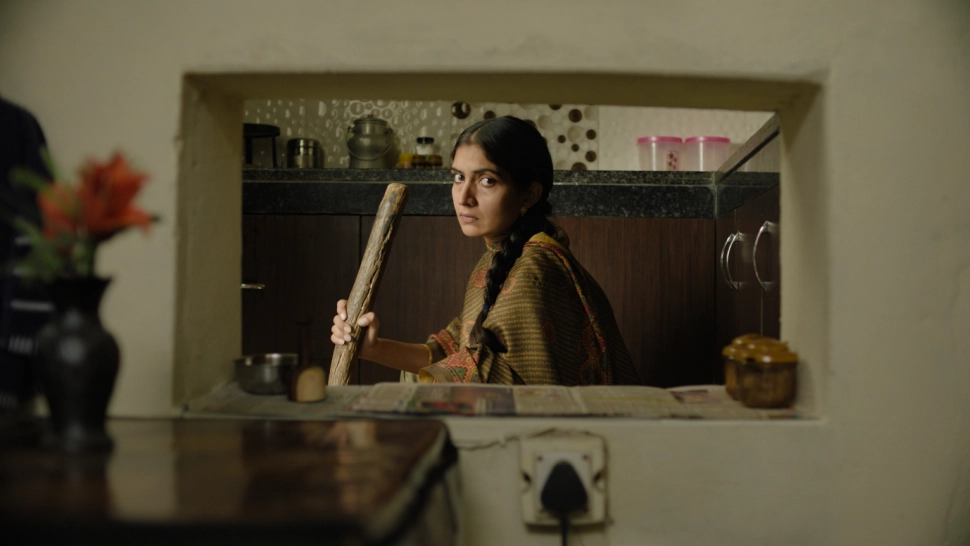
India / France | 2026 | 157 min | Drama
Three Lives Intersect Across Present-Day Punjab
Set in present-day Punjab, Rehmat brings together three interconnected stories shaped by violence, disappearance, grief and faith. A woman secretly shelters a wounded stranger while hiding him from the police; elsewhere, a family struggles with the disappearance of someone close to them; and an elderly man returns from England making the extraordinary claim that he is God. Rather than separating these experiences into independent episodes, Gurvinder Singh gradually connects them into a wider portrait of people confronting uncertainty and forces they cannot completely understand.
The film draws on stories by acclaimed Punjabi writer Ajeet Cour, with Singh adapting the material for the screen. Its ensemble includes Naseeruddin Shah, Suvinder Vicky, Mita Vashisht, Navjot Randhawa, Anita Meet, Diya Kamboj, Harwinder Aujla and Jaswant Zafar. At 157 minutes, Rehmat has the space to treat contemporary Punjab not simply as a setting but as the connective environment through which its different characters and moral dilemmas intersect.
➡️ Key Takeaway: Rehmat uses three interconnected lives to explore how violence, loss and faith ripple through contemporary Punjab.
Should You Watch It?: A Multi-Story Drama About Faith, Loss and Uncertainty
Rehmat should particularly interest viewers drawn to slow, socially rooted Indian independent cinema rather than conventional plot-driven drama. Its three-story construction moves between private experiences and wider questions: protecting a wounded stranger carries danger, disappearance transforms an entire family, while a man claiming divinity introduces a more mysterious spiritual dimension.
There is also significant interest in seeing Gurvinder Singh return to Punjab. The filmmaker behind Anhe Ghore Da Daan and The Fourth Direction again works within the region while adapting Punjabi literature, and Rehmat brings that approach together with an ensemble mixing established performers such as Naseeruddin Shah, Mita Vashisht and Suvinder Vicky with newer actors. The film is also Naseeruddin Shah’s first Punjabi-language film.
➡️ Key Takeaway: Watch Rehmat for an ambitious Punjabi ensemble drama where personal crises gradually open into larger questions about grief, morality and belief.
Why Everyone Is Talking About It?: Gurvinder Singh Returns to the International Festival Spotlight
Rehmat arrived with significant festival positioning: it had its world premiere on August 6, 2026 at the 79th Locarno Film Festival, where it was selected for the prestigious Concorso Internazionale. The film is competing for the Pardo d’Oro (Golden Leopard) and is the only Indian feature in Locarno’s 2026 main competition.
That selection is particularly notable within Singh’s career. His earlier films established him on the international festival circuit, with Anhe Ghore Da Daan premiering at Venice and The Fourth Direction appearing at Cannes. Rehmat now brings him into Locarno’s principal competition with another deeply Punjabi story rather than moving toward more conventional international filmmaking.
➡️ Key Takeaway: Rehmat is attracting attention because one of contemporary Punjabi cinema’s distinctive filmmakers has returned with an ambitious literary adaptation competing for Locarno’s highest prize.
Movie Trend: Social Drama & Spirituality — Violence, Loss and Faith Intersect Across Punjab
Rehmat fits most strongly within Social Drama, expanded through Spirituality & Faith. Gurvinder Singh uses three interconnected stories to examine people living with consequences they cannot easily control: a woman risks herself by sheltering a wounded stranger from the police, a family lives through the uncertainty of a disappearance, and an elderly man returning from England declares that he is God. Together, these stories move between social reality and spiritual uncertainty rather than functioning as separate narratives.
The contemporary Punjab setting gives those questions a specific social context. Violence and disappearance introduce fear and vulnerability, while the elderly man’s claim of divinity shifts the film toward questions of belief, compassion and how people search for meaning when ordinary explanations are insufficient. The title Rehmat—associated with mercy or divine grace—reinforces the tension between a difficult material world and the possibility of compassion within it.
➡️ Key Takeaway: Rehmat connects three very different lives to ask how people search for compassion, meaning and faith when confronted by violence and loss.
➡️ Movie Trend: Social Drama & Spirituality
Who Should Watch It? (Audience Profile): For Viewers Drawn to Socially Rooted, Reflective Cinema
|
Indian independent cinema, festival cinema and social-drama audiences |
|
|
Viewers interested in Punjabi stories, interconnected narratives, spirituality and literary adaptations |
|
|
Middle to upper-middle income, culturally engaged audience |
|
|
Film-literate, internationally curious and interested in socially and culturally specific storytelling |
|
|
More likely to attend festivals, arthouse cinemas and use curated or specialist film platforms |
Rehmat is particularly suited to viewers comfortable with cinema that prioritizes observation, atmosphere and moral complexity over rapid narrative resolution. Its 157-minute running time gives Singh room to move between different characters and experiences while allowing connections to accumulate gradually.
It should also appeal to audiences interested in contemporary Indian cinema beyond mainstream Hindi filmmaking. Punjabi language, literature and social experience remain central rather than being treated as background elements, giving the film the cultural specificity that has characterized Singh’s previous work.
➡️ Key Takeaway: Rehmat is best suited to viewers looking for patient, culturally specific cinema where social reality and spiritual questions gradually converge.
What This Movie Means for the Industry: Regional Stories Can Carry Global Festival Ambition
Rehmat reinforces the international potential of Indian regional-language cinema that remains deeply connected to its place of origin. Gurvinder Singh does not need to make Punjab culturally neutral for international audiences. The region, its language and its social realities are precisely what give the film its identity as it enters the global festival circuit.
Its selection for Locarno’s main competition demonstrates the continuing space within major international festivals for ambitious Indian filmmaking outside mainstream commercial structures. The availability of Rehmat through Festival Scope Pro for industry professionals also places it within the professional discovery ecosystem through which festival programmers, distributors and other buyers can encounter emerging international titles.
➡️ Key Takeaway: Rehmat shows that internationally positioned Indian cinema can become more distinctive by going deeper into regional stories, languages and cultural realities rather than making them more generic for global audiences.
Creative Analysis: Three Stories Search for Grace in an Uncertain Punjab
Rehmat builds its structure around three apparently different experiences: sheltering a wounded stranger, living with an unexplained disappearance, and encountering a man who claims to be God. Gurvinder Singh uses those narratives to move between physical danger, emotional absence and spiritual uncertainty, gradually revealing thematic connections rather than relying on a conventional single-protagonist journey.
What binds the stories together is vulnerability. Each character faces something that destabilizes ordinary life and demands a response—protection, endurance, belief or compassion. The film’s idea of “rehmat,” or grace, therefore becomes especially significant: what might grace look like when the surrounding world offers very little certainty?
➡️ Key Takeaway: Rehmat connects its three stories through a shared search for compassion and meaning when certainty disappears.
Storytelling: Three Narratives Turn Private Crises Into a Collective Portrait
The interconnected-story structure allows Singh to approach contemporary Punjab from several emotional directions. The wounded stranger introduces immediate danger and questions of responsibility; the disappearance transforms absence into something a family must continuously live with; and the returning elderly man introduces an unpredictable spiritual dimension.
Rather than forcing those experiences into the same dramatic register, their differences broaden the film’s perspective. Individual suffering gradually becomes part of a larger social landscape in which violence, uncertainty, family and belief coexist.
➡️ Key Takeaway: The three-story structure transforms separate personal crises into a wider portrait of people living with uncertainty.
Direction: Gurvinder Singh Keeps Punjab at the Center
Singh’s return to Punjab is important because the region is not merely scenery for a universally transferable drama. Its communities, language and social realities shape the characters and the situations confronting them, continuing the filmmaker’s commitment to regional stories told from within their cultural environment.
That specificity also distinguishes Rehmat internationally. Rather than reshaping Punjabi experience around familiar global storytelling conventions, Singh allows local realities to determine the film’s rhythm and perspective. Its Locarno competition selection consequently positions a culturally specific work within one of international arthouse cinema’s major showcases.
➡️ Key Takeaway: Singh makes Punjab more than Rehmat’s location—it becomes the social and cultural world connecting all three stories.
Ensemble: Different Generations Create Different Responses to Uncertainty
Rehmat brings together an extensive ensemble including Naseeruddin Shah, Suvinder Vicky, Mita Vashisht, Navjot Randhawa, Anita Meet, Harwinder Singh Aujla, Sahej Aziz and Diya Kamboj. The multi-generational casting suits a film interested less in one heroic protagonist than in how different people respond to instability.
Naseeruddin Shah’s Rashid Ali provides the premise’s most enigmatic presence: an elderly man returning from England claiming to be God. Placed alongside characters confronting much more tangible problems of violence and disappearance, his presence allows spiritual questions to enter a world otherwise grounded in recognizable contemporary realities.
➡️ Key Takeaway: Rehmat uses its ensemble to show different generations confronting fear, loss and belief in radically different ways.
Setting & Atmosphere: Contemporary Punjab Becomes a Landscape of Uncertainty
The film’s Punjab setting creates continuity between stories that might otherwise appear disconnected. Homes, families and communities become spaces where larger social pressures are experienced intimately rather than abstractly.
This grounding is particularly important because one storyline moves toward the metaphysical. The more convincingly Singh establishes an everyday social world, the more disruptive the claim of divinity becomes. The spiritual enters through an environment that remains firmly connected to ordinary life.
➡️ Key Takeaway: Rehmat grounds its spiritual questions in the everyday realities of contemporary Punjabi life.
Themes & Messages: What Does Grace Mean When Life Offers No Easy Answers?
The title provides a useful route into the film’s central concerns. “Rehmat” evokes mercy, blessing or grace, concepts that acquire different meanings across stories involving danger, disappearance and claimed divinity.
Grace does not necessarily mean miraculous intervention. Sheltering another person can itself become an act of mercy; continuing after disappearance can require emotional endurance; belief may provide meaning—or create further uncertainty. By placing these possibilities beside one another, the film can explore spirituality without reducing it to a simple question of whether something supernatural is true.
➡️ Key Takeaway: Rehmat asks whether grace arrives through faith itself or through the compassion people extend to one another during moments of suffering.
What Makes This Movie Different?: Social Realism Meets Spiritual Mystery
Rehmat’s most distinctive quality is the collision between socially grounded Punjabi storytelling and spiritual mystery. A wounded fugitive and a missing person belong to recognizable realities of danger and loss; an elderly man announcing that he is God destabilizes that realism without necessarily abandoning it.
That tension gives the film a broader identity than conventional social drama. Singh can examine contemporary life while leaving room for ambiguity, belief and metaphysical questions—allowing the ordinary and the inexplicable to occupy the same cinematic world.
➡️ Key Takeaway: What makes Rehmat distinctive is the way it brings social reality and spiritual mystery together to ask where people find grace when the world around them becomes uncertain.
If You Liked Rehmat (2026): Films Where Social Reality Meets Faith and Moral Uncertainty
The Fourth Direction (2015) by Gurvinder Singh
The Fourth Direction is the most natural companion because it shows Gurvinder Singh examining Punjab through fear, political violence and the everyday lives caught inside it. Set during the period of Sikh separatist conflict in the 1980s, the film follows ordinary people navigating an environment where authority and danger can arrive unexpectedly.
Rehmat broadens that approach by bringing spirituality and interconnected narratives into contemporary Punjab, but both films resist simplifying their world into heroes and villains. They instead concentrate on what uncertainty does to people living inside it.
➡️ Where to Watch: 🇺🇸
All We Imagine as Light (2024) by Payal Kapadia
Payal Kapadia’s All We Imagine as Light offers another example of Indian independent cinema where individual lives gradually reveal a much larger social environment. Following women living and working in Mumbai, it finds emotional significance in relationships, displacement, loneliness and the possibilities that appear when everyday routines begin to change.
Its storytelling is more intimate than Rehmat’s multi-strand exploration of violence and spirituality, but both films trust atmosphere and observation rather than conventional dramatic escalation. They also demonstrate how culturally specific Indian stories can travel strongly through the international festival circuit.
Santosh (2024) by Sandhya Suri
Santosh is the strongest recommendation for viewers interested in Rehmat’s engagement with violence, institutions and morally complicated contemporary India. After her husband’s death, a woman inherits his position in the police force and gradually encounters the realities of authority from inside the institution.
Unlike Rehmat’s spiritual dimension, Santosh remains firmly rooted in institutional and social realities. Yet both films are interested in ordinary people confronting systems and circumstances where easy moral answers become increasingly difficult to maintain.
➡️ Key Takeaway: Start with The Fourth Direction for more of Gurvinder Singh’s Punjab, All We Imagine as Light for observational Indian storytelling, and Santosh for another morally complex confrontation with contemporary social realities.
Final Verdict: Searching for Grace in a World of Violence and Loss
Rehmat has an ambitious structure, but its three stories appear united by a deceptively simple question: what can people hold onto when certainty disappears? A wounded stranger requires protection, disappearance leaves a family without answers, and a man claiming to be God introduces the possibility that meaning might exist somewhere beyond rational explanation.
Gurvinder Singh’s decision to root these questions in contemporary Punjab gives the film its distinctive identity. Rather than separating spirituality from social reality, Rehmat allows violence, family, compassion and belief to inhabit the same world. Its regional specificity consequently becomes one of its greatest strengths.
The result is particularly promising as festival cinema because it combines recognizable human experiences with a structure that leaves room for ambiguity. Rehmat does not need to answer whether grace is divine, accidental or something people create for one another. The search itself becomes the point.
➡️ Final Verdict: 4.2/5 — An ambitious and contemplative Punjabi drama that brings social reality, human compassion and spiritual mystery together in a search for grace amid uncertainty.
Quick Facts: Three Stories Search for Grace Across Contemporary Punjab
|
Violence, disappearance, compassion, faith and contemporary Punjab |
|
|
Ajeet Cour, Gurvinder Singh |
|
|
Harwinder Singh Aujla, Sahej Aziz, Inder Bajwa, Naseeruddin Shah, Mita Vashisht, Suvinder Vicky |
|
|
Social Drama & Spirituality |
|
|
Locarno Film Festival 2026 — International Competition |
|
➡️ Key Takeaway: Rehmat stands out as a deeply regional yet universally resonant film about people searching for mercy, meaning and human connection when life provides no simple answers.







Leave a Reply