

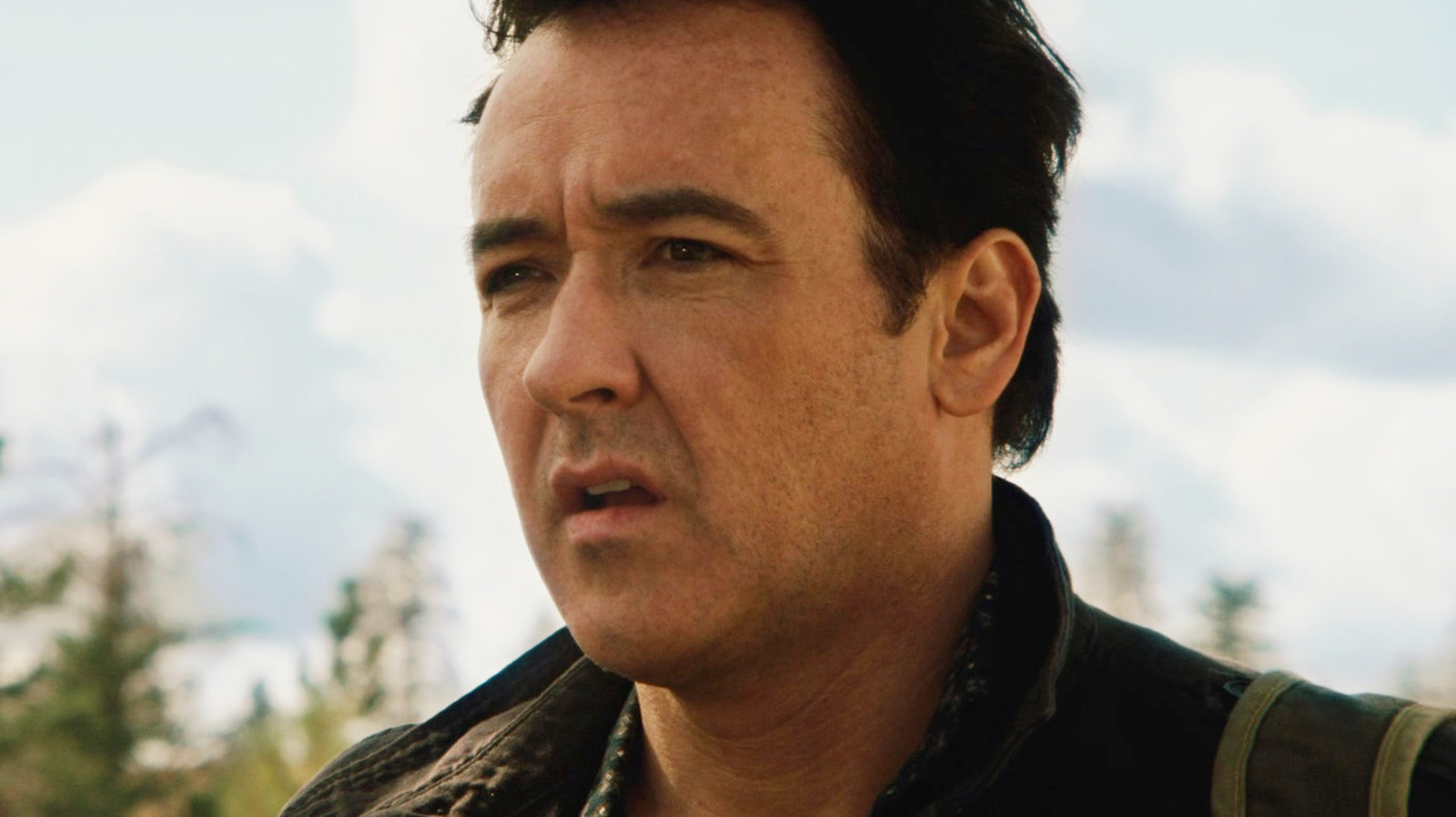
Roland Emmerich’s 2009 disaster epic “2012” is one of the most bloated, overwrought blockbusters you will ever see, running a sizable 158 minutes. Like Emmerich’s films “Independence Day” and “The Day After Tomorrow” before it, “2012” follows a global ensemble of characters as they individually attempt to survive a worldwide cataclysm. “2012” ups the ante, however, by depicting many huge disasters all at once. The critical community kind of hated it, but the movie had a loyal defender in Roger Ebert.
In his three-and-a-half-star (out of four) review, Ebert referred to “2012” as being “the mother of all disaster movies (and the father, and the extended family).” Seriously, this film has everything: mega-tsunamis, earthquakes, volcanoes, and the Earth cracking open to swallow entire cities. Our planet’s crust is shifting, you see, which may very well be bringing about the end to all life living on it. As for the movie’s title, that’s a nod to the longstanding myth that the Maya Long Count Calendar predicted the Earth would end in the year 2012.
Ebert found all of this chaos quite “fun,” writing:
“‘2012’ delivers what it promises, and since no sentient being will buy a ticket expecting anything else, it will be, for its audiences, one of the most satisfactory films of the year. It even has real actors in it. Like all the best disaster movies, it’s funniest at its most hysterical. You think you’ve seen end-of-the-world movies? This one ends the world, stomps on it, grinds it up and spits it out.”
The “real actors” Ebert refers to include John Cusack, Chiwetel Ejiofor, Oliver Platt, Thandiwe Newton, Amanda Peet, Danny Glover, and Woody Harrelson. In that respect, “2012” is indeed the disaster movie to end all disaster movies.
Roger Ebert loved the ridiculous ambition of 2012
Overall, Roger Ebert was amused by how silly a lot of the disasters in “2012” are. He acknowledged the film’s absurdity in his review, but he seemed to like it anyway, writing:
“In all disaster movies, landmarks fall like dominos. The Empire State Building is made of rubber. The Golden Gate Bridge collapses like clockwork. Big Ben ticks his last. The Eiffel Tower? Quel dommage! Memo to anyone on the National Mall: when the Earth’s crust is shifting, don’t stand within range of the Washington Monument.”
Broadly speaking, the plot of “2012” resembles that of other Roland Emmerich disaster movies. There is an extended opening sequence, set in the present day of 2009, wherein a lot of portent is laid out. All of the film’s main characters are efficiently introduced in turn, giving the global disaster a human face. Later, it’s revealed that multiple massive arks have been built to stow a healthy cross-section of humanity. Hence, it becomes a race against time for everyone to reach the arks before it’s too late.
Ebert loved the film’s elaborate visual effects, even if they were, in his words, not wholly convincing. He liked that the movie lingered on these VFX as well, as opposed to rapidly cutting away from them. Concluding his review, he wrote:
“The bottom line is: The movie gives you your money’s worth. Is it a masterpiece? No. Is it one of the year’s best? No. Does Emmerich hammer it together with his elbows from parts obtained from the Used Disaster Movie Store? Yes. But is it about as good as a movie in this genre can be? Yes.”
No small praise.
What did other critics think of 2012?
“2012” was very expensive to make, as one might imagine, costing about $200 million. And while the film was a hit, earning an impressive $791 million at the global box office, it opened in theaters the same year as mega-blockbusters such as “Transformers: Revenge of the Fallen,” “Harry Potter and the Half-Blood Prince,” “The Twilight Saga: New Moon,” and the “Star Trek” movie reboot. As such, it got a little overshadowed.
It was also, as noted, hated by critics, for the most part. Kenneth Turan, writing for the Los Angeles Times, felt that, as far as “2012” was concerned, the world ended with both a bang and whimper. More than anything, Turan disliked the movie’s terrible script, as credited to Roland Emmerich and Harald Kloser. As Turan put it:
“(Nothing) will give you more respect for how difficult it is to be an actor than watching top talent like John Cusack, Chiwetel Ejiofor, Amanda Peet, and Oliver Platt struggling to treat the film’s ungodly language and situations with perfect seriousness.”
Undeterred by such negative reviews, Emmerich charged right ahead into his 2011 Shakespeare revisionist movie “Anonymous” and his very, very excellent 2013 actioner “White House Down” (which is much better than the rather similar “Olympus Has Fallen”). More recently, Emmerich directed the 2022 dork-fest “Moonfall,” a film about how the moon is actually … you know what? I’ll simply note that “Moonfall” is somehow even sillier, and perhaps more entertaining, than “2012.”
Ebert was not above enjoying some good, slick Hollywood schlock, and his review of “2012” is proof.






Leave a Reply