
MX / FR | 2026 | 110 min | Drama, Queer Drama
When a Place Built for Beauty Becomes a Sanctuary for Death
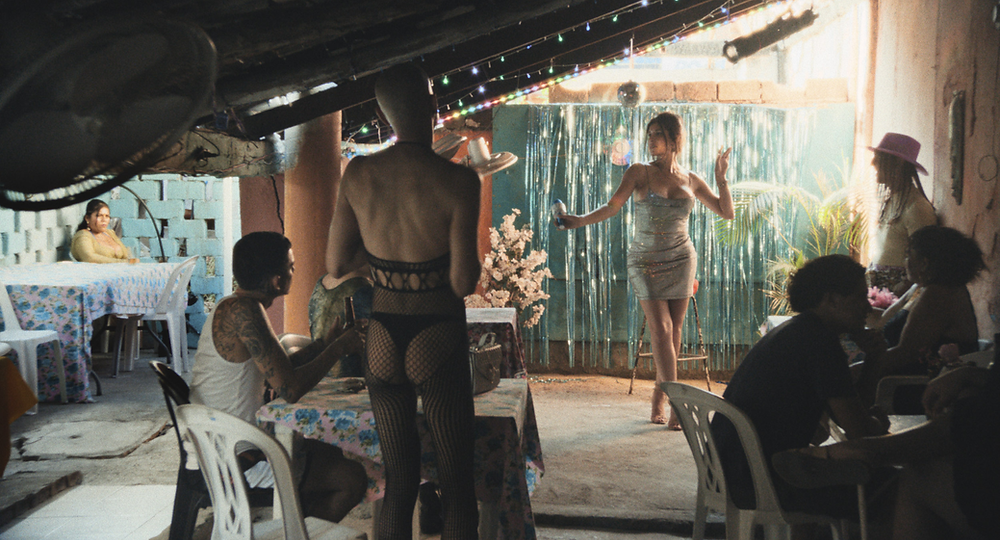
A beauty salon once associated with transformation, colour and queer community has become something radically different. In an unnamed city devastated by an unidentified illness, the Individuo, a gay hairdresser played by Sam Louwyck, turns his former salon into a refuge for terminally ill people rejected elsewhere. The premise transforms an ordinary commercial space into a threshold between community and isolation, beauty and decay, memory and death.
Nathalia Acevedo’s feature directorial debut adapts Mario Bellatin’s celebrated novel not as conventional narrative drama but as an intentionally fragmented and sensorial experience. Past and present overlap, aquariums preserve traces of the salon’s earlier life, and the act of caring for abandoned bodies becomes more important than finding explanations for the catastrophe outside.
➡️ Movie Insight: Salón de belleza transforms a familiar place of physical transformation into a final sanctuary for people society has abandoned. Beauty does not disappear when death enters the salon; instead, its meaning changes from appearance to dignity. The result is queer cinema built around care as an act of resistance.
Why This Movie Matters Right Now: Care Becomes Radical When Institutions Withdraw
The film arrives after a period in which pandemic memory, institutional failure and questions surrounding who receives care remain culturally potent. MYmovies notes that Acevedo’s adaptation shifts the novel’s epidemic associations toward contemporary memories of Covid, while the film itself keeps its city and illness deliberately indistinct.
That ambiguity makes the salon more than an improvised hospice. It represents what happens when communities pushed outside institutional protection begin constructing their own systems of survival, dignity and belonging. Acevedo connects queer marginalisation, illness and mortality without turning the film into straightforward social realism.
➡️ Why It Matters: The film asks what remains when formal systems of care stop protecting everyone equally. Its answer is not heroic rescue but the smaller rituals through which abandoned people continue caring for one another. That makes its queer perspective inseparable from its meditation on mortality.
Should You Watch It?: A Radical Experience for Viewers Comfortable With Cinema That Refuses Easy Answers
Salón de belleza is better approached as an experience than as a plot-driven drama. Acevedo deliberately abandons much of the novel’s linearity, allowing bodies, water, memory, ritual, sound and recurring imagery to carry the film instead. Cineuropa describes the result as primarily sensorial, while other critical responses have noted that its fragmented structure and relentless atmosphere can also make it demanding.
That makes it particularly suited to viewers interested in experimental festival cinema, literary adaptations and films where atmosphere matters more than narrative momentum. Audiences expecting a conventional epidemic drama, clearly explained relationships or a traditional emotional arc may find its opacity challenging.
➡️ Viewing Recommendation: This is a strong choice for arthouse viewers willing to surrender conventional storytelling for atmosphere, symbolism and emotional ambiguity. Its slowness is fundamental to the experience rather than incidental to it. The film demands patience but offers an unusually uncompromising meditation on care, memory and death.
Why Everyone Is Talking About It: A Cult Novel Finds an Uncompromising New Cinematic Life
The film entered the international conversation through the 2026 Giornate degli Autori competition in Venice, where Acevedo presented her first feature. It also earned nominations for both the Giornate degli Autori Award and Queer Lion Award, followed by a Best Feature Film nomination at the Morelia International Film Festival.
The adaptation itself gives the film another layer of attention. Bellatin’s 1994 novel has an established literary reputation, but Acevedo does not simply illustrate it: contemporary reviews have focused on how radically she dismantles conventional narrative in favour of a film structured through sensation, bodies and memory.
➡️ Viral Potential: Salón de belleza is unlikely to generate momentum through mainstream plot-driven buzz. Its stronger cultural pathway lies through festival audiences, queer cinema communities, literary readers and cinephiles drawn to uncompromising debuts. That positioning can turn a difficult film into a distinctive arthouse discovery.
Why Salón de belleza Stands Out: The Epidemic Drama Moves Away From Survival and Toward the Experience of Dying
Epidemic films traditionally build tension around contagion, escape, medical intervention or survival. Salón de belleza removes much of that machinery. The disease remains largely outside the dramatic centre because the film is interested in people for whom survival is no longer the primary question: the salon receives those already approaching death.
That changes the genre mechanism. Rather than asking whether its characters can defeat the catastrophe, Acevedo observes how they inhabit the remaining time. The salon’s transformation from a colourful queer meeting place into a refuge for terminally ill outsiders makes the disappearance of an entire social world tangible.
➡️ Cinema Insight: The film reverses the conventional epidemic narrative by refusing to make survival its principal objective. Death becomes a condition within which community, memory and care are examined rather than the climax to be avoided. That shift gives Salón de belleza its distinctive place within contemporary queer and post-pandemic cinema.
Movie Trend: Queer Drama — When a Beauty Salon Becomes a Refuge for the Dying
unknown illness → people rejected by society → beauty salon → queer caretaker → refuge for the dying → care replaces beauty → rituals of death → memories and visions merge → beauty and mortality coexist → salon becomes a final sanctuary
The broader trend is the transformation of queer community spaces into alternative systems of care. Places originally created around pleasure, identity, beauty or social connection acquire another purpose when their communities confront illness, exclusion or institutional abandonment.
Salón de belleza gives that trend an especially powerful metaphor. The salon once changed how bodies appeared; now it protects bodies that society no longer wants to see. Beauty therefore survives, but as dignity rather than decoration.
➡️ Movie Trend: Queer cinema is increasingly able to treat community spaces as social infrastructure rather than simply identity markers. Salón de belleza pushes that idea to its existential extreme by transforming a beauty salon into a place for dying. The sanctuary becomes simultaneously physical, political and emotional.
Viewer Profile: Boundary Seekers – Arthouse Viewers Looking for Radical Queer and Latin American Cinema
These viewers discover films through festival selections, critics, directors, literary adaptations and curated streaming platforms rather than mainstream theatrical marketing. Salón de belleza particularly fits audiences comfortable with slow cinema, fragmented narratives and films in which interpretation remains deliberately open.
|
Salón de belleza Audience |
|
|
Primarily adult arthouse viewers |
|
|
Culturally engaged, festival-aware, internationally oriented |
|
|
Queer cinema, Latin American cinema, slow cinema, literary adaptations, experimental drama |
|
|
Curated platforms, festival streaming, specialist arthouse services |
|
|
Festival selection, critical coverage, literary source material, emerging directors |
➡️ Audience Insight: Boundary Seekers value films that challenge the grammar of conventional storytelling. Festival discovery and cultural relevance matter more to them than genre familiarity or star power. Salón de belleza gives this audience both a strong conceptual hook and considerable interpretive space.
What This Movie Means for the Industry: Queer Stories Are Expanding Beyond Identity Narratives
Salón de belleza demonstrates how queer filmmaking can move beyond stories primarily structured around coming out, romance or discrimination while remaining fundamentally queer. Its central questions concern mortality, institutional abandonment, memory and care, but queer experience determines the community through which those questions are explored.
Its Mexico-France production structure also illustrates the importance of international co-production to ambitious arthouse cinema. The film was produced by Kintsugi Cine with France’s Farol as co-producer, while The Pool Films handles international sales.
➡️ Industry Insight: International arthouse cinema is creating more room for queer stories whose central subject extends beyond sexuality itself. That expansion allows queer experience to become a perspective through which universal questions can be explored. Co-production and festival networks remain crucial infrastructure for bringing such formally challenging projects to international audiences.
Creative Analysis: Sensory Filmmaking Turns Memory, Beauty and Death Into the Story
Acevedo builds the film around sensation rather than conventional exposition. Its creative strategy depends upon repetition, visual symbolism, fragmented memory and the physical routines of care, allowing the salon itself to function almost like another character.
Storytelling: Memory Replaces Conventional Narrative Progression
The film deliberately weakens chronological storytelling. Lived experience, recollection and imagined states overlap, creating a structure in which meaning accumulates rather than being explained.
Direction: Nathalia Acevedo Chooses Experience Over Explanation
Acevedo’s debut refuses to translate Bellatin’s novel literally. Her approach turns the material into something closer to cinematic meditation, placing viewers inside an unstable world rather than explaining that world from outside.
Performances: Sam Louwyck Makes Care a Physical Routine
Sam Louwyck plays the Individuo, while Erwan Kepoa Falé plays Juan. The protagonist’s repetitive responsibilities give the performance a physical dimension: care is expressed through what must continually be done rather than through sentimental declarations.
Visual Style: Aquariums Turn Beauty Into a Symbol of Fragility
The film famously opens in what initially appears to be an underwater world before revealing an aquarium. Water, fish and submerged imagery repeatedly connect beauty with fragility, confinement and disappearance, while the deteriorating salon contrasts with memories of its more colourful past.
Themes: Caring for Bodies Society No Longer Wants
Illness and death provide the setting, but abandonment is arguably the deeper subject. The salon receives bodies already excluded elsewhere, turning everyday care into a final assertion that those bodies still matter.
What Makes It Different: The Beauty Salon Becomes the Opposite of What It Was Built to Be
The central conceptual inversion is exceptionally clear: a business devoted to changing appearances becomes a sanctuary where appearance has almost ceased to matter. Instead of preparing bodies to be seen, the Individuo cares for people who have effectively disappeared from society.
➡️ Creative Insight: Acevedo makes transformation itself the film’s organising principle. The salon, bodies, memories and meaning of beauty all change as death moves closer. That allows production space and cinematic form to express the same underlying idea.
If You Liked Salón de belleza (2026): Queer Lives Beyond Conventional Storytelling
Plainclothes (2025) by Carmen Emmi: Queer Desire Collides With Institutional Violence
Carmen Emmi’s romantic thriller follows an undercover police officer assigned to entrap gay men who becomes attracted to one of his targets. Like Salón de belleza, it examines queer existence within a system capable of turning ordinary spaces into places of danger.
➡️ Why It Connects: Both films make institutional hostility part of the environment surrounding queer intimacy. Plainclothes is considerably more narrative-driven, while Salón de belleza moves toward abstraction. Together they show two different ways contemporary cinema is revisiting spaces historically shaped by queer vulnerability.
The History of Sound (2025) by Oliver Hermanus: Queer Memory Survives Through What Is Preserved
Oliver Hermanus follows Lionel and David as music, memory and an intimate relationship become intertwined across time. Its restrained approach to queer memory makes it a useful companion to Acevedo’s more radical exploration of the relationship between memory and disappearance.
➡️ Why It Connects: Both films treat memory as something experienced rather than simply recalled. Physical environments and sensory experiences preserve relationships that cannot remain permanently present. The result is queer cinema concerned as much with traces of life as with life itself.
Queer (2024) by Luca Guadagnino: Desire Becomes a Journey Into an Unstable Interior World
Luca Guadagnino’s adaptation of William S. Burroughs follows an American expatriate in Mexico City whose fixation on a younger man develops into an increasingly strange search for connection. Like Acevedo, Guadagnino moves literary queer material away from straightforward realism and toward a subjective sensory world.
➡️ Why It Connects: Both films adapt major queer literary works without treating cinema as simple illustration. Desire, bodies and altered perception gradually destabilise conventional reality. Each asks audiences to experience its protagonist’s interior world rather than merely follow a plot.
➡️ If You Liked Insight: These films show queer cinema expanding beyond familiar identity narratives into memory, institutional power, mortality and altered perception. Their approaches differ radically, from thriller to romance to sensory arthouse filmmaking. What connects them is the use of queer experience as a way of rethinking larger questions about belonging and human connection.
Final Verdict: A Beauty Salon Becomes an Uncompromising Meditation on Who Deserves Care
Salón de belleza is deliberately difficult cinema. Its fragmented structure, extended rhythms and symbolic density will divide audiences, and contemporary criticism has already reflected that tension: some responses praise its radical sensory construction while others find its opacity and accumulation of metaphors frustrating.
But its central transformation is difficult to forget. By turning a beauty salon into a refuge for the dying, Acevedo converts a space associated with surfaces into a place concerned with the most fundamental human need beneath them: being cared for when almost everything else has disappeared.
➡️ Final Verdict: Salón de belleza is a demanding but conceptually distinctive debut built for adventurous arthouse audiences. Its power lies less in narrative resolution than in the tension between beauty, abandonment, memory and death. Acevedo turns care itself into the film’s most radical gesture.
Quick Facts: Beauty Gives Way to Care Without Losing Its Meaning
|
Nathalia Acevedo, Diego Sepúlveda |
|
|
Based on Mario Bellatin’s novel Salón de belleza |
|
|
Sam Louwyck as the Individuo |
|
|
Erwan Kepoa Falé as Juan; Michelle Astrid, Mar Duran, Marvin Durán, Christian Évora |
|
|
Spanish; IMDb also lists French, English and Italian |
|
|
Paulina Valencia, Matt Porterfield |
|
|
Giornate degli Autori 2026 Competition |
|
|
Giornate degli Autori Award nominee; Queer Lion nominee; Morelia Best Feature Film nominee |
|
|
Queer Drama — When a Beauty Salon Becomes a Refuge for the Dying |
|
|
Caring for society’s abandoned sick while the outside world fractures |
|
|
A beauty salon transformed into a refuge for terminally ill outsiders |
|
|
Care, queer community, mortality, memory, abandonment, beauty, illness |
|
|
Radical literary adaptation turning queer community and end-of-life care into sensory cinema |
The official Giornate degli Autori credits confirm Balthazar Lab for cinematography, Olivia Neergaard-Holm for editing, Lucy Railton for music and Nathan Parker for production design.
Final Insights: Queer Cinema Is Turning Sanctuary Into a New Form of Resistance
Salón de belleza belongs to a broader movement in which queer cinema is increasingly interested not only in identity but in infrastructure: who provides shelter, intimacy, memory and care when mainstream institutions fail. The community space becomes important because it performs functions that extend far beyond socialising.
That opens a powerful direction for future queer storytelling. Bars, clubs, salons, homes and informal gathering places can become cinematic spaces through which filmmakers explore ageing, illness, migration, political hostility and mortality while preserving the specificity of queer experience.
➡️ Final Insight: Sanctuary is becoming one of contemporary queer cinema’s most powerful narrative ideas. These spaces matter not simply because characters can express identity inside them, but because they provide forms of protection the outside world may refuse. Salón de belleza takes that idea to its endpoint by asking whether dignity can survive even when survival itself cannot.





Leave a Reply