

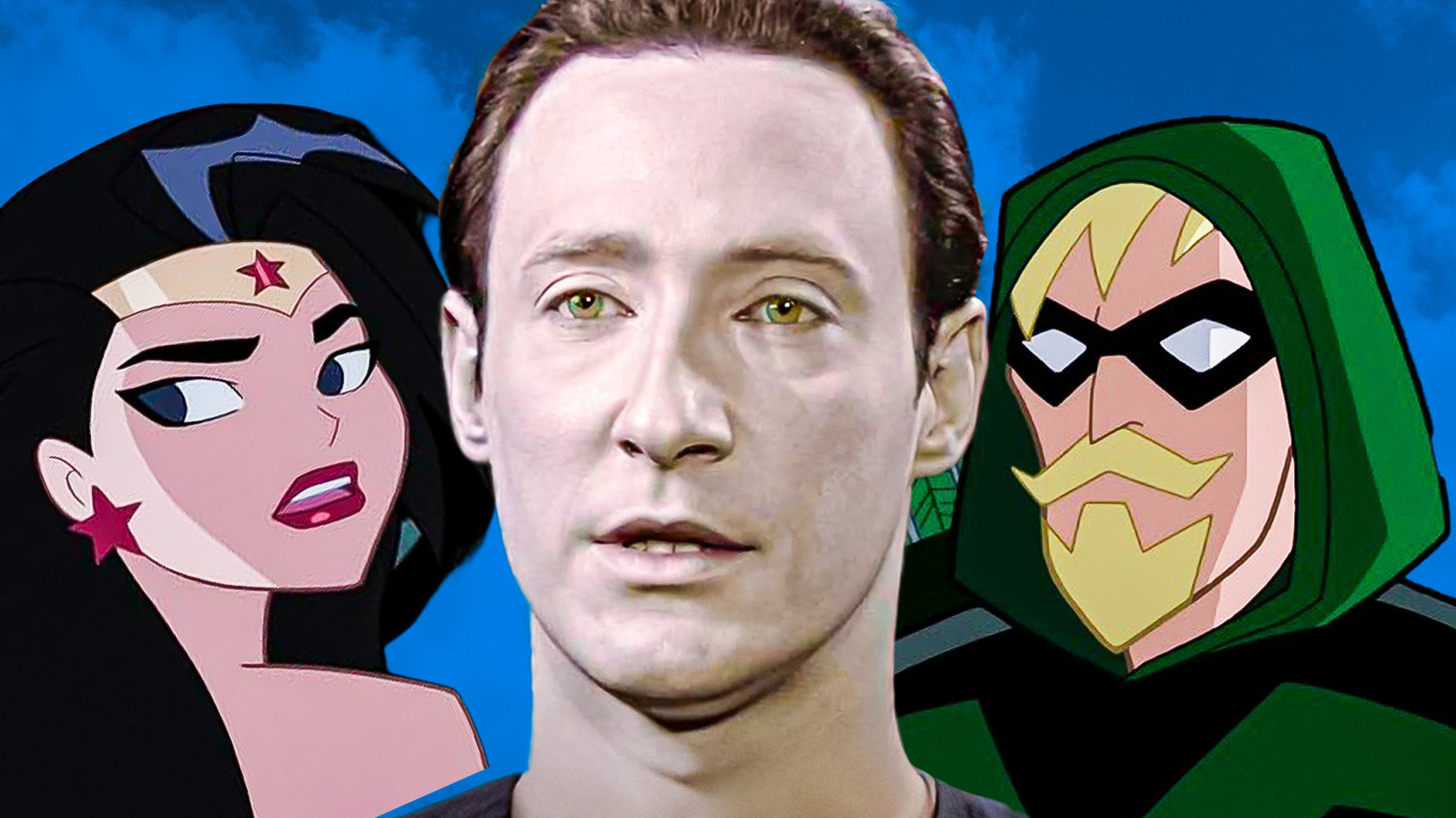
Actor Brent Spiner is most famous for playing Data, the emotionless android who wants to learn humanity, on “Star Trek: The Next Generation.” If an actor is part of a “Star Trek” main cast, they’re essentially geek royalty for life. Spiner has parlayed that into, among other things, occasional guest roles on a handful of superhero cartoons. Spiner played the Joker in two episodes of the “Young Justice” cartoon series and that’s not even the only Batman villain on his voiceover resume.
Spiner appeared as the Riddler/Edward Nigma in an episode of “Justice League Action,” except in the episode, the Riddler had reformed. “Justice League Action,” which aired 52 episodes from 2016 to 2018, was essentially a more kid-friendly “Justice League Unlimited.” Episodes were 11 minutes long, and would feature three or four DC heroes from a larger rotating cast starring in adventures.
“Justice League Action” is not part of the DC Animated Universe that began with “Batman: The Animated Series” and concluded with “Justice League Unlimited,” but its style is adjacent due to creative team overlap: Alan Burnett was one of the producers on “Justice League Action” and Paul Dini wrote several episodes. It also reused some DCAU voice actors, like the late Kevin Conroy as Batman and Mark Hamill as the Joker.
In the show’s Riddler episode, the Joker has kidnapped Batman and left clues to his location all over Gotham. Wonder Woman (Rachel Kimsey) and Green Arrow (Chris Diamantopoulos) are hopeless at solving riddles, so the Riddler offers his services. Declared sane and recently freed from Arkham Asylum, the Riddler has reinvented himself from a super-villain to a private detective, using his riddle-solving skills to fight crime instead of to cause it. The episode is, accordingly, titled “E. Nigma, Consulting Detective.”
Justice League Action features the Riddler as a private detective
There are two dominant interpretations of the Riddler; a cool, collected trickster who condescends to everyone less intelligent than him, or a short-fused, hyperactive showman. You can divide different Riddler actors across those lines fairly neatly: John Glover in “Batman: The Animated Series” is the former, Frank Gorshin in the 1960s “Batman” show and Jim Carrey in “Batman Forever” are the latter.
In fact, many Bat-historians would argue the violently murderous modern Joker owes more to Gorshin’s Riddler, who flies off the handle and often loses control of himself to sadistic laughter. How amusing, then, that in “E. Nigma, Consulting Detective,” the Riddler joins the case to save Batman because he’s angry at the Joker for stealing his act of leaving clues at crime scenes.
Spiner’s Riddler is cool and smug — definitely closer to Glover than Gorshin. His costume, a green suit and bowler hat with a question mark cane, is the one that Glover’s Riddler wore in “Batman: The Animated Series” as well. It’s the classic “refined” Riddler look, being more respectable than his original jumpsuit costume, and one that fits a Nigma who is trying to rebrand himself a respected professional. But the Riddler’s design otherwise still has classical villainous features: triangular eyes with big black eyebrows, pointed nose and chin, etc.
Even as Nigma helps Wonder Woman and Green Arrow, he talks down to them. He may be working on the side of good, but he’s still only solving mysteries to prove how smart he is.
Can the Riddler stay reformed?
Overall, “Justice League Action” is a pretty light and comedy-heavy series. The riddles that Nigma decodes in the episode are logic leaps in line with the ’60s “Batman” TV show. There’s also the episode’s last twist that the Joker actually orchestrated this scheme to get revenge on the Riddler, not on Batman. Why? Because the Riddler once stole his donut in the Arkham Asylum cafeteria.
In the climax of “E. Nigma, Consulting Detective,” the Joker traps Riddler. He asks him a riddle (“What has four eyes but doesn’t see?”) and, if the Riddler answers it, that will activate the death trap that holds Batman hostage. The Riddler tries to stop himself but he compulsively answers the riddle (“Mississippi”), leaving Wonder Woman to save Batman.
The Riddler rarely appeared on “Batman: The Animated Series” because his riddle gimmick made plots too complicated for a half-hour, action-driven cartoon. But that show still planted the seed for “E. Nigma, Consulting Detective.” In his third and last appearance as the main villain, “Riddler’s Reform,” Nigma tries and fails to go straight. When Paul Dini wrote “Detective Comics” in the 2000s, he revisited that idea by making the Riddler a private detective who reluctantly partners with Batman.
“E. Nigma, Consulting Detective” in “Justice League Action” takes its title from Dini’s “Detective Comics” #822, even though Dini didn’t write the episode (Jonathan Callan did). The Riddler endangering Batman with his compulsion is the same conclusion the status quo-bound comics eventually reached: Edward Nigma is too selfish to ever fully reform.






Leave a Reply