
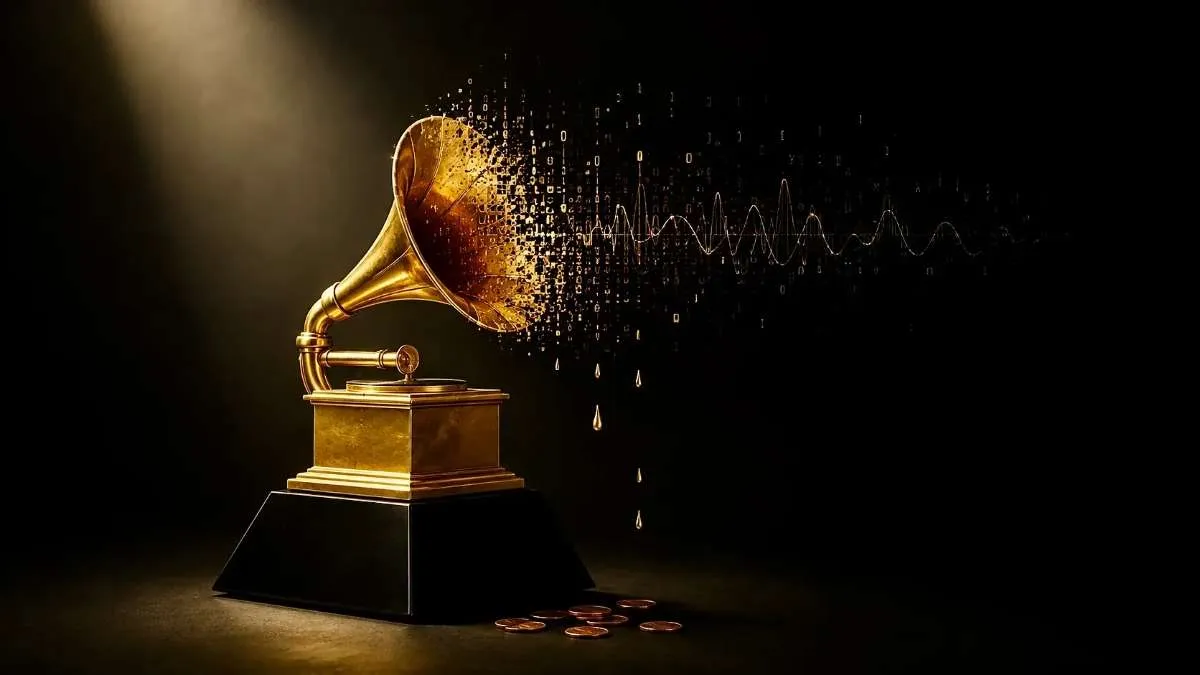

Photo: MWM
Some artists spend lots of time, lots of money and personal capital winning a statue. So what?
Every musician wants to hear their name followed by two magical words: “Grammy winner”.
For decades, winning a Grammy has been considered one of the highest achievements in the music industry — a golden stamp of credibility, artistic excellence and recognition from your peers. It could also change your career. A televised performance or major win once sent people directly to a record store. Albums moved off shelves, radio programmers added songs, promoters called, labels extended contracts and managers suddenly returned phone calls. The award and the marketplace were connected.
Today, that connection is much less predictable.
The 2027 Grammy cycle is already underway. The Online Entry Process opened July 7 and closes August 21, 2026, even though the eligibility period continues through August 28. First-round voting begins October 12, nominations will be announced November 16, and the 69th Grammy Awards will be presented February 7, 2027. For the first time, the telecast will be simulcast on ABC, Disney+ and Hulu.
The Recording Academy has also expanded the awards to 100 categories. Five new categories will debut in 2027: Best Asian Pop Music Performance, Best R&B Collaboration or Duo/Group Performance, Best Traditional Pop Vocal Performance, Best Traditional Folk Album and Best Latin Song. The expansion demonstrates just how broad the Grammy universe has become — and how little of that universe the television audience actually sees.
Thousands of artists, labels, publicists and managers will spend the next several months trying to get recordings noticed by Grammy voters. Some will spend a little, while others will spend A LOT. A few will be nominated, and far fewer will win.
But even for the winners, there is a difficult question that almost nobody wants to ask: So what?
Winning a Grammy remains an extraordinary honor. It can validate years of work, strengthen an artist’s reputation and create new opportunities. But it does not automatically create fans, income, ticket demand or a sustainable career. The Grammy is still a powerful spotlight. But it is not a business model. Some artists think it is a launching pad. It is not.
Let me insert a little Grammy news here:
South Korean boy band BTS has taken the extraordinary step of refusing to submit its latest album, Arirang, for consideration at the 2027 Grammy Awards, protesting the Recording Academy’s newly created Best Asian Pop Music Performance category. The group argued that its music should be heard and valued on its own merits rather than divided by region or language — a classification many fans and critics have condemned as racially motivated and potentially designed to keep Asian performers outside the Grammys’ major pop categories. Although the Recording Academy maintains that the award was created to expand recognition rather than restrict it, BTS’s boycott raises a larger question: Is a separate “Asian Pop” category genuine inclusion, or simply segregation presented as progress?
Now back to our story…
1. The 2026 Grammys Were a Useful Reality Check
At the 2026 Grammy Awards, Bad Bunny won Album of the Year for Debí Tirar Más Fotos. Kendrick Lamar and SZA won Record of the Year for Luther, Billie Eilish and Finneas won Song of the Year for “WILDFLOWER,” and Olivia Dean was named Best New Artist. These are the awards that dominate the headlines, television coverage and next-morning conversation.
However, they represent only a tiny portion of the Grammy Awards.
The 2026 Grammys included 95 categories across 12 fields. Of those, the official Premiere Ceremony program listed 86 awards — more than 90% of all the Grammys presented that day. Those awards were handed out before the prime-time broadcast in categories covering jazz, classical, roots, global music, new age, contemporary instrumental music, gospel, engineering, arranging, composition, packaging, historical recordings and many other areas.
Calling these the “non-major” categories is understandable, but it is not official terminology. The Academy distinguishes between the General Field, genre fields and craft categories. The General Field included Record of the Year, Album of the Year, Song of the Year, Best New Artist, Producer of the Year, Non-Classical and Songwriter of the Year, Non-Classical. Members are directed to vote only in fields in which they have relevant professional expertise.
The difference is not whether one Grammy is “real” and another is not. The difference is exposure.
At the 2026 Premiere Ceremony, ARKAI won Best Contemporary Instrumental Album for Brightside. Carla Patullo, The Scorchio Quartet and Tonality won Best New Age, Ambient, or Chant Album for NOMADICA. Samara Joy won Best Jazz Vocal Album, Sullivan Fortner won Best Jazz Instrumental Album, and Nate Smith won Best Alternative Jazz Album. Remy Le Boeuf won Best Instrumental Composition for “First Snow,” while Bryan Carter, Charlie Rosen and Matthew Whitaker won Best Arrangement, Instrumental or A Cappella for “Super Mario Praise Break.”
The awards also recognized Caetano Veloso and Maria Bethânia for Best Global Music Album, Tyler, The Creator for the inaugural Best Album Cover, and Zach Top for the first Best Traditional Country Album Grammy. These wins represented very different types of achievement, audiences and potential commercial outcomes.
Most of these artists did not receive a televised acceptance speech in front of millions of viewers. Their names might have appeared briefly online, in a press release or in coverage aimed at their specific genre communities. That limits the immediate consumer impact, even when the artistic and professional significance is enormous.
2. The “Non-Major” Grammy Bump Is a Different Kind of Bump
For a major pop artist, the desired Grammy bump is usually measured in streams, chart positions, social media followers and ticket demand. For an artist winning in jazz, classical, new age, contemporary instrumental, roots or one of the craft categories, the more important result may be a credential bump rather than a consumer bump.
A Grammy can change the way presenters, institutions, collaborators and other professionals see an artist. It may strengthen a proposal for a commission, improve an artist’s position in a negotiation, help secure a festival appearance or encourage a music supervisor to pay closer attention. For producers, engineers, composers, arrangers and art directors, the award may generate new clients and professional relationships rather than millions of additional streams.
That distinction is important because not every Grammy winner is the public face of a commercial recording. Best Instrumental Composition is a composer’s award. The arranging categories recognize arrangers. Best Engineered Album recognizes engineers, while Best Album Cover recognizes art directors. Measuring those awards entirely through the winner’s Spotify activity would misunderstand what the award is recognizing.
The economic impact may also be highly specific. One orchestral commission, festival contract, university residency, film-scoring assignment or premium private performance could be worth more to a specialized artist than a temporary increase in streaming. That does not make the Grammy’s effect less real. It means the value may appear in a different part of the artist’s business.
There is also a more personal kind of value. An artist who has spent 30 years working in a specialized field may not care whether the winning album enters the Billboard 200. Being recognized by accomplished peers can be an emotional and artistic milestone that no streaming report can measure.
However, prestige still has to be converted into action. A specialized Grammy winner who does not update their biography, contact presenters, develop new performance materials, pitch commissions, reintroduce their catalog or create a follow-up project may receive very little long-term benefit. The trophy can create professional leverage, but the artist must know where and how to apply it.
3. The Grammy Bump Is Real — But Television Drives Much of It
Let me be clear: the Grammy bump has not disappeared. Major winners and performers can still experience significant increases in streams, searches and social-media activity after the broadcast.
Bad Bunny’s U.S. on-demand streams increased 117% the day after he won Album of the Year at the 2026 Grammys. That was a genuine surge, although it was followed one week later by an even larger increase after his Super Bowl halftime performance. His U.S. streams rose another 175% after the Super Bowl, reaching almost 100 million streams in a single day.
That comparison tells us something important. The Grammy mattered, but the size of the audience and the prominence of the performance mattered even more.
For winners announced during the Premiere Ceremony, there may be no equivalent mass-media event. An artist can become a Grammy winner at three o’clock in the afternoon, post a photo with the trophy and discover that most people outside their professional circle never heard the announcement. The “next morning” on social media can be weird when you are connected with a winner and yet have no idea they won.
This is why the phrase “Grammy bump” can be misleading. It treats all 95 awards as though they occur under the same commercial circumstances. They do not. Winning Album of the Year during prime time is not the same media event as winning Best Engineered Album, Classical during an online ceremony, even though both represent peer recognition from the Recording Academy.
For many specialized artists, the better question is not, “How many additional streams did I receive?” It is, “What can I now do that I could not do before?”
4. Streaming Changed the Meaning of Commercial Success
Despite all the rumors and misinformation, the recorded-music business is not shrinking. It is growing.
Become a Medium member
U.S. wholesale recorded-music revenue reached a record $11.5 billion in 2025. Streaming generated approximately $9.5 billion and represented 82% of the market, while paid subscriptions reached 106.5 million accounts.
There is more money flowing through recorded music than there has been in years. The problem is how that money moves — and how many people may stand between the listener and the artist.
One correction from the original version of this article remains important: Spotify does not pay a universal fixed amount such as $0.003 or $0.005 every time somebody presses play. Spotify and other major services distribute royalties according to streamshare, paying recording and publishing rights holders, who then compensate artists and songwriters according to their agreements.
Therefore, five million additional streams do not automatically equal one predictable payment. The value depends on the platform, territory, subscription type, ownership, publishing participation, contractual splits and whether the artist is still recouping an advance.
The artist may own everything, or the artist may own almost nothing. Income may be divided among a label, distributor, publisher, producer, featured performers, songwriters, managers and other participants. Even a substantial post-Grammy streaming increase may produce far less personal income than the headline number suggests.
The disconnect can be even more dramatic in specialized categories. A 200% increase sounds impressive, but an album moving from 10,000 streams to 30,000 streams is still generating a relatively modest amount of gross royalty activity. The percentage makes a good headline. It does not necessarily pay for the campaign, the recording or the artist’s next project.
The music industry can report record revenue while individual musicians struggle to make a living. Both things can be true.
5. AI Is Making the Attention Problem Much Bigger
Generative AI has moved from an interesting experiment to a structural music-industry issue. AI systems can now generate songs, vocals, arrangements, instrumental performances, artwork, videos, biographies and marketing materials in minutes.
The volume is becoming staggering. In July 2026, Deezer reported that fully AI-generated tracks had exceeded 50% of all music delivered to its service each day. Deezer also said that up to 85% of the streams associated with fully AI-generated tracks during 2025 were fraudulent and had been removed from royalty calculations.
Those figures represent one streaming platform, not the entire industry, but the direction is obvious. The music business does not have a shortage of content. It has a shortage of attention, trust and meaningful human connection.
Ironically, this may increase the cultural value of a Grammy without making it more financially dependable. In an ocean of synthetic recordings, peer recognition can function as a form of human provenance.
The Recording Academy’s rules state that only human creators can be nominated for or win a Grammy. A work containing AI-generated material can still be eligible, but it must include meaningful human authorship or performance appropriate to the category. In a songwriting category, for example, the majority of the song must be human-written. That’s only 51%.
That makes the Grammy more than a trophy. It tells the industry that identifiable human beings wrote, performed, composed, arranged, produced or engineered work their peers considered “the best”.
For winners in new age, classical, jazz, instrumental and other specialized categories, that distinction may become increasingly valuable. These genres are particularly vulnerable to being flooded with inexpensive mood music, background tracks and synthetic imitations. A Grammy can help communicate that a recording has real creators, real musicianship and a meaningful artistic history behind it.
But once again, meaningful does not automatically mean profitable or even monetizable.
6. Campaigning Is Especially Complicated in Specialized Categories
Behind every “For Your Consideration” advertisement is a campaign. For an independent artist, that may involve email, social media, interviews, personal outreach and carefully targeted advertising. Larger campaigns may include publicists, consultants, showcases, travel, events, video production and months of coordinated promotion.
There is no reliable universal price for a Grammy campaign. Budgets are private, and strategies vary enormously by artist, genre and category. What is clear is that money and time can disappear quickly. Rumors abound, however, some artists in smaller categories have spent a hundred thousand dollars or more on a Grammy campaign. It’s hard to imagine that there is any real ROI for such an expenditure.
These large campaigns create a difficult calculation for artists in specialized categories. The potential professional value of a nomination may be substantial, but the likely mass-consumer response is limited. Spending heavily to pursue an award in a non-televised category can be difficult to justify if the artist’s only expected return is additional streaming revenue.
A sensible campaign should therefore create value even if the artist is not nominated. Interviews, performance videos, improved marketing materials, stronger industry relationships and greater awareness of the album should remain useful after voting ends. A campaign that has no secondary purpose becomes an all-or-nothing bet on an extremely competitive outcome.
The emotional cost must also be considered. Artists begin comparing campaigns, monitoring social media and trying to interpret every interaction with a voting member. Some start believing that a nomination will fix a stalled career.
Then the nominations are announced, and most campaigns end immediately. Even after receiving a nomination, there is no guarantee of a win. Even after winning, there is no guarantee that the financial return will come anywhere close to the campaign investment.
A Grammy campaign is not automatically foolish. But it should be treated as a speculative branding, visibility and relationship expense — not as a guaranteed revenue-producing investment. What some artists spend on these campaigns (even as an independent) is breathtaking.
7. What a Specialized Grammy Can Actually Do
For artists working in jazz, classical, roots, new age, global music and contemporary instrumental music, a Grammy may carry enormous weight inside the professional community even when the general public never hears the winning album. Commercial scale is not the only measure of an important career.
However, the artist still needs a post-Grammy strategy. Can the award support higher performance fees? Does it strengthen a commission proposal? Can it help secure better billing, improve a sync pitch or bring attention to older catalog recordings? Is there another release ready to follow the award? Does the artist have professional representation capable of using the credential?
The plan should also begin before the awards are announced. Nominees should have updated websites, biographies, press photographs, booking information, email systems and follow-up projects ready. The few days after a nomination or win are not the time to begin building the infrastructure that converts attention into opportunity.
Without that infrastructure, the attention fades. The trophy remains, but much of the opportunity disappears.
So, What Does a Grammy Really Mean Today?
Yes, winning a Grammy matters. It represents achievement, peer recognition and a permanent place in recording history. In an industry being overwhelmed by content, algorithms, synthetic music and manufactured engagement, recognition of exceptional human work may become more important — not less.
But not every Grammy creates the same kind of result. A major televised win may generate a dramatic consumer bump. A win in jazz, classical, new age, composition, arranging, engineering or another specialized category may generate a quieter but potentially valuable professional bump.
Neither result is automatic.
A Grammy cannot fix a weak live show, create a recognizable brand, repair a bad contract or make an audience care about the next album. It cannot replace consistent communication with fans, manufacture a catalog strategy or build the infrastructure of a career.
It may increase streams, create publicity, open doors and change how the music industry sees an artist. What it cannot guarantee is that the public will stay, the income will follow or the artist will know what to do next.
The danger is that some artists, driven by ego, seek validation from a statue even when there is little or no audience behind the achievement. How many classical, jazz, global, or new age artists have won because of a clever industry campaign while reaching only a small — or very small — number of listeners? I know, and have known, people who fit that description exactly. They believe the gleam of an award will somehow compensate for public indifference. The Recording Academy is surely aware that many people trade on its reputation to burnish their own, but the conversation always returns to the same things: audience, money, and an artist’s actual footprint in the industry. Will winning a Grammy suddenly light a fire under a career?
Well… no.
A Grammy is an accelerator, not the engine. It is a momentary spotlight, not a Hail Mary. It is the thing that will kick off your biography for the rest of your life like: “Emmy® Winner” kicks off mine. In the major categories, that spotlight may illuminate the entire world. In the specialized categories, it may motivate the exact people who can help move your career forward — or maybe not. In the end, our ability to retain who and why someone won an award at what time is practically gone. When I listed some of the (major) winners at the 2026 Grammys, did you remember or did I remind you who they were? I rest my case.
Let’s be clear: Grammy recognition is valuable, but it isn’t a successful career or an audience or the real respect of your peers. These things take a lifetime to secure and cultivate. I, for one, will not be seduced by “The Grammy Whammy”. I have too much music to make…





Leave a Reply