

The “Star Trek: The Next Generation” episode “Tapestry,” from the show’s sixth season, plays like a miniature morality play unto itself. We’ve already called it one of the 10-best Jean-Luc Picard episodes, but having seen the entire series, it’s actually the best episode the show has to offer. “Tapestry” is a powerful character piece about living with our choices and the importance of our regrets. It’s our bad decisions that force us to grow up, and Captain Picard (Patrick Stewart) learns this all too well here.
The episode begins with the death of Captain Picard. He’s been shot in the chest by some kind of energy weapon, and Dr. Crusher (Gates McFadden) is unable to revive him. Picard, as Trekkies know, has an artificial heart, having been stabbed through the chest as a youth. In the episode “Samaritan Snare,” Picard told the story about how, freshly graduated from Starfleet Academy, he got into a vicious bar fight with a group of Nausicaans. One of the Nausicaans stabbed Picard through the back with a very long knife, penetrating his heart. Ever since, Picard has required a mechanical heart to stay alive.
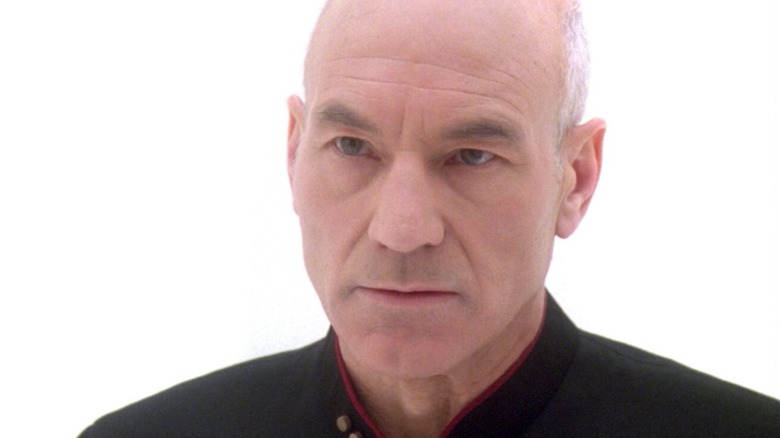
Now Picard’s heart has been damaged, and Dr. Crusher cannot repair it. Picard awakens in the afterlife (!), a quiet, bright, white space that is only occupied by him and a robe-wearing deitiy of some kind. Walking closer, Picard finds that it is the trickster god Q (John de Lancie), the bane of the Enterprise’s crew. Q suspiciously offers Picard an opportunity: He can go back in time to the events leading up to the bar brawl and change them, avoiding the fight and ultimately saving his life.
Picard will try, but the consequences may not be so rosy.
Tapestry is the best Star Trek: The Next Generation episode
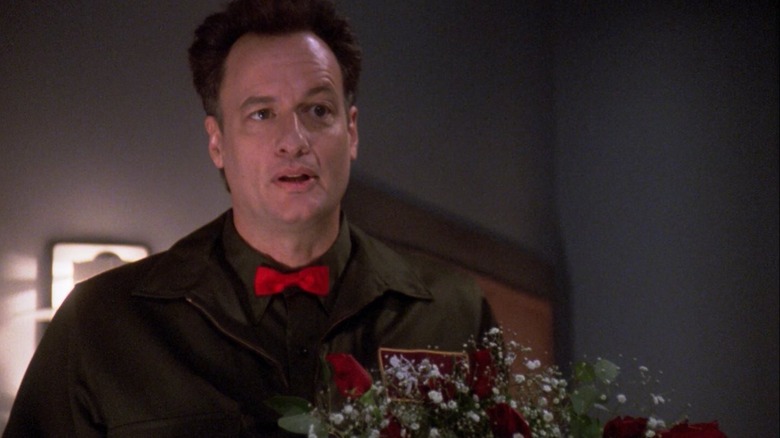
Q then takes Picard back to his youth, a few days before he is due to be stabbed. He’s about 21 years old, but, to retain a little visual fidelity, is still played by Patrick Stewart. When Picard looks in a mirror and notes that he looks like a bald man in his 50s, Q helpfully points out that he looks 21 to everyone else. Picard finds that he doesn’t like who he was at age 21. He was brash and reckless and sexually cavalier.
His best friends are Corey Zweller (Ned Vaughn) and Marta Batanides (J.C. Brandy), also recent Academy grads who are eager to start their careers in Starfleet. Corey and Marta like that Picard is a little reckless, and begin looking at him askance when he begins behaving like Captain Picard. Now a wiser man, Picard tries to impart that wisdom to his younger friends, but they reject his cautionary words as nagging. Picard also chooses to take the opportunity to have a fling with Marta, a woman he always had a crush on, but never had the temerity to approach. In just the course of a few days, Picard manages to rewrite his younger self’s character to be more cautious, judicious, and wise. In so doing, however, he finds that he is rapidly alienating his best friends.
The day of the bar brawl arrives, and Picard manages to stop Corey from throwing the first punch. Corey and Marta no longer want anything to do with him. By Q’s own rules, Picard saved his own life, and he is permitted to return to the present. It’s a bittersweet moment: He’s alive, but what kind of man is he?
“Tapestry” is one of 12 philosophical “Star Trek” episodes that will leave you thinking.
Our past mistakes make us what we are
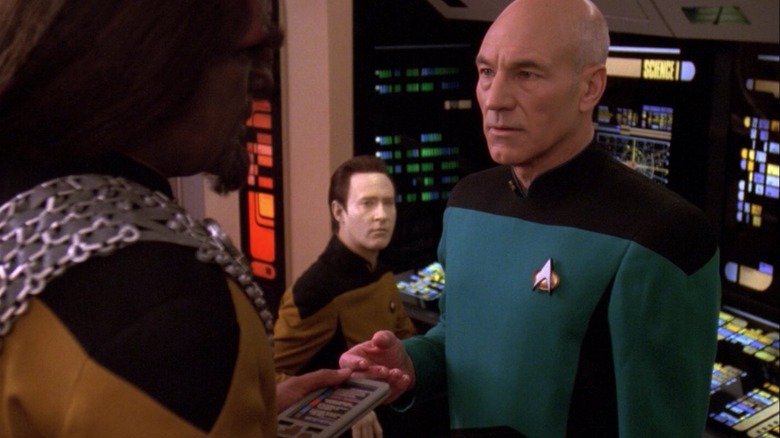
The present Picard returns to isn’t the present he remembers, of course. The life he is now living has been extrapolated from his wimpy, cautious, judicious youth, making him into an uncreative, unambitious man. Picard finds that he is still on the USS Enterprise-D, but is now a lowly science officer with the rank of lieutenant, junior grade. Picard is aghast. His life, he finds, is now a life without risk, boldness, or excitement. It’s now just a quiet, dull life of boring tasks and negative charisma.
Picard asks Commander Riker (Jonathan Frakes) to be candid and describe what kind of officer Lieutenant Picard is. Riker explains that he has always been risk-averse, has never stood out, and only ever aimed to be unremarkable. The only error with “Tapestry” is that the alternate timeline sequences are frustratingly brief. It would have been nice to see how deep Picard’s initiative-free life actually ran. Regardless, Picard groks pretty quickly that this is not a life we wants to lead. He would rather die with a faulty heart than live an unremarkable life with one.
Q ultimately allows Picard to go back in time again and repair his life. Or maybe it was all a dream. It’s hard to say. Regardless, we once declared “Tapestry” one of Q’s 12 best moments.
Regardless, “Tapestry” reminded Picard — and the audience — that taking risks and making mistakes is perhaps the most vital tool in our maturity and growth as human beings. We may regret our foolish youthful dalliances (Lord knows I’ve made plenty of mistakes in my life), but if we grow from them and remain daring in our day-to-day existence, we will become better people. “Tapestry,” like Akira Kurosawa’s “To Live,” may actually change the way we behave.






Leave a Reply